
Survivorship life insurance is one policy on two people, almost always spouses, that pays a single death benefit only after the second spouse dies, and it is priced on your combined mortality rather than on either of you alone. That last part is the whole reason it matters for a specific, common South Dakota situation: one spouse sails through underwriting and the other gets rated, postponed, or declined outright, and the couple assumes the healthy spouse’s coverage is the only option left on the table. Survivorship life insurance exists for exactly that gap. It will not fit every couple, and it solves a narrower problem than most people expect going in, but it is worth understanding on its own terms before you rule it out or, just as easily, buy one for the wrong reason. This guide walks through how the product actually works, who it fits, what it costs to get the fit wrong, and how to work through the decision yourself before you talk to anyone.
The short version
- Survivorship (second-to-die) life insurance pays once, after both insureds have died, and it is underwritten on the combined risk of two lives rather than one, which is why it can sometimes be available when one spouse's individual application would be rated or declined.
- It is a standardized national product category: the Interstate Insurance Product Regulation Commission adopted a uniform standard for it (IIPRC-L-04-I-2), most recently effective April 3, 2023.
- The 2026 federal estate-tax basic exclusion is $15,000,000 per person, about $30,000,000 per married couple with portability, according to the IRS's 2026 inflation-adjustment release under 26 U.S.C. Section 2010; South Dakota itself has no state estate or inheritance tax, per the state Department of Revenue.
- 51% of U.S. adults own some life insurance and roughly 40% are either uninsured or say they need more than they have, according to LIMRA and Life Happens' 2025 Insurance Barometer Study.
- First-to-die and second-to-die are built for opposite jobs: income replacement while a spouse is still living versus funding something that is only needed once neither spouse is left to manage it.
The pain in plain words: one of you qualified easily, the other didn’t
Here’s the version we actually hear. A couple applies for life insurance, or already has it and is adding more. One spouse breezes through underwriting at a Preferred or Standard rate. The other has a diagnosis, a past surgery, a family history, or a medication list that turns the application into a longer process, and it comes back rated, postponed, or declined. The couple’s first conclusion is usually: well, I guess we just insure the healthy one and hope. That conclusion skips a real option.
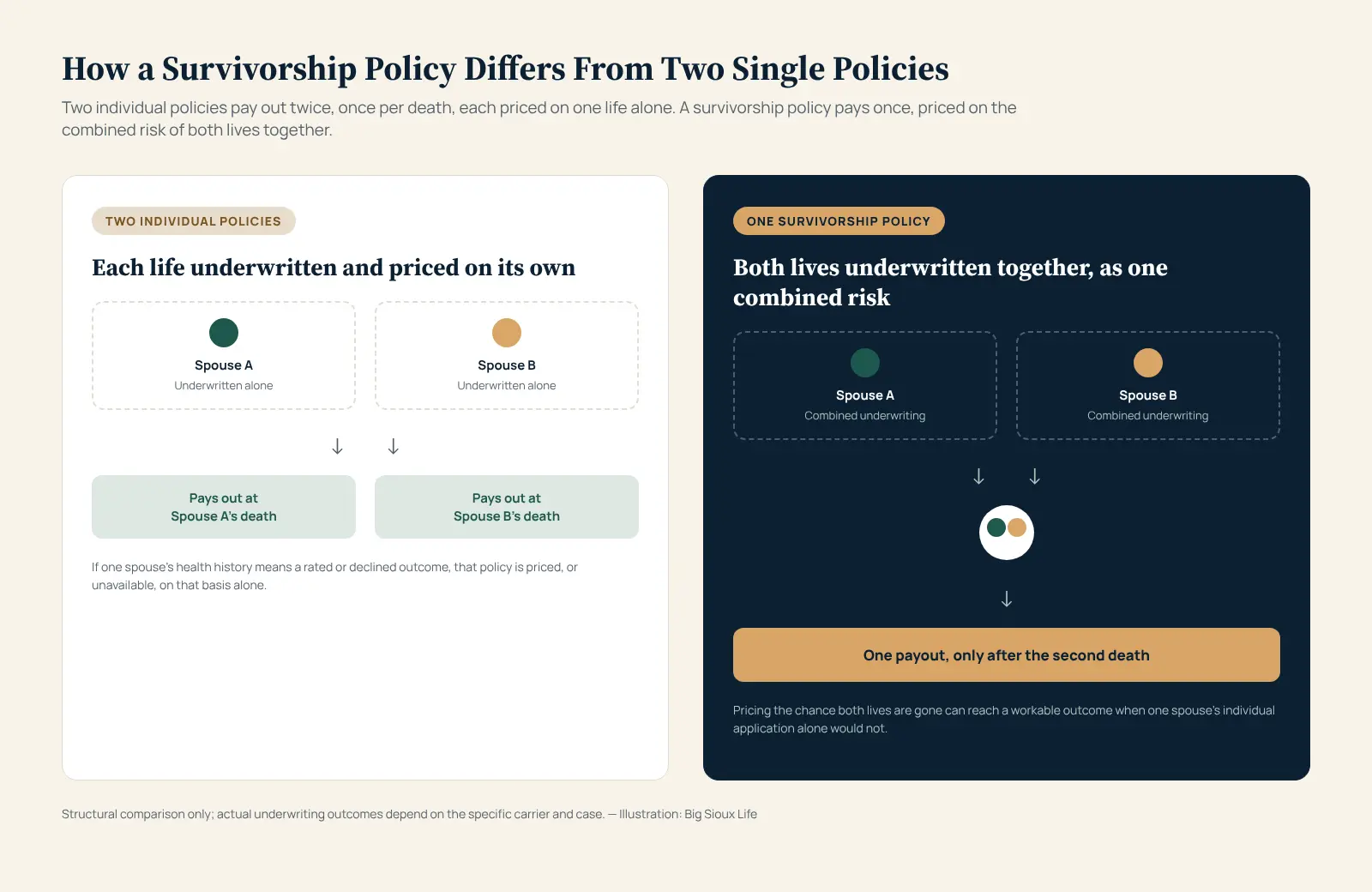
An insurance company does not have to look at each spouse’s risk as a separate, unrelated problem. When it underwrites a survivorship policy, it is pricing the chance that both of you die within some window, which is mathematically a different, and often smaller, number than the chance of the higher-risk spouse dying alone. That is not a loophole; it is the entire design of the product, and it is exactly why a joint application sometimes reaches an outcome that a single application from the higher-risk spouse alone would not.
Underwriting is the process a carrier uses to evaluate an applicant’s risk and decide whether to offer coverage, at what price, and in which rate class. A rated policy is one issued at a higher-than-standard premium because of impaired health; that is a distinct, published underwriting outcome, not the same thing as a decline, according to the American Council of Life Insurers’ own definitions in its 2025 Life Insurers Fact Book. Insurable interest is the legal requirement that whoever benefits from a policy must have a real stake in the insured’s continued life, not just an interest in their death; in South Dakota, SDCL 58-10-4 recognizes this for people related closely by blood, marriage, or by law, with a substantial interest engendered by love and affection, which is why spouses qualify as a matter of course.

What survivorship life insurance actually is, and what it is not
A survivorship life insurance policy, also called second-to-die or joint last-to-die life insurance, insures two people under one contract and pays its death benefit only after the second insured has died. Nothing is paid when the first spouse dies. The policy simply continues, usually at the same premium, covering the surviving spouse alone until that person’s death triggers the single payout.
This is not a hypothetical or a niche idea someone invented for marketing. The Interstate Insurance Product Regulation Commission (IIPRC), a multi-state compact that sets uniform product standards so carriers don’t have to file fifty different versions of the same policy, adopted a specific national standard for it: Individual Joint Last to Die Survivorship Term Life Insurance (Citation IIPRC-L-04-I-2). That standard defines the covered product as one where “the death benefit is payable upon the death of the last surviving insured to die,” and it has been through several rounds of revision, most recently approved December 15, 2022 and effective April 3, 2023 for new filings. In plain terms: regulators across the country treat this as a defined, standardized category, with its own rules, not a one-off product a single carrier made up.
Two structural points matter before anything else:
- It is priced on joint, not individual, mortality. A carrier’s actuaries work out the probability that the second of two specific lives dies by any given year, which is a smaller probability, for the same future year, than the chance that either single life dies that soon. That is simple probability, not a sales pitch: if event A (spouse 1’s death) and event B (spouse 2’s death) both have to happen for the claim to trigger, “both happened” is always at least as unlikely as either one happening alone, and usually meaningfully more so.
- It can be built as term or as permanent coverage. Most survivorship policies sold today are permanent (whole life, guaranteed universal life, or indexed universal life) because the main uses, described below, usually need coverage that doesn’t expire on a schedule. A permanent survivorship policy that builds cash value is subject to the same federal modified endowment contract (MEC) rules that apply to any permanent policy: if premiums paid in the first seven years exceed IRS limits under the 7-pay test described in Internal Revenue Code Section 7702A, the policy loses some of its favorable tax treatment on withdrawals and loans. That is a real mechanical rule, not a reason to avoid permanent coverage, but it is a reason to have any permanent survivorship illustration checked for MEC status before you fund it aggressively.
This is not the same thing as two policies that happen to be sold together
Some couples buy two individual policies through the same application process and think of that as "joint coverage." It isn't the same product. Two individual policies are two separate contracts, two separate underwriting decisions, and two separate payouts, one per death. A survivorship policy is one contract, one underwriting decision made on both lives together, and one payout, on the second death only. The confusion matters because the two structures answer completely different financial questions.
| Feature | First-to-die / individual policies | Survivorship (second-to-die) |
|---|---|---|
| Pays out when | At the first insured's death | Only after the second insured's death |
| Number of payouts | Once per policy (twice total, with two individual policies) | Once, total |
| Priced on | Each life individually | Combined mortality of both lives together |
| Typical fit | Income replacement, mortgage payoff, final expenses | Trusts, inheritances, estate-tax liquidity, business transitions |
| When one spouse has a serious health history | That spouse's policy is priced, or unavailable, on that history alone | Can sometimes reach a workable outcome the individual application would not |
Structural comparison, not a quote or a guarantee; actual pricing and underwriting outcomes depend on the specific carrier and case.
The numbers behind the pain point
| Measure | Figure | Period |
|---|---|---|
| U.S. adults who own some life insurance | 51% | 2025 |
| U.S. adults who are uninsured or say they need more coverage than they have | ~40% | 2025 |
| Federal basic estate-tax exclusion, per person, for deaths in 2026 | $15,000,000 | 2026 |
| Effective federal exclusion for a married couple, with portability | ~$30,000,000 | 2026 |
| Annual federal gift-tax exclusion per recipient | $19,000 | 2026 |
| U.S. life expectancy at birth, overall (male / female) | 79.0 years (76.5 / 81.4) | 2024 data |
| Remaining U.S. life expectancy at age 65, overall (male / female) | 19.7 years (18.4 / 20.8) | 2024 data |
Sources: LIMRA and Life Happens, 2025 Insurance Barometer Study; IRS, 2026 tax year inflation adjustments under 26 U.S.C. Section 2010; CDC National Center for Health Statistics, "Mortality in the United States, 2024." Accessed October 2026.
U.S. life expectancy, 2024 data, by sex (years)
Source: CDC National Center for Health Statistics, "Mortality in the United States, 2024." Accessed October 2026.
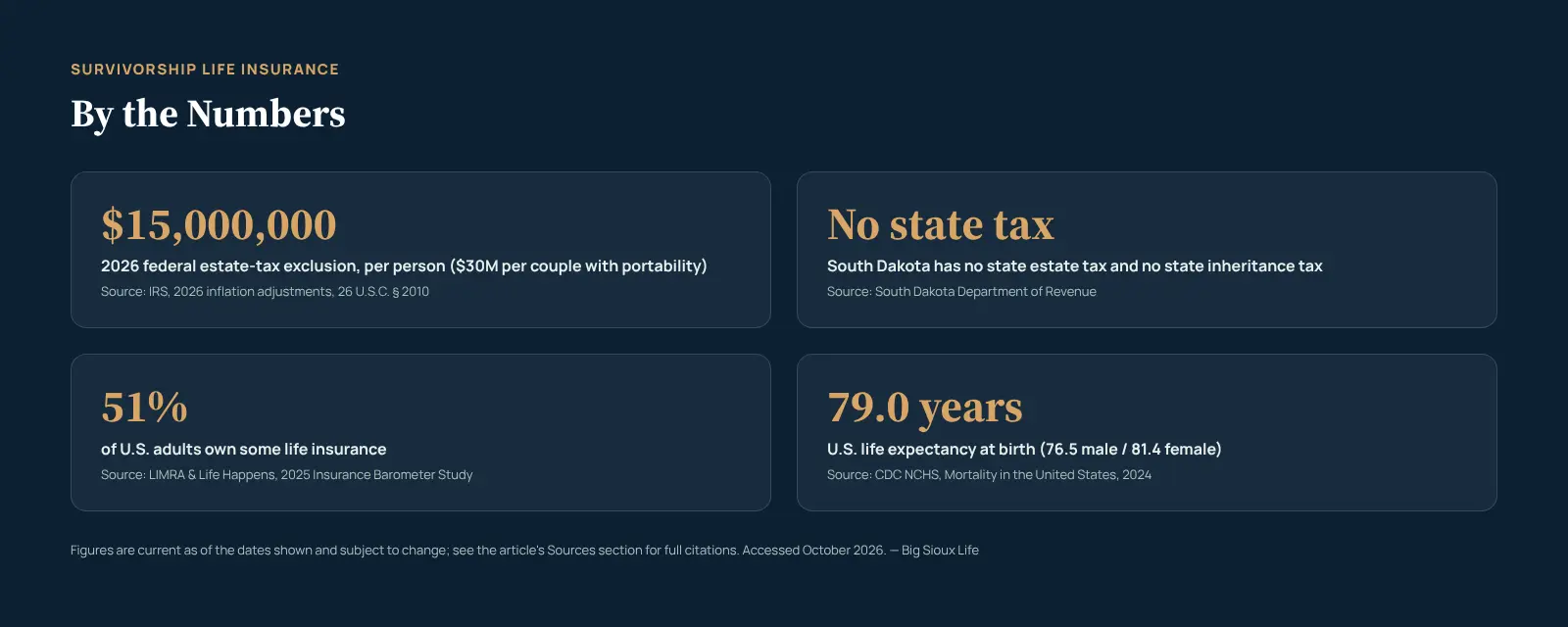
The estate-tax figures above explain why survivorship life insurance got its reputation as an “estate planning” product in the first place, and also why that reputation is overstated for most people. At $15,000,000 per person and roughly $30,000,000 per couple with portability for 2026, the vast majority of South Dakota households are nowhere near the federal threshold, and South Dakota layers on no state-level estate or inheritance tax of its own to worry about. For most couples reading this, survivorship life insurance is not an estate-tax tool at all. It is, instead, a way to get coverage in force when one spouse’s health history has made an individual policy hard to get or expensive to keep, or a way to fund something specific, a special needs trust, an inheritance for the kids, a farm or business transition, that is only needed once both spouses are gone.
Who this actually fits, and who it doesn’t
Four situations come up often enough to name directly.
One spouse is rated, postponed, or declined, and the couple wants real coverage in force anyway. This is the core case this guide opened with. A joint application, priced on both lives, can sometimes reach standard or near-standard terms even when the higher-risk spouse’s own individual application would not. It is not guaranteed; it depends on the specific health history, the ages involved, and which carrier is asked. That last part is where shopping matters most, since carriers do not all draw this line in the same place.
A couple wants to leave an inheritance or fund a trust that is only needed after both of them are gone. A special needs trust for a child who will outlive both parents, a planned gift to grandchildren, or simply “we want something to pass down” are all needs that, by definition, do not require a payout while either spouse is still alive to manage things. Paying for coverage that only pays out when it’s actually needed, instead of twice over on separate first-to-die policies, is often the more efficient structure for this specific goal.
A farm, ranch, or closely held business needs liquidity at the second death, not the first. When one spouse dies, the surviving spouse commonly keeps running things, often with marital deductions and continued operating income covering the gap. The harder financial moment is frequently the second death, when the operation has to be settled, split among heirs, or sold, often under time pressure. A survivorship policy times its payout to exactly that moment.
A couple’s combined estate is realistically near or above the federal exclusion. For 2026 that means a combined net worth approaching the roughly $30,000,000 portability figure, which describes very few South Dakota families, but for the ones it does describe, a survivorship policy funds the estate tax bill, due nine months after the second death under federal rules, without forcing a fire sale of land, a business, or other illiquid assets.
Where it does not fit as well: income replacement while either spouse is alive, paying off a mortgage if one spouse dies, or covering final expenses for whichever spouse goes first. All three of those needs exist the moment the first spouse dies, not the second, which means a survivorship policy, by design, pays at the wrong time for any of them. That is the single most common mismatch we see: someone hears “joint policy,” assumes it covers the more familiar first-to-die need, and ends up with a structure that would have left the surviving spouse with nothing in the exact scenario they were actually worried about.
Buying "joint" coverage without checking which kind
- Assumes any policy covering both spouses pays when either one dies
- Buys survivorship coverage to replace income or pay off a mortgage, needs that start at the first death
- Never checks whether the actual goal is a first-to-die or second-to-die structure
Common outcomeThe surviving spouse gets nothing from this policy at the exact moment the household's income or mortgage payment is actually at risk
Naming the actual goal before naming the product
- Separates "what do we need covered while one of us is still alive" from "what do we need funded only after we're both gone"
- Uses first-to-die or individual term coverage for income, mortgage, and final-expense needs
- Reserves a survivorship structure for the specific second-death need, estate liquidity, a trust, an inheritance, or a hard-to-insure spouse
Common outcomeEach need gets the structure built to actually pay out when that need occurs
A worked example: two different couples, two different fits
Take a hypothetical Sioux Falls couple in their late thirties with two young kids and a mortgage. One spouse is healthy; the other was treated for cancer four years ago and is now in remission, which commonly means a rated or postponed outcome on an individual application depending on the cancer type, staging, and time since treatment, as carriers’ own published underwriting guides for cancer history generally describe. If this couple’s real worry is “what happens to the mortgage and the kids’ day-to-day expenses if either of us dies in the next ten years,” a survivorship policy is close to the wrong tool regardless of underwriting outcome, because it would pay nothing if the healthier spouse died first, which is exactly the scenario that would leave the family short on income with the mortgage still outstanding. Individual term coverage on each spouse, even if the cancer history means one policy comes back rated rather than standard, fits that need far better than a joint structure built around the second death.
Now take a different hypothetical: a couple in their early sixties, mortgage paid off, kids grown, who run a small manufacturing business together and want to make sure their two adult children can keep the business running and pay out any siblings who don’t want to stay involved, without being forced to sell equipment or real estate to come up with cash on short notice. One spouse has a cardiac history that would likely mean a table rating or possible decline on an individual permanent policy. Here, a survivorship policy lines up well: the business transition pressure hits hardest at the second death, not the first, the couple’s actual goal is funding that second-death moment, and the joint underwriting may reach a workable outcome that the cardiac-history spouse’s individual application alone would not. Both examples are illustrative only, built to show how the fit works, not a quote, an approval, or a benefit estimate for any real applicant; every case is underwritten on its own facts, at whichever carrier it’s submitted to.
What it costs to guess wrong
The cost here isn’t a single dollar figure, since no honest source can quote you a premium without underwriting your actual file. It’s what happens when the mismatch between “joint” and “the specific kind of joint we need” goes unexamined, in a state where, per the 2025 LIMRA and Life Happens Insurance Barometer Study, roughly 40% of adults are already uninsured or say they need more coverage than they currently have. Three outcomes tend to follow, and all three are avoidable:
- Buying a survivorship policy to solve a first-death problem. The family discovers, at the worst possible moment, that the mortgage, the income gap, or the final expenses from the first death aren’t covered by a policy that was never designed to pay out until the second one.
- Assuming the higher-risk spouse is simply uninsurable and buying nothing on that life at all. If a joint application was never explored, that assumption was never actually tested against what a combined-risk underwriting decision would produce.
- Overfunding a permanent survivorship policy without checking MEC status. Internal Revenue Code Section 7702A’s seven-pay test is a real, mechanical limit; paying in more than the test allows during the first seven years converts favorable tax treatment on loans and withdrawals into something closer to an annuity’s tax treatment, a detail easy to miss without a proper illustration review.
Both of the first two outcomes trace back to the same root cause: treating “survivorship” and “joint” as interchangeable with “covers both of us, however we need it,” instead of checking which specific job the coverage is actually built to do. If you’d rather have someone local walk through which structure actually matches your situation, that’s worth doing before you assume either direction, that you need it or that you don’t. Compare My Options.
How to work through this yourself, before you talk to anyone
Here’s the method, with nothing held back:
- Name the actual need first, separately from the product name. Write down, in plain language, what has to be paid for, and when. “Replace my income if I die in the next fifteen years” is a first-death need. “Make sure the farm doesn’t have to be sold to pay the kids out” is a second-death need. Don’t start with “we want a joint policy”; start with the timing of the need.
- Check whether either spouse has a health history that would complicate an individual application. A diagnosis, a past surgery, a family history, a medication list, or a prior rated or declined application are all worth writing down honestly and completely, not softened.
- If the need is first-death (income, mortgage, final expenses), price individual or first-to-die coverage for each spouse separately. Don’t default to a joint structure out of convenience if the underlying need pays out at the first death, not the second.
- If the need is second-death (a trust, an inheritance, estate-tax liquidity, a business transition), get an illustration for a survivorship policy and compare it honestly against two individual policies priced for the same total goal. The joint structure’s advantage, when there is one, usually shows up most clearly when one spouse’s individual pricing would be rated or declined; if both spouses are healthy and the need is still second-death only, compare both structures rather than assuming the joint one automatically wins.
- Confirm insurable interest for anyone other than a legal spouse. SDCL 58-10-4 recognizes close relatives by blood, marriage, or law, and separately recognizes a lawful economic interest between parties like business partners; if the pairing isn’t a spouse, this is worth confirming with the carrier up front rather than discovering a problem at underwriting.
- If a permanent policy is on the table, ask specifically about MEC status at the proposed funding level. Request that the illustration confirm whether the planned premium schedule stays within the Section 7702A seven-pay limits.
- Compare more than one carrier before concluding either spouse is uninsurable or that a survivorship structure won’t help. Carriers do not all draw the line between “rated” and “declined” in the same place for the same health history, and the only way to know what a joint application would actually produce is to ask more than one.
- Answer every application question completely and honestly. South Dakota policies become incontestable, apart from fraud or nonpayment of premium, two years after issue under SDCL 58-15-10. That protects coverage already in force; it is not a reason to shade an answer on a new application.
How we help
We’re an independent agency, which means we aren’t tied to one carrier’s appetite for joint underwriting or its definition of where “rated” ends and “decline” begins. When one spouse has a health history that’s made an individual policy complicated, that independence is the point: instead of treating one company’s answer as the final word, we can look at how different carriers actually price a joint application for your specific combination of ages and health histories, and compare that against individual and first-to-die alternatives sized to what you actually need covered and when. We start with the need you’re trying to fund and its timing, not a product name, and work backward from there. If you have a health condition you’ve assumed makes you uninsurable, it’s worth asking before assuming either way; independent agencies see how different carriers treat the same combination of lives. Compare My Options.
What you get
A structure that’s actually matched to when the money is needed, not just to the word “joint.” A real answer on whether a combined application reaches a workable outcome for a spouse whose individual application didn’t, instead of an assumption that was never tested. And, if a survivorship policy turns out to be the right fit, coverage sized to the specific second-death need, a trust, an inheritance, a business transition, estate-tax liquidity, rather than coverage bought because it sounded like it should cover everything.
A survivorship policy doesn't ask "can we insure the sicker spouse." It asks "what's the chance both of you are gone by a given year," which is a smaller, different number. That's the whole mechanism, and it's also exactly why it solves a second-death problem, not a first-death one.
Mike MooreRelated reading
If a specific health condition is the concern behind this, see our guide on life insurance after cancer for how carriers evaluate that history on an individual application. If the goal is funding a trust for a child who will need support indefinitely, see special needs trusts and life insurance beneficiaries. For blended families working out who a policy should actually benefit, see blended family life insurance beneficiaries. If a business or farm transition is part of this decision, see our guide on buy-sell agreements and the Connelly case. And if a permanent policy is on the table, see guaranteed universal life insurance and indexed universal life insurance for how those structures work on an individual basis.
Not sure which structure fits your household?
See how whole life coverage works as one of the permanent options a survivorship policy can be built on.
Dealing with a health condition in the mix?
Not ready to talk to anyone yet?
Read how it works first and come back when you are, or reach us through our contact page when you have questions.
Frequently asked questions
What is survivorship life insurance?
Survivorship life insurance, also called second-to-die or joint last-to-die life insurance, is a single policy covering two people, almost always spouses, that pays its death benefit only after the second of the two insureds dies. It is a real, standardized product category: the Interstate Insurance Product Regulation Commission adopted a uniform national standard for it, Individual Joint Last to Die Survivorship Term Life Insurance (IIPRC-L-04-I-2), most recently updated December 15, 2022 and effective April 3, 2023. Nothing is paid out when the first spouse dies; the policy stays in force on the surviving spouse alone until that person also dies.
How is survivorship life insurance different from two single life insurance policies?
Two single policies each pay out on their own insured’s death, so the family can receive money twice, once per death, and each policy is underwritten and priced on one life alone. A survivorship policy pays once, on the second death, and it is priced on the combined mortality of both lives together rather than on either person individually. That joint pricing is the whole mechanism: a carrier evaluating two lives together, where only the second death triggers a claim, is taking on a different, more spread-out risk than it takes on insuring one rated or impaired life by itself.
Can you get survivorship life insurance if one spouse has a serious health condition?
Often, yes, and that is precisely the situation this product was built for. Because the payout depends on both of you dying, not just the one with the health condition, carriers can sometimes offer a survivorship policy when they would decline or heavily rate that same person’s individual application. The American Council of Life Insurers’ own glossary confirms that a rated policy, issued at a higher premium for impaired health, and a decline are two different, well-established underwriting outcomes, not the only two options; a joint application changes the math behind which outcome applies. It is not automatic and depends on the specific health history and the carrier, which is exactly why comparing carriers matters here.
Do South Dakota couples need survivorship life insurance for federal estate taxes?
Only a small number of estates are large enough for this to matter. For deaths in 2026, the federal basic exclusion amount is $15,000,000 per person under 26 U.S.C. Section 2010, as set by the One Big Beautiful Bill Act and confirmed in the IRS’s 2026 inflation-adjustment release, which works out to roughly $30,000,000 for a married couple once the surviving spouse elects portability of the first spouse’s unused exclusion. A combined estate under that threshold owes no federal estate tax regardless of how it is insured. Above it, the tax is due nine months after the second spouse’s death, which is exactly when a survivorship policy pays, making it a liquidity tool for that specific, narrow situation rather than a tax-saver by itself.
Does South Dakota have its own estate or inheritance tax that affects this decision?
No. South Dakota’s Department of Revenue states plainly that the state has no inheritance tax, repealed by the voters effective July 1, 2001, and that there is also no state estate tax. For a South Dakota couple, the only estate-tax liquidity question is the federal one described above; there is no separate state-level number to plan around.
What’s the difference between first-to-die and second-to-die life insurance?
A first-to-die (joint life) policy pays on whichever spouse dies first, which is built for income replacement or debt payoff while both spouses are presumed to need the money while at least one is still living. A second-to-die (survivorship) policy pays only after both spouses have died, which fits a different job entirely: funding something that is only needed once neither spouse is left to manage it, such as an inheritance for the kids, a special needs trust, or federal estate-tax liquidity. Confusing the two is the most common mistake people make when they hear the word “joint” and assume it means the same thing both times.
Can an unmarried couple, siblings, or business partners get a joint survivorship policy?
Insurable interest is the limiting factor, not marital status by itself. South Dakota’s insurable-interest statute, SDCL 58-10-4, lists people related closely by blood, marriage, or by law as qualifying when there is a substantial interest engendered by love and affection, and it separately allows a lawful, substantial economic interest in someone’s continued life, such as between business partners. Whether a specific unmarried couple, sibling pair, or business pairing qualifies depends on the facts of that relationship and the carrier’s own underwriting rules, so it’s worth asking rather than assuming either way.
What happens to a survivorship policy if we divorce?
The policy itself does not end automatically, but it almost always needs to be revisited, since it was built around a relationship and an insurable-interest basis that no longer exists the way it did at issue. Beneficiary designations, who continues paying premiums, and whether the policy still makes sense as a second-to-die structure at all are decisions a divorcing couple needs to work through deliberately, typically as part of the broader settlement, rather than something that resolves itself.
Sources
- IRS — IRS releases tax inflation adjustments for tax year 2026, including amendments from the One Big Beautiful Bill — 2026 basic estate/gift tax exclusion of $15,000,000 per individual and $19,000 annual gift exclusion per recipient, under Rev. Proc. 2025-32; accessed October 2026
- Cornell Law School Legal Information Institute — 26 U.S.C. Section 2010, Unified credit against estate tax — statutory text confirming the $15,000,000 basic exclusion amount for decedents dying after 2025 and the inflation-adjustment mechanism beginning after 2026; accessed October 2026
- South Dakota Department of Revenue — Individual Income Tax / Other Taxes — confirms South Dakota has no state inheritance tax, repealed by voters effective July 1, 2001, and no state estate tax; accessed October 2026
- LIMRA and Life Happens — 2025 Insurance Barometer Study — 51% of U.S. adults own some life insurance, and roughly 40% are uninsured or underinsured (30% uninsured who say they need it, 10% underinsured who say they need more); 2025 data; accessed October 2026
- CDC National Center for Health Statistics — Life Expectancy, FastStats (Mortality in the United States, 2024) — U.S. life expectancy at birth of 79.0 years overall (76.5 male, 81.4 female) and remaining life expectancy at age 65 of 19.7 years overall (18.4 male, 20.8 female); 2024 data; accessed October 2026
- Interstate Insurance Product Regulation Commission — Individual Joint Last to Die Survivorship Term Life Insurance Standards (IIPRC-L-04-I-2) — uniform national product standard for survivorship term life insurance, adopted December 15, 2022, effective April 3, 2023 for new filings; accessed October 2026
- American Council of Life Insurers — 2025 Life Insurers Fact Book, Glossary — industry definitions of “rated policy” (issued at a higher-than-standard premium for impaired health) and “substandard risk”; 2025; accessed October 2026
- South Dakota Legislature — SDCL 58-10-4, Insurable interest with reference to personal insurance — qualifying insurable-interest categories including close relatives by blood, marriage, or law, and lawful economic interests; accessed October 2026
- South Dakota Legislature — SDCL 58-15-10, Incontestability provision required — two-year incontestability period for South Dakota life insurance policies, except fraud or nonpayment of premium; accessed October 2026
- Internal Revenue Service — Section 7702A modified endowment contract guidance — confirms the seven-pay test distinguishing a modified endowment contract from an ordinary life insurance contract; accessed October 2026
Related reading: life insurance after cancer, special needs trusts and life insurance beneficiaries, blended family life insurance beneficiaries, buy-sell agreements and the Connelly case, guaranteed universal life insurance, and indexed universal life insurance.
Before you act on any of this
This article is general education, not insurance, legal, financial, medical, or tax advice, and it is not an underwriting decision or a promise of coverage for any individual. Figures shown are illustrative examples current as of the dates listed and are subject to change; carrier guidelines and tax law may differ or change after publication. Product availability, features, and rates vary by carrier and are subject to underwriting. No coverage exists until a policy is issued and in force. Any guarantees are subject to the claims-paying ability of the issuing insurer. Please review actual policy documents and speak with a licensed agent, and a qualified tax or legal advisor for any estate-planning question, about your own situation.
The question is timing, not whether “joint” sounds right
Most couples who ask about survivorship life insurance are really asking one of two different questions, and the product only answers one of them. If the worry is what happens to the mortgage, the income, or the day-to-day bills if either of you dies in the next ten or twenty years, this is the wrong tool, full stop, no matter how the underwriting turns out. If the worry is what happens to a trust, an inheritance, a business, or an estate tax bill once neither of you is left to manage it, and especially if one spouse’s health history has complicated an individual application, it’s worth a real look. Write down which question you’re actually asking before you look at a single illustration. That one sentence decides more of this than anything else in this guide.
Not sure which structure actually fits your situation?
We'll walk through what you're trying to fund and when, and compare survivorship, first-to-die, and individual options sized to that, across carriers.