Yes, in nearly every case. High cholesterol is one of the most common findings on a life insurance application in South Dakota, not a disqualifying one. About 36% of South Dakota adults have been told by a doctor or nurse that their cholesterol is high, according to the South Dakota Department of Health’s own 2024 survey report, so you are not an unusual applicant walking in with an unusual problem. What actually varies — sometimes by a wide margin — is which rate class your specific numbers land in and at which company, because the two carriers whose real 2026 underwriting guides this article quotes directly disagree with each other on where “high” even starts. This guide walks through exactly how that pricing works, using real, named, dated carrier documents, so you can see roughly where your own lab numbers stand before you ever fill out an application.
The short version
- About 36% of South Dakota adults have been told their cholesterol is high, per the South Dakota Department of Health's 2024 BRFSS report (2023 data) — close to the national rate of 36.9% (America's Health Rankings, BRFSS 2023).
- Carriers price your total cholesterol and your cholesterol/HDL ratio together, not either number alone, and they don't agree on where the line falls.
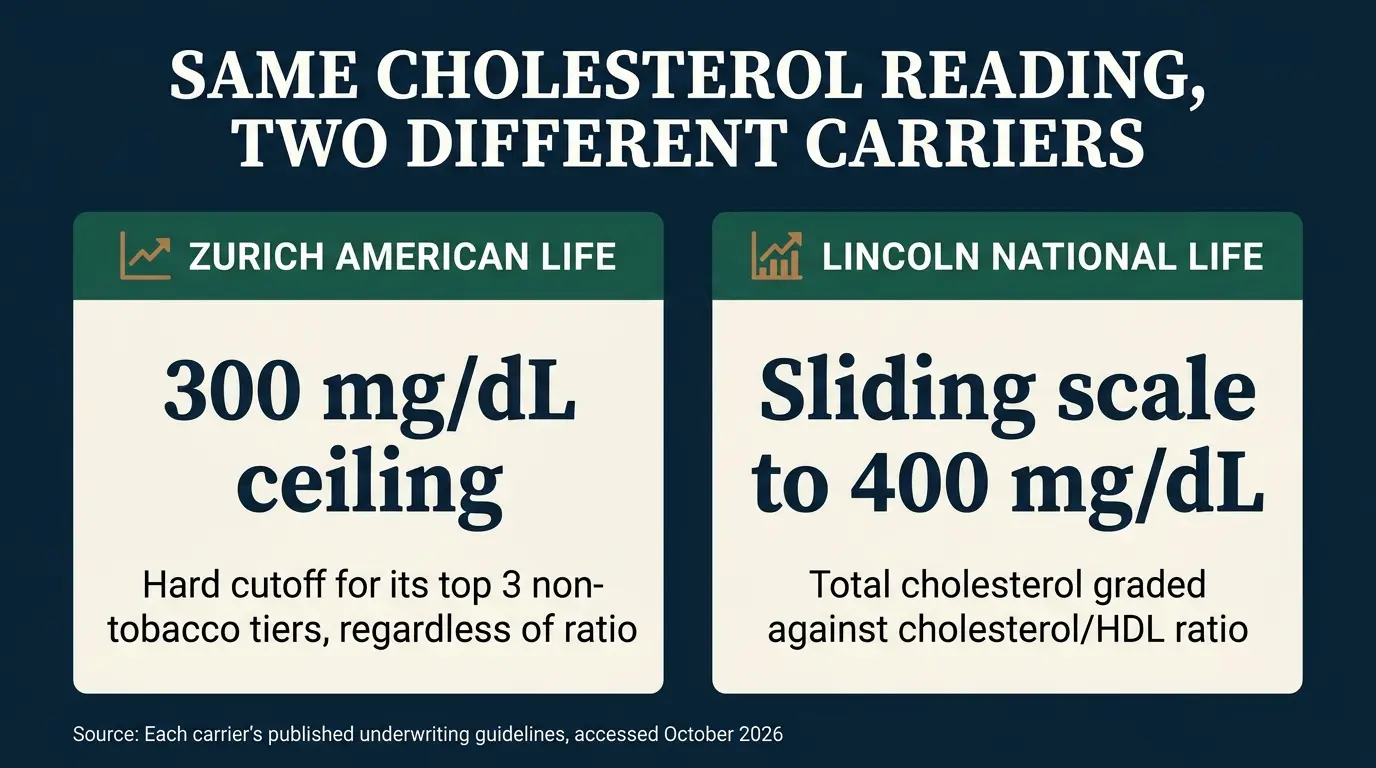
- Zurich American Life Insurance Company's published guidelines cap its top three pricing tiers at 300 mg/dL total cholesterol, no matter your ratio. Lincoln National Life Insurance Company's 2026 guide instead grades cholesterol and ratio together on a sliding scale up to 400 mg/dL.
- Being treated for cholesterol is not automatically worse than being untreated — several carriers evaluate treated and untreated numbers the same way, per their own published criteria.
- This article does not quote specific premium dollar amounts. It shows the mechanics using real, sourced carrier documents, so you can check your own numbers before you talk to anyone.
What actually counts as “high cholesterol” in 2026?
Clinically, a total cholesterol reading of 240 mg/dL or higher is considered high, and a reading under 200 mg/dL is considered healthy, under the categories the CDC and the National Institutes of Health use today. Cholesterol itself is a waxy, fat-like substance your liver makes and your body also gets from food; you need some of it to build cells and hormones, but too much of certain kinds, carried in your blood, builds up in artery walls over years and raises your risk of heart attack and stroke.
Your cholesterol test, called a lipid panel, actually reports several separate numbers:
- Total cholesterol: the overall amount in your blood, in milligrams per deciliter (mg/dL).
- LDL (“bad”) cholesterol: the kind that builds up in artery walls. The NIH’s MedlinePlus considers a reading under 100 mg/dL healthy for adults.
- HDL (“good”) cholesterol: helps carry cholesterol away from your arteries to your liver, where it’s removed. Higher is better here, the reverse of total and LDL. MedlinePlus lists under 40 mg/dL as low for men and under 50 mg/dL as low for women, with 60 mg/dL or higher considered protective.
- Cholesterol/HDL ratio: your total cholesterol divided by your HDL number. This single ratio is the number life insurance underwriters lean on most heavily, because it captures both halves of the picture — how much cholesterol you’re carrying overall, and how much of it your body is already clearing — in one figure.
Nationally, 11.3% of U.S. adults age 20 and older had high total cholesterol (240 mg/dL or above) when actually tested, with almost no difference between men (10.6%) and women (11.9%), according to the CDC’s National Center for Health Statistics, using National Health and Nutrition Examination Survey (NHANES) data collected August 2021 through August 2023. The same report found 13.8% of adults had low HDL, split much more unevenly by sex: 21.5% of men versus 6.6% of women.

Here’s where the two commonly cited statistics diverge, and it matters for how you read your own situation: that 11.3% NHANES figure measures cholesterol directly, at the moment of the exam. South Dakota’s own survey data, discussed below, asks a different question — whether a doctor has ever told you your cholesterol was high — which is why the state figure runs noticeably higher. A lot of people who were told their cholesterol was high years ago are now successfully treating it, and their current blood draw may look nothing like the number that got them the diagnosis in the first place. That distinction is exactly why several carriers’ underwriting guides, as you’ll see further down, evaluate “treated and untreated findings” side by side rather than asking only whether you’ve ever been diagnosed.
Why does a lab number you can’t feel matter this much to an underwriter?
Because it’s measured directly during underwriting rather than self-reported, and because decades of actuarial data tie it to the kinds of outcomes life insurance exists to cover. A few terms are worth pinning down before looking at real numbers:
- Underwriting class (rate class): the health and risk category a carrier assigns you after reviewing your application, medical history, and usually lab work from a paramedical exam, which sets your premium relative to other applicants your age and sex.
- Table rating: a priced step above a carrier’s standard rate class, expressed as a percentage of the standard premium (for example, 125% or 150%), used for applicants whose combined risk factors sit outside the range that qualifies for standard or preferred pricing without being high enough risk for a decline.
- Cholesterol/HDL ratio: explained above — your total cholesterol divided by your HDL. A ratio of 5.0 means your total cholesterol is five times your HDL level.
- Contestability period: the first two years a policy is in force, during which an insurer can investigate and potentially deny a claim if the application contained a material misrepresentation — one more reason to report your actual numbers accurately rather than guess.
Two real, currently published carrier underwriting guides make the mechanics concrete. Lincoln National Life Insurance Company’s 2026 underwriting guide (form LCN-8800097-030226, copyrighted 2026) grids total cholesterol against the cholesterol/HDL ratio for its non-tobacco applicants:
| Total cholesterol | Ratio ≤4.0 | Ratio 4.1–4.9 | Ratio 5.0–5.8 | Ratio 5.9–7.0 | Ratio 7.1–8.9 | Ratio 9.0–10.9 |
|---|---|---|---|---|---|---|
| Up to 250 mg/dL | Standard | Standard | Standard | Standard | 125% | 150% |
| 251–300 mg/dL | Standard | Standard | Standard | Standard | 125% | 175% |
| 301–350 mg/dL | Standard | 125% | 125% | 125% | 150% | 200% |
| 351–400 mg/dL | 125% | 125% | 150% | 150% | 175% | 250% |
Source: Lincoln National Life Insurance Company, Underwriting Guidelines (Lincoln individual and survivorship products), form LCN-8800097-030226, ©2026, accessed via Pinney Insurance. "Standard" and the percentages shown are the applicant's resulting non-tobacco rate class relative to standard pricing; separate, stricter ratio-only criteria (≤5.0 up to age 69, ≤5.5 at 70+) apply to qualify for Lincoln's Preferred Plus tier. Minimum untreated cholesterol reading accepted is 100 mg/dL; maximum is 300 mg/dL for Preferred Plus consideration. Illustrative of this carrier's published criteria only; not a quote. Accessed October 2026.
Notice what moves the price and what doesn’t. Look at the row for 301–350 mg/dL: the exact same total cholesterol reading prices at standard rates with a ratio of 4.0 or better, but jumps to a 200% table rating — double the standard premium — with a ratio between 9.0 and 10.9. The total cholesterol number never changed across that row. The ratio did all the work.
This article doesn't quote specific premium dollar amounts
What a table rating actually costs you in dollars depends on your age, sex, coverage amount, tobacco status, and the specific carrier and product — variables no article can responsibly guess at in advance. The percentages above are each carrier's own published rate-class structure, not a premium quote for you.
Not every carrier draws the line in the same place
This is the single most useful fact in this guide. Zurich American Life Insurance Company’s published underwriting guidelines use an entirely different mechanic than Lincoln’s: a flat total-cholesterol ceiling for its three best non-tobacco tiers, with the ratio ceiling loosening at each lower tier.
| Rate class | Max total cholesterol | Max cholesterol/HDL ratio |
|---|---|---|
| Preferred Best | 300 mg/dL | 4.5 |
| Non-tobacco Preferred | 300 mg/dL | 5.5 |
| Standard Plus | 300 mg/dL | 6.5 |
| Non-tobacco Standard | Above 300 mg/dL | Above 6.5, accepted if not otherwise ratable |
Source: Zurich American Life Insurance Company of New York / Zurich American Life Insurance Company, Underwriting Guidelines 2022, "Preferred risk classification criteria" table, accessed via Pinney Insurance. Treatment allowed at all tiers shown. Illustrative of this carrier's published criteria only; not a quote or guarantee of any outcome. Accessed October 2026.
Compare the two tables directly. At Zurich, a total cholesterol of 320 mg/dL — just 20 points over its 300 mg/dL ceiling — rules out all three of its better non-tobacco tiers entirely, regardless of how good your ratio is. At Lincoln, that same 320 mg/dL reading is squarely inside the 301–350 mg/dL row of its grid, where it can still land at standard pricing (with a ratio of 4.0 or better) or no worse than a 125% rating across most of the ratio range up to 7.0. Neither carrier is wrong. They’re different, equally lawful business decisions about how to price the same risk, which is exactly why South Dakota’s own insurance law doesn’t require them to match each other.
South Dakota’s anti-discrimination statute, SDCL 58-33-26, states that no insurer may make or permit unfair discrimination between insureds having like insuring or risk characteristics in premium, rates, or any other term or condition of insurance, and a violation is a Class 2 misdemeanor. That protects against a single company arbitrarily pricing two genuinely similar applicants differently from each other. It says nothing about requiring every company to use the same underwriting thresholds as every other company — which is exactly why Zurich’s 300 mg/dL ceiling and Lincoln’s 400 mg/dL sliding scale can both be lawful, current, real pricing structures at the same time.
Missing one company's cutoff is not missing the market's cutoff
A total cholesterol reading that pushes you out of Zurich's best tiers can still land comfortably inside Lincoln's standard pricing, or vice versa depending on your ratio. The lab result didn't change between companies. The company's line did.
A worked example: the same lab results, two carriers, two different outcomes
Say a 52-year-old South Dakotan goes in for a routine physical and gets a lipid panel back showing total cholesterol of 320 mg/dL and an HDL of 51 mg/dL, untreated. Divide 320 by 51 and the cholesterol/HDL ratio works out to about 6.3. Run that single set of numbers through both carriers’ published tables above:
| Carrier | Where 320 mg/dL / ratio 6.3 falls | Resulting outcome |
|---|---|---|
| Lincoln National Life | 301–350 mg/dL row, 5.9–7.0 ratio column | 125% of standard non-tobacco pricing |
| Zurich American Life | Total cholesterol exceeds the 300 mg/dL ceiling used for all three better tiers | Non-tobacco Standard tier (above 300 mg/dL / above 6.5 ratio, accepted if nothing else is independently ratable) |
A hypothetical applicant profile built to illustrate real, published carrier mechanics. Actual underwriting outcomes depend on your complete file, not cholesterol alone, and are not a quote or guarantee of any result. Sources: Lincoln National Life Insurance Company and Zurich American Life Insurance Company underwriting guidelines, accessed via Pinney Insurance, October 2026.
Nothing about this applicant’s blood changed between rows. At Lincoln, that 320/6.3 combination sits comfortably in a mild, graded rating — 125% of standard, one of the lightest ratings on the whole grid. At Zurich, the same numbers fall outside the ceiling its three better tiers all share, landing in its standard-and-below bracket instead, though still with coverage available rather than a decline, as the next section explains. The honest takeaway isn’t that one company is better than the other in general. It’s that a single lab result genuinely prices differently depending on which door you knock on, which is the entire argument for comparing more than one carrier before accepting a first answer as final.
Try this with your own numbers
Pull your most recent lipid panel. Divide your total cholesterol by your HDL to get your own ratio. Then find your row and column in the Lincoln table above, and check whether your total cholesterol clears Zurich's 300 mg/dL ceiling. You now know roughly where two real carriers would likely place you, before anyone asks you for an application.
If you’d rather have someone local run your actual numbers against more than two carriers, that’s what an independent agency does. Compare My Options.
What does high cholesterol actually cost South Dakota, in the numbers that exist?
South Dakota doesn’t have a state-specific figure for how underwriting pricing plays out across its population — that data isn’t published anywhere, by any carrier or regulator, and this guide won’t guess at one. What is published, and sourced, is how common the underlying condition is here, which is the honest starting point for understanding why carriers bother pricing it so specifically at all.
South Dakota adults told their cholesterol is high, by survey year
Source: South Dakota Department of Health, The Health Behaviors of South Dakotans, 2024 (Table 2, Behavioral Risk Factor Surveillance System), published 2026. The question is asked in alternating survey years; 2024 had not yet been published at the time this guide was written.
The most recent figure, 36% in 2023, is close to a separate, independently calculated number: America’s Health Rankings, using the same underlying 2023 BRFSS survey, puts South Dakota’s high cholesterol prevalence at 35.5%, against a national figure of 36.9%, ranking South Dakota 15th among states (1st being the lowest rate). The two figures come from the same federal survey tabulated by two different organizations and land within half a percentage point of each other, which is about as close as you’d expect from two independent counts of the same underlying data.
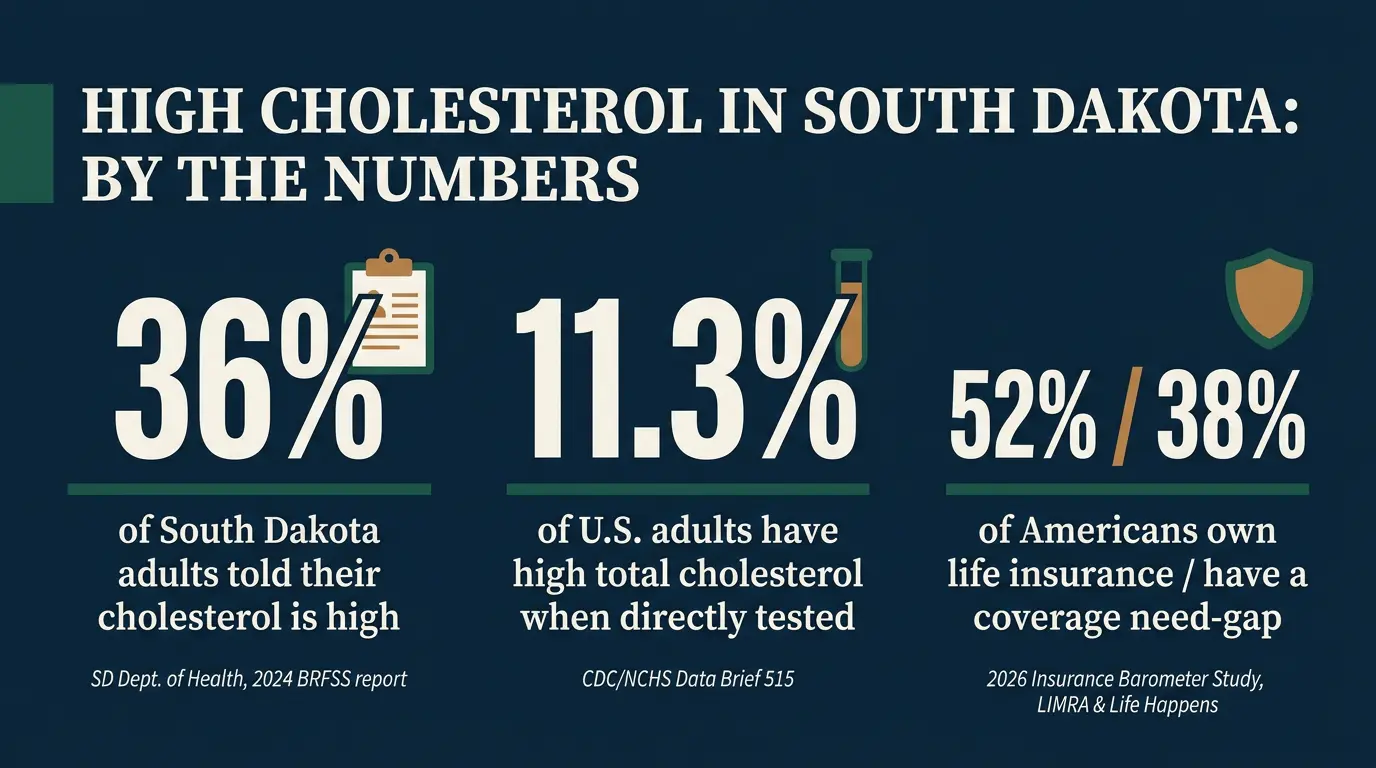
That BRFSS figure (36%) measures something different from the NHANES figure discussed earlier (11.3% nationally) — BRFSS asks whether you’ve ever been told your cholesterol was high, a cumulative, self-reported, lifetime question, while NHANES actually draws blood and measures where you stand right now. Both are legitimate and both matter for different reasons: the BRFSS figure is closer to “how many South Dakotans have a cholesterol history an underwriter might ask about,” while the NHANES figure is closer to “how many people would currently test above the clinical high threshold.” Carriers care about both: your history, and your current, up-to-date numbers.
There’s a broader cost to getting coverage decisions wrong based on assumption rather than numbers, too. The 2026 Insurance Barometer Study, from LIMRA and Life Happens, fielded in January 2026 among more than 5,000 adults, found that 52% of Americans own at least one life insurance policy, while 38% — about 92 million adults — have a coverage need-gap, either because they have no coverage and say they need it, or because they have some and say they need more. The same study found that nearly half of Americans admit their estimate of what life insurance actually costs is a “gut feeling” or a “wild guess.” A health condition you’ve never actually checked against real carrier numbers is one more version of that same guess.
How do you check where you likely stand, before you apply?
This takes about fifteen minutes with a recent lab result in hand, no underwriter required:
- Pull your most recent lipid panel. You want three numbers: total cholesterol, HDL, and (if listed) the cholesterol/HDL ratio itself — many labs calculate it for you.
- Calculate your ratio if it isn’t already on the report. Divide total cholesterol by HDL. A total cholesterol of 240 and an HDL of 48 gives a ratio of 5.0.
- Compare your total cholesterol against Zurich’s 300 mg/dL ceiling. If you’re under it, you’re still in range for that carrier’s three better non-tobacco tiers (subject to your ratio also clearing the tier you’re aiming for).
- Find your row and column in Lincoln’s grid above. This shows roughly where that same reading lands at a carrier that uses a sliding scale instead of a hard ceiling.
- Note whether you’re treated or untreated, and for how long. Several carriers, including Lincoln per its published criteria, evaluate treated and untreated findings side by side rather than penalizing treatment itself — but stability over time still matters to most underwriters.
- Compare your numbers against more than one carrier’s thresholds, since the tables above show directly that the same reading can qualify for one company’s better pricing and miss another’s.
Skipping the application because of a diagnosis label
- Decides based on "high cholesterol" as a category, not your actual total cholesterol and ratio
- Never checks whether your specific numbers would clear a real carrier's published thresholds
- Leaves a real coverage gap in place indefinitely, based on a guess
Common outcomeGoing without coverage a specific carrier would likely have offered at a reasonable rate class
Comparing your real lab results against real carrier tables
- Uses your actual total cholesterol, HDL, and ratio, not a label
- Checks more than one carrier's published criteria before assuming any one answer is final
- Applies to the carrier whose published guidelines actually fit the file
Common outcomeA realistic first answer, from a carrier likely to price the file well
Working through your own numbers this way is something you can do entirely on your own. If you’d rather have someone compare how several real carriers would price your specific lab results instead of doing the lookup yourself, that’s a reasonable second opinion to ask for: Compare My Options.
What if your numbers don’t clear anyone’s best tier right now?
That’s not the end of the conversation, and it isn’t a decline. Per Zurich’s own published guidelines, a total cholesterol above 300 mg/dL and a ratio above 6.5 can still land you in its Non-tobacco Standard class — active, in-force coverage — as long as nothing else on your file is independently ratable. A table rating simply means the carrier is pricing added risk into the premium rather than turning you away.
Two other categories of product exist as backstops if a fully underwritten policy genuinely isn’t pricing well anywhere right now:
- Simplified-issue policies ask a shorter list of health questions, without the lab work a fully underwritten policy requires, in exchange for smaller available coverage amounts and a higher cost per dollar of coverage.
- Guaranteed-issue policies accept applicants within an eligible age range regardless of health, typically with a graded death benefit — commonly two to three years — before the full payout applies for causes other than accidents.
Neither is automatically the right fit for a cholesterol file that’s likely to underwrite well through the normal, fully underwritten path at the right carrier — but it matters to know they exist if you’ve been priced unfavorably elsewhere or your overall health picture is more complex than cholesterol alone.
A worse outcome at one carrier is not the market's final answer
Because the mechanics genuinely differ by company, as the two tables earlier in this guide show directly, an unfavorable rate class at one carrier reflects that carrier's specific published criteria applied to your numbers — not a verdict on your insurability generally. The same lab results, submitted to a carrier whose grid or ceiling fits your profile better, commonly produce a different outcome.
How we help
We’re an independent agency, which matters directly for a finding like this, where the tables above show real, carrier-specific variation instead of one universal answer. When a South Dakotan comes to us with a recent lipid panel, we don’t guess which company to apply to first — we compare how the carriers we represent actually price that specific combination of total cholesterol and HDL ratio, including whether it’s treated or untreated and how long it’s been stable, and aim the application at the carrier whose published guidelines genuinely fit the file. Compare My Options.
What you get
A way to check your own lab numbers against two real, currently published carrier tables before you ever request a quote, so you’re deciding from information instead of a guess. An honest explanation of why Zurich and Lincoln, two real companies, use entirely different mechanics for the same lab finding — instead of a single generic “here’s what high cholesterol costs” number that wouldn’t describe either company’s actual rules anyway. And, if you want it, a comparison of how the carriers we work with would likely price your specific numbers, checked against more than one company instead of just the first one you happened to call.
A line on a lab report and a rate class on a policy are two different things, priced by two different companies two different ways. Most people never find out how different until someone actually checks.
Mike MooreRelated reading
If a different health factor is part of your picture too, see our guides on life insurance with high blood pressure, life insurance with diabetes, and does Ozempic affect your life insurance. For the broader picture of how carriers evaluate an applicant with any health condition, see getting life insurance after a health condition. And if you’re weighing whether a shorter health-question path fits your situation, see no-medical-exam life insurance: how it works.
Living with a health condition?
See how we work with people with health conditions to compare carriers that fit your specific file.
Curious what other conditions look like in underwriting?
See our guide to getting coverage after a health condition.
Not ready to talk to anyone?
Read how it works first and come back when you're ready.
Frequently asked questions
Can you get life insurance if you have high cholesterol?
Yes, in nearly every case. High cholesterol is one of the most common findings on a life insurance application, not a disqualifying one. About 36% of South Dakota adults have been told by a health professional that their cholesterol is high, according to the South Dakota Department of Health’s 2024 BRFSS report (2023 data), so carriers have detailed, well-established rules for pricing it. It typically changes your rate class rather than your eligibility, and the specific numbers that matter are your total cholesterol and your cholesterol/HDL ratio together, not a diagnosis label by itself.
Does high cholesterol affect life insurance rates more than high blood pressure or diabetes?
Not necessarily more or less. It’s priced through the same kind of rate-class system as other common lab findings. What makes cholesterol specific is that two numbers matter together: your total cholesterol and your cholesterol/HDL ratio. Lincoln National Life Insurance Company’s 2026 underwriting guide, for example, grids both numbers against each other, and the same total cholesterol reading can land at standard pricing or a meaningfully higher table rating depending on what your HDL ratio does with it.
What cholesterol number is too high for the best life insurance rate class?
There’s no single answer, because carriers set their own cutoffs and don’t agree with each other. Per Zurich American Life Insurance Company’s published underwriting guidelines, its top three non-tobacco pricing tiers all require total cholesterol at or below 300 mg/dL, with the cholesterol/HDL ratio ceiling getting looser at each lower tier (4.5, then 5.5, then 6.5). Lincoln National Life Insurance Company’s 2026 guide takes a different approach: it allows total cholesterol up to 400 mg/dL before the heaviest rating applies, grading the cost up gradually based on the combination with your ratio instead of drawing one hard line at 300.
Does cholesterol medication hurt your life insurance application?
Being treated for cholesterol is not automatically worse than being untreated, and in Lincoln National Life’s 2026 grid the same total cholesterol and ratio numbers are evaluated whether they’re “treated and untreated findings” together, per its published criteria for its best non-tobacco tier. What carriers are actually checking is where your current numbers land, not whether you needed a prescription to get there. An applicant whose medicated numbers look good is generally in a stronger position than an untreated applicant whose numbers are the same or worse.
Is the cholesterol/HDL ratio more important than my total cholesterol number?
Both matter, and carriers price them together rather than picking one. Lincoln National Life’s grid shows this directly: a total cholesterol of 320 mg/dL prices at standard rates paired with a ratio of 4.0 or lower, but prices at a 125% table rating paired with a ratio between 5.9 and 7.0, and the total cholesterol number never changed. The ratio, which divides your total cholesterol by your HDL (“good”) cholesterol, is what moves the price at a fixed total cholesterol level in that table.
Will every life insurance company treat my cholesterol numbers the same way?
No. That’s the single most useful fact in this guide. Zurich American Life Insurance Company and Lincoln National Life Insurance Company, two real carriers with published 2026-current underwriting guidelines, use different mechanics entirely: Zurich draws a hard total-cholesterol ceiling at 300 mg/dL for its three best tiers regardless of ratio, while Lincoln grades cholesterol and ratio together on a sliding scale up to 400 mg/dL. The same lab result can clear one company’s best tier and miss another’s, which is exactly the kind of variation an independent agency exists to shop for you.
What if my cholesterol numbers don’t qualify for a carrier’s best rate class?
A rate class below a carrier’s best tier is still active coverage, not a decline. Per Zurich’s own published guidelines, a total cholesterol above 300 mg/dL and a ratio above 6.5 can still qualify for its Non-tobacco Standard class, as long as nothing else on the file is independently ratable. Being priced above a carrier’s best tier at one company also doesn’t mean every company would price you the same way; the tables in this guide show real carrier-to-carrier variation on that exact point.
Sources
- South Dakota Department of Health — The Health Behaviors of South Dakotans, 2024 (BRFSS report) — Table 2, “High Cholesterol” 36% (2023 data); historical figures 37% (2021), 28% (2019), 29% (2017), 33% (2015); published 2026; accessed October 2026
- America’s Health Rankings (United Health Foundation) — High Cholesterol, South Dakota — South Dakota 35.5%, national 36.9%, South Dakota ranks 15th; BRFSS 2023 data; accessed October 2026
- CDC/National Center for Health Statistics — NCHS Data Brief No. 515, Total and High-density Lipoprotein Cholesterol in Adults: United States, August 2021–August 2023 — 11.3% high total cholesterol (≥240 mg/dL) overall, 10.6% men / 11.9% women; 13.8% low HDL-C (<40 mg/dL) overall, 21.5% men / 6.6% women; NHANES August 2021–August 2023; published November 2024; accessed October 2026
- MedlinePlus (U.S. National Library of Medicine, NIH) — Cholesterol Levels — total cholesterol under 200 mg/dL healthy (age 20+); LDL under 100 mg/dL healthy; HDL under 40 mg/dL (men) / under 50 mg/dL (women) low, 60 mg/dL+ best; last updated October 15, 2024; accessed October 2026
- Lincoln National Life Insurance Company — Underwriting Guidelines (Lincoln individual and survivorship products) — total cholesterol × cholesterol/HDL ratio grid, non-tobacco rate classes; form LCN-8800097-030226; ©2026; accessed via Pinney Insurance, October 2026
- Zurich American Life Insurance Company — Underwriting Guidelines 2022 — “Preferred risk classification criteria” table, cholesterol/HDL thresholds by rate class; accessed via Pinney Insurance, October 2026
- LIMRA and Life Happens — 2026 Insurance Barometer Study (member toolkit) — 52% of Americans own at least one life insurance policy; 38% (about 92 million adults) have a coverage need-gap; survey of 5,237 adults fielded January 2026; accessed October 2026
- South Dakota Legislature — SDCL 58-33-26, Unfair discrimination as to terms and conditions of insurance as misdemeanor — full statute text and Class 2 misdemeanor classification; accessed October 2026
- National Association of Insurance Commissioners — Consumer guidance on life insurance — general underwriting and rate-class mechanics; accessed October 2026
Related reading: Life insurance with high blood pressure, life insurance with diabetes, does Ozempic affect your life insurance, getting life insurance after a health condition, and no-medical-exam life insurance. See who we help: people with health conditions.
Before you act on any of this
This article is general education, not insurance, legal, financial, medical, or tax advice. It does not diagnose, treat, or offer guidance on managing cholesterol — talk with your doctor about your own health and lab results. Product availability, features, and rates vary by carrier and state and are subject to underwriting. No coverage exists until a policy is issued and in force. Any guarantees are subject to the claims-paying ability of the issuing insurer. The carrier thresholds cited here reflect each company's own published underwriting guide as accessed in October 2026 and can change; they illustrate how underwriting works, not a promise of any specific outcome for you. Please review actual policy documents and speak with a licensed agent about your own situation.
A lab number is not the same thing as a verdict
High cholesterol shows up on a large share of the life insurance applications South Dakota carriers see, and the industry has built detailed, carrier-specific rules for pricing it rather than treating it as a single yes-or-no gate. What determines your rate class isn’t the words “high cholesterol” on a chart — it’s your actual total cholesterol, your actual HDL, the ratio between them, and which carrier’s specific, published criteria you’re measured against. You can run your own numbers through the tables in this guide this afternoon. Comparing how several real carriers would price your specific lab results is the part worth a second opinion.
Want to know where your numbers actually stand?
We'll compare how the carriers we represent price your specific total cholesterol and HDL ratio, so you get a realistic answer instead of a guess.