Guaranteed universal life insurance (GUL) is a permanent policy that locks in a death benefit for life, or to a chosen age, at a fixed premium, as long as you pay exactly what’s scheduled, on time, every time. It isn’t whole life wearing a different label, and it isn’t the same thing as the indexed universal life policy your neighbor might have. It’s a narrower, more contractual product: pay what the contract says, and the death benefit is guaranteed. Miss a payment, and in many designs that guarantee can disappear for good. This guide walks through how GUL actually works, where it fits into an independent shopping process in South Dakota, and where it doesn’t.
The short version
- GUL guarantees a death benefit through a "no-lapse guarantee" rider funded almost entirely by on-time premium, not by cash value growth, which is why it typically runs cheaper than whole life for the same guaranteed benefit.
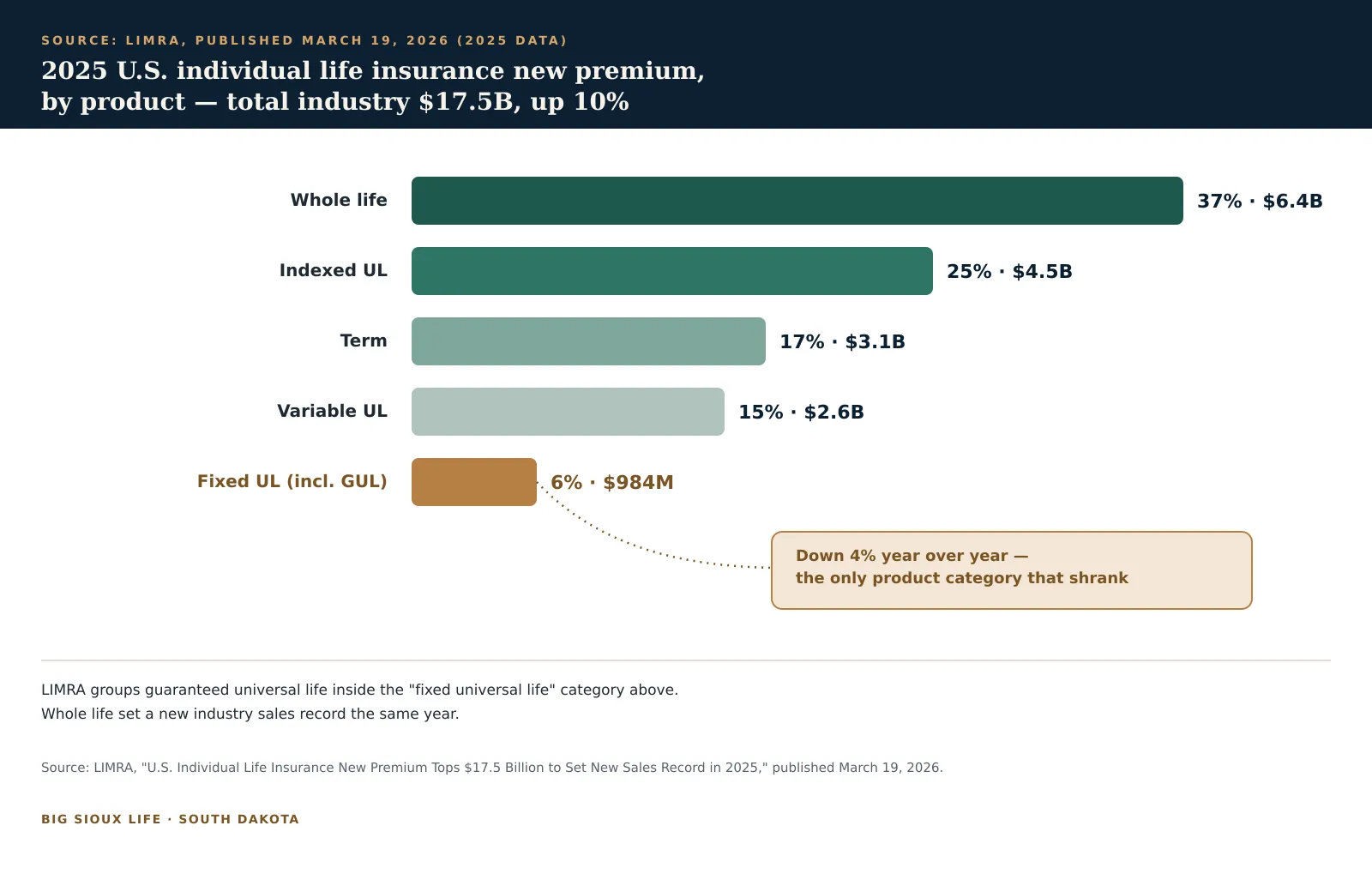
- LIMRA tracks GUL inside its broader "fixed universal life" category, which held just 6% of new individual life insurance premium in 2025 and fell 4% year over year, while whole life set a new sales record at 37% of the market.
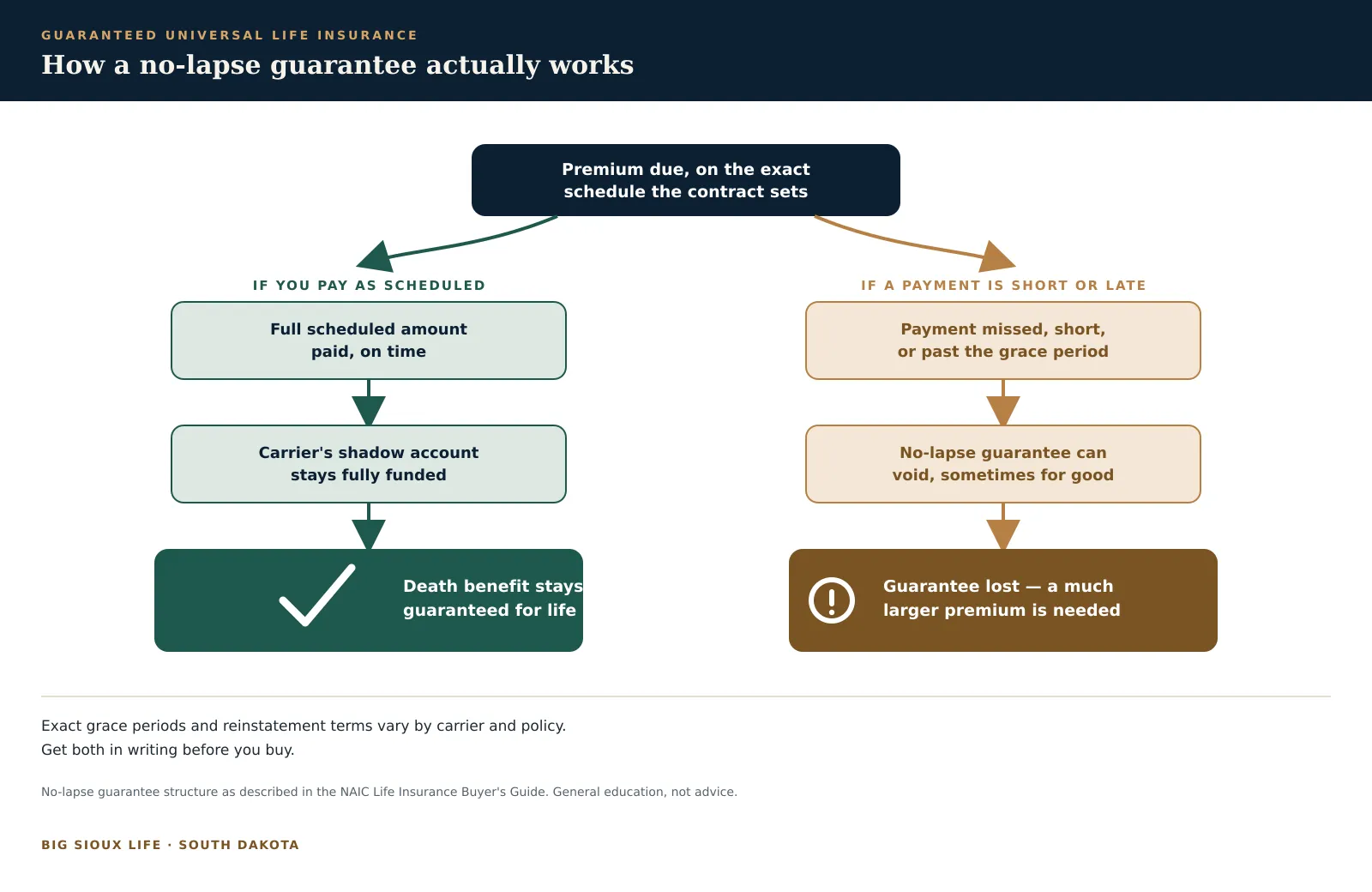
- Missing or shorting a scheduled premium can void the no-lapse guarantee, sometimes permanently, turning a "guaranteed" policy into a standard universal life policy that needs much larger payments to stay in force.
- The 2026 federal estate tax exemption is $15,000,000 per individual, according to the IRS, so for most South Dakota households GUL is a tool for a guaranteed, level-premium death benefit, not estate-tax avoidance.
- South Dakota carries no product-specific GUL rule; it's regulated the same way every permanent life policy is, under the state insurance code enforced by the South Dakota Division of Insurance.
What guaranteed universal life insurance actually is
Guaranteed universal life insurance is permanent coverage built around one contractual promise: if you pay the exact premium the policy schedules, on time, for as long as the contract specifies, the death benefit stays in force, regardless of what happens to the policy’s internal cash value account. That promise is called a no-lapse guarantee, and it’s the entire point of the product. You’re not buying growth. You’re not buying flexibility to skip a payment in a tight month. You’re buying a fixed number, guaranteed to a fixed age, for a fixed price.
Universal life, as a category, works differently from whole life under the hood. A whole life policy has one integrated pricing structure: premium, guaranteed cash value, and death benefit move together under a single guaranteed schedule set at issue. A universal life policy separates the pieces. Premiums go into an account, the insurer deducts the cost of insurance and expenses from that account each month, and whatever’s left earns interest. In most universal life designs, if the account runs low, the policy can lapse. GUL adds a rider on top of that structure that says, in effect: regardless of what the account value does, as long as you’ve paid what the schedule requires, the death benefit is guaranteed anyway.
That’s a meaningfully different guarantee than a whole life policy’s guarantee. Whole life guarantees a growing cash value as part of the deal, and that cash value is one of the things funding the insurer’s reserves behind the policy. GUL, by contrast, is engineered to hold as little value in that internal account as the actuarial math allows while still supporting the death-benefit guarantee. Less reserve-funding through cash value generally means a lower premium for the same guaranteed death benefit, which is the product’s main selling point, and also its main limitation: there’s usually little to nothing to borrow against or cash out later.
This is general education, not insurance, legal, financial, or tax advice
Nothing here evaluates your specific finances or recommends a particular policy, carrier, or coverage amount. Product availability, features, and rates vary by carrier and are subject to underwriting.
How the no-lapse guarantee works, and what can quietly void it
The guarantee lives inside a “shadow account” or “secondary guarantee test” the carrier tracks separately from the policy’s actual cash value. Every carrier’s contract spells out a minimum premium schedule that keeps that shadow account funded. Pay at least that amount, on time, and the no-lapse guarantee stays intact even if the real cash value account hits zero. Pay less than scheduled, pay late past the grace period, or skip a payment, and many contracts void the guarantee, sometimes permanently, sometimes with a “reinstatement” option that requires catching up the shortfall plus interest within a limited window.
This is the part that catches people off guard, because it runs against the intuition most of us have about permanent insurance. With whole life, missing a payment usually just triggers an automatic premium loan against the cash value, if there’s enough cash value to cover it, and the policy keeps going. With GUL, there’s often no meaningful cash value to fall back on. A missed payment isn’t a minor hiccup the policy can absorb on its own. It can be the event that ends the guarantee.
The NAIC’s Life Insurance Buyer’s Guide covers this category of product as part of its standard consumer education material on permanent life insurance and no-lapse designs. The practical takeaway from that framing is simple: before you buy, get the exact grace period, the exact minimum payment, and the exact consequence of a shortfall in writing from the carrier’s illustration, not from a verbal summary.
A missed payment can be permanent
On many GUL contracts, once the no-lapse guarantee is voided, it doesn't reset just because you catch up later. Some carriers offer a limited reinstatement window with back payments plus interest; others don't. If a job change, a bank switch, or an autopay glitch could realistically interrupt a payment, ask the carrier in writing what happens, before you sign.
Where GUL sits next to whole life, IUL, and term
These four products all solve different problems, and a lot of the confusion people run into comes from an agent presenting one as a universal answer instead of explaining the tradeoff. Here’s the structural comparison, without pretending any one of them is simply “better.”
| Feature | Term life | Whole life | Indexed universal life | Guaranteed universal life |
|---|---|---|---|---|
| Coverage length | Set period (10-30 years) | Life, if premiums are paid | Life, if funded to plan | Life or to a chosen age, if the schedule is met |
| Death benefit | Guaranteed during the term | Guaranteed | Not guaranteed unless a rider is added and funded | Guaranteed, contingent on exact premium payment |
| Cash value | None | Guaranteed, grows on a fixed schedule | Tied to an index, within a cap and floor | Minimal to none by design |
| Premium flexibility | Fixed for the term | Fixed | Flexible within limits | Fixed, and generally unforgiving if underpaid |
| Where it tends to fit | Income replacement, mortgage, a defined window of need | Lifetime need plus guaranteed cash value access | Lifetime need with upside potential and flexibility | Lifetime need, guaranteed, at the lowest premium for that guarantee |
Structural comparison compiled from product mechanics described in the NAIC Life Insurance Buyer's Guide and standard industry product design. Not a quote or rate comparison for any specific policy.
A guaranteed universal life policy isn't whole life with a different name. It's built to guarantee one number, the death benefit, and not much else.
— Mike Moore, Life Insurance Advisor, Big Sioux LifeWhat the market is actually telling us about GUL
The clearest evidence that GUL is a narrow tool, not a default answer, is in how the industry itself is selling it. LIMRA reported that U.S. individual life insurance new premium hit a record $17.5 billion in 2025, up 10% from 2024. That growth wasn’t evenly spread. Indexed universal life led every category, with $4.5 billion in new premium, 25% of the market, up 17% year over year. Whole life set its own new sales record at $6.4 billion, 37% of the market, up 7%. Variable universal life climbed 17% to $2.6 billion, 15% of the market. Term held roughly steady at $3.1 billion, 17% of the market, up 3%.
Fixed universal life, the category LIMRA uses for GUL and other non-indexed universal life designs, was the only one of the five to shrink. New premium fell to $984 million, just 6% of the market, down 4% from 2024, even as every other category grew.
That’s not a case against GUL. It’s a case for shopping it deliberately instead of defaulting to it, or dismissing it, because of a sales pitch. GUL’s shrinking share likely reflects genuine tradeoffs: no cash value to fall back on, an unforgiving payment schedule, and a design that only pays off cleanly if you actually keep paying exactly as scheduled for decades. For the specific person who wants a guaranteed number and nothing else, at the lowest premium that can guarantee it, none of that is a problem. For someone who might want flexibility later, it’s worth knowing going in.
This gap between “GUL exists and can be the right tool” and “most buyers are choosing something else” is the same pattern behind the broader coverage gap in the country. Only 51% of Americans own life insurance, down from 63% in 2011, and roughly 100 million adults say they need coverage they don’t have, according to LIMRA’s research on the industry’s coverage gap. A lot of that gap isn’t people rejecting permanent insurance on purpose. It’s people never getting a clear side-by-side of what each product actually guarantees, so they put off the decision entirely.
A worked example: what “guaranteed” is actually guaranteeing
Consider a hypothetical South Dakota scenario, not a real client or a quoted rate. A 58-year-old small business owner in Watertown wants to guarantee a fixed amount for two purposes: covering a buy-sell obligation to a business partner, and leaving an even inheritance to a child who isn’t part of the business, separate from the farm or company equity that child’s sibling will inherit. Neither goal depends on market performance. Both depend on a number showing up, guaranteed, whenever death happens, whether that’s next year or in 30 years.
That’s close to the textbook use case for GUL: a fixed, known obligation, a buyer who wants price certainty over cash-value flexibility, and no real need to access money from the policy while alive. It’s also a case where whole life could work, at a higher premium, with the tradeoff of guaranteed cash value the business owner could theoretically borrow against later if plans changed. And it’s a case where the $15,000,000 federal estate tax exemption for 2026 isn’t really the driver. Unless this business owner’s total estate is worth many millions more than that threshold, the policy isn’t solving an estate-tax problem. It’s solving a “make sure this specific number shows up for this specific purpose” problem, which is a different, more common reason people actually buy GUL.
Every dollar figure in this example beyond the cited estate tax exemption and gift tax exclusion is illustrative structure, not a quote, a recommendation, or a real client’s numbers.
Relying on assumed values
- Death benefit depends partly on cash value performance or index crediting continuing as illustrated
- A weak stretch of years can require added premium later to keep the policy on track
- The buy-sell or inheritance obligation isn't contractually certain to be funded
A contractual guarantee
- Death benefit doesn't depend on any account value or index performance
- Premium is fixed and doesn't rise if scheduled and paid correctly
- The obligation is guaranteed, as long as every payment is made exactly as scheduled
For readers weighing the business side of this specific example, our guide to buy-sell agreements and life insurance and our farm and business life insurance guide both go deeper into structuring that half of the decision.
How to figure out if GUL fits your situation
Run through these questions honestly before you talk to anyone. They’re the same questions an independent shopping process works through, just without someone else doing the arithmetic for you first.
- Do you need the coverage to last your whole life, or just through a specific window? If it’s a mortgage, your working years, or your kids’ childhood, term life is usually cheaper and simpler. If the need genuinely doesn’t expire, permanent coverage is worth comparing.
- Do you want access to cash value while you’re alive? If yes, whole life or indexed universal life are built for that. GUL generally isn’t.
- Can you commit to the exact premium schedule for decades, without interruption? GUL’s guarantee is only as strong as your ability to pay it precisely, on time, indefinitely. A shaky income, frequent job changes, or a habit of letting autopay lapse are real reasons to think twice.
- Is the goal a specific, fixed obligation? A buy-sell agreement, an even inheritance across kids, or final expenses you want locked in regardless of when death happens are the cases where “guaranteed, and nothing else” is exactly what you’re shopping for.
- Have you actually compared GUL’s guaranteed premium against whole life’s guaranteed premium for the same death benefit, from more than one carrier? No-lapse guarantee designs vary meaningfully by carrier. Some price more aggressively than others for the same guarantee, which is exactly the kind of comparison an independent shop is built to make.
The honest tradeoff
Most South Dakota households don't have an estate anywhere near the $15,000,000 federal exemption, so GUL isn't usually solving an estate-tax problem here. If your goal really is estate-tax planning at that scale, that's a conversation for an estate attorney and a tax professional first, life insurance second. If your goal is a guaranteed, predictable death benefit for a defined purpose, that's exactly what GUL is built for, and that's the more common reason South Dakota families and business owners actually buy it.
Questions worth asking before you buy
Once GUL looks like a fit on paper, the product you actually get depends heavily on carrier design, not just the label. A few questions expose the differences fast:
- What’s the exact grace period, and what counts as a “late” payment? Get this in writing, not summarized.
- Is there a reinstatement option if the guarantee lapses, and what does it cost? Some carriers allow it with back premium plus interest within a set window; others don’t offer it at all.
- Can I solve for a specific premium or a specific guarantee age, and see both illustrations? Carriers price no-lapse guarantees differently depending on whether you’re optimizing for the lowest premium or the latest guaranteed age.
- What happens to the guarantee if I overpay one year and underpay the next? Some designs allow averaging; others require the exact scheduled amount each period regardless of prior overpayment.
- How does this carrier’s guaranteed premium compare to at least one other carrier’s, for the same death benefit and guarantee age? This is the single biggest lever, and it’s exactly what shopping independently across carriers is for.
Understand what you're solving for
We start with the actual obligation, whether that's a buy-sell agreement, an inheritance you want guaranteed, or final expenses, before talking about any specific product.
Compare the guarantee, not just the pitch
We look at GUL alongside whole life and IUL for the same goal, so you're choosing based on what each one actually guarantees, not on which agent you talked to first.
Shop the guarantee across carriers
No-lapse guarantee pricing and terms vary by carrier. Because we're independent, we can compare more than one carrier's design for the same guaranteed death benefit.
Stay after you apply
If your situation changes, we're the ones you call, not a call center that doesn't know your file.
If you’d rather have someone local do this comparison with you, that’s what we do. Compare options and we’ll walk through whether a guaranteed structure like this actually fits what you’re trying to accomplish.
What you get from shopping it this way
A GUL decision made this way ends somewhere specific: either a policy whose guarantee you actually understand, including exactly what would void it, or a clear reason you chose whole life, IUL, or term instead. Either outcome beats picking a product because one agent’s pitch sounded more confident than another’s. You also end up with the actual grace-period and reinstatement terms in writing, which is the detail that matters most if life gets in the way of a payment fifteen years from now.
Not ready to talk to anyone yet? Read how it works first and come back when you are. If you’re weighing this specifically against whole life, our term vs. whole life comparison and the term vs. whole comparison tool are both good next stops. And if your real question is closer to “how much coverage do I need in the first place,” our life insurance needs calculator runs that math before you get into product selection at all.
Compare guaranteed coverage across carriers
An independent shop means we can compare GUL's guarantee against whole life and IUL for the same goal, across more than one carrier.
Frequently asked questions
What is guaranteed universal life insurance?
It’s a type of permanent life insurance where the death benefit is guaranteed to stay in force for life, or to a specified age, as long as you pay the scheduled premium on time and in full. Unlike other universal life designs, the guarantee doesn’t depend on how the policy’s internal cash value account performs. LIMRA groups guaranteed universal life under the broader “fixed universal life” category, which made up 6% of new individual life insurance premium in 2025, down 4% from 2024.
How is guaranteed universal life insurance different from whole life insurance?
Both can guarantee a death benefit for life, but they get there differently. Whole life guarantees a growing cash value alongside the death benefit, and that cash value is part of what funds the policy’s reserves, which is one reason whole life premiums tend to run higher. A GUL policy is built almost entirely to fund the death-benefit guarantee itself, with little or no cash value along the way, which is generally why it’s priced lower than whole life for the same guaranteed benefit.
What happens if I miss a premium payment on a GUL policy?
The no-lapse guarantee can be voided, sometimes permanently, if a scheduled premium isn’t paid in full and on time, in the structure the NAIC’s Life Insurance Buyer’s Guide describes for no-lapse guarantee designs. Once that happens, the policy is no longer guaranteed and can require a much larger premium going forward to avoid an actual lapse. Ask your carrier in writing exactly how many days of grace you have and whether a partial payment counts.
Does guaranteed universal life insurance build cash value?
Usually very little, and sometimes close to none. The premium is priced to fund the death-benefit guarantee, not to build a cash account you can borrow against later. If cash value access matters to you, whole life or indexed universal life are built for that purpose in a way GUL generally isn’t.
Is guaranteed universal life insurance worth it if my estate is nowhere near the federal estate tax exemption?
It can still make sense, just for a different reason. The federal estate tax exemption is $15,000,000 per individual for deaths in 2026, according to the IRS, which is well above most South Dakota estates. Most people who buy GUL are after a guaranteed, level-premium death benefit for a set purpose, such as final expenses, a business buyout, or an inheritance they want to guarantee, not estate-tax avoidance.
How is GUL different from indexed universal life (IUL)?
IUL’s cash value and, on many designs, its long-term guarantee depend partly on how a market index performs, within a cap and a floor set by the carrier. IUL new premium reached $4.5 billion in 2025, 25% of the individual life market, according to LIMRA, and grew faster than every other product category. GUL trades that upside potential for a flat, contractual guarantee that isn’t tied to index performance at all.
Can I convert a term life policy into a guaranteed universal life policy?
Some term policies include a conversion privilege that lets you convert to a permanent policy, sometimes including GUL, without new medical underwriting, but only during a window set by the original contract and only among the products the issuing carrier makes available for conversion. Check your term policy’s conversion terms and deadline before assuming this option is still open.
Does South Dakota regulate guaranteed universal life insurance differently than other states?
No product-specific rule singles out GUL. Like every life insurance product sold here, it’s regulated under South Dakota’s general insurance code, and carriers and producers are licensed and monitored by the South Dakota Division of Insurance. The disclosure and underwriting standards that apply to any permanent life policy apply to GUL as well.
Before you buy
This article is general education, not insurance, legal, financial, or tax advice, and it does not evaluate any specific policy, carrier, or your personal finances. Product availability, features, and rates vary by carrier and state and are subject to underwriting. No coverage exists until a policy is issued and in force. Any guarantees are subject to the claims-paying ability of the issuing insurer. Please review actual policy documents and speak with a licensed agent about your specific situation.
Sources
- LIMRA — U.S. Individual Life Insurance New Premium Tops $17.5 Billion to Set New Sales Record in 2025 — published March 19, 2026; 2025 new premium and market share by product category (whole life $6.4B/37%, IUL $4.5B/25%, VUL $2.6B/15%, term $3.1B/17%, fixed UL $984M/6%), total industry new premium $17.5B up 10%. Sole source for this LIMRA product-mix breakdown; no independent organization publishes the same category-level figures.
- IRS — IRS releases tax inflation adjustments for tax year 2026, including amendments from the One, Big, Beautiful Bill (IR-2025-103) — published October 9, 2025; 2026 federal basic estate tax exclusion amount of $15,000,000 per individual (up from $13,990,000 in 2025) and 2026 annual gift tax exclusion of $19,000.
- LIMRA — How to Convert Intent to Action: Closing the Life Insurance Coverage Gap — published April 24, 2025; 51% of Americans own life insurance, down from 63% in 2011, and roughly 100 million adults say they need coverage they don’t have.
- NAIC — Life Insurance Buyer’s Guide — standard consumer education reference on permanent life insurance product types, including universal life and no-lapse guarantee designs.
- South Dakota Division of Insurance — Laws, Rules & Bulletins — accessed September 2026; confirms life insurance producers and products in South Dakota are licensed and regulated under the state’s general insurance code (Title 58, SDCL) rather than a GUL-specific rule.
Related reading: Term vs. Whole Life: A 2026 Data-Driven Comparison, Indexed Universal Life Insurance in South Dakota (2026), and Buy-Sell Agreements and Life Insurance in South Dakota (2026). See our current whole life and indexed universal life options, or start with how it works.