
A buy-sell agreement is a contract among a business’s co-owners that says what happens to an owner’s share of the company if that owner dies, and life insurance is the tool most South Dakota partnerships use to fund the buyout in cash instead of debt. On June 6, 2024, the U.S. Supreme Court ruled in Connelly v. United States that when the business itself owns that insurance and uses the payout to redeem a deceased owner’s stock, the incoming death benefit counts as a company asset for federal estate tax purposes, and the company’s obligation to hand that same money to the family does not reduce the company’s taxable value. If your buy-sell agreement is funded with company-owned life insurance, that single ruling can change what your partner’s family actually walks away with.
The short version
- In Connelly v. United States, 602 U.S. ___ (2024), decided unanimously on June 6, 2024, the Supreme Court held that life insurance proceeds a corporation receives to redeem a deceased shareholder's stock are included in the company's date-of-death value for estate tax purposes, and the redemption obligation does not offset that value.
- The decision applies specifically to entity-purchase (stock-redemption) agreements, where the business owns the policy. A properly structured cross-purchase agreement, where each owner personally owns a policy on the others, generally avoids the problem.
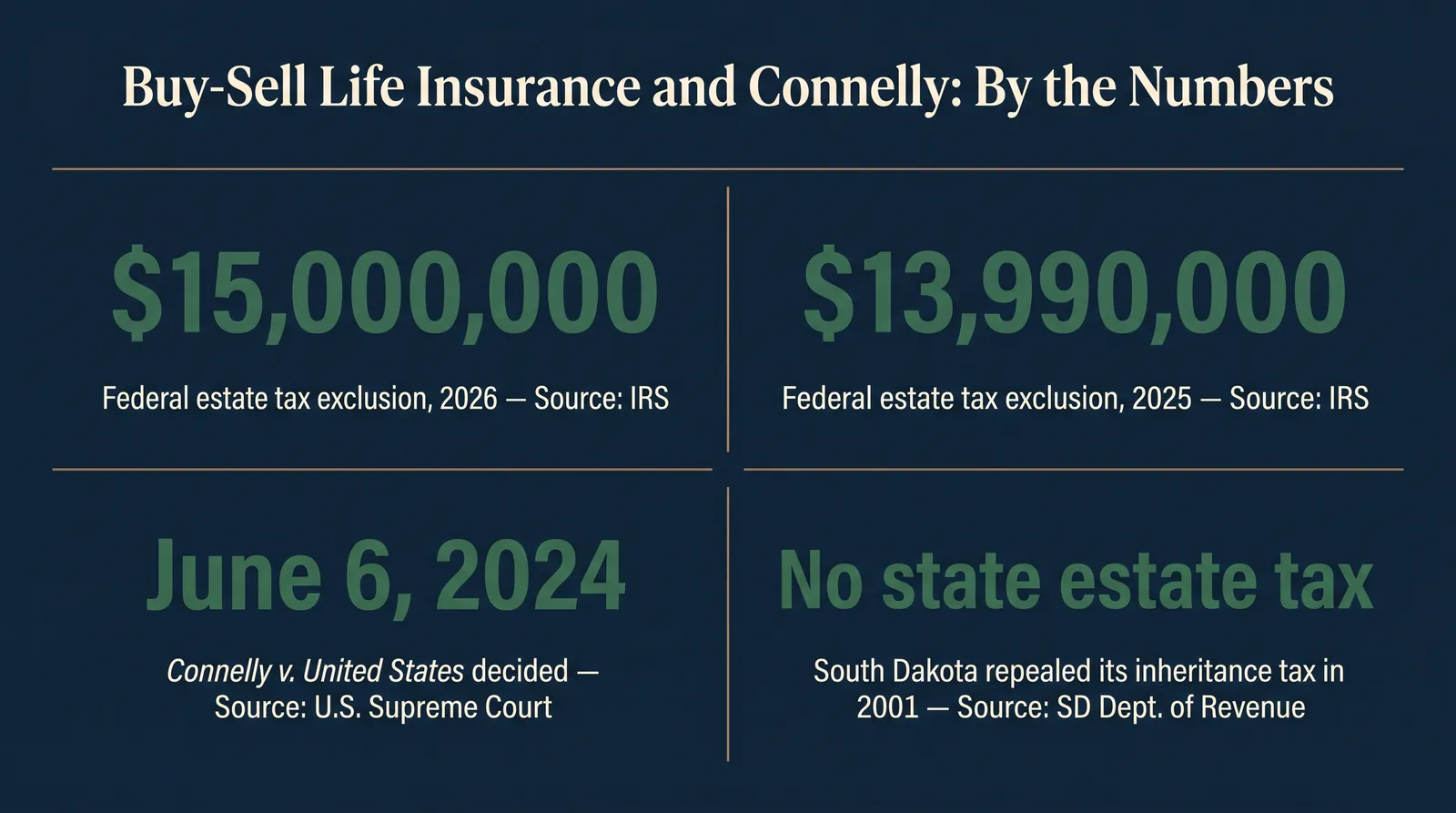
- The federal estate tax basic exclusion is $15,000,000 per person for 2026, up from $13,990,000 for 2025, according to the IRS. South Dakota has no state estate or inheritance tax, per the South Dakota Department of Revenue.
- Under South Dakota Codified Law 58-10-4, business partners have a specific, named insurable interest in each other's lives for the purpose of a buy-sell contract, which is the legal basis for this kind of coverage.
- Under 26 U.S.C. Section 2703, the price your agreement sets is only respected for estate tax purposes if it is a bona fide business arrangement with arm's-length terms, not a stale number nobody has revisited.
The pain: you funded the buyout, but maybe not the tax bill
Picture two co-owners of a mid-sized implement dealership near Watertown, each holding half the company, with a buy-sell agreement drawn up years ago by a lawyer who has since retired. The company owns a life insurance policy on each partner, sized to buy out whoever dies first at a price the agreement spells out. Both partners believe the paperwork is finished business: something happens to one of them, the company writes a check from the insurance payout, the surviving partner keeps the business, the deceased partner’s spouse gets a fair number, and life goes on. That is exactly what most owners assume a funded buy-sell agreement does.
This is general education, not legal or tax advice for your agreement
Nothing here tells you what your specific buy-sell agreement says, how your company's policies are actually owned, or whether your situation is affected by Connelly. It walks through the mechanics and the named sources so you can bring the right questions to your attorney, your CPA, and whoever is reviewing your policies.
What most owners do not realize is that the same insurance payout that funds the buyout can also increase the taxable value of the deceased owner’s estate, on paper, by roughly the same amount, if the company owns the policy and uses it to redeem the stock. That is not a hypothetical. It is the exact fact pattern the Supreme Court ruled on in 2024, and it means an agreement that felt airtight the day it was signed can leave a surviving family with a smaller number and a bigger tax question than anyone planned for.
Why it happens: two ways to structure the same promise
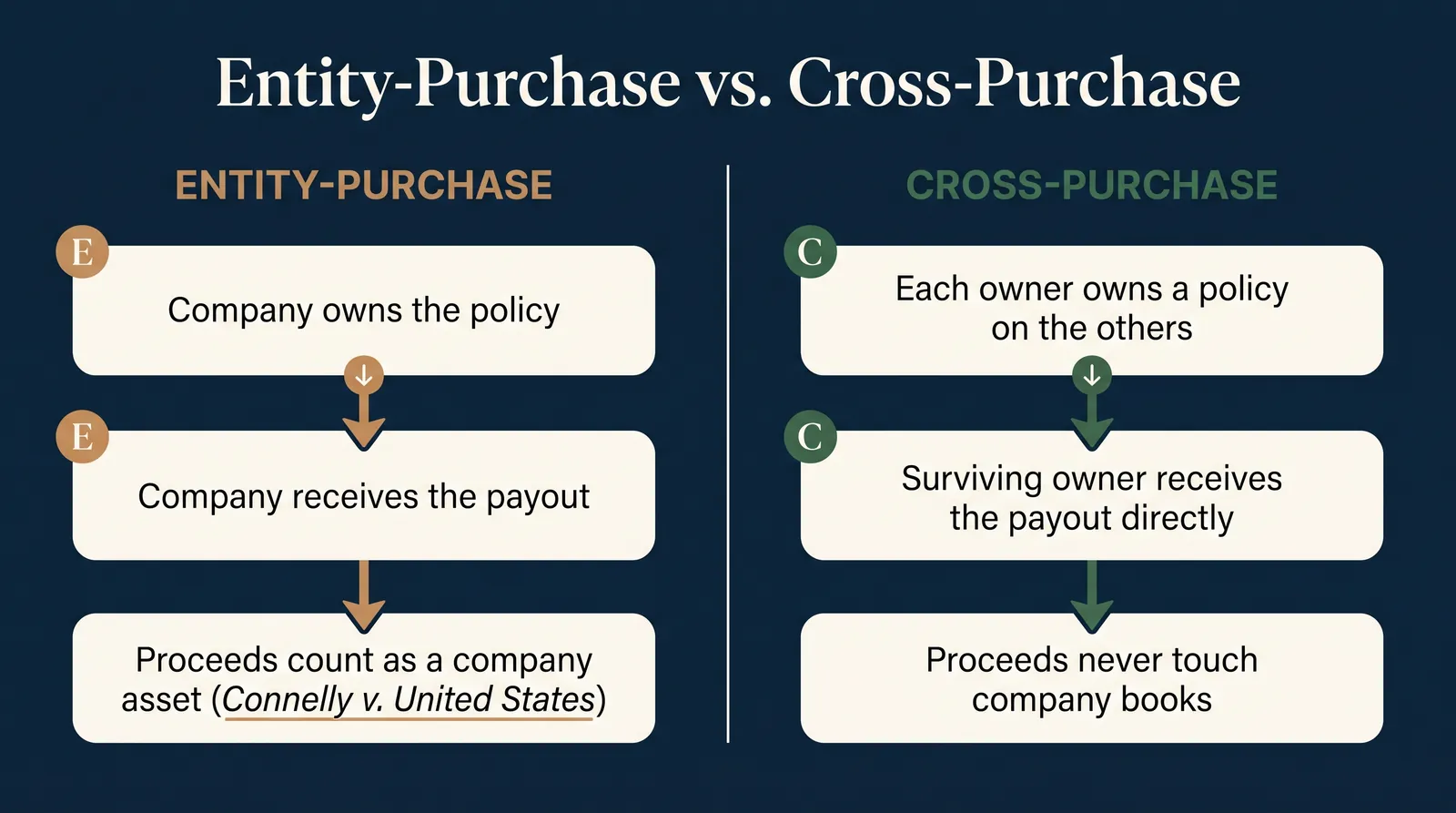
A buy-sell agreement works one of two structurally different ways, and which one your business uses determines whether Connelly applies to you at all. An entity-purchase agreement, also called a stock-redemption agreement, has the business itself buy back a deceased owner’s shares; the company owns the life insurance policy on each owner, is the beneficiary, and uses the death benefit to fund the redemption. A cross-purchase agreement works differently: each individual owner personally owns and pays for a policy on every other owner’s life, and when one dies, the surviving owners personally receive the death benefit and use it to buy the deceased owner’s shares directly from their estate.
The insurance company underwriting either kind of policy needs a legal basis to issue it in the first place, called an insurable interest: a real financial stake in the insured person staying alive, as opposed to a benefit that only exists because they died. South Dakota spells this out directly. Under South Dakota Codified Law 58-10-4, a party to a contract for the purchase or sale of an interest in a business partnership, firm, or closed corporation “has an insurable interest in the life of each individual party to the contract and for the purpose of the contract only,” and the same statute recognizes a broader insurable interest for anyone with “a lawful and substantial economic interest” in another person’s continued life. In both structures, the insured owner still has to consent to being covered.
A few more terms are worth defining before going further, since the whole analysis depends on keeping them straight:
- Redemption. The company’s act of buying back a departing or deceased owner’s shares, reducing the number of shares outstanding and increasing each remaining owner’s percentage stake without them spending a dollar personally.
- Fair market value, for this purpose. What a hypothetical willing buyer would pay a hypothetical willing seller for the company or the shares, neither one under pressure to act, which is the standard the IRS applies when valuing a deceased owner’s estate.
- Basic exclusion amount. The dollar amount of an estate’s value that passes free of federal estate tax; only value above that number is potentially taxed, and it changes most years with inflation and, since 2025, with new legislation.
- Bona fide business arrangement. A legal test, discussed below, that a price-setting agreement must pass to have its stated price respected for estate tax valuation instead of being disregarded in favor of independent appraisal.
The reason the two structures diverge is simple once you see it: in an entity-purchase agreement, the insurance money passes through the company on its way to the family, so for a moment it sits on the company’s books as an asset. In a cross-purchase agreement, the money never touches the company at all; it moves straight from the insurance carrier to the surviving owners personally. That single difference in cash flow is the entire reason one structure creates a Connelly problem and the other, done correctly, generally does not.
| Feature | Entity-purchase (stock redemption) | Cross-purchase |
|---|---|---|
| Who owns the policy | The business | Each individual owner, on each other owner |
| Who receives the death benefit | The business | The surviving owner(s), personally |
| Does the payout touch company books | Yes, even briefly | No |
| Exposure under Connelly v. United States | Direct exposure; this is the exact fact pattern the Court ruled on | Generally avoided, if structured and maintained correctly |
| Number of policies for 2 owners | 2 (one per owner, company-owned) | 2 (each owner insures the other) |
| Number of policies for 3 owners | 3 | 6 (each owner insures the other two) |
| Basis step-up for surviving owners | Surviving owners get no basis increase in their existing shares | Surviving owners get a basis increase equal to what they paid for the deceased owner's shares |
The case that changed the math: Connelly v. United States
Connelly v. United States is a real 2024 Supreme Court decision, not a proposed rule or an industry rumor, and its facts look a lot like an ordinary small-business succession plan. Michael and Thomas Connelly were the only two shareholders of Crown C Supply, a building supply corporation. Their agreement said that if one brother died, the surviving brother could buy his shares personally, and if he declined, the company itself was required to redeem them. To make sure the money would be there, Crown bought $3.5 million in life insurance on each brother, owned by the company, according to the Supreme Court’s opinion.
June 6, 2024
Date Connelly v. United States was decided, unanimously, per the Supreme Court
$3.5M
Company-owned life insurance on each Connelly brother, per the Court's opinion
9-0
Unanimous Supreme Court vote in Connelly v. United States, per the Court's opinion
$15M
2026 federal estate tax exclusion per person, per the IRS
Michael Connelly died first, and Crown redeemed his shares using its insurance proceeds. When Michael’s estate reported the value of his shares for estate tax purposes, it treated the incoming insurance money as offset by the company’s contractual obligation to spend it on the redemption, so the two effectively canceled out in its calculation. The IRS disagreed, arguing Crown’s value had to include the full insurance proceeds with no offset for the redemption obligation. The Supreme Court sided with the IRS, unanimously. The opinion holds that life insurance proceeds received by a corporation to redeem a shareholder’s stock are a company asset includible in the company’s date-of-death value, and the obligation to use that money for the redemption does not offset the inclusion, because a hypothetical buyer of the company would not discount the price for an obligation that does not reduce what they, as the new owner, actually receive.
The redemption obligation is not a liability of the kind that reduces a company's value to a buyer. It is simply how the company plans to spend an asset it already has.
Summary of the reasoning in Connelly v. United States, 602 U.S. ___ (2024)That reasoning is the whole ballgame for any South Dakota business using the same structure. If your company owns life insurance on you specifically to fund a stock redemption, the day you die, that policy’s proceeds are added to your company’s value for estate tax purposes, in full, with no credit given for the fact that the company is contractually obligated to hand most of it right back to your family.
What this costs to get wrong: a worked example
Here is the arithmetic, using a hypothetical two-owner South Dakota company and numbers different from the actual Connelly case, so you can see how the mechanism plays out on a smaller, more typical business. This is illustrative math only, built to show the shape of the problem, not a valuation of any real company.
Say a two-owner manufacturing shop is worth $2,000,000 in operating value, land, equipment, and goodwill, before any insurance is factored in, split evenly between two 50% owners. The company carries a $1,500,000 life insurance policy on each owner, company-owned, to fund an entity-purchase agreement. The agreement’s redemption price was set years ago at a formula the partners have not revisited, which currently works out to $1,000,000 for a 50% share, roughly the operating-value split.
| Item | Amount |
|---|---|
| Company operating value before insurance | $2,000,000 |
| Life insurance proceeds received by the company | $1,500,000 |
| Company value for estate tax purposes, per Connelly (no offset for redemption obligation) | $3,500,000 |
| Deceased owner's 50% share, valued for estate tax | $1,750,000 |
| Actual buyout price the family receives, per the stale agreement formula | $1,000,000 |
| Gap between taxable value and cash received | $750,000 |
Author's calculation, structured consistent with the holding in Connelly v. United States, 602 U.S. ___ (2024). Illustrative numbers only, not a valuation of any specific business.
Company value for estate tax purposes: before and after adding insurance proceeds
Illustrative example only, structured consistent with the holding in Connelly v. United States, 602 U.S. ___ (2024). Not a valuation of any specific business or agreement.
Seven hundred fifty thousand dollars is a real gap, and it plays out two ways depending on the size of the estate. If the deceased owner’s total estate, including this inflated share value, stays under the federal basic exclusion amount of $15,000,000 for 2026, no federal estate tax is actually owed on the extra value, because the exemption absorbs it. But the inflated valuation still matters for two reasons that have nothing to do with the exemption: it can distort a formula that ties other things to company value, such as a divorce settlement, a related buy-sell for a different class of stock, or a bank’s assessment of the estate’s borrowing capacity, and it exposes the redemption price itself to challenge as unfairly low relative to what the company is actually worth once the insurance is counted, a separate problem addressed below.
If you would rather have someone local run these numbers on your actual policy and agreement instead of a hypothetical, that is part of what we do. Compare your options.
Does the 2026 exemption make this a non-issue?
Often, but not always. The federal estate tax basic exclusion amount is $15,000,000 per person for decedents dying in 2026, up from $13,990,000 for 2025, reflecting changes under the One, Big, Beautiful Bill, according to the IRS. South Dakota adds no state-level estate or inheritance tax on top of the federal rules; the state repealed its inheritance tax effective July 1, 2001, according to the South Dakota Department of Revenue. For most South Dakota family businesses, that combination means no actual estate tax bill gets triggered by an inflated Connelly-style valuation.
Two situations still make this worth checking under a high exemption. A growing business, or an owner with significant assets beyond the company, can approach that threshold over time, since the exemption applies per person and an inflated valuation eats into it faster than an accurate one would. And the valuation fight isn’t only about tax: if your agreement’s price no longer reflects what an appraiser would say the company is worth once insurance proceeds are added, a family member who feels shortchanged has grounds to argue the price was never fair, independent of the IRS. IRC Section 2703, covered next, sets its own test for whether your price is even respected for valuation purposes, and that test doesn’t care whether your estate owes tax.
"We're under the exemption" is not the same as "our price is fair"
A business well under the federal exemption can still be using a stale or unfair redemption price. Connelly is a reason to check the price-setting mechanism itself, not just a tax question for estates near the top bracket. This is general education, not tax advice for your specific estate; talk with a qualified tax professional and estate attorney about your numbers.
The other test your agreement has to pass: IRC Section 2703
Under 26 U.S. Code Section 2703, an agreement’s stated buyout price is disregarded for estate tax valuation purposes, in favor of an independent fair market value appraisal, unless the arrangement meets three conditions: it is a bona fide business arrangement, it is not a device to transfer the business to family members for less than full and adequate consideration, and its terms are comparable to what unrelated parties would negotiate at arm’s length. Most ordinary two- or three-owner South Dakota partnerships that are not close relatives clear the first two conditions without much difficulty. The third condition, comparable to arm’s-length terms, is where an agreement drafted once and never revisited tends to fail, because a genuinely arm’s-length deal gets renegotiated as the business’s value changes; a price frozen for a decade while the company doubled in size starts to look like something other than what two unrelated parties would actually agree to today.
This matters independently of Connelly, but the two issues compound each other. An agreement that fails the Section 2703 test gets its price thrown out entirely in favor of appraisal, and an agreement that passes Section 2703 but uses an entity-purchase structure still runs into the Connelly valuation problem on top of it. Passing one test does not mean you have passed both.
How to check your own agreement
None of this requires a specialist to get started. Here is the method, using documents you already have.
- Find out who owns the policy. Pull your company’s life insurance policy statement. If the policy owner listed is the business itself, and the beneficiary is the business, you have an entity-purchase structure and Connelly applies directly. If each individual owner personally owns a policy on each other owner, you have a cross-purchase structure.
- Read your agreement’s price-setting clause. Look for a fixed dollar figure, a formula tied to book value or a multiple of earnings, or a requirement for a fresh appraisal at the time of death. A fixed number set more than two or three years ago, in a business that has grown, is the clearest warning sign.
- Add your insurance proceeds to your company’s last known value. Take your best estimate of the company’s operating value and add the full face amount of any company-owned policy funding the redemption. Compare that total to what your agreement would actually pay a departing owner’s family. A large gap is the Connelly exposure, in dollar terms, for your specific business.
- Check where you sit relative to the exemption. Compare the deceased owner’s full estate, company interest included at the inflated value from step 3, against the $15,000,000 federal exclusion for 2026. If you are well under it even after adding the insurance proceeds, tax exposure is unlikely, though the fairness-of-price issue from Section 2703 still applies.
- Ask your attorney which fix fits your ownership structure. The right answer depends on how many owners you have, whether you want the surviving owners or the company to hold the shares, and what your CPA says about the basis and cash-flow tradeoffs, covered next.
Steps 1 through 4 take about half an hour with your policy statement and agreement in hand
Where a second opinion tends to help most is deciding which funding structure fits your specific ownership situation, and comparing how different carriers price cross-purchase versus entity-purchase coverage for your company. Not ready to talk to anyone yet? Read How It Works first and come back when you are.
What tends to happen
- Company owns the policy, drafted years ago, price formula never revisited
- Nobody has checked whether the redemption price still passes the Section 2703 arm's-length test
- An owner's death triggers a redemption, and the family discovers the company's value for estate tax purposes is higher than the buyout check they receive
- Surviving owners get no basis increase in their own shares from the transaction
What tends to happen instead
- Owners know which structure they have and what it does to valuation at death
- The price-setting mechanism is current enough to hold up under Section 2703's arm's-length test
- If cross-purchase fits better, policies are owned individually, and proceeds never inflate the company's estate tax value
- The insurance funding is reviewed on a schedule, not left untouched since the agreement was signed
Three ways businesses fix a Connelly-exposed agreement
There is no single right answer, and each option trades one kind of complexity for another.
Convert to a cross-purchase agreement. Each owner personally owns and pays premiums on a policy covering each other owner. This generally sidesteps the Connelly issue, since proceeds never touch company books, and it gives surviving owners a basis increase equal to what they paid for the deceased owner’s shares. The tradeoff is administrative: the number of policies multiplies fast, from six with three owners to twenty with five, and premiums can differ meaningfully between owners of different ages or health.
Use a “wait-and-see” hybrid agreement. The agreement gives the company the first option to redeem, the surviving owners the next option to buy personally if the company declines, and specifies in advance how proceeds get allocated depending on which option is exercised. Done carefully, this preserves some entity-purchase simplicity while addressing the valuation issue. It needs a lawyer experienced with the specific case law, not a template from a generic form book.
Route the policies through a partnership or LLC instead of the operating company. Some multi-owner businesses have the owners form a separate holding entity that owns the life insurance rather than putting it on the operating company’s books. This can avoid the Connelly fact pattern, since proceeds never sit as an asset of the business being valued, but it adds a second entity to maintain, with its own filings and formalities.
None of these is automatically right for every business. A one-person company with no co-owner has no redemption to fund, so the problem doesn’t apply. A two-owner partnership comfortably under the federal exemption, even after adding insurance proceeds, may reasonably leave the current structure alone and revisit it as the company grows. The point of the math above is knowing which category your business is actually in, instead of assuming.
How we help
We’re independent, so we work through your actual ownership structure and funding goals rather than defaulting to whichever policy type is easiest to sell. If you already have a buy-sell agreement funded with company-owned life insurance, we can review how the coverage is structured, compare what cross-purchase funding would look like for your specific ownership group, and coordinate with your attorney and CPA on the insurance side while they handle the legal drafting and tax filings. We don’t draft buy-sell agreements ourselves; that is legal work for your business attorney. What we do is make sure the insurance funding underneath the agreement actually matches what your attorney intended it to do.
What you get
A clear answer on which structure your current agreement uses, and what that means for your company’s value if an owner dies. An honest comparison of what cross-purchase versus entity-purchase funding would cost for your specific ownership group, across more than one carrier. Coordination with your attorney and CPA instead of insurance advice given in isolation from the legal document it is supposed to fund. And, if your existing coverage already fits your situation well, someone willing to say so instead of pushing a change you do not need.
Get your buy-sell insurance funding reviewed against your actual agreement
Bring your buy-sell agreement and your current policy statements, and we'll walk through how the structure works today, what Connelly means for your specific setup, and what your options look like.
Not ready to talk to anyone yet? Read How It Works first and come back when you are. If you’re still working out how much coverage your farm or business needs in the first place, our guide on how much life insurance your farm or business needs walks through that separate question in detail.
Frequently asked questions
What is a buy-sell agreement, and how does life insurance fund it?
A buy-sell agreement is a contract among a business’s co-owners spelling out what happens to an owner’s share if they die, become disabled, or want to exit. Life insurance funds the cash side of it: a policy on each owner’s life pays out on death, and that money buys the deceased owner’s share from their estate at a price the agreement already set, without the business borrowing money or selling assets.
What did the Supreme Court decide in Connelly v. United States?
On June 6, 2024, the Court ruled unanimously that life insurance proceeds a corporation receives to redeem a deceased shareholder’s stock count as a corporate asset when valuing the company for federal estate tax purposes, and that the company’s contractual obligation to use that money for the redemption does not reduce or offset the company’s value, according to the Supreme Court’s opinion in Connelly v. United States, 602 U.S. ___ (2024).
How does the Connelly decision affect an entity-purchase buy-sell agreement?
An entity-purchase, or stock-redemption, agreement has the business itself, not the individual co-owners, buy the deceased owner’s shares using corporate-owned life insurance. Under Connelly, the incoming death benefit inflates the company’s value for estate tax purposes at the exact moment the deceased owner’s shares are being valued, which can raise the taxable value of their estate above what the buyout agreement actually pays their family.
Does a cross-purchase agreement avoid the Connelly problem?
Generally yes, because in a cross-purchase agreement each owner personally owns and is the beneficiary of a policy on every other owner’s life, so the death benefit never becomes a corporate asset and never inflates the company’s value under the Connelly analysis. The tradeoff is more policies to administer: with three owners a full cross-purchase structure needs six separate policies, and the number keeps climbing as more owners join.
What is the federal estate tax exemption in 2026, and does South Dakota have its own estate tax?
The federal basic exclusion amount is $15,000,000 per person for decedents dying in 2026, up from $13,990,000 in 2025, according to the IRS. South Dakota has no state estate tax or inheritance tax; the state repealed its inheritance tax effective July 1, 2001, per the South Dakota Department of Revenue. Most South Dakota estates owe no estate tax at either level, though a growing business can approach the federal threshold over time.
What does South Dakota law say about insuring a business partner’s life?
Under South Dakota Codified Law 58-10-4, a person who is party to a contract or option for the purchase or sale of an interest in a business partnership, firm, or closed corporation has an insurable interest in the life of each other party to that contract, specifically for the purpose of that contract. The person being insured still has to consent to the policy.
What makes a buy-sell agreement’s price a bona fide business arrangement under IRC Section 2703?
Under 26 U.S.C. Section 2703, a price-setting agreement is respected for estate tax valuation only if it is a bona fide business arrangement, is not a device to transfer the business to family members for less than full and adequate consideration, and has terms comparable to what unrelated parties would negotiate at arm’s length. A stale formula nobody has revisited in years is the kind of term the IRS is most likely to challenge on that third point.
Should every South Dakota small business update its buy-sell agreement after Connelly?
Every business with more than one owner and a corporate-owned life insurance policy funding its buy-sell agreement should at least have the structure reviewed, since Connelly specifically addressed that setup. Whether a change is worth making depends on the company’s value, how the agreement sets its buyout price, and the owners’ actual goals, which is a conversation for your attorney, your CPA, and whoever is reviewing the insurance funding.
Before you change anything
This article is general education, not insurance, legal, financial, or tax advice. It does not replace review of your specific buy-sell agreement by a business attorney or a determination of your company's tax situation by a qualified tax professional. Product availability, features, and rates vary by carrier and state and are subject to underwriting. Any guarantees are subject to the claims-paying ability of the issuing insurer.
Sources
- Supreme Court of the United States — Connelly v. United States, No. 23-146 (decided June 6, 2024) — case facts, the $3.5 million insurance figure, and the holding that corporate-owned life insurance proceeds used for a stock redemption are included in the company’s estate tax value without offset for the redemption obligation
- Internal Revenue Service — IRS releases tax inflation adjustments for tax year 2026, including amendments from the One, Big, Beautiful Bill — $15,000,000 basic exclusion amount for 2026, up from $13,990,000 for 2025
- South Dakota Department of Revenue — Taxes — confirms South Dakota has no state estate tax and repealed its inheritance tax effective July 1, 2001
- South Dakota Legislature — SDCL 58-10-4, Insurable interest in personal insurance defined — insurable interest for parties to a business partnership or closed corporation buy-sell contract, and the broader lawful-and-substantial-economic-interest standard
- Cornell Law School Legal Information Institute — 26 U.S. Code Section 2703, Certain rights and restrictions disregarded — the bona fide business arrangement, no-device-to-transfer-to-family, and arm’s-length-comparable-terms test for whether a buy-sell agreement’s stated price is respected for estate tax valuation
The illustrative worked example above uses hypothetical numbers built to show the shape of the Connelly valuation mechanic. It is the author’s own calculation, structured consistent with the Supreme Court’s reasoning, and is not a valuation of any specific business, agreement, or policy.
Related reading: How Much Life Insurance Does Your Farm or Business Need? and Life Insurance for Self-Employed South Dakotans in 2026. See current options for business life insurance, learn more about how we help business owners, or read how it works.