A table rating is not a decline. It’s an approval with a price increase attached, used when a carrier’s underwriters decide your health, build, or lifestyle carries more risk than their standard applicant pool but not enough to turn you down outright. Carriers typically label the steps above standard Table A through Table P, or Table 1 through Table 16, and each step adds a set percentage to your premium. AccuQuote, an insurance brokerage that publishes a rate-class explainer for consumers, lists Table A at 25% above standard, Table B at 50% above standard, and Table C at 75% above standard. This guide walks through what that letter actually means, what the number costs in real terms, and what you can do about it, with every figure traced to where it came from.
The short version
- A table rating is an approval at a higher price, not a decline. You were found insurable; the carrier just priced your file above its standard rate.
- Carriers commonly use a stepped structure. AccuQuote's published explainer lists Table A at +25%, Table B at +50%, and Table C at +75% over the standard premium — a convention, not a universal fixed rule, since each carrier sets its own steps.
- A table rating and a flat extra are different mechanisms. One scales your base premium by a percentage; the other adds a fixed dollar charge that can be temporary.
- According to Fox Business, a MetLife chief underwriter said most carriers allow reapplication, typically around two years after issue, to see if a rating can be lowered.
- Carriers don't all rate the same file the same way. South Dakota law bars unfair discrimination between people of equal risk at the same insurer, but it doesn't force every company to use the same underwriting threshold as every other company.
- This article does not quote a premium you would actually pay. Every dollar figure here is a labeled, hypothetical illustration built from a published percentage structure, to show the arithmetic, not a rate.
What does a table rating actually mean?
It means you got approved, at a price above the carrier’s best available rate for someone your age and sex with no rated health or lifestyle factors.
Life insurers sort applicants into risk classes before they set a price. A few terms worth knowing before the rest of this makes sense:
- Standard rate class: the baseline premium for an applicant with average risk for their age and sex, no significant rated factors.
- Preferred / preferred plus: rate classes priced below standard, for applicants whose health markers, family history, and lifestyle come in better than average.
- Substandard rate class (table rating): a priced step above standard. This is the category this guide covers.
- Flat extra: a fixed-dollar surcharge, usually quoted per $1,000 of coverage, added on top of whatever rate class you land in. Covered in detail below.
- Underwriting class: the general term for whichever of the categories above you were assigned.
- Decline: a refusal to issue a policy at any price. Different from all of the above.

Here’s the part that catches people off guard: a table rating is not one universal scale that every carrier shares. Each insurance company builds its own mortality tables, reinsurance agreements, and underwriting manuals, and decides on its own how many steps to use and how much each one costs. The letters and numbers (Table A, Table 4, and so on) look standardized because the industry borrowed a common naming convention, but the actual pricing behind those labels is set independently by each company.
Why does a table rating happen at all?
Because pricing life insurance is, underneath the paperwork, a bet on how long you’re likely to live, and insurers price that bet using data, not guesswork.
The U.S. Centers for Disease Control and Prevention’s National Center for Health Statistics reported in its January 2026 data brief that life expectancy at birth in the United States reached 79.0 years in 2024, up 0.6 year from 78.4 in 2023. That single national number sits behind every mortality table an insurer builds: carriers then adjust it up or down for an individual applicant based on medical exam results, lab work, prescription history, family history, driving record, and the answers on the application. When those adjustments push your expected mortality meaningfully above the standard applicant’s, but not so far that the carrier won’t take the risk at any price, a table rating is the mechanism that bridges the gap.
Most applicants never see the math behind the letter. The underwriter reviewing your file is translating a stack of medical and lifestyle evidence into a single number: how much more likely are you, statistically, to die during the policy term than the standard applicant the base rate was built around? A table rating is that answer expressed as a percentage.
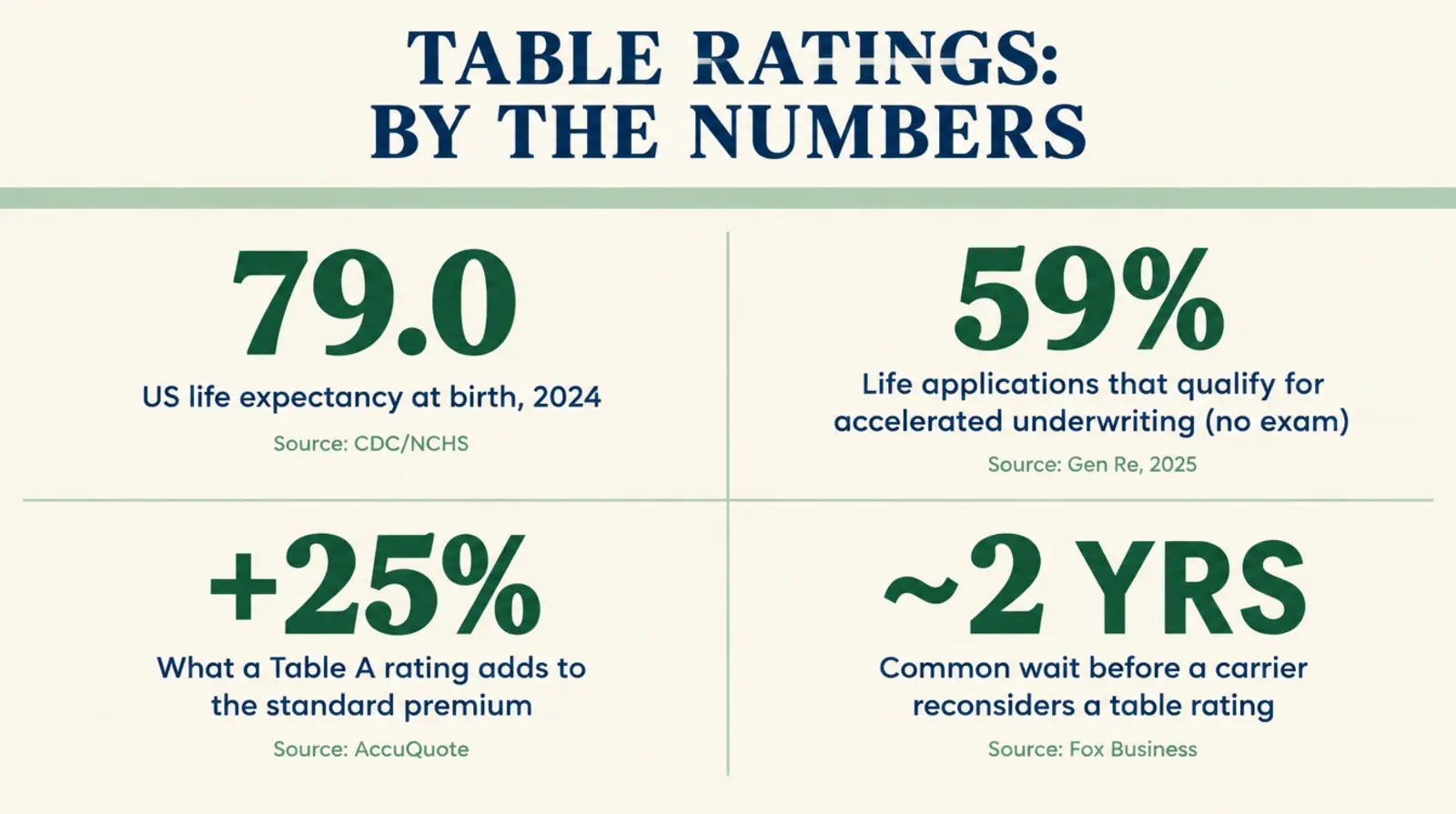
Table ratings vs. flat extras: two different tools
These get confused constantly, and the confusion is understandable, because both show up as “more money” on the same page of a policy illustration. They work differently.
| Mechanism | How it's calculated | Typically permanent or temporary? | Common trigger |
|---|---|---|---|
| Table rating | A percentage added to your base premium (for example, +25%, +50%, +75%, scaling up by table) | Generally stays for the life of the policy unless you request reconsideration | Overall combined risk from health markers, build, family history, or driving record |
| Flat extra | A fixed dollar amount per $1,000 of coverage, added on top of whatever rate class you're in | Can be temporary, removed once a specific elevated-risk period ends | A time-limited risk, such as a hazardous hobby, recent surgery, or a condition still being monitored |
Mechanics generalized from published consumer underwriting explainers, including AccuQuote's life insurance rate class guide. Specific calculation methods and whether a given flat extra is temporary or permanent are set by each carrier for each case.
A simplified way to picture it: the table rating scales your base premium first, and a flat extra, if one applies, gets added afterward as its own separate charge. You can have a table rating with no flat extra, a flat extra with no table rating, both at once, or neither.
A worked flat-extra example, labeled as hypothetical
Say a carrier assigns a temporary flat extra of $3.00 per $1,000 of coverage for a hazardous hobby, on a $250,000 policy. That's 250 units of $1,000, times $3.00, which adds $750 a year, or about $62.50 a month, on top of whatever rate class the rest of the file lands in. This is an illustration built from a general published calculation method, not a quote. Actual flat-extra amounts are set per carrier and per case.
What a table rating actually costs: a worked example
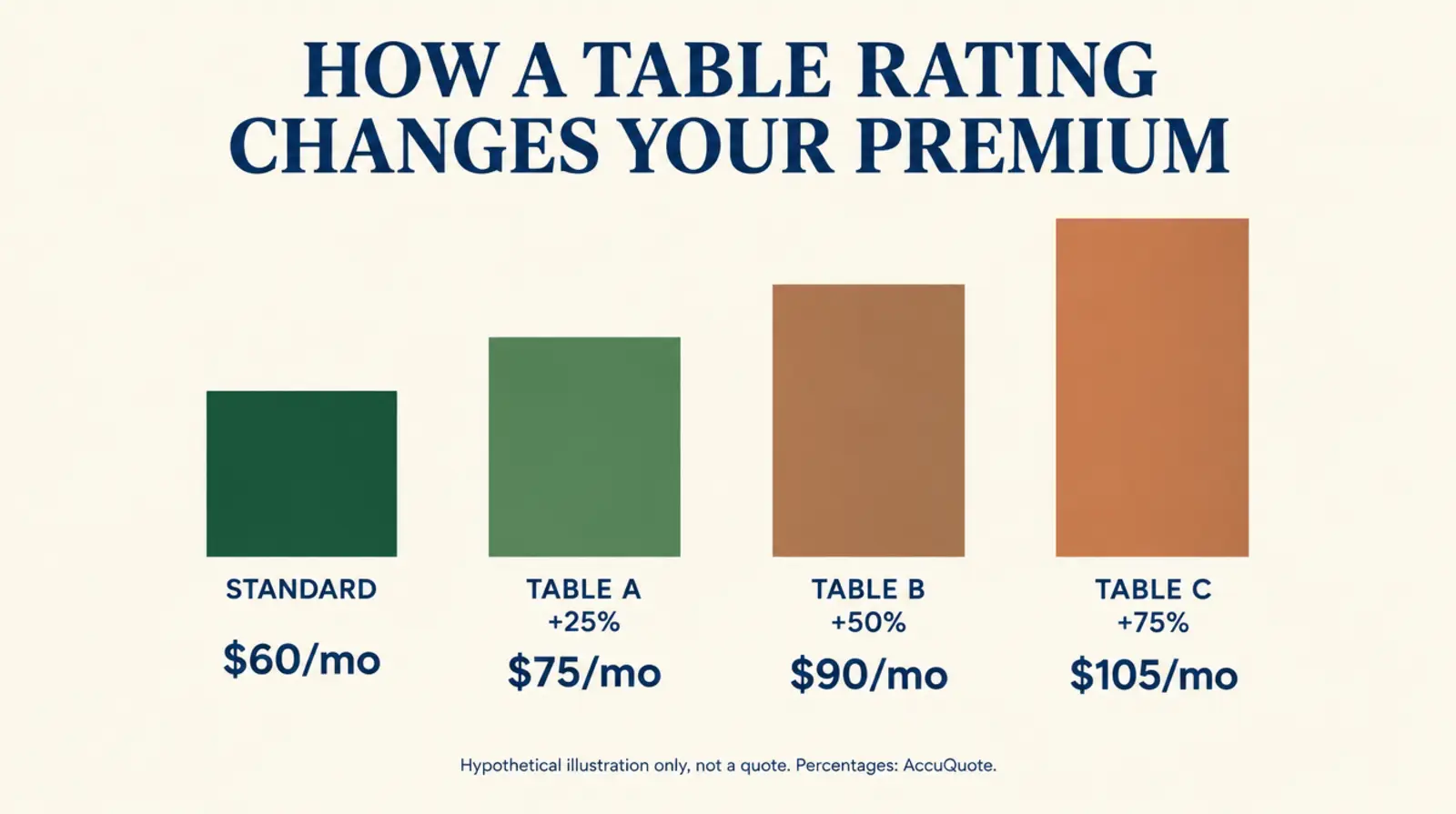
Worked math is the most useful thing a guide like this can offer, so here’s the arithmetic in full, using AccuQuote’s published percentage structure as the only source for the percentages. The dollar figures below are a hypothetical starting premium chosen purely to make the math concrete. They are not a quote, and they don’t reflect your age, sex, health, tobacco use, coverage amount, or any specific carrier’s actual pricing.
Illustrative monthly premium at each table step (hypothetical $60/month standard base)
Hypothetical illustration only, not a quote. Percentages per table: AccuQuote, life insurance rate class guide. Base premium of $60/month is an assumed, invented starting figure used purely to demonstrate the math. Accessed October 2026.
Walking through it: 25% of $60.00 is $15.00, so Table A brings the illustrative premium to $75.00. 50% of $60.00 is $30.00, so Table B brings it to $90.00. 75% of $60.00 is $45.00, so Table C brings it to $105.00. The pattern is linear at this stage because each step is simply adding another 25 percentage points, per AccuQuote’s structure; carriers can and do structure their own higher tables differently; this guide isn’t claiming the pattern continues indefinitely at every company.
What that means in practice: a table rating roughly 1.75 times your hypothetical standard rate is a real cost difference worth taking seriously, and also a real reason to find out whether a different carrier’s underwriting guidelines would treat your specific file more favorably, rather than assuming the first number you see is the only one available.
Does every carrier rate the same file the same way?
No, and this is the detail that makes shopping worthwhile instead of optional.
Each insurance company writes its own underwriting manual, built from its own claims experience, reinsurance arrangements, and risk appetite. One carrier might table-rate a specific combination of blood pressure and family history that another carrier, with a different manual, prices at standard. South Dakota law doesn’t require insurers to agree with each other on this. SDCL 58-33-12 makes it a Class 2 misdemeanor for an insurer to “make or permit any unfair discrimination between individuals of the same class” in life insurance rates, dividends, or benefits — but that statute governs how one insurer treats people within its own book of business, not whether Carrier A and Carrier B have to reach the same conclusion about you.
Same file, different company, different answer
Because underwriting manuals are company-specific, a table rating at one carrier is a statement about that carrier's rules applied to your file. It isn't a verdict that follows you to the next company you apply with. That's the entire reason comparing carriers, rather than accepting the first offer, tends to matter most for anyone who's been rated.
That difference also explains why accelerated underwriting hasn’t erased table ratings. Gen Re’s 2025 U.S. Individual Life Next Gen Underwriting Survey, which collected responses from 30 individual life insurance carriers, found that an average of 59% of individual life applications now qualify for an accelerated path that skips the paramedical exam. That’s a real shift in how carriers gather evidence: more reliance on prescription databases, motor vehicle records, and lab data pulled electronically instead of a nurse visit. It is not a shift in the underlying rate-class structure. An accelerated file still gets sorted into preferred, standard, or a substandard table, using the same categories this guide describes; the survey measures how the evidence gets collected, not whether rating categories still exist.
How to find out if a table rating can come down
Some of this you can start before you talk to anyone.
- Ask exactly which finding drove the rating. A table rating is usually tied to one or two specific factors, such as a lab value, a BMI reading, a driving record entry, or a family history answer. Knowing which one it is tells you what, if anything, is realistically changeable.
- Document any improvement since the application. Lower lab numbers, a completed treatment, a resolved driving violation, or a stretch of time with no new findings are the kind of evidence carriers look at on reconsideration.
- Ask the carrier directly whether it has a formal reconsideration or table-reduction process, and when you’d be eligible. According to Fox Business, Maureen Leydon, identified as MetLife’s vice president and chief underwriter, said most companies offer a reapplication option, commonly around two years after the policy was issued, to see whether the table can be lowered. That two-year figure is a commonly cited starting point from one named source, not a rule every carrier follows on an identical timeline, so confirm your specific carrier’s own policy rather than assuming.
- Get a second opinion from a different carrier before you assume the first number is final. Since underwriting manuals are company-specific, reapplying with a different insurer, armed with the same updated documentation, is a legitimate path and doesn’t require waiting out the original carrier’s own reconsideration clock.
- Keep the policy in force while you investigate. A table-rated policy that’s actually in place is still real coverage. Letting it lapse while you shop removes protection you already have, during exactly the stretch of time you’d most want it to stay active.
Treating a table rating as a closed door
- Reads "substandard" as a verdict instead of one carrier's specific pricing decision
- Never asks which exact finding drove the rating
- Doesn't check whether a different carrier's manual would price the same file lower
Common outcomePaying a higher rate indefinitely, or dropping coverage altogether, without checking either option
Asking what drove it and comparing carriers
- Gets the specific finding behind the rating in writing
- Documents improvement and asks about a formal reconsideration timeline
- Compares how a second carrier's underwriting manual treats the same file
Common outcomeEither a lower rating on reconsideration, or a better offer at a different carrier
What if you think the rating itself was unfair?
There’s a difference between disagreeing with a price and believing you were treated differently than someone with the same risk and the same life expectancy. The first is a shopping problem; the second is a legal one, and South Dakota has a specific answer for it.
SDCL 58-33-12 prohibits an insurer from unfairly discriminating “between individuals of the same class and of essentially the same hazard” in life insurance and annuity rates, dividends, benefits, or other contract terms, and classifies a violation as a Class 2 misdemeanor. If you believe that standard was violated, not just that you don’t like your price, South Dakota’s Division of Insurance takes consumer complaints. Its own guidance is to contact the insurer first and try to resolve the issue directly; if that doesn’t work, you can file online or call the Division at 605-773-3563. The Division’s office is at 124 South Euclid Avenue, 2nd Floor, Pierre, SD 57501. Its complaint form includes a specific “Individual Life” category separate from group life and other lines.
It’s worth being precise about what the Division can and can’t do here: it reviews whether an insurer followed the law and its own filed practices, not whether your specific table rating was the “right” number in some objective sense. Underwriting judgment within the bounds of the law is the carrier’s to make. That’s exactly why comparing carriers, rather than filing a complaint over a price you simply dislike, is the more useful first step for most people.
What a table rating doesn’t change
A table rating is about what you pay going forward. It’s worth knowing what it doesn’t touch.
If you’ve already had a policy in force for a while, South Dakota law separately protects you from a different kind of risk: the insurer digging back into your original application after the fact. SDCL 58-15-10 requires South Dakota life insurance policies to become incontestable, except for fraud or nonpayment of premium, once the policy has been in force for two years from its date of issue. That provision is about challenging the validity of the policy itself over something stated or omitted on the original application; it’s a separate legal protection from whether a table rating can later be reconsidered or lowered, which is a pricing decision the carrier makes on its own terms, not a contestability question.
How we help
We’re an independent agency, which matters most for exactly this situation. We don’t send every applicant to one company by default. When a table rating lands on your file, or when you’re worried about one before you even apply, we look at the specific finding behind it and compare how the carriers we represent tend to treat that finding, because their underwriting manuals genuinely differ on cases like yours. Compare My Options.
What you get
A clear read on what your letter actually says, instead of a guess based on the word “substandard.” A second opinion on whether a different carrier’s underwriting guidelines might treat your specific file more favorably, since that’s the real lever available to most people who’ve been rated. And a plain answer, in writing, about what any rating would add to your premium at the carriers we’d actually recommend for your situation, before you commit to anything.
A table rating is a price, not a verdict. The number on the letter is one carrier's answer. It is rarely every carrier's answer.
Mike MooreRelated reading
If a specific health factor is part of what led to your rating, our condition-specific guides go deeper on how carriers evaluate diabetes, heart disease, high blood pressure, and a cancer history. For the broader picture of how underwriting works after any health condition, see getting life insurance after a health condition and what to expect at a life insurance medical exam. If a shorter health-question path is worth comparing against a fully underwritten table-rated offer, see no-medical-exam life insurance: how it works.
Already have a table-rated offer in hand?
See how we work with people with health conditions to compare how other carriers would treat the same file.
Not sure which health factor is driving your price?
See our guide to getting coverage after a health condition.
Not ready to talk to anyone?
Read how it works first and come back when you're ready.
Frequently asked questions
What is a life insurance table rating?
It’s a priced step above a carrier’s standard rate class, used when an applicant’s combined health or lifestyle risk is higher than standard but not high enough for the carrier to decline the application. Carriers commonly label these steps Table A through Table P, or Table 1 through Table 16, depending on the company, and each step adds a set percentage to the standard premium. AccuQuote’s published rate-class explainer lists Table A at 25% above standard, Table B at 50% above standard, and Table C at 75% above standard. A table rating means you were approved. It is not a decline.
How much more does a table rating actually cost?
It depends on which table you’re assigned and which carrier issued it, since carriers set their own percentage steps. Using AccuQuote’s published structure as an illustration only, not a quote: if a standard-rate 20-year term policy carried an illustrative base premium of 60 dollars a month, a Table A rating (plus 25%) would add about 15 dollars, a Table B rating (plus 50%) would add about 30 dollars, and a Table C rating (plus 75%) would add about 45 dollars. These are hypothetical numbers built only to show the math; your actual premium depends on your age, sex, health, tobacco use, coverage amount, and the specific carrier and product, and is set at underwriting.
What’s the difference between a table rating and a flat extra?
A table rating scales the base premium by a percentage and generally stays in place for as long as the policy does, unless you request reconsideration later. A flat extra is a separate, fixed dollar charge added on top, usually quoted per $1,000 of coverage, and it can be temporary: it’s designed to apply only while a specific, time-limited risk, such as a hazardous hobby or a recent diagnosis still being monitored, is actually elevated. Some applications carry a table rating, a flat extra, both, or neither.
Can you get a table rating lowered or removed?
Often, yes, though it isn’t automatic and there’s no single industry-wide rule. According to Fox Business, Maureen Leydon, MetLife’s vice president and chief underwriter at the time she was quoted, said most companies offer a reapplication option, typically about two years after the policy was issued, to see whether the rating can be reduced. Carriers generally want to see documented improvement: better lab results, a resolved condition, quit-smoking milestones, or simply more time passing without new findings. Because each carrier runs its own underwriting, reapplying somewhere else is also an option, not just waiting on the original carrier.
Does every carrier give the same applicant the same table rating?
No. Each insurer builds its own underwriting guidelines from its own mortality and reinsurance data, so the same file can land in different places at different companies. South Dakota law, SDCL 58-33-12, makes it a Class 2 misdemeanor for an insurer to unfairly discriminate in life insurance rates between individuals of the same class with the same life expectancy, but it does not require every insurance company to use identical underwriting thresholds as every other company. That’s the whole argument for comparing more than one carrier before accepting the first table rating you receive.
Is a table rating the same thing as being declined?
No, and this is the single most common misunderstanding about the letter. A decline means the carrier won’t issue a policy at any price. A table rating means the carrier reviewed your file, decided your risk is insurable, and set a price for it that’s higher than its standard rate. You received an approval, with a surcharge attached, not a rejection.
Does accelerated underwriting mean fewer people get table-rated?
Accelerated underwriting changes how a file gets evaluated, not the rating categories themselves. Gen Re’s 2025 U.S. Individual Life Next Gen Underwriting Survey, which drew responses from 30 individual life insurance carriers, found that an average of 59% of individual life applications now qualify for an accelerated underwriting path, meaning no paramedical exam. Those applications still get evaluated against the same preferred, standard, and substandard (table-rated) structure; accelerated underwriting is a faster way to gather evidence, not a different pricing system.
What should you do if you think a table rating was unfair?
First, ask the carrier or your agent exactly which finding drove the rating and whether it has a specific reconsideration or table-reduction program and timeline. If you believe the insurer actually treated you differently than someone with the same risk and life expectancy, which is a narrower claim than simply disagreeing with the price, South Dakota’s Division of Insurance accepts consumer complaints against licensed insurers, including an “Individual Life” complaint category, after you’ve first tried to resolve the issue directly with the company. Its consumer line is 605-773-3563, and its office is at 124 South Euclid Avenue, 2nd Floor, Pierre, SD 57501.
Sources
- CDC/NCHS — Mortality in the United States, 2024 (NCHS Data Brief 548) — U.S. life expectancy at birth of 79.0 years in 2024, up 0.6 year from 78.4 in 2023; published January 2026, reviewed January 29, 2026; accessed October 2026
- Gen Re — 2025 Gen Re Releases U.S. Individual Life Next Gen Underwriting Survey Results — an average of 59% of individual life applications qualify for an accelerated underwriting path; 30 individual life insurance carriers participated; released December 17, 2025; accessed October 2026
- AccuQuote — Life Insurance Rate Class — substandard table ratings typically increase 25% per table over standard; Table A at +25%, Table B at +50%, Table C at +75%; accessed October 2026
- Fox Business — Understanding Life Insurance Table Ratings — Maureen Leydon, identified as MetLife’s vice president and chief underwriter, on most companies offering reapplication approximately two years after issue to reconsider a table rating; accessed October 2026
- South Dakota Legislature — SDCL 58-33-12, Unfair discrimination as misdemeanor, life insurance and annuities — bars unfair discrimination in life insurance and annuity rates between individuals of the same class and essentially the same hazard; Class 2 misdemeanor; accessed October 2026
- South Dakota Legislature — SDCL 58-15-10, Incontestability provision required, exceptions — policies become incontestable, except for fraud or nonpayment of premium, after two years from the date of issue; accessed October 2026
- South Dakota Division of Insurance — Consumer Complaint Process — complaint process steps, “Individual Life” complaint category, Division phone 605-773-3563, office at 124 South Euclid Avenue, 2nd Floor, Pierre, SD 57501; accessed October 2026
Related reading: life insurance with diabetes, life insurance with heart disease, life insurance with high blood pressure, life insurance after cancer, getting life insurance after a health condition, what to expect at a life insurance medical exam, and no-medical-exam life insurance. See who we help: people with health conditions.
Before you act on any of this
This article is general education, not insurance, legal, financial, medical, or tax advice. The dollar figures in this guide are hypothetical illustrations built from a published percentage structure, not a quote, and not a promise of any premium, rating, or outcome for you. Product availability, features, rates, and reconsideration or table-reduction policies vary by carrier and are subject to underwriting. No coverage exists until a policy is issued and in force. Any guarantees are subject to the claims-paying ability of the issuing insurer. Please review actual policy documents and speak with a licensed agent about your own situation.
The letter is a price, not a sentence
Most people open a table-rated approval and read it as a verdict on their health. It’s closer to a receipt: one company’s specific pricing decision, built from its own mortality data and its own underwriting manual, applied to the file you submitted on a specific day. That decision is often negotiable with time and documentation, and it is almost never the only answer available, since the next carrier’s manual was built independently of the first one’s. Finding out whether a different company would price your exact situation differently is the part worth a second opinion.
Got a table-rated offer, or worried you might?
We'll compare how the carriers we represent would actually price your specific file, so you know whether the first number you saw is the best one available.