
If you have a spouse and children from more than one relationship under the same roof, here is the direct answer: South Dakota’s default legal definition of “child” excludes a stepchild, a foster child, a grandchild, and any more remote descendant, under SDCL 29A-1-201. That single definition sits underneath both your state’s intestate succession rules and how South Dakota reads a generic term like “my children” on a beneficiary form. It means the people you actually consider your kids may not be the people a beneficiary form, left on autopilot, actually pays. Nothing about this is unusual or a sign you did something wrong. It is just a form that was built around one kind of family, being asked to answer for a different kind, and nobody tells you that until it matters.
The short version
- South Dakota's own definition of "child," in SDCL 29A-1-201, explicitly excludes "a person who is only a stepchild, a foster child, a grandchild, or any more remote descendant." That definition applies to intestate succession and, through SDCL 29A-2-705, to class terms like "my children" written into a governing instrument, which SDCL 29A-1-201(19) confirms includes a life insurance policy.
- Writing "my children" on a beneficiary form, instead of listing each child by full legal name, is the single most common way a stepchild ends up unintentionally left out.
- 17% of U.S. children under 18 lived in a blended family in 2023, down from 23% in 2013, according to Pew Research Center's analysis of U.S. Census Bureau Survey of Income and Program Participation data, published April 2026.
- Life insurance proceeds paid to a named beneficiary because of the insured's death are generally not taxable income, per the IRS, which removes one worry from an already complicated decision.
- A trust, not the beneficiary form itself, is usually the right tool if you want to provide income for a surviving spouse first and principal for your children afterward. That is estate planning work, not a form you fill out alone.
The form that doesn’t know your family is blended
Here is how this usually shows up. A man in Brookings remarries at 44. He has two kids from his first marriage, a son who was 12 and a daughter who was 9 when he and their mother divorced. His new wife has a daughter of her own, 10 years old, from a relationship before they met. He helps raise her for the next decade the same way he raises his own two kids: school events, braces, driving lessons, all of it. Nobody in that house would ever describe her as anything other than his daughter.
He owns a $450,000 term policy he bought two years into the marriage, and when he filled out the beneficiary form, he wrote “my children, equally” without a second thought, the same phrase he’d have used if all three kids shared both parents. He never adopted his stepdaughter. Adoption was never urgent, because nothing about daily life required the paperwork.
If he dies while that form is still on file exactly as written, South Dakota’s default rules do not read “my children” the way his family actually functions. SDCL 29A-1-201 defines “child,” for purposes of the state’s intestate succession rules, to exclude “a person who is only a stepchild.” SDCL 29A-2-705 then says a class term like “children,” used in a governing instrument, is construed “in accordance with the rules for intestate succession.” A life insurance policy counts as a governing instrument under SDCL 29A-1-201(19), which lists “insurance or annuity policy” by name. Chain those three provisions together, and the plain phrase “my children, equally” on a South Dakota beneficiary form is very unlikely, as a matter of default state law, to reach the stepdaughter he has raised for ten years, unless he legally adopted her or named her individually.
That is not a hypothetical technicality. It is the ordinary, predictable result of the form he filled out doing exactly what a generic class term is built to do: default to the state’s own definition of family, which was written for the most common case, not his particular one.
Why the law works this way
A few terms are worth defining before going further, because the mechanism here depends on understanding exactly what each word is doing.
Beneficiary is the person or entity a policyowner names on a life insurance contract to receive the death benefit. Governing instrument is South Dakota’s legal term, under SDCL 29A-1-201(19), for the document that creates a disposition of property, and the statute explicitly lists “a deed, will, trust, insurance or annuity policy, POD account, security registered in beneficiary form (TOD), pension, profit-sharing, retirement, or similar benefit plan.” Your life insurance beneficiary form sits inside that same legal category as a will.
Class gift describes a beneficiary designation made to a group defined by relationship rather than by name, such as “my children” or “my grandchildren,” instead of “Sarah Johnson and Michael Johnson.” A class gift is administratively convenient. You do not have to update the form every time a child is born or, in theory, every time your family changes shape. The tradeoff is that a class gift only works the way you expect if the state’s legal definition of that relationship term matches your actual family.
Intestate succession is the set of default rules a state applies to divide someone’s estate when they die without a valid instruction covering that property. South Dakota’s version lives in SDCL Title 29A, Chapter 2. Even though a life insurance beneficiary designation is not itself an intestate estate, SDCL 29A-2-705 borrows the same definitions: “adopted individuals and individuals born out of wedlock… are included in class gifts and other terms of relationship in accordance with the rules for intestate succession.” A stepchild is not adopted and is not the policyowner’s child by birth, so the statute’s inclusion rule for adopted and nonmarital children does not extend to them, and the base exclusion in SDCL 29A-1-201 stands.
Per stirpes and per capita describe what happens if a named beneficiary dies before you do. Per stirpes passes that beneficiary’s share down to their own children. Per capita instead redivides the share among the beneficiaries who are still alive. Both options still run through the same class-term problem above: a “per stirpes to my children” designation is still built on South Dakota’s definition of “children,” so it would not automatically extend a share down to a stepgrandchild any more than “my children” alone would reach a stepchild.
| What the form says | Governed by | Does it reach a stepchild by default? |
|---|---|---|
| "My children, equally" | SDCL 29A-2-705, construed against SDCL 29A-1-201's definition of child | Unlikely, as a matter of default state law |
| "My children, per stirpes" | Same default definition, applied one generation further | Unlikely, same underlying exclusion |
| Each child listed by full legal name | The contract itself, not a class-term default | Yes, whoever is named by name is paid regardless of legal relationship |
| Legally adopted stepchild, named or unnamed as "child" | SDCL 29A-1-201, which includes adopted individuals in the definition of child | Yes, once legal adoption is complete |
How common this actually is
This is not an edge case built around one unusual family. Pew Research Center’s April 2026 analysis of the U.S. Census Bureau’s Survey of Income and Program Participation found that 17% of U.S. children under 18 lived in a blended family, meaning a household including a stepparent, stepsiblings, or half siblings, as of 2023. That share has fallen from 23% in 2013, but it still describes roughly one in six American kids, and the same analysis found real variation by background: 28% of Black children lived in a blended family in 2023, compared with 19% of Hispanic children, 15% of white children, and 7% of Asian children. The share was also higher among households where a parent had a high school education or less, at 28%, than where a parent held a bachelor’s degree or higher, at 9%.
The same Pew analysis found a real financial gap sitting alongside these family structures: the median net worth of families raising children in a blended household was $86,300 in 2023, compared with $194,400 for non-blended families, and the homeownership rate was 55% for blended families versus 66% for non-blended families. None of that is a reason a blended family needs less protection. If anything, a thinner asset cushion is exactly why getting the beneficiary form right, at no added cost beyond the time it takes to fill it out correctly, matters more, not less.
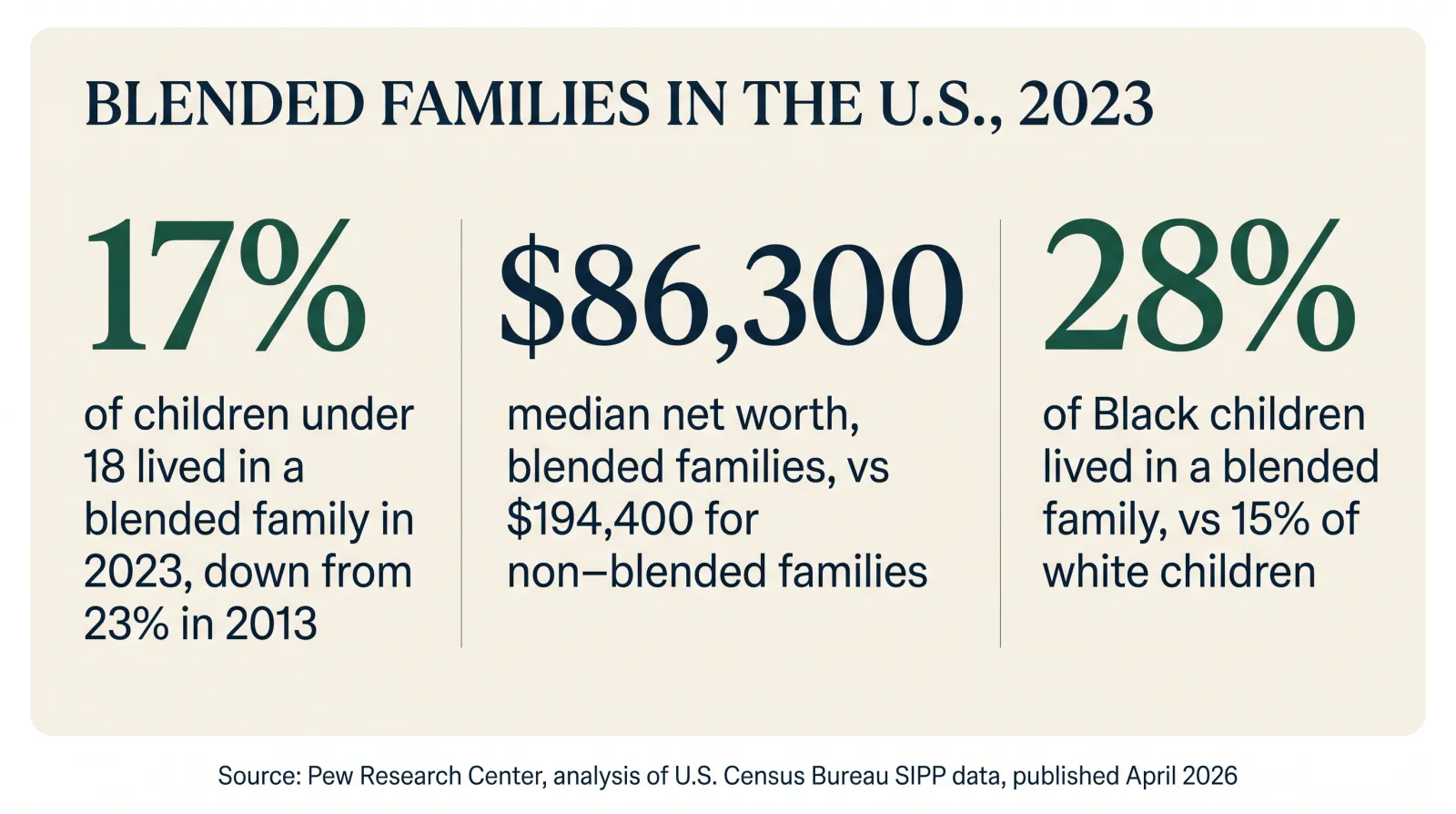
Share of U.S. children under 18 living in a blended family
Source: Pew Research Center, analysis of U.S. Census Bureau Survey of Income and Program Participation data, published April 2026.
What it actually costs when the form is left generic
Go back to the Brookings example and put real numbers on it. The father carries a $450,000 term policy. His household includes his two biological children and his stepdaughter, all three raised together for a decade. Say his intention, if you asked him directly, is that all three kids and his wife are provided for, roughly evenly.
If the form says “my children, equally” and he dies with that language unchanged, the practical result under South Dakota’s default rules is that his son and daughter split the $450,000 between them, $225,000 each, and his stepdaughter, whom he never adopted, has no claim on that policy at all. His wife, who is not named on this particular policy, also receives nothing from it directly. Whatever happens for the stepdaughter and the wife depends entirely on what other assets or plans exist outside this one document.
If he instead names each child individually by full legal name and splits the policy three ways, each of the three kids receives $150,000, and the form does exactly what he intended, regardless of who is legally his child under state law. Naming individuals by name sidesteps the entire class-term question, because the insurer pays whoever is written on the form, full stop.
If he wants his wife provided for too, one workable structure is naming her as primary beneficiary for a percentage sized to the household’s ongoing needs, say 50%, with the remaining 50% split three ways among all three kids by name, 16.67% each, or about $75,000 apiece on a $450,000 policy. Another is keeping this policy focused on the kids and carrying a separate, second policy that names only his wife, so neither beneficiary group’s share depends on the other group agreeing to redirect money after the fact.
| Beneficiary form as written | Son and daughter (biological) | Stepdaughter (not adopted) | Wife |
|---|---|---|---|
| "My children, equally" | $225,000 each | $0, under SD's default class-term rule | $0, not named on this policy |
| All three kids named individually, equal thirds | $150,000 each | $150,000 | $0, not named on this policy |
| Wife 50%, three kids named individually, 50% split | ≈$75,000 each | ≈$75,000 | $225,000 |
The dollar amounts here are illustrations built from one hypothetical $450,000 policy to show the mechanics, not a quote or a recommendation for any specific family’s coverage amount; how much coverage actually fits your household depends on your income, debts, and dependents.
How to fix your own beneficiary form
None of this requires an attorney to get the beneficiary form itself right, though it is worth talking to an estate planning attorney licensed in South Dakota if you want to go further than the form allows, covered below.
List every child you want covered by full legal name, not by a relationship term. “My children, equally” defaults to South Dakota’s legal definition of child, which excludes a stepchild. “Emma R. Larson, Cole T. Larson, and Ava M. Peterson, equally” pays exactly those three people regardless of which of them is your legal child under state law.
Decide the split on purpose, before you write anything down. A common structure is a percentage for a surviving spouse sized to ongoing household needs, and a separate percentage split among the kids, named individually. There is no single correct ratio; the point is choosing it deliberately instead of letting a generic class term decide it for you by accident.
Consider two policies instead of one if you want a spouse’s share and a set of children’s shares to be genuinely independent of each other. A policy that names only your kids, individually, guarantees their share exists regardless of anything that happens with your spouse later, including if your spouse remarries after your death. A separate policy naming your spouse covers your household’s ongoing needs without competing against your kids’ share on the same form.
If any beneficiary is still a minor, remember that South Dakota law does not let a minor receive life insurance proceeds directly no matter how the form is worded. See our guide on naming a minor life insurance beneficiary in South Dakota for how that actually gets handled, since a blended family with young kids on both sides usually needs to solve both problems, the class-term issue and the minor issue, on the same form.
Check every policy again after every remarriage, not just the first one you think of. If you or your new spouse each came into the marriage with an existing policy from a prior relationship, those forms do not update themselves. Our guide on life insurance beneficiaries after divorce covers what South Dakota’s divorce-revocation law does and does not fix automatically; remarriage adds a second layer on top of that, since a policy purchased during a first marriage can still be sitting untouched, years later, in a second one.
If you are not sure an old policy exists at all, the South Dakota Division of Insurance points consumers to the NAIC Life Insurance Policy Locator Service, a free national search tool that can identify a policy naming a specific deceased person as the insured. This comes up often in blended families sorting out a death where one spouse is not fully certain what coverage the other one held from before they met.
If you want a stepchild to inherit the same way a biological child would, beyond a single named beneficiary line, two paths exist and they are different in scope. Legal adoption brings a stepchild inside South Dakota’s own definition of “child” under SDCL 29A-1-201, which changes their status for intestate succession and class-gift purposes broadly, not just for one policy. Short of adoption, a trust named as the policy’s beneficiary can be drafted to treat a stepchild and a biological child identically, or differently, exactly as you specify, without changing anyone’s legal status. Drafting that kind of trust is estate planning work that goes beyond what a beneficiary form alone can do, and it is worth a conversation with an attorney rather than attempting it as a do-it-yourself project.
You can run all of this yourself in an afternoon once you have your list of names and percentages written down. The part most people skip is simply sitting down and deciding the numbers on purpose, rather than assuming the form already reflects what they intend.
"My children, equally"
- Defaults to South Dakota's legal definition of "child," which excludes a stepchild under SDCL 29A-1-201
- Convenient to write, but the outcome depends on a statute most people have never read
- A stepchild raised for years can be left out without anyone intending it
Every intended beneficiary listed by name
- Pays exactly who is written on the form, regardless of legal relationship
- Removes the class-term question entirely
- Still needs to be redone after any major family change, including remarriage
What South Dakota’s rules do not decide for you
A beneficiary form only controls the policy it is attached to. It says nothing about your will, your retirement accounts, or how any other asset passes, and it does not, on its own, make a stepchild your legal heir for any purpose beyond that one form. If your goal is broader than one life insurance policy, meaning you want a stepchild treated the same as your biological children across your whole estate, that is a will or trust question, not a beneficiary-form question, and it is worth raising with an attorney licensed in South Dakota rather than assuming one fix covers everything.
Taxes are one worry you can mostly set aside here. The IRS is direct on this point: life insurance proceeds paid to a beneficiary because of the insured’s death are generally not included in gross income and do not need to be reported, with a narrow exception for a policy that was transferred to someone else for money or other value while the insured was alive. Interest that accrues on proceeds left on deposit with the insurer, or paid out over time in installments, is taxed separately as interest income, but the death benefit itself is not the taxable event most people worry it might be.
| Question | Does the beneficiary form answer it? |
|---|---|
| Who receives this specific policy's death benefit | Yes, this is exactly what the form controls |
| Whether a stepchild is your legal heir for other assets | No, that is a will, trust, or adoption question |
| Whether the death benefit is taxable to the beneficiary | No, but the IRS answer is generally no, it is not taxable |
| What happens if a named beneficiary dies before you | Depends on per stirpes vs. per capita language you choose |
How we help
We are independent, so when a blended family comes to us to sort out coverage, we are not starting from a single carrier’s default beneficiary language. We will go through what you actually have today, individual policies, anything through an employer, and anything left over from a prior relationship, and walk through how to name every beneficiary you intend to include so the form matches your actual family instead of a generic template. If your goals go beyond one policy, meaning you are weighing a trust or want a stepchild treated identically to a biological child across your estate, we will tell you plainly when that is estate planning work for a South Dakota attorney rather than something a beneficiary form can carry on its own. What we can do is help you compare separate or layered policies across carriers so your spouse’s share and your kids’ share do not have to compete against each other on a single form. Compare My Options.
What you get
A beneficiary form that lists the people you actually mean, by name, instead of a class term that quietly defers to a legal definition most people have never seen. Clarity on which of your goals a beneficiary form can handle by itself, and which ones need a trust or a will instead. And, if you are comparing or buying coverage at the same time, a policy structured from day one around your actual family instead of left as one more thing to fix later.
A generic beneficiary form was written for the most common family. Yours might not be that family, and the fix costs nothing but the time it takes to write down real names.
Mike MooreRelated reading
If any of your beneficiaries are still minors, see naming a minor life insurance beneficiary in South Dakota before you finalize a new form. If you are updating coverage after a divorce that came before this marriage, see life insurance beneficiaries after divorce for how South Dakota’s revocation law does and does not apply. And if you and your partner are not currently married, see life insurance for unmarried couples in South Dakota for a related set of default-rule gaps.
Naming a minor as beneficiary too?
See naming a minor life insurance beneficiary in South Dakota for how South Dakota actually requires that money to be held.
Remarried after a divorce?
See life insurance beneficiaries after divorce to check what South Dakota's revocation law already changed, and what it didn't.
Not ready to talk to anyone yet?
Read how it works first and come back when you are.
Frequently asked questions
Do stepchildren automatically inherit life insurance in South Dakota?
Not automatically, and not by default. South Dakota’s definition of “child” under SDCL 29A-1-201 specifically excludes “a person who is only a stepchild, a foster child, a grandchild, or any more remote descendant.” A stepchild only receives life insurance proceeds if you name them directly on the beneficiary form, or through a trust or will you specifically set up to include them. Being raised as your own, for any number of years, does not change this default rule on its own.
If I name “my children” as beneficiary, does that include my stepchildren?
Under South Dakota’s default rules, generally no. SDCL 29A-2-705 says a class term like “children” in a governing instrument, which SDCL 29A-1-201(19) confirms includes a life insurance policy, is construed “in accordance with the rules for intestate succession.” Since intestate succession’s own definition of “child” excludes a stepchild, writing “my children” on a beneficiary form is unlikely to reach a stepchild by default. The fix is simple: list every child you want covered by full legal name instead of relying on a class term.
Should I split my life insurance between my current spouse and my kids from a previous relationship?
That is a decision only you can make, but it is worth making on purpose rather than by default. A common approach is naming your spouse as primary beneficiary for a percentage sized to your household’s ongoing needs, and naming your children by name, individually, for a separate percentage or a separate smaller policy, so their share does not depend on your spouse choosing to share it with them later.
Can a trust help provide for a spouse and children from different relationships at the same time?
Yes, that is one of the main reasons blended families use one. A trust named as beneficiary can be structured to pay income to a surviving spouse for their lifetime, or for a set period, with the remaining principal going to your children afterward. Setting one up correctly is estate planning work that goes beyond a beneficiary form, so this is a case where talking to an estate planning attorney licensed in South Dakota is worth the cost.
What happens to a life insurance policy from my first marriage if I remarry and never update it?
The policy pays whoever is actually named on the form on file with the insurer, regardless of who you are married to when you die. If you bought a policy during a first marriage and never changed the beneficiary, it can still pay your first spouse or your first spouse’s children, not your current spouse, unless a divorce specifically revoked that designation under SDCL 29A-2-804. Every remarriage is a reason to check every policy you hold, not assume it updated itself.
Are life insurance proceeds paid to my beneficiaries taxable?
Generally no. The IRS states that life insurance proceeds paid to a beneficiary by reason of the insured’s death are not included in gross income and do not need to be reported, with a narrow exception for policies that were transferred to someone else for money or other value. Interest that accrues on proceeds left with the insurer, or paid out in installments, is taxable separately as interest income.
How do I find an old life insurance policy from a previous marriage if I am not sure it exists?
The South Dakota Division of Insurance points consumers to the NAIC Life Insurance Policy Locator Service, a free national search tool that can identify policies naming a specific deceased person as the insured. It is worth running any time a blended family is sorting out coverage after a death and is not certain what already exists from an earlier marriage.
What is the difference between per stirpes and per capita for a blended family?
Per stirpes means if one of your named beneficiaries dies before you, that beneficiary’s own children step into their share. Per capita means the share is instead redivided among the beneficiaries who are still living. In a blended family, this choice matters more than usual, since a per stirpes designation naming “my children” would still be read using South Dakota’s default definition of child, so it would not automatically extend a deceased biological child’s share down to a stepgrandchild unless you named that line specifically.
Sources
- South Dakota Legislative Research Council — Codified Law 29A-1-201 — defines “child” to exclude a person who is only a stepchild, foster child, grandchild, or more remote descendant, and defines “governing instrument” to include an insurance or annuity policy; accessed September 2026
- South Dakota Legislative Research Council — Codified Law 29A-2-705 — class gifts and other terms of relationship in a governing instrument are construed in accordance with the rules for intestate succession; accessed September 2026
- Pew Research Center — 5 facts about U.S. children living in blended families — 17% of U.S. children under 18 lived in a blended family in 2023, down from 23% in 2013, with breakdowns by race, parent education, and household net worth, based on the U.S. Census Bureau’s Survey of Income and Program Participation; published April 21, 2026; accessed September 2026
- Internal Revenue Service — Life insurance & disability insurance proceeds FAQ — life insurance proceeds paid by reason of death are generally not includable in gross income, with an exception for policies transferred for valuable consideration; accessed September 2026
- South Dakota Division of Insurance — Consumer information — points consumers to the NAIC Life Insurance Policy Locator Service and the Division’s producer license lookup; accessed September 2026
Related reading: naming a minor life insurance beneficiary in South Dakota, life insurance beneficiaries after divorce, and life insurance for unmarried couples in South Dakota.
Before you act on any of this
This article is general education, not insurance, legal, financial, or tax advice, and describes South Dakota and federal law as of the dates cited; consult the current codified law and a licensed attorney about your own family situation before relying on any of it. Product availability, features, and rates vary by carrier and are subject to underwriting. No coverage exists until a policy is issued and in force. Any guarantees are subject to the claims-paying ability of the issuing insurer. Please review actual policy documents and speak with a licensed agent about your own situation.
The form is the easy part
Deciding how to provide for a spouse and children from more than one relationship is the hard part, and no article can make that decision for you. Writing it down correctly, once you’ve decided, is the easy part, and it costs nothing beyond the time it takes to list real names instead of a relationship term. Pull up every policy you or your spouse hold this week, individual and employer coverage both, and check whether the form actually says what you mean, or whether it is quietly relying on a legal definition you never read until now.
Want help naming beneficiaries across a blended family the way you actually intend?
We'll go through your current coverage, explain what a class term like "my children" actually does under South Dakota law, and help you compare policies structured around your real family.