In most cases, yes. A history of cancer is one of the most common things life insurance underwriters review, not a rare disqualifier, and for a large share of applicants it changes which rate class you land in and which carrier fits your file best, rather than whether you can get covered at all. What actually varies, sometimes significantly, is how a specific carrier treats your specific cancer type, stage, and time since treatment ended — because insurers don’t use one shared rulebook for this. This guide walks through how that underwriting actually works in 2026, using two real carriers’ published guidelines, so you can understand where you likely stand in South Dakota before you assume the answer is no.
The short version
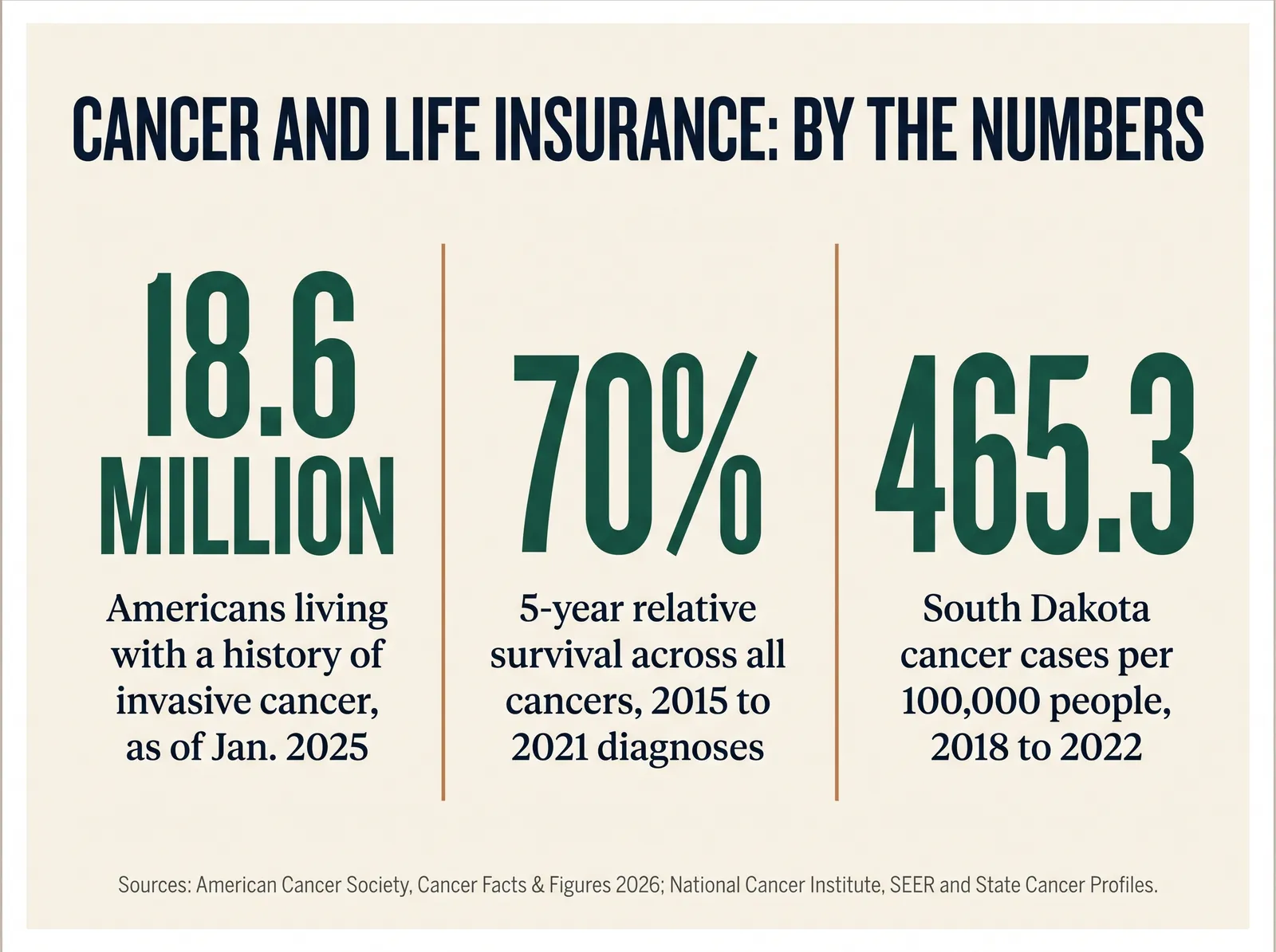
- An estimated 18.6 million Americans were living with a history of invasive cancer as of January 1, 2025, according to the American Cancer Society's Cancer Facts & Figures 2026 — you are far from an unusual applicant.
- The overall 5-year relative survival rate across all cancers combined is now 70% for people diagnosed 2015 to 2021, up from 49% in the mid-1970s, per the same ACS report.
- Carriers do not use one shared rulebook. Banner Life's March 2026 underwriting guide and MassMutual's underwriting guide use genuinely different mechanisms for evaluating cancer history — this article shows both, with sources.
- A table rating or a decline at one company is not the final word everywhere. Underwriting guidelines are carrier-specific, and South Dakota law does not require them to match.
- This article does not quote specific premium dollar amounts or promise any outcome for you. It shows the mechanics, sourced, so you can see how the process actually works before you apply.
What actually happens when you apply with a cancer history?
Before the specifics, a few terms are worth pinning down, because they get used loosely and it matters which one applies to you:
- Remission: the absence of detectable signs of cancer after treatment. Carriers care less about the word itself than about how long it’s been true and what evidence documents it.
- Table rating: a priced step above a carrier’s standard rate class for applicants whose combined risk is elevated but not high enough to decline. It’s active coverage at a higher price, not a decline.
- Flat extra: a temporary, fixed dollar surcharge added to a premium for a specific, time-limited risk. Unlike a table rating, a flat extra is designed to drop off once the elevated-risk period passes.
- Postponement: a carrier’s decision to defer a decision on an application until a later date, usually because not enough time has passed since diagnosis or treatment to evaluate risk reliably.
- Attending Physician Statement (APS): records a carrier’s medical team requests directly from your doctor or oncologist to verify diagnosis, staging, treatment, and follow-up, used when an application discloses something like a cancer history.
- Contestability period: the window during which an insurer can investigate and potentially rescind a policy over a material misrepresentation on the application. In South Dakota, that window is fixed by statute, which this guide covers later.
Here’s the part that surprises a lot of applicants: carriers don’t just price cancer history differently — they use structurally different evaluation methods for it. That’s not a minor wording difference. It means the honest answer to “how long do I have to wait” is “it depends which carrier’s guidelines you’re measured against,” not a single universal number.

Why does cancer history get this much attention from underwriters?
Because it’s common, survivable at rates that have changed enormously in the underwriters’ own working lifetimes, and still measurably tied to future risk in ways carriers price rather than ignore.
The American Cancer Society’s Cancer Facts & Figures 2026 puts it plainly: the overall 5-year relative survival rate for all cancers combined has reached 70% for people diagnosed between 2015 and 2021, up from 49% in the mid-1970s. That’s not a rounding change. It’s the reason underwriting for cancer history looks completely different today than it did a generation ago — carriers have decades more outcome data to price against, across far more cancer types and treatments than existed when a flat “cancer equals decline” rule was common industry practice.
South Dakota’s own numbers track close to, and slightly above, the national picture. The National Cancer Institute’s State Cancer Profiles put South Dakota’s age-adjusted cancer incidence rate at 465.3 per 100,000 people for 2018–2022, compared with a national rate of 448.6, and the state’s cancer mortality rate at 151.1 per 100,000 for 2019–2023, compared with a national rate of 145.4. In plain terms: cancer touches South Dakota families at a rate essentially in line with the rest of the country, which is exactly why South Dakota carriers underwrite it as a routine part of the file, not an exotic one.
Survival also isn’t one number — it depends heavily on cancer type. The National Cancer Institute’s SEER program, the federal government’s cancer surveillance system, tracks 5-year relative survival by cancer type for people diagnosed 2016 through 2022:
5-year relative survival varies enormously by cancer type
Source: National Cancer Institute, SEER Cancer Stat Facts, 5-year relative survival for diagnoses 2016–2022. Accessed August 2026.
That spread is exactly why “how does life insurance treat cancer” doesn’t have one answer. A five-year survival rate near 98%, like prostate cancer’s, and one near 30%, like lung cancer’s, are not the same actuarial story, and no honest underwriting process would price them identically. This is also why carriers ask about type and staging in detail rather than checking a single “history of cancer: yes/no” box.
This article doesn't quote specific premium dollar amounts
What a table rating or a specific rate class actually costs in dollars depends on your age, sex, coverage amount, tobacco status, and the individual carrier and product — variables no article can responsibly guess at in advance for you. Instead, this guide shows the underwriting mechanics using real, sourced carrier guidelines, so you can see how the process works before you request a quote.
Two real underwriting guides, side by side
This is the single most useful comparison in this article, because it shows directly that “cancer history” isn’t evaluated the same way company to company. Here’s what two named carriers’ published underwriting guides actually say, in their own words:
| Carrier | How cancer history is evaluated | Best available outcome, per the guide |
|---|---|---|
| Banner Life | Basal and squamous cell skin cancer is handled separately from other cancer histories. Other personal cancer history is evaluated individually based on type, staging, date of onset, and treatment (including how effective the treatment was). Underwriters ask to be contacted before applying if diagnosis or treatment occurred within the last 12 months, or if there's a history of multiple cancers or recurrence. | Preferred Plus is available for basal and squamous cell (superficial) skin cancer; Standard Plus is the best available tier for other cancer histories, depending on the individual case. |
| MassMutual | Uses a fixed lookback rule: no cancer history that resulted in a rating within the last 10 years, measured from when the rating ended, not from the diagnosis date, unless current underwriting guidelines allow an exception. A permanent flat extra or table rating specifically for cancer makes an applicant permanently ineligible for preferred classes at this carrier. Cancer-related findings (biopsy, tumor, cancer other than basal cell carcinoma) trigger a required Attending Physician Statement. | Preferred classes become available once 10 years have passed since a temporary cancer-related rating ended, assuming no permanent rating was applied; standard and rated coverage can be available sooner depending on the case. |
Source: Banner Life, Field Guide for Life Insurance Underwriting, March 2026; MassMutual, Life Underwriting Requirements Guide. Both are the carriers' own published underwriting reference documents. Accessed August 2026.
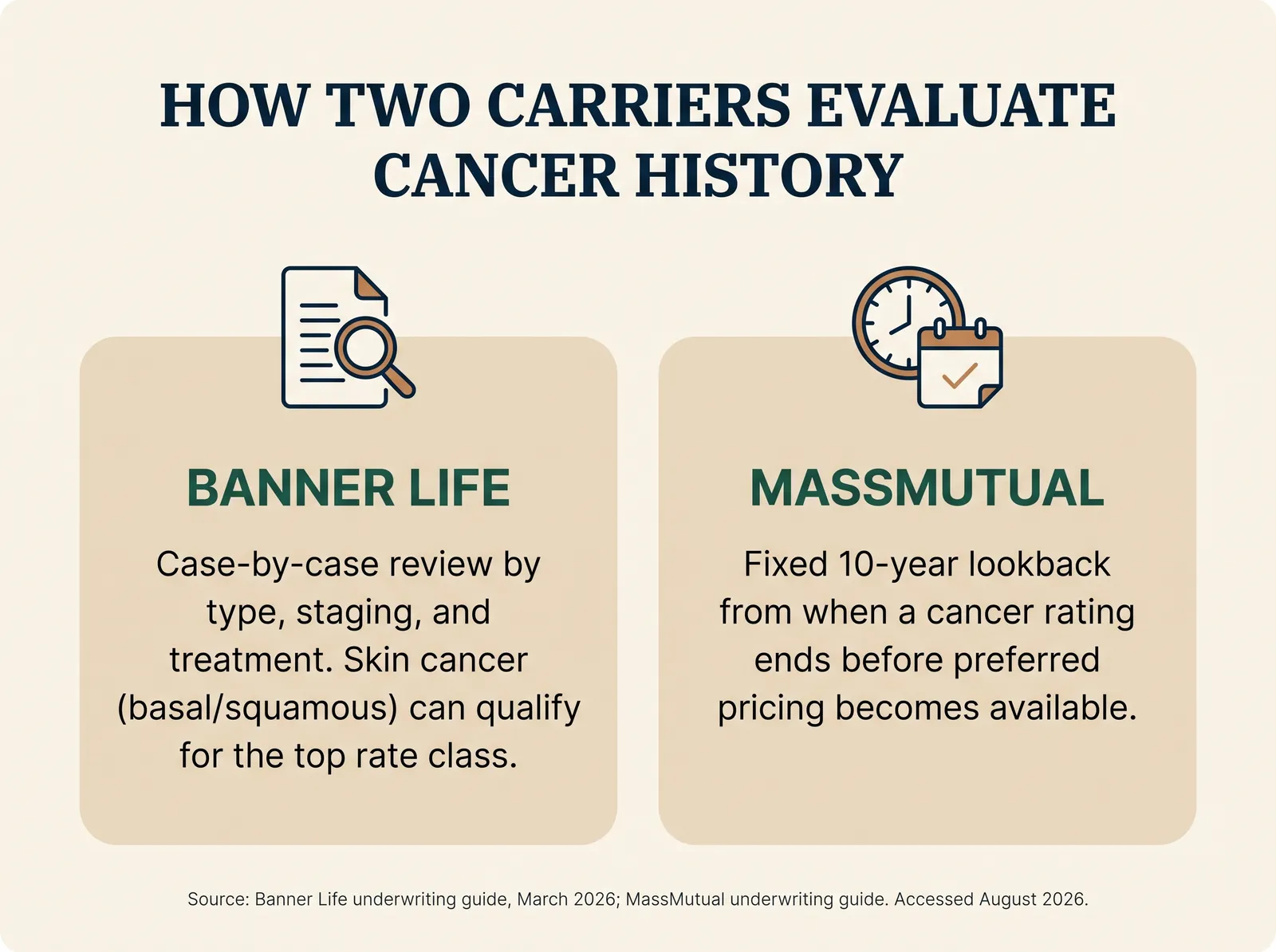
Notice what’s actually different here. Banner Life’s approach is case-by-case: it names one category (certain skin cancers) that qualifies for its top tier outright, and evaluates everything else individually against the specifics of the diagnosis, rather than publishing a fixed number of years. MassMutual’s approach is rule-based: a specific 10-year clock, measured from when a rating ended, before preferred pricing becomes available — with a hard line that a permanent rating for cancer takes preferred pricing off the table at that company entirely, for good.
Neither approach is wrong. They’re different business decisions about how to price the same underlying risk. But they mean the identical applicant, with the identical file, can get a meaningfully different answer depending on which company reviews it — which is the entire argument for comparing carriers rather than accepting one company’s guidelines as the industry’s answer.
A worked example: the same history, two different reviews
Take two hypothetical South Dakota applicants and walk their files through both guides above, using only what each guide actually states.
Applicant A had a squamous cell skin cancer removed three years ago, with no recurrence since. Under Banner Life’s guide, this is explicitly the category that can qualify for the carrier’s best available rate class, Preferred Plus, because basal and squamous cell (superficial) skin cancers are separated out from the broader “other cancer history” bucket. Under MassMutual’s guide, this same history would still trigger an Attending Physician Statement requirement, since any cancer other than basal cell carcinoma is listed as needing one — squamous cell would still require the paperwork even where the ultimate rate class ends up favorable.
Applicant B completed treatment for a cancer that resulted in a table rating four years ago and has had clean follow-up scans since. Under Banner Life’s individualized-review approach, this file goes to an underwriter for evaluation based on type, staging, date of onset, and treatment efficacy — a genuinely case-specific outcome that this article can’t predict in advance. Under MassMutual’s fixed 10-year rule, this applicant is roughly six years away from becoming eligible for that carrier’s preferred classes, though standard or rated coverage could still be available sooner depending on the case; and if the original rating for cancer was permanent rather than temporary, MassMutual’s guide states preferred pricing isn’t available at that company regardless of how much time passes.
| Applicant | History | Under Banner Life's guide | Under MassMutual's guide |
|---|---|---|---|
| Applicant A | Squamous cell skin cancer removed 3 years ago, no recurrence | Named category for the carrier's best tier, Preferred Plus | Still requires an Attending Physician Statement, since only basal cell carcinoma is exempted from that requirement |
| Applicant B | Cancer resulting in a table rating 4 years ago, clean follow-up scans since | Individual underwriter review based on type, staging, date of onset, and treatment efficacy; no fixed timeline published | About 6 years from preferred eligibility under the 10-year lookback, unless the original rating was permanent, in which case preferred pricing is unavailable at this carrier regardless of time passed |
Illustrative applicant profiles built from real, named carrier guidelines: Banner Life, Field Guide for Life Insurance Underwriting, March 2026; MassMutual, Life Underwriting Requirements Guide. Hypothetical histories; not a quote or a guarantee of any outcome. Accessed August 2026.
Same two people, same two histories, two different mechanisms determining the outcome — and that’s comparing only two of the many carriers South Dakota applicants can apply through. Nothing about either applicant changed between the two rows. Only the carrier’s rulebook did.
A rule at one carrier is rarely the rule everywhere
Look back at the comparison table: Banner Life has no published fixed year-count for most cancer histories, while MassMutual has a specific 10-year lookback with a permanent-rating exception. An applicant whose file doesn't fit neatly into one carrier's framework may fit cleanly into the other's — which is exactly the kind of variation an independent agency exists to check for you before you commit to one company's first answer.
What it costs to wait, or to assume you already know the answer
There’s a real, measurable cost to skipping the question entirely. LIMRA and Life Happens’ 2026 Insurance Barometer Study found that 48% of U.S. adults have no life insurance at all, and separately that 29% of Americans say they need life insurance while another 9% say they need more than they currently have. The same study found that 38% of people who don’t own life insurance cite cost as the top reason — and that people consistently overestimate what coverage actually costs, with adults under 31 in the study estimating an average annual cost of around $1,200 when the actual median cost measured in the study was closer to $192.
None of that data is specific to cancer survivors. But it points at the same underlying pattern this guide is built around: a lot of people who could likely get coverage, or coverage on better terms than they assume, simply never find out, because they decided the answer in advance instead of checking it. For someone with a cancer history specifically, “I probably can’t get covered” is an especially expensive guess to leave unverified, given that 18.6 million Americans currently carry that same history and the industry has built detailed, if inconsistent, rules for evaluating it rather than treating it as an automatic no.
How do you check where you actually stand?
This is documentation-gathering you can largely do yourself before you ever talk to anyone:
- Get your pathology or oncology summary. The specific cancer type, stage at diagnosis, and treatment received are the facts every carrier’s guide above actually keys off of — not a general “I had cancer” statement.
- Document your treatment end date and follow-up results. Both Banner Life’s and MassMutual’s guides care about how much time has passed and what it’s measured from — treatment completion, or the end of a rating — so know your own dates precisely rather than approximately.
- Ask whether your case would go to individual underwriter review or a fixed rule. As the comparison above shows, that alone changes what the process looks like and what to expect.
- Expect an Attending Physician Statement request for most cancer histories beyond basal cell skin cancer; having your oncologist’s contact information ready shortens this step rather than surprising you mid-application.
- Compare more than one carrier’s guidelines before accepting a single answer, since the worked example above shows directly that identical histories can land differently depending on which company reviews the file.
Deciding not to apply because of a past diagnosis
- Treats "I had cancer" as a single fact instead of gathering the type, stage, and treatment details underwriters actually use
- Never checks whether a specific carrier's guidelines happen to fit your file well
- Leaves a real coverage gap in place indefinitely, based on an assumption
Common outcomeGoing without coverage a specific carrier may well have offered
Gathering your records and comparing real carrier guidelines
- Documents type, stage, treatment, and dates precisely
- Compares more than one carrier's approach, since they genuinely differ
- Applies where the file is most likely to be reviewed favorably
Common outcomeA realistic answer from a carrier whose guidelines fit your history
Does an old diagnosis ever stop mattering to a policy you already own?
For coverage you already hold and have kept current, yes, in a specific and legally defined way. South Dakota law, SDCL 58-15-10, requires life insurance policies issued in the state to become incontestable, except for fraud or nonpayment of premium, once the policy has been in force for two years from its date of issue. In plain terms: once your existing policy passes its second anniversary and your premiums are current, the insurer generally can’t go back and rescind that policy over a misstatement on the original application, cancer-related or otherwise, outside of fraud.
That protection is specific to a policy you already own — it doesn’t change how a new application gets underwritten, which is the separate process this whole guide describes. And South Dakota’s broader anti-discrimination rule, SDCL 58-33-26, prohibits an insurer from unfairly discriminating between insureds who share genuinely similar risk characteristics, with a violation classified as a Class 2 misdemeanor. That statute protects against arbitrary treatment of similar risks at the same company; it doesn’t require different companies to use identical underwriting rules, which is exactly why Banner Life’s and MassMutual’s guides can legitimately differ the way the comparison above shows.
What if you don’t qualify anywhere right now?
If you’re early in treatment, or your specific history doesn’t fit any fully underwritten carrier’s guidelines favorably right now, that’s genuinely common and it isn’t the end of the conversation. It’s worth understanding, as a category, that no-medical-exam life insurance exists in more than one form: some ask a shortened set of health questions in place of a paramedical exam, and others accept applicants within an eligible age range with fewer health questions, typically for a smaller coverage amount than fully underwritten policies provide. Final expense coverage, sized to funeral and end-of-life costs rather than income replacement, is another category built for situations where full underwriting isn’t the right fit today. Which of these categories is realistic for your specific situation is worth reviewing directly rather than assuming from a general description.
A decline at one carrier is not a decline everywhere
Because underwriting guidelines genuinely differ by company, as Banner Life's and MassMutual's own published guides show above, an unfavorable outcome at one carrier reflects that carrier's specific rules applied to your file, not a verdict on your insurability in general. Reapplying at a different carrier, or after more time and documentation accumulate, commonly produces a different result.
How we help
We’re an independent agency, and for a history like this, that matters directly. The comparison above shows two real carriers using genuinely different methods to evaluate the same kind of history — one case-by-case, one rule-based with a fixed lookback. We don’t send every applicant to the same company by default. We look at your specific diagnosis, staging, treatment, and timeline, and compare it against how the carriers we represent actually evaluate histories like yours, so your application goes to the company whose guidelines are most likely to fit your file. Compare My Options.
What you get
A clear, sourced explanation of how cancer history actually gets underwritten in 2026, instead of a vague reassurance or a scare. An honest look at how two real carriers differ on the same question, so you understand why “call one company and get one answer” isn’t the same as knowing the market’s answer. And, if you want it, a comparison of how the carriers we work with would likely evaluate your specific history, checked against more than one company instead of just the first one you happened to call.
A diagnosis in your chart and an answer from one underwriter are not the same thing as the answer. Most people never find out how different those two things are until someone actually checks.
Mike MooreRelated reading
If a different health factor is part of your picture too, see our guides on life insurance with diabetes, life insurance with high blood pressure, and does Ozempic affect your life insurance. For the broader picture of how carriers evaluate an applicant with any health condition, see getting life insurance after a health condition. And if a shorter health-question path is part of what you’re weighing, see no-medical-exam life insurance: how it works.
Living with a health condition?
See how we work with people with health conditions to compare carriers that fit your specific file.
Curious what other conditions look like in underwriting?
See our guide to getting coverage after a health condition.
Not ready to talk to anyone?
Read how it works first and come back when you're ready.
Frequently asked questions
Can cancer survivors get life insurance?
In most cases, yes, though the path there varies a lot by carrier, cancer type, stage, and how long ago treatment ended. Roughly 18.6 million Americans were living with a history of invasive cancer as of January 1, 2025, according to the American Cancer Society’s Cancer Facts & Figures 2026, and life insurers underwrite that history every day rather than treating it as an automatic decline. Some carriers, like Banner Life, offer their best rate class for certain skin cancers and case-by-case review for others; other carriers, like MassMutual, use a fixed lookback period before a rated cancer history stops affecting preferred eligibility. Which carrier you apply to changes the answer.
How long after cancer treatment can you apply for life insurance?
There’s no single industry-wide waiting period, and any specific number you read elsewhere without a named source should be treated skeptically. What’s actually documented: Banner Life’s March 2026 underwriting field guide asks agents to contact underwriting before applying if diagnosis or treatment happened within the last 12 months, or if there’s a history of multiple cancers or recurrence, and evaluates other cases individually based on type, stage, date of onset, and treatment. MassMutual’s underwriting guide uses a 10-year lookback from when a cancer-related rating ended before an applicant becomes eligible for its preferred rate classes. Those are two different mechanisms at two different carriers, which is exactly why comparing carriers matters.
What is a table rating, and how does it apply after cancer?
A table rating is a priced step above a carrier’s standard rate class, used when an applicant’s combined risk factors are elevated but not high enough to decline. It isn’t a decline. MassMutual’s underwriting guide states that a proposed insured with a permanent flat extra or table rating specifically for cancer is not eligible for that carrier’s preferred classes now or in the future, though standard and rated coverage can still be available. A table rating at one carrier is also not necessarily a table rating at every carrier, since guidelines differ.
Does an early-stage diagnosis get treated differently than a later one?
Carriers do evaluate type and staging as part of the file, though the specific rules vary by company and aren’t uniformly published with exact stage-by-stage timelines. Banner Life’s guide explicitly separates basal and squamous cell skin cancer, which can qualify for its best rate class, from other personal cancer histories, which it evaluates individually based on type, staging, date of onset, and treatment, including how effective the treatment was. That individualized review is the norm across the industry, not the exception, which is part of why a specific applicant’s timeline is worth checking rather than assuming from a general rule.
Will a decline at one insurance company follow you to another?
Not automatically, and it’s not something South Dakota law requires. SDCL 58-33-26 prohibits an insurer from unfairly discriminating between insureds who have genuinely similar risk characteristics, but it doesn’t require every carrier to use identical underwriting thresholds as every other carrier. Because guidelines differ by company, as the Banner Life and MassMutual examples in this guide show, an unfavorable outcome at one carrier reflects that carrier’s specific rules applied to your file, not a verdict on your insurability everywhere.
Does an old cancer diagnosis ever stop being relevant to a policy you already own?
For a policy you already own and have paid premiums on, yes, in a specific legal sense. SDCL 58-15-10 requires South Dakota life insurance policies to become incontestable, except for fraud or nonpayment of premium, after the policy has been in force for two years from its issue date. That means once a policy passes its second anniversary, the insurer generally can’t rescind it over an application misstatement discovered later. That protection applies to a policy you already hold; it’s separate from how a new application is underwritten, which is its own process with its own rules at each carrier.
What if you’re still in active treatment right now?
Fully underwritten coverage is the hardest category to qualify for during active treatment, and Banner Life’s guide specifically flags diagnosis or treatment within the last 12 months for individual underwriter review rather than standard processing. This is also when it’s worth understanding, without this article claiming any specific product is available to you, that no-exam and simplified-issue policies exist as a broader category with different underwriting questions than fully underwritten coverage. An independent agency can walk through what’s realistically worth applying for at your specific stage of treatment.
Why do carriers care about cancer history at all if survival rates have improved so much?
Because pricing is still built on mortality risk relative to the general population, even as that risk has fallen substantially. The overall 5-year relative survival rate for all cancers combined reached 70% for people diagnosed between 2015 and 2021, according to the American Cancer Society’s Cancer Facts & Figures 2026, up from 49% in the mid-1970s. That’s real, measurable progress, and it’s exactly why carriers now offer meaningfully better outcomes for many cancer histories than they did a generation ago. It’s also why a diagnosis from years ago is treated differently than one from last year: the actuarial risk genuinely changes with time, treatment outcome, and cancer type, which is the whole basis for individualized underwriting instead of a blanket rule.
Sources
- American Cancer Society — Cancer Facts & Figures 2026 — 18.6 million Americans with a history of invasive cancer as of January 1, 2025; 70% overall 5-year relative survival for 2015–2021 diagnoses, up from 49% in the mid-1970s; approximately 2.1 million new U.S. cancer cases and more than 626,000 deaths projected for 2026; accessed August 2026
- National Cancer Institute — Office of Cancer Survivorship, Statistics and Graphs — corroborating estimate of approximately 18.6 million cancer survivors in the United States, with 70% having lived 5+ years since diagnosis; accessed August 2026
- National Cancer Institute — SEER Cancer Stat Facts, Common Cancer Sites — 5-year relative survival by cancer type for diagnoses 2016–2022: prostate 98.2%, melanoma of the skin 94.7%, breast 91.9%, colorectal 65.4%, lung and bronchus 29.5%; accessed August 2026
- National Cancer Institute — State Cancer Profiles, South Dakota Quick Profile — South Dakota age-adjusted cancer incidence rate of 465.3 per 100,000 (2018–2022) versus a U.S. rate of 448.6; South Dakota mortality rate of 151.1 per 100,000 (2019–2023) versus a U.S. rate of 145.4; accessed August 2026
- Banner Life — Field Guide for Life Insurance Underwriting — March 2026 edition; cancer-specific rate class and referral guidance; accessed August 2026
- MassMutual — Life Underwriting Requirements Guide — 10-year cancer rating lookback rule, permanent-rating preferred ineligibility, and Attending Physician Statement requirements; accessed August 2026
- LIMRA and Life Happens — 2026 Insurance Barometer Study — 48% of U.S. adults have no life insurance; 29% say they need life insurance and 9% say they need more; 38% cite cost as the top barrier to buying; adults under 31 estimated average annual cost near $1,200 versus an actual measured median of $192; accessed August 2026
- South Dakota Legislature — SDCL 58-15-10, Incontestability provision required — Exceptions — two-year incontestability period from a policy’s date of issue, except for fraud or nonpayment of premium; accessed August 2026
- South Dakota Legislature — SDCL 58-33-26, Unfair discrimination as to terms and conditions of insurance as misdemeanor — prohibition on unfair discrimination between insureds with like risk characteristics; Class 2 misdemeanor; accessed August 2026
Related reading: Life insurance with diabetes, life insurance with high blood pressure, does Ozempic affect your life insurance, getting life insurance after a health condition, and no-medical-exam life insurance. See who we help: people with health conditions.
Before you act on any of this
This article is general education, not insurance, legal, financial, medical, or tax advice. It does not diagnose, treat, or offer guidance on managing cancer or any other health condition — talk with your oncologist or physician about your own health. Product availability, features, and rates vary by carrier and are subject to underwriting. No coverage exists until a policy is issued and in force. Any guarantees are subject to the claims-paying ability of the issuing insurer. The carrier guidelines cited here reflect each company's own published underwriting reference documents as of the dates noted and can change; they illustrate how underwriting works, not a promise of any specific outcome for you. Please review actual policy documents and speak with a licensed agent about your own situation.
A diagnosis is not the same thing as a decline
Cancer history shows up on a meaningful share of the applications life insurers review every year, and the industry has built detailed, if inconsistent, rules for evaluating it rather than a single yes-or-no gate. What actually determines your outcome isn’t the word “cancer” on your chart — it’s your specific type, stage, treatment, and timeline, measured against whichever carrier’s guidelines you’re compared to. You can start gathering your own records this week: the pathology report, the treatment end date, the follow-up results. Comparing how more than one real carrier would weigh that file is the part worth a second opinion.
Want to know where your history actually stands?
We'll compare how the carriers we represent evaluate your specific cancer history, so you get a realistic answer instead of a guess.