
If a former employer’s pension plan has sent you a letter asking you to choose, by a stated deadline, between a lump sum payout and a monthly check for the rest of your life, the honest first answer is: neither option is automatically better, and the real answer depends on numbers specific to your plan, your health, and the rest of your household’s guaranteed income, not on a rule of thumb. A 2026 industry survey found that 58% of pre-retirees worry about running out of their defined-contribution savings in retirement, up from a share closer to 30% a decade ago, and that one in five retirees who took a lump sum had spent it within about four and a half years on average, according to MetLife’s 2026 Paycheck or Pot of Gold study. That is not a reason to avoid the lump sum automatically. It is a reason to run the actual math on your actual offer before the deadline passes, instead of guessing.
The short version
- A pension lump sum is calculated using IRS minimum present value segment rates under Section 417(e)(3); for August 2026 those rates were 4.65%, 5.75%, and 6.73%, per IRS Notice 2026-57. Higher rates mean a smaller lump sum for the same promised monthly check.
- If a private pension plan fails, the federal PBGC guarantees only up to a capped monthly amount: $8,113.64 for a 65-year-old's straight-life annuity in plans terminating in 2027, per PBGC's published tables. Amounts above the cap are not protected.
- 58% of pre-retirees and 51% of retirees with savings left worry about running out of money, and 20% of lump-sum retirees had spent their withdrawals within about 4.5 years on average, per MetLife's 2026 research.
- South Dakota has no state individual income tax, so neither a lump sum nor a monthly pension is taxed at the state level, per the South Dakota Department of Revenue. Federal tax and 20% mandatory withholding on direct payouts still apply.
- If you take the lump sum and buy your own annuity in South Dakota, the state's guaranty association backstop caps at $250,000 in annuity present value per person, under SDCL 58-29C-46, a different and separately capped system from the PBGC's pension guarantee.
The pain: a deadline, two boxes to check, and no real numbers in the letter
Most pension buyout letters are built the same way. They state your current monthly benefit, offer a lump sum alternative calculated to a decimal point, and give you 30, 60, or 90 days to pick one. What they rarely do is explain why the lump sum number is what it is, what happens to your money under either choice if something goes wrong, or how your specific health and household income change the right answer. That gap is where most people either freeze and let a default option apply, or take whichever number looks bigger without checking what it actually buys.
This is not a hypothetical problem. According to MetLife’s 2026 Paycheck or Pot of Gold Retirement Income Study, fielded October 8 through 31, 2025, among 1,007 retirees and 1,015 pre-retirees surveyed online by The Harris Poll, 58% of pre-retirees now worry about running out of money in their defined-contribution plan during retirement, and pre-retirees’ own expected savings duration fell from 19 years to 15 years in just four years. Among retirees who have already taken a lump sum, 20% had spent through their withdrawals in about four and a half years on average, a pace that has quickened from five years in 2022 and five and a half years in 2017. These are not people who made an obviously bad decision at the time; they are people who were handed a number without a framework for spending it down safely.
This is general education, not a recommendation
Nothing here tells you which option to choose, promises a specific annuity payout, or substitutes for reading your own plan's relative value notice. It explains the mechanics behind both choices, using named sources, so you can evaluate your actual offer instead of guessing at what the numbers mean.
Why it happens: a monthly promise and a lump sum are two different products built from the same formula
A traditional pension, known formally as a defined benefit plan, promises you a specific monthly payment for life, calculated from your salary history and years of service. The plan’s assets, pooled across every current and former employee, are invested and managed by the employer or a trustee to fund that promise. When a plan offers you a lump sum instead, it is not handing you a separate pot of money; it is converting the present value of your future monthly promise into a single number today, using a formula set by federal law rather than by the employer’s discretion. Understanding that formula changes how you read the offer in front of you.
A few terms carry almost the entire decision, so it’s worth defining each one before the numbers:
- Defined benefit plan. A pension that promises a specific monthly payment for life based on a formula (commonly years of service times a percentage of final average salary), rather than a balance that can run out based on market performance.
- Lump sum. A single payment today that is actuarially intended to equal the present value of your promised future monthly payments, discounted at a required interest rate and based on standard mortality assumptions.
- Minimum present value segment rates (IRC §417(e)(3)). The specific interest rates the IRS publishes monthly that plans must use, at minimum, to calculate a lump sum. For August 2026, the first, second, and third segment rates were 4.65%, 5.75%, and 6.73% respectively, according to IRS Notice 2026-57. Each segment applies to cash flows expected in a different time window (roughly the next five years, the next 5-to-20 years, and beyond 20 years).
- Annuitize. To convert a sum of money into a stream of guaranteed periodic payments, either by keeping a pension’s monthly form or by using a lump sum (or other savings) to purchase an immediate annuity from an insurance company.
- PBGC (Pension Benefit Guaranty Corporation). A federal agency that insures most private-sector defined benefit pensions up to a capped monthly amount if the sponsoring employer’s plan becomes unable to pay promised benefits.
- Funded status. The ratio of a pension plan’s assets to the value of benefits it owes. A well-funded plan is less likely to ever need PBGC’s backstop in the first place; your plan’s annual funding notice states this figure.
- Direct rollover. Having a lump sum paid straight from the plan to an IRA or another eligible retirement plan, rather than to you personally, which avoids mandatory withholding and preserves tax deferral.
- Guaranty association. A state-level, insurance-industry-funded safety net (distinct from the federal PBGC) that pays claims, up to statutory limits, if a life insurance or annuity company becomes insolvent. South Dakota’s version is created under SDCL Chapter 58-29C.
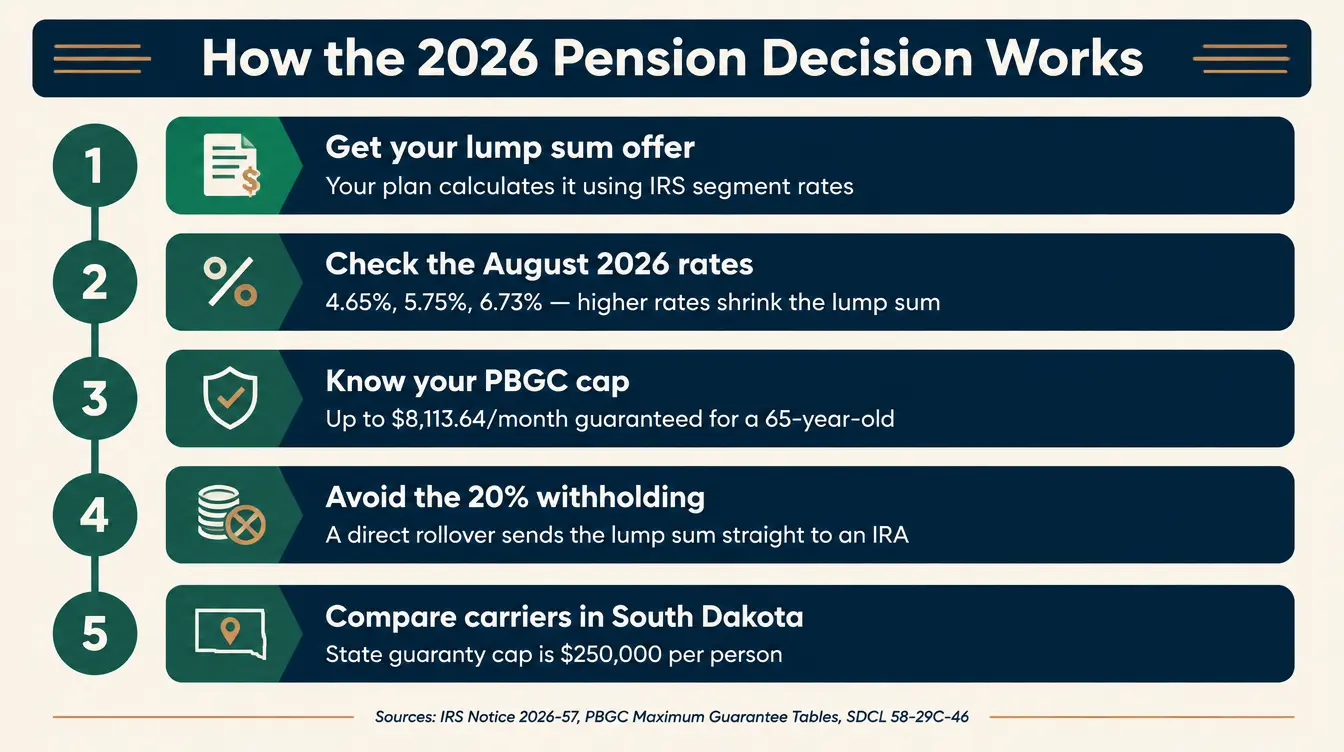
The practical effect of the segment-rate formula is this: in a higher interest-rate environment, lump sum offers shrink relative to the monthly benefit, because the math assumes your money can grow faster on its own before it is needed. That is exactly backward from how it feels; a lump sum often looks most attractive psychologically right when the formula is making it smallest. If you received a buyout offer in a year when segment rates were low, your lump sum would have been larger for the identical monthly promise. Neither number is “wrong.” They are the same promise, translated by a formula that moves with interest rates, which is also why two people with the same monthly pension amount but different buyout years can receive very different lump sum offers.
If you are weighing this decision alongside Social Security timing, our guide on whether Social Security survivor benefits actually cover your family walks through that separate, federal guaranteed-income layer, which factors into how much additional guaranteed income you may or may not need from a pension decision.
What it costs to get wrong: the 2026 numbers, and a worked illustration
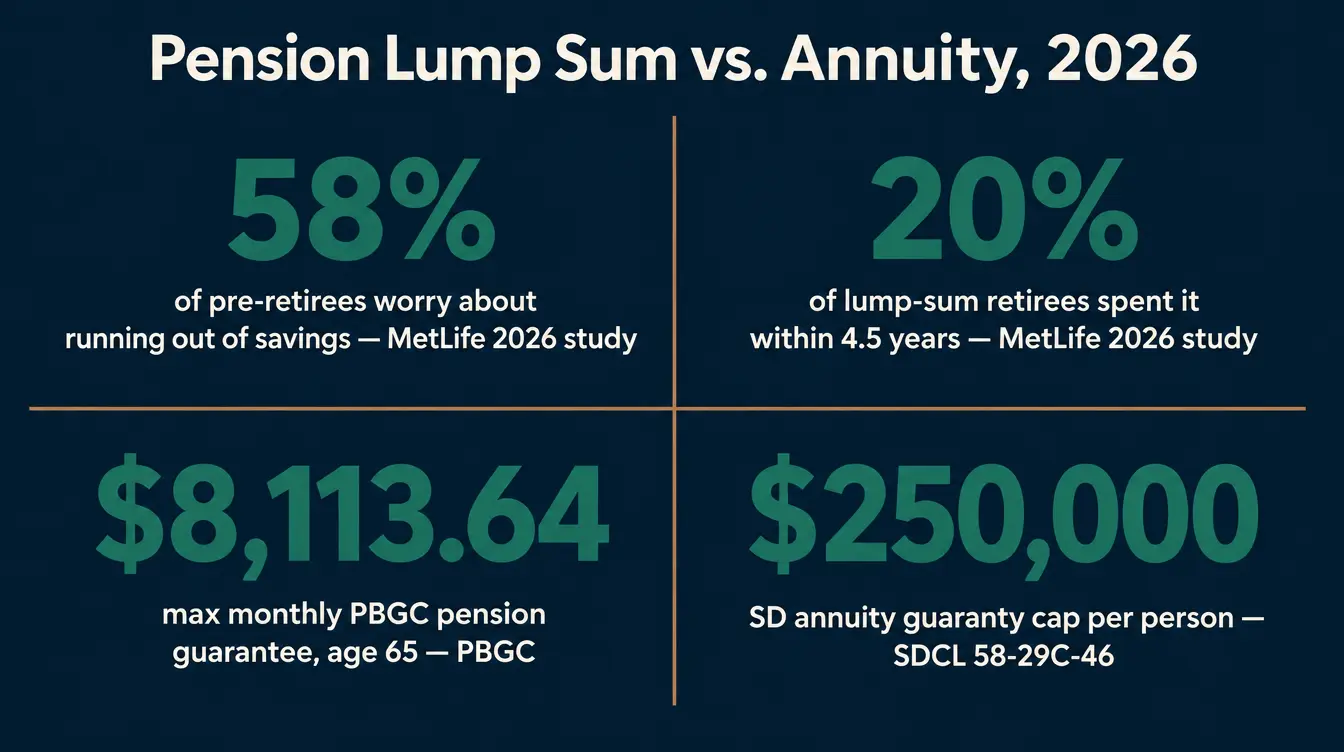
58%
of pre-retirees worry about running out of defined-contribution savings in retirement, up from about 30% a decade earlier, per MetLife's 2026 study
20%
of lump-sum retirees had spent their withdrawals within about 4.5 years on average, quicker than 5 years in 2022 and 5.5 years in 2017, per the same study
$8,113.64
maximum monthly PBGC guarantee for a 65-year-old's straight-life annuity if a 2027-terminating plan fails, per PBGC's published tables
Picture a 65-year-old in Brookings retiring from a manufacturing employer with a traditional pension, offered a choice between a $2,400-a-month single-life annuity starting immediately, or a lump sum calculated by the plan at roughly $340,000. This is an illustration of the decision mechanics only, built from round numbers, not a quote, projection, or promise for any real plan or applicant; every real plan’s formula, segment-rate stability period, and mortality assumptions will produce a different figure.
Framed only as “$2,400 a month forever” against “$340,000 today,” the lump sum can look like the clearly larger number. But $2,400 a month for the 19.7 years an average 65-year-old is expected to live, per the CDC’s 2024 life expectancy data, works out to roughly $567,000 in un-discounted total payments, before accounting for the fact that payments stop entirely at death and are not available to spend faster or leave to heirs. The lump sum, by contrast, is immediately exposed to how well it is invested, how much is withdrawn each year, and how long it actually needs to last, which could be shorter or meaningfully longer than the statistical average. Neither total is “the real number”; they measure different kinds of risk, not the same risk at two prices.
| Risk | Monthly annuity (keep the pension) | Lump sum (take the payout) |
|---|---|---|
| Outliving your money | Pays for life regardless of how long you live, as long as the plan or PBGC backstop holds | Risk sits entirely with you and your withdrawal rate; the money can run out before you do |
| Employer or insurer failure | PBGC covers up to a capped monthly amount; benefits above the cap are not protected | Once rolled over, it is no longer the plan's risk; if later used to buy an annuity, a different, state-level guaranty cap applies instead |
| Flexibility and legacy | Payments generally stop at death (unless a survivor or period-certain option was elected); little to leave heirs | Unspent balance can be left to heirs, used for a large expense, or redirected, but only if it is not drawn down first |
| Inflation | Most pension annuities pay a fixed amount with no cost-of-living adjustment, so buying power erodes over a long retirement | Invested assets have a chance, not a guarantee, of growing faster than inflation over time |
The IRS rate that shrinks (or grows) your lump sum: August 2026 segment rates
IRS Notice 2026-57, minimum present value segment rates under Internal Revenue Code Section 417(e)(3), for August 2026. These rates, or the rates for whatever month your plan's stability period specifies, are the minimum a plan may use to calculate your lump sum; a higher rate produces a smaller lump sum for the same promised monthly benefit.
A pension buyout letter hands you one number with a deadline attached. The honest first step isn't picking a side. It's finding out what formula produced that number, and what it leaves exposed either way.
Mike Moore, Life Insurance AdvisorHow to work it out yourself: six things to pull before the deadline
You do not need anyone else to start this part. Most of what actually drives the decision is already sitting in paperwork your plan is required to give you, or can be requested directly.
- Read the relative value notice, not just the offer letter. Federal pension law requires plans offering a lump sum to also provide a relative value disclosure comparing it to the monthly annuity, often using the plan’s own actuarial assumptions. This document, not the marketing-style cover letter, usually contains the real comparison.
- Check your plan’s funded status. Your plan’s annual funding notice states the ratio of assets to promised benefits. A plan funded well above 100% is a much lower risk of ever needing the PBGC backstop than one funded well below it.
- Know your PBGC exposure either way. If your monthly benefit is comfortably under the PBGC’s capped guarantee for your age (for a 65-year-old in a plan terminating in 2027, $8,113.64 a month on a straight-life basis, per PBGC’s tables), a plan failure would not reduce your check. If your benefit is well above that cap, the uninsured portion is a real, if unlikely, risk worth weighing.
- Add up every other source of guaranteed income you already have. Social Security, a spouse’s pension, and any other annuity income all reduce how much this particular decision needs to carry on its own. A household with strong guaranteed income elsewhere can afford to take more risk with a lump sum than one relying on this pension for most of its fixed costs.
- Be honest about health and family longevity, not statistics alone. The 19.7-year average life expectancy at 65 is a population average, not a prediction for you; family history, chronic conditions, and lifestyle shift the real odds in either direction, and that shift is personal, not actuarial.
- Confirm whether a partial split is available. Many, though not all, plans allow taking part of the benefit as a lump sum and the rest as a reduced monthly annuity. If your plan allows it, splitting can reduce both the “all the eggs in one basket” feeling and the all-or-nothing risk.
Steps 1 through 5 are yours to pull together today
Your relative value notice and annual funding notice should already be in your benefits paperwork, or available on request from your plan administrator. Where a second opinion tends to help most is after you have those numbers in hand, specifically in comparing what a lump sum could realistically buy back in guaranteed income from more than one carrier, since no single insurer's quote tells you what a competitor would offer for the same money.
PBGC, South Dakota’s guaranty association, and what “guaranteed” actually means in each direction
The word “guaranteed” gets used loosely in this decision, and it means something different depending on which side you are standing on. It is worth separating the two systems plainly, because they are not interchangeable and they are not sized the same.
If you keep the monthly pension, your guarantee ultimately rests on your former employer’s plan, backstopped by the federal Pension Benefit Guaranty Corporation up to a capped amount. That cap rises with Social Security’s national average wage index each year and varies by your age and the form of annuity you chose, but it is a hard ceiling, not full insurance. For a plan terminating in 2027, PBGC’s maximum guarantee is $8,113.64 a month for a 65-year-old’s straight-life annuity, or $7,302.28 a month under a joint-and-50%-survivor form (which pays less per month in exchange for continuing at half that rate to a surviving spouse), according to PBGC’s published maximum guarantee tables. Most people’s pensions sit well under this cap; a smaller number of long-tenured, higher-salary retirees from underfunded plans do not, and for them the cap is a real, specific number worth knowing rather than assuming “the government covers it.”
If you take the lump sum and later use some or all of it to buy your own annuity from an insurance company, a completely different, state-level system applies: South Dakota’s Life and Health Insurance Guaranty Association, created under SDCL Chapter 58-29C. Under SDCL 58-29C-46, if a member insurer becomes impaired or insolvent, the association covers up to $250,000 in the present value of annuity benefits per person, including cash surrender and withdrawal values, and generally no more than an aggregate of $300,000 in benefits for any one life across most policy types combined. This is industry-funded, not taxpayer-funded, and it exists specifically so that an insurance company’s failure does not automatically mean a total loss for the policyholder, though, like the PBGC cap, it is a ceiling, not a replacement for choosing a financially strong carrier in the first place.
| System | Applies to | Cap |
|---|---|---|
| PBGC (federal) | Private-sector defined benefit pension plans, if the plan fails | $8,113.64/mo for a 65-year-old, straight-life, 2027-terminating plans (varies by age and form) |
| SD Life & Health Guaranty Association (state) | Annuity or life insurance contracts you personally own, if the insurer fails | $250,000 present value of annuity benefits per person; $300,000 aggregate per life (most policy types) |
Sources: Pension Benefit Guaranty Corporation, Maximum Guarantee Tables (2027 plan-termination year); South Dakota Codified Law 58-29C-46, as amended through SL 2020, ch. 210. Figures are statutory caps, not a projection of any specific plan's or insurer's actual claims-paying ability.
Neither cap is a reason to assume failure is likely; well-funded pension plans and financially strong, highly rated insurers rarely test these limits. They matter because they change how a large lump sum should be structured if guaranteed income is the goal: spreading a sizable purchase across more than one carrier, rather than placing all of it with a single insurer, is a direct, practical way to keep more of the eventual income stream inside South Dakota’s guaranty cap per company. Our guide on South Dakota’s annuity best-interest standard covers the separate disclosure and suitability rules that apply when you are shopping for that replacement annuity.
What actually happens
- You pick based on which single number looks bigger, not on which risk fits your household
- You never check your plan's funded status or your actual PBGC exposure
- If you take the lump sum, you may not know where, or across how many carriers, to place it for the most guaranteed income back
- A default election (often the monthly annuity) applies automatically if the form isn't returned in time
What actually happens
- You know which risks (longevity, inflation, insurer or plan failure, legacy) matter most for your household
- You know your real PBGC exposure and your plan's funded status before assuming either way
- If a lump sum makes sense, you compare carriers for the income it could buy back instead of guessing at one quote
- You make the election you intended to make, on time, for a reason you can explain later
Taxes, and the one part of this decision that is simpler in South Dakota
Wherever you land on the lump sum versus annuity question, the tax mechanics are largely the same at the federal level and genuinely simpler at the state level if you live in South Dakota. South Dakota is one of seven states with no state individual income tax, according to the South Dakota Department of Revenue, which means neither a monthly pension payment nor a lump sum distribution is taxed by the state once it reaches you; the Department of Revenue’s list of individual taxes covers only sales and use, property, motor fuel, alcohol, and tobacco taxes, with no state income tax line at all. South Dakota also has no state inheritance or estate tax, which is relevant if leaving an unspent lump sum to heirs is part of why it appeals to you.
Federal tax rules are a separate matter and apply regardless of which state you live in. If your pension plan pays a lump sum directly to you rather than to another retirement account, federal law requires the payer to withhold 20% of the taxable amount for federal income tax, even if you plan to roll the money over yourself afterward, according to IRS Tax Topic 413. You then have 60 days to deposit the distribution into an IRA or another eligible plan to avoid current taxation on the rolled-over portion, but only the amount actually deposited counts; to defer tax on the full amount after 20% was withheld, you would need to make up that withheld portion from another source. A direct rollover, where the plan sends the money straight to your IRA rather than to you personally, avoids the mandatory withholding entirely. Monthly pension payments, by contrast, are simply subject to ordinary federal income tax withholding as you receive them, similar to a paycheck, with no 60-day deadline or rollover mechanics involved.
Under 59½ changes the math
If you are not yet 59½ and take a lump sum distribution yourself rather than rolling it over, the taxable portion you do not roll over may also be subject to a 10% additional federal tax on early distributions, on top of ordinary income tax, unless a specific exception applies, per IRS Tax Topic 413. This is a separate issue from the 20% withholding and can meaningfully change which option nets out ahead for someone retiring earlier than full retirement age.
When the monthly annuity is probably the better fit, and when the lump sum probably is
This is not a decision where one side is quietly the “smart” choice and the other is for people who don’t understand the math; both sides are mathematically coherent for different households. The monthly annuity tends to fit better when you have family longevity on your side, little or no other guaranteed income to lean on, a spouse who would need continued survivor income, or a straightforward preference to never have to manage or worry about an investment account in retirement. It is also the simpler path if you are not confident you, or whoever might eventually help you, would actively manage a large lump sum through decades of withdrawals.
The lump sum tends to fit better when you already have solid guaranteed income from Social Security or another pension covering essential expenses, when you have reason to expect a shorter-than-average retirement due to health or family history, when you have meaningful debt (a mortgage balance, for instance) that a lump payoff would materially improve, or when leaving money to heirs matters enough to outweigh giving up a check that pays only as long as you live. It is also the only path that lets you shop the open annuity market yourself, across multiple carriers, rather than accepting one plan’s internal pricing, which is sometimes, though not always, less competitive than what an independent purchase could buy.
It is worth saying plainly that taking the lump sum and doing nothing with it, letting it sit in a low-yield account while slowly spending it down with no plan, is the scenario behind the MetLife statistic about lump sums running out in roughly 4.5 years on average. That outcome is not inherent to lump sums; it is what happens when a lump sum is treated as found money instead of as the replacement for a paycheck it actually is.
If you are weighing this decision against other pieces of your retirement income picture, our guide on whether your retirement savings will actually last covers withdrawal-rate math separately from the pension-specific mechanics here, and is worth reading before, not instead of, this decision.
How we help
We are independent, so when you are deciding what to do with a pension lump sum, we are not trying to steer you toward annuitizing it with one company’s product because that is the only shelf we stock. If keeping the monthly pension is genuinely the better fit for your household, we say that. If a lump sum makes sense, we compare immediate income annuities, fixed annuities, and MYGA options across multiple carriers to see what guaranteed income, if any, the money could realistically buy back, and we factor in South Dakota’s guaranty association caps when deciding whether to split a large purchase across more than one insurer rather than placing all of it with one.
What you get
A side-by-side look at what your specific pension offer is actually proposing, not a generic rule of thumb. A clear read on your real exposure if your former employer’s plan or a prospective insurer ever failed, using the actual PBGC and South Dakota guaranty association caps rather than an assumption that “it’s all guaranteed anyway.” And, if a lump sum is the direction you choose, a comparison across more than one carrier for what that money could turn into as guaranteed income, so the decision is made with real numbers on both sides of the letter you were sent.
Bring your pension buyout letter and we'll work through both sides with you
We'll help you read the relative value notice, understand your PBGC exposure, and, if a lump sum fits, compare what it could realistically buy back in guaranteed income across more than one carrier.
Not ready to talk to anyone yet? Read How It Works first and come back when you are. And if you haven’t yet worked out whether your broader retirement savings, pension decision included, are actually on track to last, our guide to retirement savings longevity is a reasonable place to start that math on your own.
Frequently asked questions
Should I take a pension lump sum or keep the monthly annuity?
There is no universal right answer, because the two options trade different risks. The monthly annuity transfers longevity risk and investment risk to the pension plan (backed, if the plan fails, only up to the Pension Benefit Guaranty Corporation’s capped monthly guarantee); the lump sum hands both risks to you, in exchange for control over the money today, the ability to leave an estate, and the option to buy your own guaranteed income instead. People with strong family longevity, no other guaranteed income, or a spouse who needs survivor income generally lean toward keeping or replacing the annuity. People with shorter life expectancy, other pensions or Social Security already covering essentials, or debt to pay off generally lean toward the lump sum. Running both numbers side by side, using your own plan’s actual offer, is the only way to know which side you are on.
How is a 2026 pension lump sum offer calculated?
Your plan administrator converts your promised monthly annuity into a present-value lump sum using the interest rates required under Internal Revenue Code Section 417(e)(3), published monthly by the IRS as the minimum present value segment rates. For August 2026, those three segment rates were 4.65%, 5.75%, and 6.73%, according to IRS Notice 2026-57. Higher segment rates produce a smaller lump sum for the same promised monthly check, because less money is assumed to be needed today to grow, at that rate, into the future payments. Plans typically lock in a specific month’s rates under a stability-period rule stated in the plan document, so the rates that applied when your statement was generated may differ from this month’s rates.
What happens to my pension if my former employer’s plan fails?
The Pension Benefit Guaranty Corporation (PBGC), a federal agency, insures most private-sector defined benefit pensions up to a capped monthly amount that rises each year with Social Security wage trends. For a plan terminating in 2027, PBGC’s maximum guarantee for a 65-year-old is $8,113.64 a month as a straight-life annuity, or $7,302.28 a month under a joint-and-50%-survivor form, according to PBGC’s published maximum guarantee tables. If your promised monthly benefit is below that cap, a plan failure would not reduce your check; if it is above the cap, PBGC would only pay up to the limit. The cap does not apply to lump sums you have already taken and rolled over, since that money is no longer the plan’s obligation once it is paid out.
Does South Dakota tax a pension lump sum or monthly pension payment?
No. South Dakota is one of seven states with no state individual income tax, according to the South Dakota Department of Revenue, so it does not tax pensions, 401(k) or IRA withdrawals, Social Security, or a pension lump sum at the state level. Federal income tax still applies to the taxable portion of any distribution, and a lump sum paid directly to you (rather than rolled over) is generally subject to mandatory 20% federal withholding on the taxable amount, per IRS Tax Topic 413. South Dakota also has no state inheritance or estate tax, which matters if leaving money behind, rather than spending it down, is part of your decision.
If I take the lump sum and buy my own annuity in South Dakota, what happens if that insurance company fails?
South Dakota’s Life and Health Insurance Guaranty Association provides a backstop, but it is capped well below most insurers’ actual claims-paying strength and below the PBGC’s pension guarantee in dollar terms. Under South Dakota Codified Law 58-29C-46, the association covers up to $250,000 in the present value of annuity benefits per person, and no more than $300,000 in total benefits for any one life across most policy types. This is a separate, state-level, industry-funded system from the federal PBGC, and it is why comparing more than one carrier’s financial strength, not just its quoted payout, is part of deciding where to place a lump sum.
Can I split the decision and take part lump sum, part monthly annuity?
Many, though not all, pension plans allow a partial lump sum alongside a reduced monthly annuity; the option has to exist in your specific plan document, so check your benefit election paperwork or ask your plan administrator directly rather than assuming it is available. Where it is offered, splitting can let you keep enough guaranteed monthly income to cover essential bills while taking a smaller lump sum for debt payoff, a near-term need, or your own supplemental annuity purchase, rather than treating the choice as all-or-nothing.
What is the mandatory 20% withholding on a pension lump sum, and how do I avoid it?
If your plan pays an eligible rollover distribution directly to you rather than to another retirement account, federal law requires the payer to withhold 20% of the taxable amount for federal income tax, even if you intend to roll the money over yourself within 60 days, according to IRS Tax Topic 413. To avoid that withholding, you request a direct rollover, where the plan sends the money straight to an IRA or another eligible employer plan on your behalf; no withholding applies to a direct rollover. If you take the distribution yourself and want to roll over the full taxable amount, you would need to add funds from another source to replace the 20% withheld, since only the amount actually deposited within 60 days avoids current taxation.
How many years will a lump sum realistically need to last?
There’s no way to know your own date in advance, but life expectancy tables give a planning baseline. For a 65-year-old in 2024, overall life expectancy at that age was 19.7 more years, 20.8 years for women and 18.4 years for men, according to the CDC’s National Center for Health Statistics Data Brief No. 548. That is an average across the whole population; it says nothing about your own health or family history, and roughly half of 65-year-olds will live longer than their sex-specific average. A lump sum invested to last 20 years and a lump sum invested to last 30 years require very different withdrawal strategies, which is one reason a monthly annuity, which pays for exactly as long as you live, removes a risk a lump sum cannot fully remove on its own.
Before you decide
This article is general education, not insurance, legal, financial, or tax advice. Pension lump sum offers, PBGC coverage, guaranty association limits, and annuity availability vary by plan, carrier, and individual circumstances, and are subject to each plan's and insurer's own terms. No annuity coverage exists until a contract is issued and in force. Any guarantees are subject to the claims-paying ability of the issuing insurer or, for a pension, the plan's funded status and the PBGC's statutory limits. Please review your plan's actual relative value notice and speak with a licensed agent, a tax professional, and your plan administrator about your specific situation.
Sources
- MetLife — 2026 Paycheck or Pot of Gold: Retirement Income Strategy Study — 58% of pre-retirees and 51% of retirees worry about running out of money; 20% of lump-sum retirees exhausted withdrawals in about 4.5 years on average; survey fielded October 8-31, 2025, released February 10, 2026
- Pension Benefit Guaranty Corporation — Maximum Monthly Guarantee Tables — maximum PBGC guarantee for a 65-year-old: $8,113.64/month straight-life, $7,302.28/month joint-and-50%-survivor, for plans terminating in 2027
- Internal Revenue Service — Notice 2026-57, Update for Weighted Average Interest Rates, Yield Curves, and Segment Rates — minimum present value segment rates under IRC §417(e)(3) for August 2026: 4.65%, 5.75%, 6.73%
- Internal Revenue Service — Tax Topic 413, Rollovers from Retirement Plans — mandatory 20% withholding on eligible rollover distributions paid directly to the recipient; direct rollovers avoid withholding; 60-day rollover deadline; 10% additional tax on early distributions under age 59½
- South Dakota Department of Revenue — Individual Taxes — South Dakota is one of seven states with no state individual income tax; no state inheritance or estate tax
- South Dakota Legislature — SDCL 58-29C-46 — South Dakota Life and Health Insurance Guaranty Association coverage limits: $250,000 present value of annuity benefits per person; $300,000 aggregate benefits per life for most policy types; as amended through SL 2020, ch. 210
- National Association of Insurance Commissioners — Insurance Topics: Annuities — definitions of immediate annuities, fixed deferred annuities, and indexed annuities; page last updated September 30, 2026
- CDC National Center for Health Statistics — Data Brief No. 548, Mortality in the United States, 2024 — life expectancy at age 65 in 2024: 19.7 years overall, 20.8 years for women, 18.4 years for men
Related reading: Will Your Retirement Savings Last? A South Dakota Guide, South Dakota’s Annuity Best Interest Law: A 2026 Guide, Does SDRS Cover Your Family If You Die? A 2026 SD Guide, and Does Social Security Cover My Family If I Die? 2026 Guide. See current options for fixed indexed annuities and immediate income annuities, or learn more about how we work.