
An immediate income annuity, also called a single premium immediate annuity or SPIA, is a contract you buy with one lump sum that starts paying you a guaranteed monthly income within a year, according to the National Association of Insurance Commissioners. You are not investing the money and waiting for it to grow. You are handing an insurance company a sum you already have and converting it, immediately, into a paycheck that keeps arriving for the rest of your life or for a period you choose. That trade, a lump sum for an income stream you cannot outlive, is the entire product. Understanding it well enough to decide whether it fits your situation is the point of everything below.
The short version
- An immediate annuity converts a one-time premium into income payments that start within one year, unlike deferred products such as fixed indexed annuities or MYGAs, which grow money for years before payout, per the National Association of Insurance Commissioners.
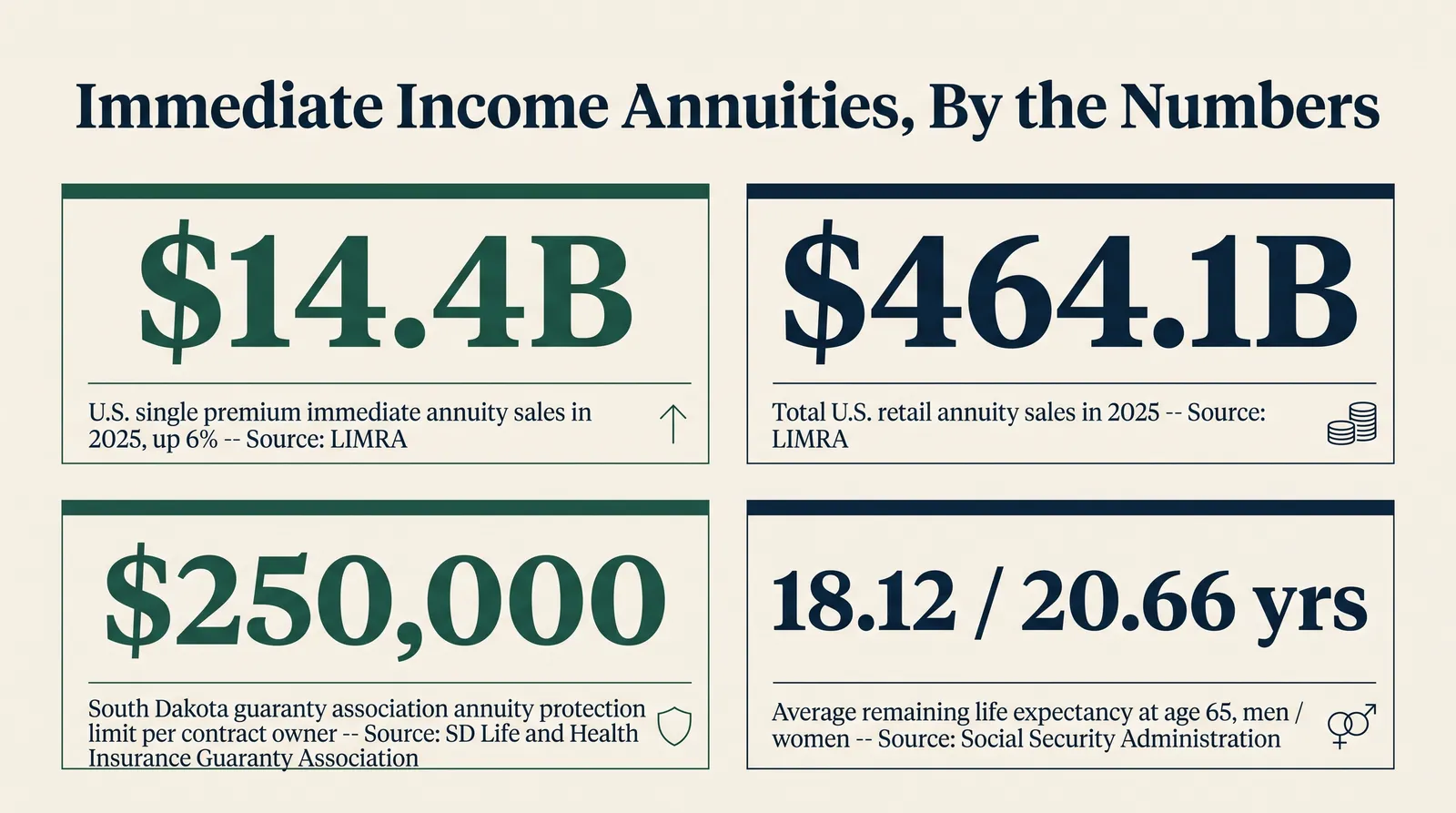
- U.S. single premium immediate annuity sales reached $14.4 billion in 2025, up 6% from 2024, while total U.S. retail annuity sales hit $464.1 billion, up 7%, according to LIMRA's final 2025 report.
- Once you buy an immediate annuity and the free-look period ends, the decision is generally irreversible. There is no cash value to withdraw the way there is with a deferred annuity.
- South Dakota's Life and Health Insurance Guaranty Association covers annuity benefits up to $250,000 in present value per contract owner if a carrier becomes insolvent, capped at $300,000 in aggregate on any one life, per the association's published FAQ.
- A 65-year-old man had an average of 18.12 years of remaining life expectancy and a 65-year-old woman 20.66 years, based on 2023 mortality data used in the Social Security Administration's 2026 Trustees Report, a figure that sits behind how insurers price every immediate annuity.
The pain: you have the money, and no idea how to turn it into a paycheck
You did the hard part. You saved through a 401(k), took a pension buyout instead of the monthly check, sold a farm or a business, or received an inheritance you were not expecting, and now there is a number sitting in an account, $150,000, $250,000, $400,000, that has to somehow become the income you live on for the next twenty or thirty years. Nobody handed you an instruction manual for that part.
The fear underneath it is specific, even when people describe it vaguely. It is not “what if I lose money.” It is “what if I am 84 and the money is gone and I am still alive.” That fear has a name in the financial world, longevity risk, and it is different from every other risk you managed while you were working. A bad year in the stock market during your career meant your balance dipped and you kept contributing until it recovered. A bad twenty years in retirement, where you outlive your savings by a decade or more, has no recovery play. You cannot go back to work at 87.
An immediate income annuity exists to solve exactly that fear, and only that fear. It does not grow your money. It does not protect against inflation on its own. It does not offer flexibility if your plans change. What it does is guarantee that a check keeps arriving as long as you are alive, transferring the specific risk of outliving your money from you to an insurance company, which is set up to absorb that risk across a large pool of people. Whether that trade is worth the tradeoffs, giving up access to the lump sum, giving up growth potential, locking in today’s rates, is a real decision, not an obvious one, and it depends on what else you have.
This is general education, not a recommendation
Nothing here tells you to buy or avoid an immediate income annuity, or to take a lump sum instead of a monthly pension. It explains the actual mechanics, using the NAIC's own definitions and current 2026 industry and regulatory data, so you can read a real quote and know what questions to ask before you commit a lump sum you cannot get back.
Why it happens: mortality pooling is the whole mechanism
Here is the part almost nobody explains clearly: how can an insurance company promise to pay you income for the rest of your life, however long that turns out to be, without simply running out of your money if you live to 100?
The answer is mortality pooling, sometimes called mortality credits, and it is not a trick. The insurer takes your premium and pools it with premiums from thousands of other people who bought the same kind of contract around the same time. Some of those people will die at 70. Some will live to 98. The insurer does not know which group you are in, and neither do you. But across a large enough pool, the insurer can predict the average outcome with real precision, using actuarial tables built from decades of mortality data, the same category of data the Social Security Administration publishes in its own period life tables.
The people who die earlier stop drawing income, and the money that would have kept paying them stays in the pool, effectively subsidizing the payments still going out to people who live longer. That subsidy, mortality pooling, is what lets an insurer pay you more each month from an immediate annuity than you could safely pay yourself by simply withdrawing the same lump sum on your own and investing the rest, especially at older ages where the pooling effect is stronger. It is also exactly why the money is not yours to get back once you buy the contract: the pooling mechanism only works because premiums stay in the pool.
To make this concrete, based on mortality experience in 2023 as used in the Social Security Administration’s 2026 Trustees Report, a person who is exactly 65 today has an average remaining life expectancy of 18.12 more years if male, or 20.66 more years if female. At age 70, that drops to 14.66 years for a man and 16.76 years for a woman. Nobody knows their own actual number, which is precisely the uncertainty an immediate annuity is built to absorb: the insurer is pricing across the whole distribution, not betting on any one person’s outcome, and your monthly payment reflects that pooled math, not a guess about you individually.
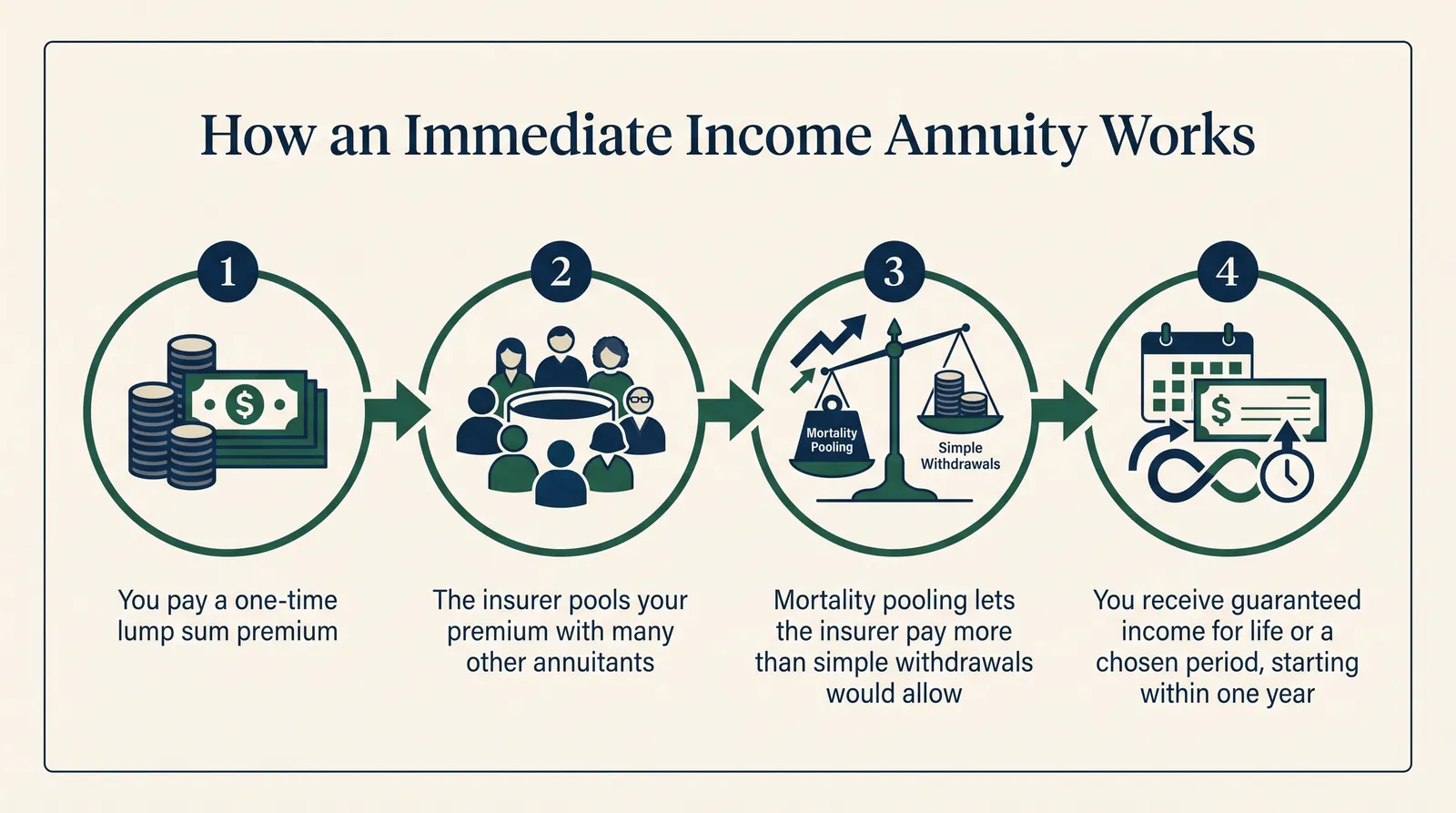
The payout option you choose changes how that pooling math plays out for your family, and it is the single most consequential decision in the entire purchase, because it cannot be changed once the contract is issued.
| Payout option | What it pays | What happens if you die early | Typical effect on monthly income |
|---|---|---|---|
| Life only | Income for as long as you live | Payments stop; nothing passes to heirs | Highest monthly amount of the three |
| Life with period certain (e.g. 10 or 20 years) | Income for life, with a guaranteed minimum number of years | Remaining guaranteed payments go to your named beneficiary | Lower than life only; longer certain period lowers it further |
| Joint and survivor | Income for as long as either you or a named second person lives | Payments continue to the survivor, often at a reduced percentage | Lower than single-life options, reflecting two lives covered |
Structure of common payout options; exact terms, percentages, and availability vary by carrier and specific contract. Consult an actual illustration for your options.
What it costs to get wrong: irrevocability is not fine print, it is the product
The single biggest way people get hurt by an immediate annuity is funding it with money they end up needing back. There is no surrender feature to fall back on the way there sometimes is with a deferred annuity. Beyond the state-required free-look period, typically 10 to 30 days after you receive the contract, the lump sum is gone in exchange for the income stream. If your furnace fails, if a grandchild needs help, if a health event creates a large unplanned bill, the money that used to be liquid savings is now a fixed monthly check, and no amount of asking will turn it back into a lump sum.
This is not a hidden trap. It is disclosed clearly in every contract. It is simply the part people underweight when they are focused on the appeal of guaranteed income and are not thinking hard enough about the version of the future where they need a large sum of cash on short notice. The right amount of money to put into an immediate annuity is the amount you are confident you will never need back as a lump sum, not the full balance of an account just because it exists.
The second real risk is inflation. A level, non-adjusting immediate annuity pays the same dollar amount every month for as long as it pays at all. $2,000 a month feels comfortable today. Over decades of even modest inflation, that same $2,000 buys meaningfully less. Some contracts offer a cost-of-living adjustment rider, which raises the payment over time in exchange for a lower starting amount, a real tradeoff with no universally right answer; it depends on how much other inflation-protected income, such as Social Security, you already have.
The environment these contracts are sold into matters too. U.S. retail annuity sales reached $464.1 billion in 2025, up 7% from 2024, and single premium immediate annuities alone accounted for $14.4 billion of that, up 6% from the prior year, according to LIMRA’s final 2025 sales report published in March 2026. Deferred income annuities, a related but distinct product that lets you delay the start of payments to a future date you choose, added another $4.8 billion, down 3% from 2024, per the same report. That is a genuinely active market, which cuts both ways: more competition among carriers can mean better payout rates for shoppers, but it also means more sales pressure, and pressure is exactly the wrong condition under which to make an irrevocable decision.
U.S. single premium immediate annuity (SPIA) sales, 2024 vs. 2025
LIMRA, "LIMRA: Final U.S. Retail Annuity Sales Set New Sales High, Totaling $464.1 Billion in 2025" (March 23, 2026). The 2024 figure is calculated from LIMRA's reported 6% year-over-year increase to $14.4 billion in 2025; LIMRA did not separately restate the 2024 total in this release.
$14.4B
U.S. SPIA sales in 2025, up 6% from 2024, per LIMRA
$250K
South Dakota guaranty association annuity protection limit per contract owner
4.70%
10-year Treasury yield, August 3, 2026, per the Federal Reserve's FRED database
Why include a Treasury yield here at all? Because it is genuine context, not a promise about your payout. Insurers back immediate annuity payments largely with high-quality bonds, so the prevailing interest-rate environment shapes what payout rates carriers can afford to offer at any given time, even though no specific quote is tied to the 10-year Treasury by formula. A 4.70% 10-year Treasury yield as of August 3, 2026, per the Federal Reserve Bank of St. Louis’s FRED database, is one piece of backdrop worth knowing when you compare a quote you receive today against one you might get a year from now.
You are not buying an investment. You are buying the transfer of one specific risk, the risk of outliving your money, from yourself to an insurance company.
Mike Moore, Life Insurance AdvisorA worked comparison: the same $250,000 lump sum, three approaches
Take a hypothetical 68-year-old retiree in Rapid City who rolled a 401(k) into an IRA and, separately, received a $250,000 pension buyout offer instead of a monthly pension check. Pennington County, home to Rapid City, had an estimated population of 116,792 in 2025, according to the U.S. Census Bureau’s county population estimates as published through the Federal Reserve’s FRED database, and a meaningful share of that population is at or near retirement age, the exact stage where this decision comes up. This example is illustrative only, built to show how the approaches differ mechanically, not a quote, a projection, or a promise of any outcome.
| Approach | Monthly income, illustrative | Access to the lump sum later | What happens if the retiree lives to 95 |
|---|---|---|---|
| Buy an immediate annuity, life only | Highest of the three, hypothetical example only | None; the sum is converted to income | Income keeps paying, unaffected by how long the money would have otherwise lasted |
| Buy an immediate annuity, 20-year period certain | Lower than life only, hypothetical example only | None during the contract; unpaid guaranteed years pass to a beneficiary if death occurs early | Income keeps paying past year 20 for as long as the retiree is alive |
| Keep the $250,000 invested and withdraw a set percentage annually | Varies year to year with account performance and the withdrawal rate chosen | Full access to the remaining balance at any time | Depends entirely on investment performance and withdrawal discipline; running out is possible |
Illustrative example only. Actual payout amounts depend on age, sex, payout option, the specific carrier, and interest rates at time of purchase; get a real quote before comparing numbers. See our related guide on whether retirement savings will last for more on withdrawal-rate mechanics.
The pattern in that table is the actual decision, stripped of marketing language. An immediate annuity trades the lump sum, permanently, for a number that keeps arriving no matter how long the retiree lives, which is exactly the protection someone worried about longevity risk is looking for. Staying invested keeps every dollar accessible and gives it a chance to grow, but shifts the entire risk of running out back onto the retiree’s own withdrawal discipline and the market’s cooperation. Neither approach is correct in the abstract. The right answer depends on how much other guaranteed income, Social Security, a pension that was not taken as a lump sum, another annuity, is already covering fixed expenses, and how much of this specific $250,000 the retiree can honestly say they will never need back as a lump sum.
How the income is actually taxed
The tax treatment of an immediate annuity payment depends entirely on how you funded it, and it surprises people in both directions.
If you funded the annuity with pre-tax money, a traditional 401(k) or IRA rollover being the most common case, every dollar of every payment is generally taxable as ordinary income when you receive it, the same as it would have been had you simply withdrawn the money directly, according to how the IRS treats qualified retirement distributions.
If you funded the annuity with after-tax money, savings, an inheritance, or proceeds from selling property, the IRS applies what it calls the General Rule, described in Publication 939. Under this rule, the IRS calculates an exclusion ratio, your total investment in the contract divided by your total expected return over the contract’s payout period, using actuarial tables built around your age at the time payments start. That ratio determines what percentage of every single payment counts as a tax-free return of your own principal, with the remainder taxed as ordinary income.
Here is a simplified version of the math, for illustration only and not a substitute for the actual Publication 939 tables or a tax professional’s calculation: say a retiree puts $100,000 of after-tax savings into a life-only immediate annuity, and based on the IRS actuarial tables for that retiree’s age, the expected total return over their life expectancy works out to $160,000. The exclusion ratio is $100,000 divided by $160,000, or 62.5%. On a $1,000 monthly payment, $625 would be treated as a tax-free return of principal and $375 as taxable ordinary income, every month, until the retiree’s investment in the contract is fully recovered; after that point, the entire payment typically becomes taxable. This is a teaching example with invented numbers, not a real calculation; ask your carrier or tax preparer for the actual exclusion ratio on any specific quote.
Ask for the exclusion ratio before you compare quotes
Two illustrations showing the same gross monthly payment can produce very different after-tax income if one was funded with pre-tax retirement money and the other with after-tax savings. Always compare after-tax numbers, not the headline payment, and confirm the source of funds with whoever prepares your taxes before you sign anything.
How to work it out yourself: five things to check before you buy
You can do all five of these with real quotes and the actual contract disclosure, no one else required.
- Get quotes from more than one carrier for the same payout option and the same premium amount. Payout rates for the same product type vary meaningfully by carrier, and the only way to see that spread is to ask more than one company for the same comparison, using your actual date of birth and payout choice.
- Decide the payout option before you shop, not after. Life only, life with a period certain, or joint and survivor produce materially different monthly amounts and materially different outcomes for a spouse or heirs. This choice is locked in once the contract is issued, so settle it with your actual family situation in mind first.
- Confirm the source of funds and ask for the exclusion ratio. Pre-tax money is taxed differently than after-tax money, and the exclusion ratio changes the real, after-tax number you should be comparing across offers.
- Check the carrier’s financial strength rating and understand South Dakota’s guaranty limits. No specific rating is a substitute for your own judgment, but it is a data point worth having, and it matters more the larger the premium is relative to South Dakota’s $250,000 per-contract-owner guaranty limit.
- Only fund it with money you are confident you will never need back as a lump sum. This is the step people skip because it requires being honest about future uncertainty, not just current comfort. If there is real doubt, consider annuitizing only part of the lump sum and keeping the rest liquid.
You can request these quotes yourself
All five steps above just require asking carriers for real, apples-to-apples quotes and reading the disclosure they are required to give you. Where a second opinion tends to help is getting several carriers' numbers side by side on the same payout option, since a single company's illustration cannot show you whether its offer is competitive.
If you would rather have someone local pull those comparisons together than call several carriers yourself, that is what we do: Compare My Options.
When an immediate annuity is genuinely not the right tool
It is worth saying plainly: if there is any real chance you will need a large lump sum back within the next several years, for a health event, to help a family member, or simply because your plans are not settled, an immediate annuity works against you, not for you. The irrevocability that makes it valuable to someone who is certain about the money is a liability to someone who is not. A high-yield savings account, a short MYGA, or simply staying invested and liquid is very likely the better fit in that situation.
The product also is not designed to fight inflation on its own, and if protecting purchasing power over a long retirement matters more to you than eliminating longevity risk, a level, non-adjusting immediate annuity may not be the right primary tool, even though a cost-of-living rider can partly address it at the cost of a lower starting payment. And if you already have enough guaranteed income from Social Security, a pension you kept as a monthly benefit, or another annuity to cover your fixed expenses, adding an immediate annuity may simply reduce your flexibility without solving a problem you actually have.
The opposite is also true. If you are specifically afraid of outliving your money, and you have already set aside a separate emergency reserve you will not touch, an immediate income annuity is solving a real, well-defined problem: it removes the guesswork of how long the money has to last by making the answer “for as long as you live,” a genuinely different guarantee than any investment account can offer. Our related guide on whether your retirement savings will last goes deeper on withdrawal rates and Social Security timing, and our comparison of fixed indexed annuities covers the accumulation-phase alternative if you are not ready to start income yet.
How we help
We are independent, so we are not built around any one carrier’s payout table. We start with what the lump sum actually needs to do, income you can count on for the rest of your life, a bridge until Social Security or a pension starts, or simply a safer alternative to managing withdrawals yourself, and then compare payout rates and payout options across carriers against that specific goal. If a deferred annuity, a MYGA, or keeping the money invested and liquid turns out to fit better, we say so, because the point is matching the tool to what you actually need in Rapid City or anywhere else in South Dakota, not filling a quota for any one product.
What you get
A plain comparison of real payout quotes from more than one carrier, for the same payout option and premium amount, so you can see the actual spread instead of a single company’s number presented as the only option. A clear read on the exclusion ratio and what it means for your after-tax income, based on how you actually funded the annuity. And an honest answer about whether locking in guaranteed income now fits your specific situation, or whether staying liquid, or splitting the difference and annuitizing only part of the lump sum, serves you better.
Get real quotes before you decide anything irreversible
We will pull payout comparisons across carriers for the same payout option and premium, walk through the exclusion ratio on your actual numbers, and lay out the alternatives before you commit a lump sum you cannot get back.
Not ready to talk to anyone yet? Read How It Works first and come back when you are.
Frequently asked questions
What is an immediate income annuity and how is it different from a fixed indexed annuity or a MYGA?
An immediate annuity is purchased with a one-time contribution and provides income payments to the annuitant within one year of purchasing the contract, according to the National Association of Insurance Commissioners. That is the opposite of a deferred annuity, fixed, fixed indexed, or a multi-year guaranteed annuity (MYGA), which are purchased to accumulate value over years before you touch the money. A fixed indexed annuity or a MYGA answers the question “how do I grow this safely for later.” An immediate income annuity answers a different question entirely: “how do I turn this lump sum into a paycheck starting now.” You generally cannot get the lump sum back once you buy an immediate annuity, which is the tradeoff for the income it guarantees.
How much monthly income will a lump sum actually generate?
It depends on your age, sex, the payout option you choose, interest rates at the time of purchase, and the specific carrier’s pricing, so there is no single honest answer without an actual quote. What drives the number is a mechanic called mortality pooling: the insurer pools your premium with many other annuitants, and people who die earlier effectively subsidize the payments of people who live longer, letting the insurer pay each surviving annuitant more than a simple withdrawal-and-interest calculation would produce alone. Because your own life expectancy is part of that formula, a real quote is the only way to know your number; anyone who quotes a payout rate without your date of birth and payout option is estimating, not quoting.
Is the income from an immediate annuity taxable?
It depends on how you funded it. If you bought the annuity with pre-tax retirement money, such as a traditional 401(k) or IRA rollover, the entire payment is generally taxable as ordinary income when you receive it. If you bought it with after-tax money, such as savings, an inheritance, or proceeds from a sale, the IRS’s General Rule applies an exclusion ratio: a fixed percentage of each payment is treated as a tax-free return of your own principal, and the rest is taxable, calculated using the actuarial tables in IRS Publication 939. Ask your carrier for the exclusion ratio on any illustration before you compare after-tax income across products.
What happens to the money if I die earlier than expected?
That depends entirely on the payout option you select when you buy the contract, and this is the single most important decision in the entire purchase. A life-only payout stops paying the day you die, with nothing left for heirs, in exchange for the highest possible monthly income. A life-with-period-certain payout guarantees payments for a minimum number of years (commonly 10 or 20) even if you die sooner, with the remainder going to a named beneficiary, in exchange for a somewhat lower monthly amount. A joint-and-survivor payout continues, often at a reduced percentage, for as long as either you or a named second person, typically a spouse, is alive. None of these options can be changed after the contract is issued, so the choice has to fit your actual family situation before you sign, not after.
Is my money protected if the insurance company that issued the annuity fails?
South Dakota law provides a backstop through the South Dakota Life and Health Insurance Guaranty Association, which covers annuity benefits up to $250,000 in present value per contract owner if a member insurer becomes insolvent, capped at an aggregate $300,000 across all policies from that insurer on the same life, according to the association’s published FAQ. That protection is not a reason to skip due diligence on a carrier’s financial strength ratings, and it does not cover every product structure, but it is a real, state-backed limit worth knowing before you commit a lump sum larger than $250,000 to a single company.
Can I change my mind and get my money back after I buy an immediate annuity?
Generally, no, beyond a short free-look period required by state law that typically runs 10 to 30 days from delivery of the contract. After that window closes, a single premium immediate annuity has no cash value to surrender and no liquidity provision the way a deferred annuity does; you converted a lump sum into a stream of income, and that conversion is not reversible. This is the central tradeoff of the entire product category, and it is exactly why you should never fund an immediate annuity with money you might need in a lump sum for an emergency, a large purchase, or a health event.
Should I take my pension as a lump sum and buy my own immediate annuity, or just take the monthly pension?
Both convert a sum of money into guaranteed lifetime income using the same basic mortality-pooling mechanic, so the real comparison is the payout rate, the payout options offered, and the financial strength of the entity standing behind the promise, your former employer’s pension plan (backed federally by the Pension Benefit Guaranty Corporation up to its own limits) versus an insurance carrier (backed by South Dakota’s guaranty association up to its limits). Shopping a lump sum across multiple insurance carriers sometimes produces a higher payout than the pension plan’s own annuity option, and sometimes it does not; the only way to know is to get an actual comparison, not to assume either side wins by default.
Does South Dakota regulate how immediate annuities are sold?
Yes. South Dakota adopted the NAIC’s 2020 Annuity Best Interest Model, and any producer selling, soliciting, or negotiating annuities in the state, immediate or deferred, has had to complete a specific training requirement since it took effect on January 1, 2023, according to the South Dakota Division of Labor and Regulation. Producers licensed on or after that date must complete a one-time four-hour annuity best interest course before selling any annuity; producers licensed earlier had to complete a one-hour update course by June 30, 2023. A producer who has not met this requirement is not authorized to recommend or sell annuities in South Dakota.
Before you sign anything
This article is general education, not insurance, legal, financial, or tax advice. Product availability, payout rates, payout options, exclusion ratios, and guaranty coverage vary by carrier, contract, and individual circumstances, and are subject to underwriting and current product terms. No coverage exists until a contract is issued and in force. Any guarantees are subject to the claims-paying ability of the issuing insurer. Please review actual contract documents and speak with a licensed agent and a tax professional about your situation.
Sources
- LIMRA — LIMRA: Final U.S. Retail Annuity Sales Set New Sales High, Totaling $464.1 Billion in 2025 — published March 23, 2026; total 2025 annuity sales and SPIA/DIA sales figures
- National Association of Insurance Commissioners — Insurance Topics: Annuities — definitions of immediate annuities and deferred annuities
- South Dakota Life and Health Insurance Guaranty Association — Frequently Asked Questions — annuity present value coverage limit and aggregate per-life cap
- Social Security Administration — Actuarial Life Table — life expectancy at ages 65 and 70 by sex, 2023 mortality data as used in the 2026 Trustees Report
- Federal Reserve Bank of St. Louis (FRED) — 10-Year Treasury Constant Maturity Rate — observation for August 3, 2026
- Federal Reserve Bank of St. Louis (FRED) — Resident Population in Pennington County, SD — 2025 population estimate, sourced from the U.S. Census Bureau
- South Dakota Division of Labor and Regulation — Annuity Best Interest Standards — producer training requirements effective January 1, 2023, under the NAIC 2020 Annuity Best Interest Model
- Internal Revenue Service — About Publication 939, General Rule for Pensions and Annuities — exclusion ratio method for taxing annuity payments funded with after-tax money
- Internal Revenue Service — Topic no. 410, Pensions and annuities — tax treatment of pension and annuity distributions
Related reading: Fixed Indexed Annuities Explained: A 2026 South Dakota Guide, MYGA vs. CD: Which Wins for South Dakota Savers in 2026? and Will Your Retirement Savings Last? A South Dakota Guide. See current options for an immediate income annuity or a fixed annuity, or learn more about who we help.