Usually not, once the decree is final. If you are divorcing after 50, the life insurance and Social Security assumptions built during a long marriage mostly stop applying to you the moment the divorce is final, whether or not anyone told you so at the settlement table. South Dakota law automatically strips your former spouse’s name off your own beneficiary designations, and it works the other way too. Nothing requires your ex to name you, or keep you, as a beneficiary on anything unless the divorce decree says so in writing. This guide walks through what South Dakota statutes, federal Social Security rules, and the actual research on gray divorce say about what changes financially, using real numbers, so you can figure out what you are actually exposed to instead of guessing.
The short version
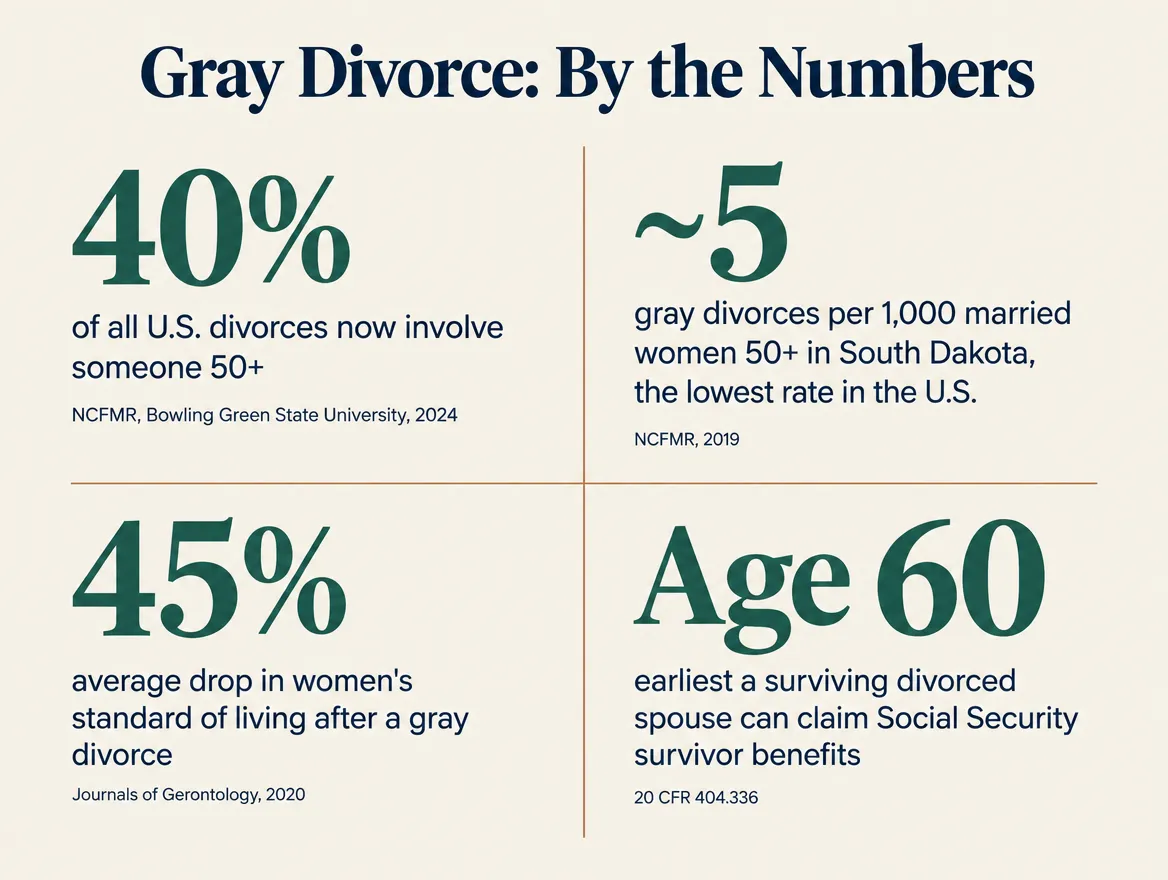
- Gray divorce, meaning divorce at 50 or older, has grown from 8% of all U.S. divorces in 1990 to nearly 40% in 2022, according to the National Center for Family & Marriage Research (NCFMR) at Bowling Green State University.
- South Dakota had the lowest gray divorce rate of any U.S. state in a 2017 analysis, about 5 divorces per 1,000 married women 50 and older, roughly half the national rate of 10.3 that year, per NCFMR researcher Colin Allred.
- South Dakota's SDCL 29A-2-804 automatically revokes a beneficiary designation naming a former spouse the moment a divorce is final, on life insurance and almost everything else, unless the decree says otherwise in writing.
- Women's standard of living drops an average of 45% after a gray divorce and men's drops 21%, with roughly a 50% drop in wealth for both, according to a 2020 peer-reviewed study in the Journals of Gerontology using Health and Retirement Study data.
- A surviving divorced spouse generally cannot claim a Social Security benefit on an ex's record until age 60, even after a 10-plus-year marriage, under 20 CFR 404.336, which leaves a real income gap for anyone divorced in their 50s.
Why “I’m still covered somehow” is the wrong assumption
Here is the pain point in the words we actually hear: we were married for decades, so surely something from all that joint planning still applies to me. It usually does not, and the reason is a specific, boring piece of law that most people never read until it already applies to them.
Gray divorce is the term family researchers use for a divorce involving someone age 50 or older. It is a distinct category worth naming because the financial mechanics are different from a divorce at 30: retirement accounts instead of a starter home, a Social Security earnings record built over 25 or 30 years instead of five, and, often, health issues that were never underwritten because one spouse was covered as a dependent on the other’s employer plan the whole time. A beneficiary designation is the instruction on file with an insurer naming who receives a policy’s payout; it is a form, not a permanent legal status, and it can be changed, revoked, or automatically voided depending on what happens in your life. Alimony, also called spousal support, is court-ordered payment from one former spouse to the other after divorce; South Dakota courts set it case by case, with no fixed formula. A surviving divorced spouse benefit is a specific category of Social Security benefit, separate from a regular survivor benefit, that a person can claim on a deceased ex-spouse’s earnings record under its own set of rules.

None of this is a secret, but none of it is intuitive either, and divorce settlement conversations tend to focus on splitting what exists today, the house, the 401(k), the pension, rather than on what happens to income replacement going forward. That gap is where this pain point lives.
How common is gray divorce, really, and how common is it here?
Before getting into the mechanics, it helps to know the actual scale of what is being discussed, because South Dakota’s numbers cut against the national story in an interesting way.
Nationally, gray divorce has become a much bigger share of all divorce than it used to be. In 1990, only 8% of people going through a divorce were 50 or older; by 2022, that share was nearly 40%, according to the NCFMR’s Family Profile FP-24-12 (Westrick-Payne & Brown, published April 30, 2024), which analyzed 2022 American Community Survey data. That same analysis found the median marriage lasted 29 years before a first gray divorce, with a quarter of those marriages lasting 37 years or longer. This is not a story about people who married young and split up quickly; it is mostly long marriages ending late.
South Dakota, though, does not track the national trend the way you might expect. A separate NCFMR analysis of 2017 data, “Gray Divorce Rate in the U.S.: Geographic Variation” (Allred, Family Profile FP-19-20, published 2019), found South Dakota had the lowest gray divorce rate of any state in the country that year, about 5 divorces per 1,000 married women age 50 and older, compared to a national rate of 10.3 per 1,000 the same year. Nationally, that rate had already more than doubled between 1990 (4.9 per 1,000) and 2008 (10.7 per 1,000) before leveling off. South Dakota’s overall divorce rate, all ages combined, was 2.3 per 1,000 population in 2023, against a marriage rate of 5.9 per 1,000, according to the CDC’s National Center for Health Statistics state data page.
National gray divorce rate, per 1,000 married women age 50+
Source: National Center for Family & Marriage Research, Bowling Green State University. Allred, "Gray Divorce Rate in the U.S.: Geographic Variation, 2017," Family Profile FP-19-20 (2019).
| Measure | Figure | Period |
|---|---|---|
| Share of all U.S. divorces involving someone 50+ | 8% (1990) → nearly 40% (2022) | 1990-2022 |
| Median marriage length before a first gray divorce | 29 years | 2022 |
| National gray divorce rate, per 1,000 married women 50+ | 10.3 | 2017 |
| South Dakota gray divorce rate (lowest in the U.S.) | ~5.0 per 1,000 | 2017 |
| South Dakota overall divorce rate, all ages | 2.3 per 1,000 population | 2023 |
| South Dakota marriage rate, all ages | 5.9 per 1,000 population | 2023 |
Sources: National Center for Family & Marriage Research, Bowling Green State University, Family Profiles FP-24-12 (Westrick-Payne & Brown, 2024) and FP-19-20 (Allred, 2019); CDC/National Center for Health Statistics, Stats of the States, South Dakota, 2023 data.
Lower rate does not mean this doesn't happen here
A lower per-capita rate than the rest of the country still means real South Dakota households go through this every year, and the financial mechanics, South Dakota's own alimony and beneficiary-revocation statutes, and federal Social Security rules, apply the same way regardless of how the state compares nationally.
The mechanism: what a South Dakota divorce actually changes, automatically and not
Most people picture a divorce decree as a single document that settles everything at once. It settles the things it explicitly addresses. Everything it does not address falls back on default rules, and three of those defaults matter enormously for life insurance and income replacement.
Default one: beneficiary designations naming your former spouse are automatically revoked. South Dakota’s version of the Uniform Probate Code, SDCL 29A-2-804, states that divorce or annulment “revokes any revocable disposition or appointment of property made by a divorced individual to a former spouse,” which covers life insurance beneficiary designations along with most other named-beneficiary assets, and separately severs joint tenancy interests the couple held together. The statute protects an insurer that pays out before receiving written notice of the divorce, and it explicitly allows the revocation to be overridden by “the express terms of a governing instrument, a court order, or a contract relating to the division of the marital estate.” In plain terms: if the decree does not say the designation stays, it does not stay, for either spouse.
Default two: nothing requires your ex to carry life insurance for you unless a court orders it. South Dakota’s alimony statute, SDCL 25-4-41, gives the court wide latitude: it “may compel one party to make such suitable allowance to the other party for support during the life of that other party or for a shorter period, as the court may deem just,” and it can modify that order later as circumstances change. That discretion is exactly why divorce attorneys frequently ask a paying spouse to carry a life insurance policy naming the receiving spouse as beneficiary while support is owed, so a death does not simply end the payments with nothing behind them. It is discretionary, not automatic. If it never gets requested, briefed, or written into the order, a court is not going to add it after the fact.
Default three: property division in South Dakota does not depend on who caused the divorce. SDCL 25-4-45.1 states plainly that “fault shall not be taken into account with regard to the awarding of property,” with narrow exceptions tied to how specific property was acquired or to parental fitness in custody matters. That matters here because it means the financial exposure this guide covers, the loss of a beneficiary designation, the absence of a life insurance requirement, is not something either spouse can argue their way out of, or into, based on why the marriage ended. It is a separate, deliberate negotiation, not a consequence assigned by blame.
| Rule | Divorced spouse benefit (ex still living) | Surviving divorced spouse benefit (ex has died) |
|---|---|---|
| Marriage-length requirement | At least 10 years, ending immediately before the divorce | At least 10 years, ending immediately before the divorce |
| Minimum age to claim | 62 | 60 (or 50, if disabled) |
| Other conditions | Unmarried; divorced at least 2 years, unless the ex has already filed; not entitled to a larger benefit on your own record | Generally unmarried, though remarriage after age 60 does not disqualify the benefit |
| Governing rule | 20 CFR 404.331 | 20 CFR 404.336 |
Source: Code of Federal Regulations, 20 CFR 404.331 and 404.336, via Cornell Law School Legal Information Institute. General summary of federal rules; individual eligibility depends on your complete record and is determined by the Social Security Administration.
Put those two rows together and a specific, under-discussed gap shows up: since the median gray divorce follows a 29-year marriage, per the NCFMR’s 2024 data, the 10-year marriage test is rarely the obstacle. The age test is. If you are divorced at 55 after 29 years of marriage, you do not have any claim to a benefit on your ex’s record, living or deceased, for another five to seven years at minimum. If your ex dies during that window, and there is no life insurance in place, there is no Social Security backstop either. That is not a policy failure; it is simply how the rule is written, and it is exactly the kind of gap a term policy is built to cover.
What it costs to get this wrong
The honest cost here is not one universal number, since no legitimate source can quote your specific premium or benefit without underwriting your file and the Social Security Administration calculating your record. What is well documented is what happens financially, on average, to people who go through a gray divorce, and it is a bigger hit than most people expect walking in.
A 2020 peer-reviewed study published in the Journals of Gerontology, Series B, by researchers I-Fen Lin and Susan L. Brown, using Health and Retirement Study data from 2004 to 2014, found that women’s standard of living, measured as an income-to-needs ratio, dropped an average of 45% following a gray divorce, while men’s dropped 21%. Both sexes saw wealth fall by roughly 50%, an average drop of about $129,800 for women and $111,300 for men. The same study found these losses did not recover over time for people who did not repartner, and repartnering itself was far from universal: only about 20% of women and 31% of men in the study had repartnered within 10 years of their divorce.
Treating the old household plan as still in force
- Assumes a life insurance beneficiary designation from the marriage still applies, when SDCL 29A-2-804 revoked it the moment the divorce was final
- Assumes a support order comes with a life insurance requirement automatically, when SDCL 25-4-41 requires that to be requested and written in
- Assumes a Social Security benefit on the ex's record will be there if needed, without checking the age-60 rule under 20 CFR 404.336
Common outcomeA real gap in coverage that nobody notices until it's tested by an actual death or a missed payment
Confirming what's written down, and what isn't
- Confirms in writing whether a beneficiary designation survives the divorce, or gets a new one filed if it should
- Gets any life insurance requirement for support obligations written into the decree in dollar terms and a duration, not left implied
- Sizes an individual policy to cover the specific years between the divorce and age 60, or whenever other income actually starts
Common outcomeA number you can defend, tied to your actual decree and your actual age, not an assumption inherited from the marriage
This is general education, not your settlement
The Lin and Brown figures are averages across a national research sample and describe what happened to that group between 2004 and 2014; they are not a prediction for any individual's outcome. Nothing here should be read as legal or financial advice about a specific divorce settlement. Talk with your own attorney about what belongs in your decree.
A worked, hypothetical example
Take a hypothetical, illustrative case built to show the mechanics, not a real client. A 58-year-old South Dakota resident divorces after a 29-year marriage. The decree awards her $1,800 a month in alimony for 10 years, and she keeps the house, taking over a mortgage with 12 years left on it. Her ex-husband, 60, is the higher earner and the one paying support.
Run the numbers on what she is actually exposed to if he dies before that 10-year support period ends. Ten years of alimony at $1,800 a month is $216,000 in payments she is counting on; if he dies in year 3, roughly $151,200 of that is still outstanding. She is also on the mortgage now in her name alone, with a remaining balance to account for separately. And because the marriage lasted 29 years, well past the 10-year Social Security threshold, she will eventually qualify for a surviving divorced spouse benefit on his record, but not until she turns 60, two years from now at the point of divorce, and the benefit does not apply retroactively to income lost before that birthday.
If the divorce decree required him to carry a term life insurance policy naming her as beneficiary for the remaining support period, that gap closes. If it did not, and nothing named her, SDCL 29A-2-804 already stripped any prior beneficiary designation from the marriage the day the divorce was final, so there is nothing left to fall back on. This is a hypothetical example built to walk through the arithmetic, not an estimate of what any real household would receive; every decree, mortgage, and benefit calculation is different, and this is not a substitute for reviewing your own documents with an attorney.
The same math runs the other direction, too
If you are the one paying alimony or child support after a gray divorce, a policy naming your former spouse or children as beneficiary, sized to what you would still owe if you died mid-obligation, protects them just as directly, and a court may already require it. Either side of this arithmetic is worth running.
How to work through this yourself
Here is the method, laid out step by step, with no part of it held back:
- Pull your actual decree and read the life insurance and beneficiary language, if any. Most people have not reread it since it was signed. Look specifically for whether a policy is required, who is named, how much, and for how long.
- Check every beneficiary designation you personally control. SDCL 29A-2-804 only revokes a designation naming your former spouse; it does nothing to a designation naming someone else. If you want your ex removed from an old policy and it somehow was not caught, file a new form directly with the carrier rather than assuming the statute already handled it.
- Add up any support you are receiving, multiplied by the months or years remaining. That total is the size of the exposure if the paying spouse dies before the obligation ends, not a number to be softened with a rough estimate.
- Work out your Social Security timeline honestly. If your marriage lasted 10 years or more, note your age against the 62 threshold for a living ex’s record (20 CFR 404.331) and the 60 threshold for a deceased ex’s record (20 CFR 404.336). The years between your current age and whichever threshold applies are the years with no Social Security backstop at all.
- Add any debt you kept or co-signed for, most commonly a mortgage, and check whether it is covered by any existing policy or needs its own.
- If you are the paying spouse, run the same arithmetic from the other side. What would your former spouse or children actually lose if you died mid-obligation, and does anything currently in force cover that.
- Compare what a policy sized to that specific gap, for that specific number of years, actually costs across more than one carrier, rather than assuming a single company’s quote at your current age is the only option on the table.
How we help
We are an independent agency, which means we are not limited to one carrier’s age cutoffs, health rules, or term-length menu. A gray divorce usually means applying for individual coverage for the first time in decades, sometimes with health history that never got underwritten because you were covered as a dependent the whole marriage. Instead of taking one company’s answer as the ceiling, we can compare how different carriers price the specific years you need covered, from the divorce to age 60, to the end of a support obligation, or to whatever milestone your own numbers point to. Compare My Options.
What you get
A number tied to your actual decree, your actual age, and the actual Social Security rules that apply to your marriage length, instead of an assumption inherited from a marriage that no longer governs your finances. If coverage makes sense once those numbers are in front of you, a policy sized to the years you are actually exposed, not a generic multiple of income built for a different kind of household.
A divorce decree settles what existed on the day it was signed. It does not automatically protect what you're still counting on five or ten years after that, unless someone wrote it down.
Mike MooreIf you would rather have someone local run these numbers with you, that is what we do. You can also work through the seven steps above yourself with your decree in hand; most people find the carrier comparison is the part worth a second opinion once the actual gap is written down in dollars.
Related reading
If beneficiary rules after divorce are the immediate question, see our guide on life insurance beneficiaries after divorce. If you are newly single without dependents, see life insurance if you’re single with no kids. If the kids are grown and you are re-evaluating coverage generally, see do empty nesters still need life insurance. For unmarried partners navigating similar default-rule gaps, see life insurance for unmarried couples, and for a mortgage kept after a settlement, see mortgage protection insurance vs. term life.
Not sure what your decree actually requires?
That question belongs with your divorce attorney first. We can size a policy once you know what's required.
Keeping the house after the split?
See mortgage protection insurance as a category before deciding what to add.
Not ready to talk to anyone yet?
Read how it works first and come back when you are, or reach us through our contact page when you have questions.
Frequently asked questions
What is “gray divorce,” and how common is it in South Dakota?
Gray divorce is the term researchers use for divorce among people age 50 and older. It has grown from 8% of all U.S. divorces in 1990 to nearly 40% in 2022, according to the National Center for Family & Marriage Research at Bowling Green State University (Westrick-Payne & Brown, Family Profile FP-24-12, April 2024). South Dakota is actually an outlier in the other direction: a 2019 NCFMR analysis of 2017 data (Allred, FP-19-20) found South Dakota had the lowest gray divorce rate of any state, about 5 divorces per 1,000 married women age 50 and older, roughly half the national rate of 10.3 that same year. Less common here does not mean rare. The state’s overall divorce rate was still 2.3 per 1,000 population in 2023, per the CDC’s National Center for Health Statistics.
Does my ex-spouse’s life insurance still cover me after we divorce?
Almost never, unless a court order or the divorce settlement itself says otherwise. Under South Dakota’s version of the Uniform Probate Code, SDCL 29A-2-804, a divorce or annulment automatically revokes any revocable beneficiary designation naming a former spouse, on a life insurance policy or almost any other asset, the moment the divorce is final. The one exception is if the governing policy, a court order, or the divorce decree’s own property-division terms expressly say the designation should stay in place, which is exactly why a support obligation needs to be written into the decree rather than assumed.
Can a South Dakota court require my ex to carry life insurance to back up alimony or child support?
South Dakota’s alimony statute, SDCL 25-4-41, gives a divorce court broad discretion to order “such suitable allowance” as it “may deem just” based on the parties’ circumstances, and to modify that order over time. Courts routinely use that discretion to require a paying spouse to maintain a life insurance policy naming the receiving spouse or children as beneficiary for as long as support is owed, but it is not automatic. If it is not written into the decree or a separate order, it does not exist, no matter what either spouse assumed during settlement talks.
Can I still collect Social Security based on my ex-spouse’s record after a gray divorce?
Sometimes, and the rules are stricter than most people expect. Under 20 CFR 404.331, a divorced spouse can claim a benefit on an ex’s record while the ex is still living if the marriage lasted at least 10 years, the divorced spouse is 62 or older, unmarried, and has been divorced at least 2 years (or the ex has already filed). Under 20 CFR 404.336, a surviving divorced spouse can claim a survivor benefit after the ex’s death under the same 10-year marriage rule, but generally not until age 60 (or 50 if disabled), and remarriage before age 60 can disqualify that benefit. A median first gray divorce happens after 29 years of marriage, per the NCFMR’s 2024 analysis, so the 10-year test is rarely the problem. The age-60 wait is.
How much life insurance do I need after a gray divorce?
Start with what your ex’s death would actually cost you financially right now, not what a general rule of thumb says. Add up any alimony or support payments you are still counting on, what you would owe on a house or debt you kept or co-signed, and the gap between your age today and age 60, or whenever a Social Security survivor benefit or your own retirement income would kick in. That gap, in dollars, is the number a policy needs to cover, not a multiple of income pulled from a general calculator built for young families with kids at home.
Am I too old, at 58 or 62, to get affordable life insurance?
No, but the math changes with age and health, and a specific premium cannot be quoted without underwriting. Term life insurance is available well into your 60s and 70s from most carriers, though the length of term you can buy and the price both shift with age. Being independent means we are not limited to one company’s age cutoffs or health rules, so we can compare how different carriers price the years you actually need covered instead of assuming one company’s answer is the only one available.
What if health conditions came up during the marriage that I never had to think about before?
It is worth checking rather than assuming the worst. Underwriting looks at your current health picture, not your marital history, and carriers vary widely in how they treat the same condition. If you were previously covered as a dependent on a spouse’s employer plan and are applying for individual coverage for the first time in years, that is a common situation, not an unusual one, and it is a reason to compare more than one carrier’s guidelines rather than stopping at the first answer.
What should I do first if I’m going through a gray divorce right now?
Before the decree is final, get any life insurance requirement for alimony or child support written into it explicitly, in dollar terms and duration, not left as an assumption. Separately, check your own beneficiary designations on any policy you own, since SDCL 29A-2-804 only revokes designations naming your former spouse, not the reverse, and confirm in writing whether your name is expected to come off any policy your ex controls. Then work out your own coverage need using your actual numbers, the alimony, the mortgage, the age-60 gap, before assuming either the old household policy or a Social Security benefit down the road will be there when you need it.
Sources
- National Center for Family & Marriage Research, Bowling Green State University — Family Profile FP-24-12, “Marriage Duration at Time of Gray Divorce” — Westrick-Payne & Brown, published April 30, 2024; share of U.S. divorces involving people 50+ rose from 8% (1990) to nearly 40% (2022); median marriage duration before a first gray divorce is 29 years (2022 American Community Survey data); accessed September 2026
- National Center for Family & Marriage Research, Bowling Green State University — Family Profile FP-19-20, “Gray Divorce Rate in the U.S.: Geographic Variation, 2017” — Allred, published 2019; national gray divorce rate rose from 4.9 per 1,000 married women 50+ (1990) to 10.7 (2008) to 10.3 (2017); South Dakota had the lowest state rate in 2017, about 5 per 1,000; accessed September 2026
- CDC/National Center for Health Statistics — Stats of the States, South Dakota — South Dakota divorce rate 2.3 per 1,000 population and marriage rate 5.9 per 1,000 population, 2023 data; accessed September 2026
- Lin, I-F. & Brown, S.L. (2020), “The Economic Consequences of Gray Divorce for Women and Men,” Journals of Gerontology: Series B — Health and Retirement Study data, 2004-2014; standard-of-living decline of 45% for women and 21% for men after gray divorce; roughly 50% wealth decline for both, averaging -$129,800 for women and -$111,300 for men; about 20% of women and 31% of men repartnered within 10 years; accessed September 2026
- Code of Federal Regulations, 20 CFR 404.331, Divorced Spouse’s Benefits — via Cornell Law School Legal Information Institute; requires a 10-year marriage, age 62+, unmarried status, and at least 2 years since divorce (or the worker already entitled); accessed September 2026
- Code of Federal Regulations, 20 CFR 404.336, Surviving Divorced Spouse’s Benefits — via Cornell Law School Legal Information Institute; requires a 10-year marriage, age 60+ (or 50+ if disabled), and generally unmarried, with remarriage after age 60 not disqualifying; accessed September 2026
- South Dakota Legislature — SDCL 29A-2-804, Effect of divorce, annulment, or decree of separation — automatically revokes a revocable beneficiary disposition to a former spouse upon divorce or annulment, unless the governing instrument, a court order, or the marital-estate division contract provides otherwise; accessed September 2026
- South Dakota Legislature — SDCL 25-4-41, Alimony on granting divorce — grants the court discretion to order suitable support “as the court may deem just,” modifiable over time; accessed September 2026
- South Dakota Legislature — SDCL 25-4-45.1, Fault not to be considered in property or custody award — fault is not considered in property division except as it relates to acquisition of property or parental fitness; accessed September 2026
Related reading: life insurance beneficiaries after divorce, life insurance if you’re single with no kids, do empty nesters still need life insurance, life insurance for unmarried couples, and mortgage protection insurance vs. term life.
Before you act on any of this
This article is general education, not insurance, legal, financial, or tax advice, and it does not replace a conversation with your own divorce attorney about your decree. Statutes and regulations cited here are current as of the dates listed and are subject to change. Product availability, features, and rates vary by carrier and are subject to underwriting. No coverage exists until a policy is issued and in force. Any guarantees are subject to the claims-paying ability of the issuing insurer. Please review actual policy documents and speak with a licensed agent about your own situation.
The decree settles the past. Only you can cover what comes next.
Most people walk out of a divorce settlement focused on what got divided that day, the house, the accounts, the furniture. Fewer walk out having checked what happens to income they are still counting on five or ten years out, or what happens to a benefit that will not exist until a specific birthday. South Dakota’s own statutes and federal Social Security rules already answer most of those questions, in writing, if you go look. You can pull your decree this week and check it against the seven steps above; that is worth more than assuming the old plan still applies.
Want a number tied to your actual decree, not a guess?
We'll walk through your specific timeline, alimony, mortgage, and Social Security age gap included, and compare carrier options sized to what you're actually exposed to.