If you work for a South Dakota school district, city, county, or state agency, someone likely told you at some point that you have a pension, so you are covered. Whether that is true depends entirely on what “covered” means to you. The South Dakota Retirement System does pay a survivor benefit if a member dies before retirement, but for most current members, that benefit does not start the week you die, the year you die, or even the decade you die. For a member who joined on or after July 1, 2017, the surviving spouse benefit becomes payable at your spouse’s age 67, or as early as 57 at a reduced rate, according to SDRS’s own member materials. If you are 34 with two kids and a mortgage, that gap between “my family needs money now” and “my family’s pension benefit starts” can run two or three decades.
The short version
- SDRS pays a Family Benefit to eligible dependent children under 19 and a Surviving Spouse Benefit if an active member with three or more years of service dies, according to SDRS's own materials at sd.gov/sdrs.
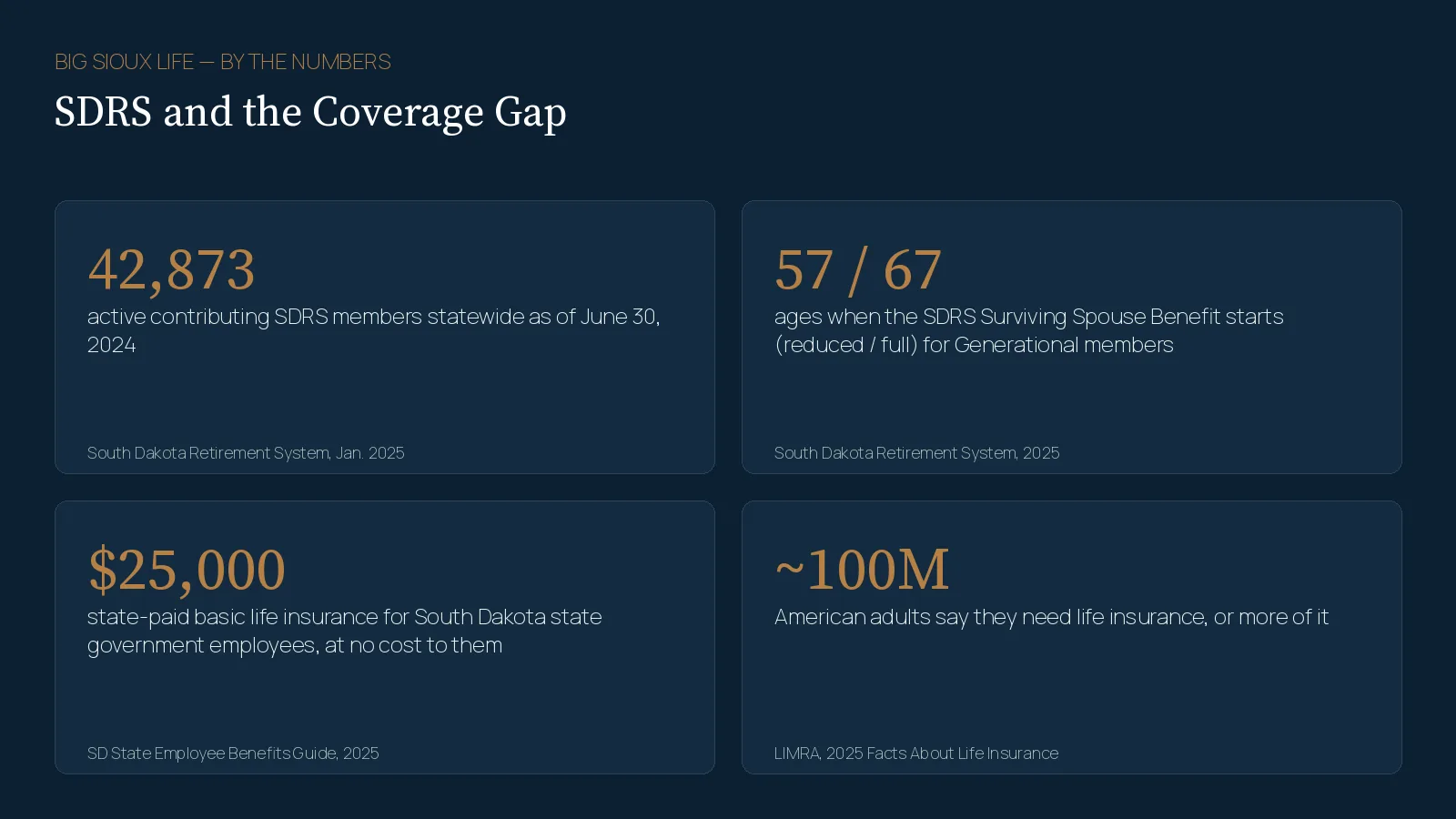
- For Generational members (anyone who joined SDRS on or after July 1, 2017), the Surviving Spouse Benefit does not become payable until your spouse turns 67, or 57 at a reduced rate, no matter how young you were when you died.
- There is no lump sum in this structure. SDRS is a lifetime pension benefit, not a life insurance death benefit your family can use immediately.
- South Dakota state government employees get $25,000 of state-paid basic life insurance separate from SDRS, according to the state's Benefits Guide, but that figure does not automatically apply to teachers, city employees, or county employees, whose employers set their own group benefits.
- As of June 30, 2024, SDRS had 42,873 active contributing members across more than 500 participating employers statewide, according to SDRS's Retirement Laws Committee Update.
The pain: “I have a pension, so my family is covered”
This is the assumption that quietly sits underneath a lot of South Dakota households where one or both spouses work in public service: a school, a city hall, a county courthouse, a state agency. You contribute a chunk of every paycheck to SDRS, your employer matches it, and somewhere in the back of your mind is the sense that this system exists partly to protect your family if something happens to you. That sense is not wrong, exactly. SDRS does provide survivor benefits. What it gets wrong is the timing, and timing is the entire point when you are talking about a family that has a mortgage payment due on the first of the month and two kids who need groceries this week.
Nobody explains this clearly at new-employee orientation, and it is easy to see why. SDRS’s own materials describe the survivor benefit honestly and accurately; they are simply written the way pension documents are written, for a member reading them decades before the benefit would ever apply. A 26-year-old new hire skims past “Surviving Spouse Benefit” in a handbook and files it under “someday” along with retirement itself. Then life happens on its own schedule, not the pension’s schedule, and the gap between what people assume and what the plan document actually says becomes someone’s real problem at the worst possible time.
This is general education, not a recommendation
Nothing here tells you SDRS is a bad plan or that you should buy anything. SDRS is, by independent accounts, one of the best-funded public pension systems in the country. This explains one specific mechanism inside it, the timing of pre-retirement survivor benefits, so you can decide for yourself whether your household has a gap worth addressing.
Why it happens: SDRS is a pension, and a pension pays over a lifetime, not up front
To understand the timing gap, you need to understand what SDRS actually is. SDRS is a 401(a) defined benefit pension plan that provides retirement, survivor, and disability benefits for South Dakota’s public employees, according to SDRS’s own welcome materials. As of June 30, 2024, it had 103,299 total members, including 42,873 active contributing members, 34,119 people already drawing a monthly benefit, and 26,307 people who left covered employment but have not yet started benefits, spread across more than 500 participating employers, per SDRS’s Retirement Laws Committee Update presented to the South Dakota Legislature in January 2025.
Defined benefit, one of the first terms worth defining, means your eventual payout is calculated by a formula based on your years of service and your compensation history, rather than being whatever happens to be sitting in an individual investment account, which is how a 401(k) or 403(b), called a defined contribution plan, works instead. SDRS funds these promised benefits through member contributions (6% of pay for most Class A members), a matching employer contribution, and investment returns managed by the South Dakota Investment Council, according to SDRS’s Retirement Laws Committee Update. That structure is a major reason SDRS has stayed 100% funded, a genuinely unusual accomplishment among U.S. public pensions, per the same legislative presentation, which cites outside reviews from the Pew Charitable Trusts and the Equable Institute praising South Dakota’s approach.
None of that changes the basic mechanics of what happens if a member dies while still working. SDRS uses two membership classes structured around a July 1, 2017 dividing line. If you joined SDRS before that date, you are a Foundation member. If you joined on or after that date, you are a Generational member. The two classes have different benefit formulas, different normal retirement ages, and, importantly for this article, different documented rules for some aspects of survivor benefits. Since Generational members represent most people hired into South Dakota public service over roughly the last decade, and since that group is the most likely to still have young children and an outstanding mortgage, the rest of this article focuses on the Generational structure, using SDRS’s own published description of it. If you are a Foundation member, the mechanism is broadly similar, but confirm your specific ages and formulas in your Class handbook at sd.gov/sdrs rather than assuming the Generational numbers below apply to you.
The two pieces of an active-member survivor benefit
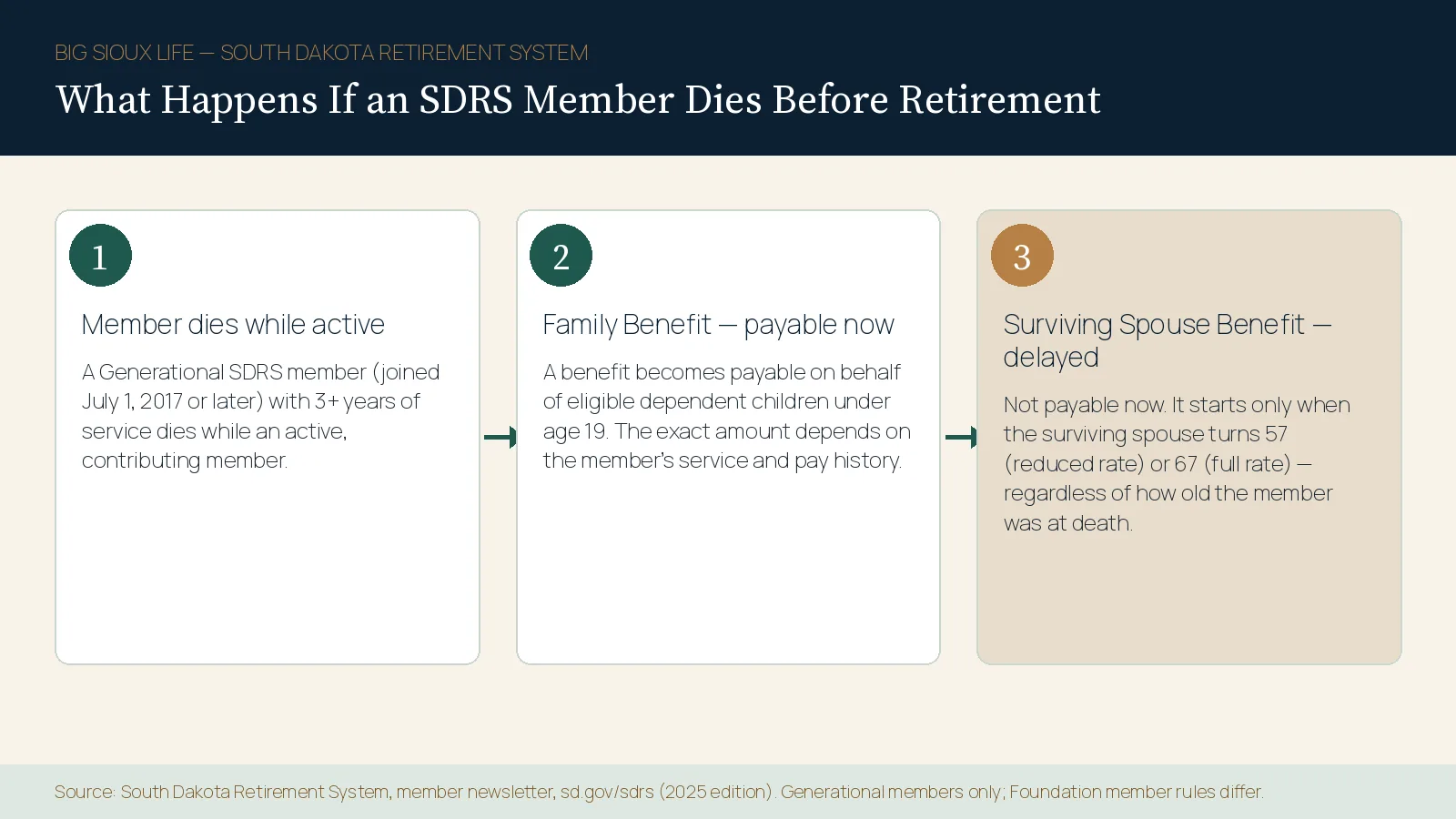
SDRS’s member newsletter describes what happens “if your death occurs while you are employed” in two separate pieces, and the distinction between them matters enormously for a working-age family.
Family Benefit. If you have three or more years of contributory service and die while actively participating in SDRS, a benefit becomes payable on behalf of your eligible dependent children under age 19, according to SDRS. There is a stated exception: if you die while performing the usual duties of your job, the Family Benefit applies regardless of your years of service. SDRS’s public materials describe this eligibility rule but do not publish the dollar calculation in the documents available to us; the amount depends on your individual service credit and compensation history.
Surviving Spouse Benefit. This is the piece with the timing that catches people off guard. “A surviving spouse benefit is effective and payable when your surviving spouse reaches age 67,” SDRS’s Generational Survivor Benefits section states. “Your eligible surviving spouse has the option to elect to start the surviving spouse benefit as early as age 57, payable at a reduced rate.” Read that again: the trigger is your spouse’s age, not the date of your death. A 30-year-old member who dies leaves a spouse who, if also 30, waits 27 years for the reduced benefit at 57 or 37 years for the full benefit at 67. A 50-year-old member with a spouse the same age leaves a much shorter wait, but still one measured in years, not weeks.
| Benefit | Who it covers | Vesting requirement | When it starts |
|---|---|---|---|
| Family Benefit | Eligible dependent children under 19 | 3+ years of contributory service (waived for accidental death on the job) | Payable while children remain eligible; amount not published, depends on service and pay history |
| Surviving Spouse Benefit | Eligible surviving spouse | 3+ years of contributory service | Spouse's age 67 (full) or age 57 (reduced, elective) |
| Variable Retirement Account | Beneficiary on file | Funded by up to 1.5% of pay while active | Payable at death, alongside other benefits |
Source: South Dakota Retirement System, "Your SDRS Benefits: Generational Member" newsletter, sd.gov/sdrs (2025 edition). Applies to members who joined SDRS on or after July 1, 2017. Foundation member rules differ; confirm your own ages and formulas in your Class handbook.
There is also a Variable Retirement Account, or VRA, a supplemental account funded by up to 1.5% of pay for active Generational members that becomes payable at retirement, disability, or death, according to SDRS. This adds some value at death, but SDRS’s materials do not publish typical VRA balances, so we cannot put a dollar figure on it here; it will not close a large income-replacement gap for a member who died with only a handful of years of contributions.
What it costs to get wrong: a worked example with real South Dakota numbers
Picture a hypothetical SDRS Generational member: a 34-year-old public employee, eight years of contributory service (past the three-year vesting mark), married to a spouse also 32, with two kids ages 4 and 7. This household earns close to South Dakota’s real median household income, which was $82,460 in 2025, according to the Federal Reserve Bank of St. Louis’s FRED database, sourced from the U.S. Census Bureau. They bought a home financed near South Dakota’s median listing price, which was $375,000 as of August 2026, also per FRED.
This member dies unexpectedly. Here is what actually happens on the SDRS side, based only on what SDRS’s own materials describe:
- The three-year vesting requirement is met, so the Family Benefit becomes payable for the two children, ages 4 and 7, until each turns 19. The exact monthly amount is calculated from this member’s specific service credit and pay history; SDRS’s public materials do not publish a formula we can reproduce here, so we cannot put a number on it without inventing one.
- The Surviving Spouse Benefit does not begin. The surviving spouse is 32. Under the Generational structure, that benefit becomes payable at the spouse’s age 57 at the earliest, meaning a 25-year wait for a reduced monthly benefit, or age 67 for the full amount, a 35-year wait.
- The mortgage on the $375,000 home does not pause for 25 years. Neither does the cost of raising two children, nor the household’s need to replace this earner’s share of a roughly $82,460 median income, starting immediately.
Years until the SDRS Surviving Spouse Benefit begins, by age at death (spouse the same age)
Illustrative calculation assuming the surviving spouse is the same age as the member at death, using the reduced-benefit start age of 57 published by SDRS for Generational members. Source: South Dakota Retirement System, sd.gov/sdrs (2025 edition). Individual households will differ based on the spouse's actual age.
Now compare that against what group life insurance, where it exists, might provide. If this household includes a South Dakota state government employee specifically, meaning someone covered under the State Employee Benefits Program rather than a school district, city, or county plan, they would have $25,000 of state-paid basic life insurance and AD&D, provided at no cost to the employee, according to the state’s own Benefits Guide. That $25,000 is a real, immediate, lump-sum amount, a fundamentally different shape of benefit than the SDRS pension: available right away rather than in a quarter century, and usable for anything the household needs, from the mortgage payment due next week to funeral costs to simply keeping the lights on while the household adjusts.
But even $25,000 does not go far against a mortgage that starts near $375,000 and years of income replacement for two young children. And that $25,000 figure only applies if this SDRS member happens to work directly for the State of South Dakota. SDRS itself covers teachers, school district staff, city employees, county employees, and state employees alike, but SDRS membership does not include life insurance. Each of the system’s 500-plus participating employers sets its own separate group benefits, if it offers any at all, outside of SDRS entirely.
SDRS pays a real benefit if you die before retirement. It was never designed to be the thing your family lives on next month.
Mike Moore, Life Insurance AdvisorThis gap is not unique to South Dakota public employees; it echoes a pattern researchers see nationally. Forty percent of American adults believe they need more life insurance, representing close to 100 million adults, according to LIMRA’s 2025 Facts About Life Insurance. Nearly half, 47%, say they would have trouble paying living expenses within six months of a primary wage earner’s death, per the same research. LIMRA also found that 55% of working adults say they have life insurance coverage through an employer, which sounds reassuring until you remember, as the worked example above shows, that “coverage through work” and “coverage sized to what my family needs right now” are two different claims. We were not able to locate an independent second source for LIMRA’s specific figures beyond LIMRA’s own research; LIMRA and Life Happens are themselves the organizations that conduct this study jointly, so there is no separate primary source to cross-check the numbers against.
How to work it out yourself: four steps, no one else required
You do not need us, or anyone, to walk through the first part of this. You need your own membership details and about twenty minutes.
- Find your membership class. Log in to MySDRS at sd.gov/sdrs and confirm whether you are a Foundation member (joined before July 1, 2017) or a Generational member (joined on or after that date). The survivor benefit rules described in this article apply specifically to Generational members; Foundation members should pull their own Class handbook for the equivalent ages and formulas.
- Check your years of contributory service. Three years is the vesting threshold SDRS describes for both the Family Benefit and the Surviving Spouse Benefit. If you are under three years, confirm your specific situation directly with SDRS, since public materials describe an exception for accidental death on the job but do not spell out every other scenario.
- Find your spouse’s age relative to 57 and 67. Subtract your spouse’s current age from 57 to see how many years away the earliest, reduced Surviving Spouse Benefit would be if you died today. That gap, not the eventual benefit amount, is the number that matters for near-term planning.
- Ask your specific employer about group life insurance, separately from SDRS. SDRS is not the place to ask about life insurance, because SDRS does not provide it. Whether you work for a school district, a city, a county, or the state itself, your employer’s HR office, not SDRS, is where you would confirm any group life benefit and its amount.
You can run this yourself
All four steps above just require your MySDRS login, your Class handbook, and a conversation with your own employer's HR office. Where a second opinion tends to help is comparing individual term life insurance across carriers once you have a sense of the gap between now and when any survivor pension benefit would actually start.
Why this is not a knock on SDRS
It is worth saying directly: this is not an argument that SDRS is a weak plan or that public employment is a bad deal. Independent reviewers have specifically praised South Dakota’s approach. The Pew Charitable Trusts named South Dakota among a small group of states with “stable costs” and “well-funded benefits” from 2008 to 2022, and the Equable Institute called South Dakota one of “the best-funded plans historically,” both cited in SDRS’s own January 2025 legislative update. SDRS recommends members plan to replace roughly 85% of pre-retirement income across all of their retirement income sources combined, using what it calls a three-legged stool: SDRS itself, Social Security, and personal retirement savings, per its member newsletter. A pension plan built to reliably fund decades of retirement income is doing a fundamentally different job than a life insurance policy built to hand a lump sum to a young family the week after a funeral. Both can be true at once: SDRS can be an excellent, well-run pension, and its pre-retirement survivor benefit can still leave a real, years-long gap for a working-age household with a mortgage and young kids.
How we help
We are independent, so we are not selling every SDRS member the same product regardless of their situation. What we do is walk through the actual gap between when your household would need money and when any SDRS survivor benefit, employer group life benefit, or Social Security survivor benefit would actually arrive, then compare individual term life insurance across carriers if a gap is real. If your spouse is close to 57, or your kids are nearly grown, or your specific employer already provides solid group coverage, the gap may be smaller than you’d guess, and we will say so rather than manufacture urgency that does not fit your household.
What you get
A clear, honest look at what SDRS actually promises your family if you die before retirement, set next to what your household would need in the meantime, using your own numbers rather than a hypothetical. If your employer offers group life insurance, a way to check whether it is enough on its own. And if there is a real gap between now and whenever a spouse’s benefit would start, a comparison of individual term policies from more than one carrier, priced for your age and health rather than assumed.
See your own timing gap
Bring your MySDRS membership class and your spouse's age, and we will walk through what your household would actually have, and when, if something happened to you this year.
Not ready to talk to anyone yet? Read How It Works first and come back when you are. If you are weighing whether your household’s coverage adds up at all, it’s worth asking rather than assuming; independent agencies can compare carriers side by side instead of offering just one.
Frequently asked questions
Does the South Dakota Retirement System pay my family if I die before I retire?
Yes, but not the way most people picture it. SDRS pays a Family Benefit to eligible dependent children under 19 if you have three or more years of contributory service and die while actively participating in the system. For Generational members (anyone who joined SDRS on or after July 1, 2017), the Surviving Spouse Benefit is a separate piece, and it does not become payable until your spouse reaches age 67, or age 57 at a reduced rate if they elect to start early, according to SDRS’s own member materials at sd.gov/sdrs. There is no lump-sum death benefit for an active member’s survivor benefit under this structure.
How long do I have to work before SDRS survivor benefits apply?
Three years of contributory service, called vesting, for both Family and Surviving Spouse Benefits under the Generational structure, per SDRS. SDRS’s public materials describe one exception: if you die while performing the usual duties of your job in an accident, the Family Benefit is payable regardless of your years of service. Outside that specific exception, SDRS’s own documents do not spell out what happens if you die with fewer than three years of service; that is a question for SDRS directly or your Class handbook, not something we could verify from public materials.
When does the SDRS surviving spouse benefit actually start?
For Generational members, at your surviving spouse’s age 67 for the full benefit, or as early as age 57 at a reduced rate if your spouse elects to start early, according to SDRS. That is true no matter how old you were when you died. If you die at 34 and your spouse is 32, the earliest that benefit can begin is roughly 25 years later, at your spouse’s 57th birthday. Foundation members, meaning anyone who joined SDRS before July 1, 2017, have a different benefit design; check your Class handbook at sd.gov/sdrs for your specific ages, since we could not verify Foundation pre-retirement survivor benefit start ages from the materials available to us.
What is the SDRS Family Benefit for children?
It is a benefit payable on behalf of your eligible dependent children under age 19 if you have three or more years of contributory service and die while an active SDRS member, according to SDRS’s member newsletter. SDRS’s public materials describe the eligibility rule but do not publish the dollar calculation in the documents we reviewed; your specific amount depends on your service credit and compensation history, which SDRS or MySDRS can calculate for your account.
Do South Dakota state government employees get life insurance through their job?
Yes. The South Dakota State Employee Benefits Program provides $25,000 of basic life insurance plus accidental death and dismemberment coverage, paid entirely by the state at no cost to the employee, according to the state’s own Benefits Guide. That coverage is not portable, meaning it does not automatically follow you if you leave state employment, though it can be converted to an individual policy. This applies specifically to employees under the State of South Dakota’s own benefits program, not to every SDRS-covered employer.
Do teachers, city employees, and county employees get the same $25,000 life insurance as state employees?
Not necessarily. SDRS covers more than 500 separate participating employers across South Dakota, including school districts, cities, counties, and the state itself, and each employer sets its own group benefits separately from SDRS and separately from the State Employee Benefits Program. The $25,000 basic life figure applies to employees under the state’s own BHR-administered program. If you work for a school district, city, or county, check with your specific employer’s HR office for whatever group life insurance, if any, applies to you; SDRS membership itself does not include life insurance.
Is the SDRS survivor benefit the same thing as life insurance?
No, and this is the mechanism most SDRS members never get explained to them. SDRS is a pension plan that pays retirement, survivor, and disability benefits funded by member and employer contributions and investment income. Life insurance is a contract that pays a death benefit, often as a lump sum, that a beneficiary can use immediately for whatever the household needs. SDRS survivor benefits are real and valuable over a working lifetime, but for a member who dies with young children and a mortgage, they are not structured to replace income in the near term the way a life insurance policy is.
What if I have fewer than three years of SDRS service when I die?
SDRS’s public materials describe the three-year vesting requirement for the Family Benefit and Surviving Spouse Benefit, with one stated exception for accidental death while performing your job’s usual duties, in which case the Family Benefit applies regardless of years of service. We could not find published SDRS language addressing every other scenario of death with under three years of service outside that exception; if this applies to you, contact SDRS directly or review your Class handbook rather than relying on an assumption.
Before you decide anything
This article is general education, not insurance, legal, financial, or tax advice, and it is not affiliated with or endorsed by the South Dakota Retirement System. Product availability, features, and rates vary by carrier and are subject to underwriting. No coverage exists until a policy is issued and in force. Any guarantees are subject to the claims-paying ability of the issuing insurer. Please review your actual SDRS Class handbook, your employer's benefits materials, and speak with a licensed agent about your situation.
Sources
- South Dakota Retirement System — “Welcome to the South Dakota Retirement System” member newsletter — sd.gov/sdrs, 2025 edition; Generational member survivor benefit mechanics and vesting
- South Dakota Retirement System — Retirement Laws Committee Update, January 2025 — presented to the South Dakota Legislature; membership counts, participating employer count, Foundation/Generational structure
- State of South Dakota — Benefits Guide, South Dakota State Employee Benefits Program — Bureau of Human Resources and Administration; $25,000 basic life insurance and AD&D for state employees
- LIMRA — 2025 Facts About Life Insurance — Life Insurance Awareness Month 2025; national underinsurance and coverage statistics
- Federal Reserve Bank of St. Louis (FRED) — Median Household Income in South Dakota (MEHOINUSSDA672N) — 2025 estimate, sourced from the U.S. Census Bureau
- Federal Reserve Bank of St. Louis (FRED) — Housing Inventory: Median Listing Price in South Dakota (MEDLISPRISD) — August 2026 observation, sourced from Realtor.com
Related reading: Is Your Employer’s Life Insurance Enough? A 2026 SD Guide, Does Social Security Cover My Family If I Die? 2026 Guide, and Will Your Retirement Savings Last? A South Dakota Guide. See current options for term life insurance, or learn more about who we help.