
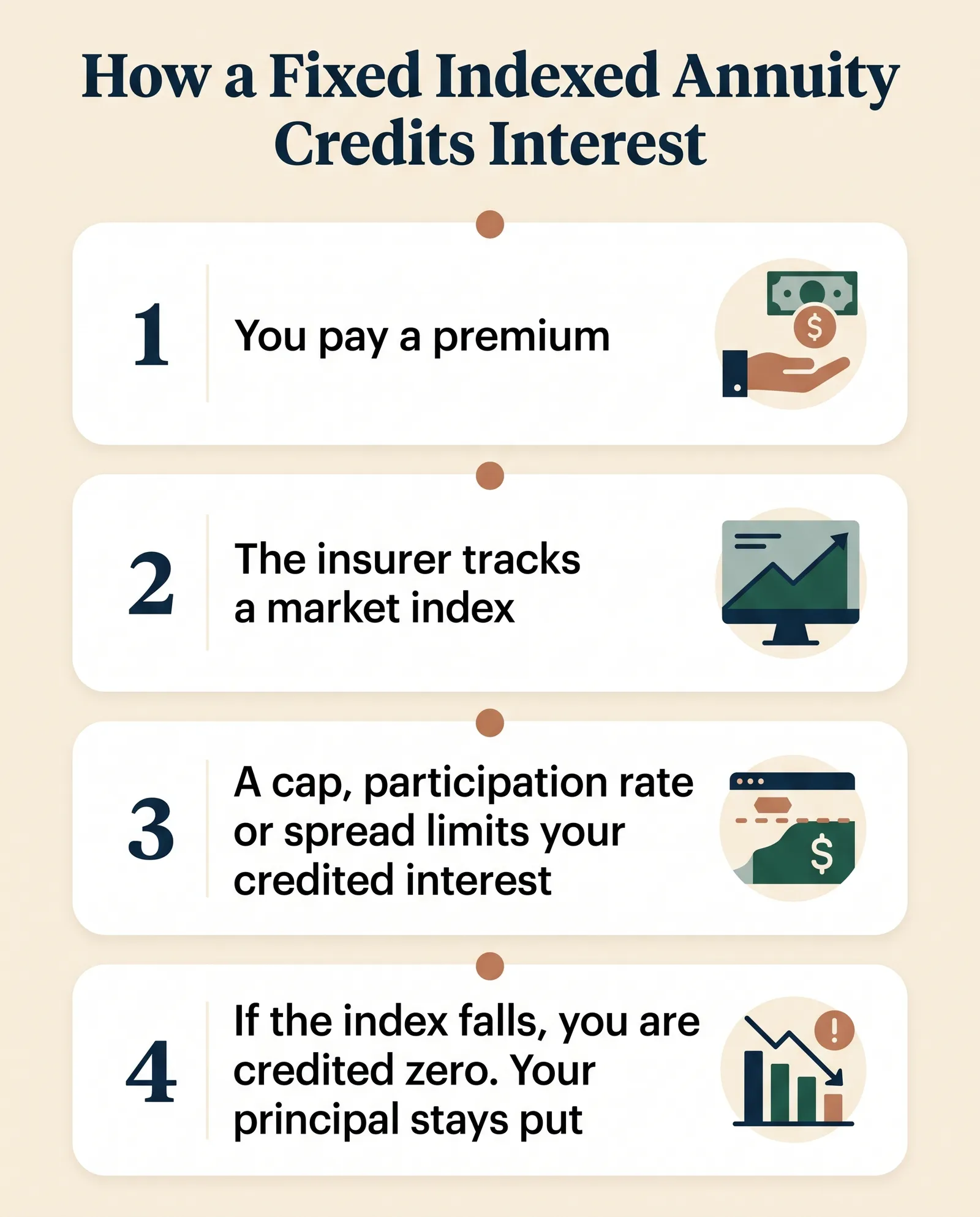
A fixed indexed annuity is a contract with an insurance company, not a stock, a mutual fund, or a savings account. You hand the insurer a premium, and each year (or each multi-year “index term”), it credits interest using a formula tied partly to how a market index performs, capped or limited on the way up, but with a floor of zero on the way down, according to the National Association of Insurance Commissioners’ own Buyer’s Guide for Deferred Annuities. That trade, a guarantee against loss in exchange for a limited upside, is the entire product in one sentence. Everything that goes wrong with these contracts happens when someone buys the guarantee without understanding what the limit on the upside actually costs them, or locks money into a surrender schedule they did not read closely enough before an emergency hit.
The short version
- A fixed indexed annuity credits interest tied to an index like the S&P 500, but a cap rate, a participation rate, or a spread limits how much of that gain you actually receive, per the NAIC's Buyer's Guide for Deferred Annuities.
- If the index falls during a term, credited interest is zero, not negative. Your account value does not drop from market performance, but any guarantee is only as strong as the issuing insurer's claims-paying ability.
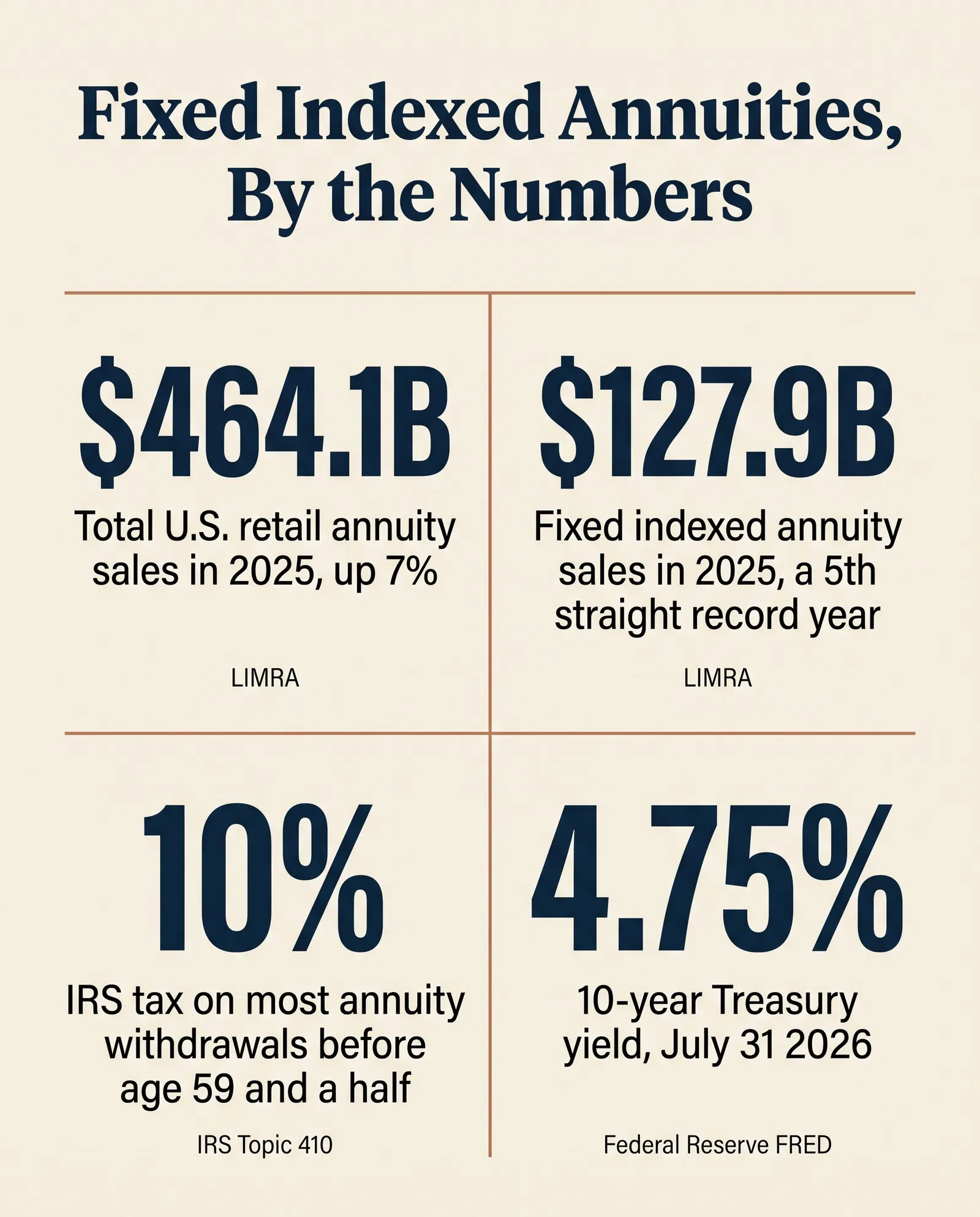
- U.S. retail annuity sales hit $464.1 billion in 2025, up 7% from 2024, and fixed indexed annuities alone accounted for $127.9 billion of that, their fifth consecutive record year, according to LIMRA.
- Surrender charges apply if you withdraw more than the contract's free-withdrawal amount, commonly up to 10% a year, during the surrender period, and the IRS adds its own 10% tax on most annuity withdrawals taken before age 59 and a half.
- South Dakota has required annuity producers to complete NAIC-based best-interest training since January 1, 2023, per the South Dakota Division of Insurance, which shapes how these products are supposed to be recommended in this state.
The pain: you did the saving. Nobody taught you how to turn it into income without betting on the market’s timing.
You spent thirty years putting money away, and somewhere along the way you got good at not touching it. Now you are 62, or 66, or newly retired, and the problem has flipped completely. The money has to start doing something, and every option in front of you seems to carry a version of the same fear: leave it in the market and a bad year right when you start withdrawing could do real damage you never get time to recover from. Leave it in a savings account and inflation quietly eats it while it earns almost nothing. Buy an annuity and you have heard just enough horror stories, an aunt who “got locked in for ten years,” a coworker who “never actually understood what he bought,” to be suspicious of the whole category.
That suspicion is not irrational. A retiree in Aberdeen with $300,000 in CDs and savings, watching the market swing through a rough month, is not wrong to worry about sequence-of-returns risk, the specific danger that a market downturn in your first few retirement years can permanently shrink how long your money lasts, even if the market fully recovers later. A widow in Rapid City who wants some of her savings to grow faster than a CD without the chance of losing it in a downturn is describing a real, specific tradeoff, not a fantasy. The mistake is not wanting protection from a bad market year. The mistake is buying a product built to solve exactly that problem without understanding the mechanism, the cap, the participation rate, or the surrender schedule, that makes the protection possible in the first place.
This is general education, not a recommendation
Nothing here tells you to buy or avoid a fixed indexed annuity. It explains, using the NAIC's own Buyer's Guide language and current 2026 industry and regulatory data, how the mechanics actually work, so you can read an illustration or a contract and know what you are looking at before you sign anything.
Why it happens: the guarantee and the cap are the same trade, not two separate features
Every dollar an insurance company credits to your annuity has to come from somewhere. With a fixed indexed annuity, the insurer typically buys a mix of bonds for stability and options tied to the chosen index to fund the potential interest credit, then sets a cap rate, a participation rate, or a spread rate to control how much of that option-based upside it passes along to you. Those three terms describe the same underlying tradeoff in different shapes, and the NAIC’s Buyer’s Guide for Deferred Annuities defines all three plainly:
- Cap rate. A ceiling on the interest you can earn in a given index term. If the index gains 15% and your cap is 6%, you are credited 6%, no more. The excess above the cap is what pays for the floor that keeps you from losing money in a down year.
- Participation rate. The percentage of the index’s gain that actually gets credited to you. A 60% participation rate on a 10% index gain credits 6% interest; on a 3% gain, it credits 1.8%. Participation rates often apply without a hard cap, though a product can combine a participation rate with a cap too.
- Spread (also called a margin or asset fee). A percentage subtracted from the index’s gain before interest is credited. A 3% spread on an 8% index gain credits 5%. If the index’s gain is smaller than the spread, you are credited zero for that term, not a negative number.
Whichever formula your contract uses, the floor is the part that makes the whole trade make sense: if the index goes down during the term, your credited interest is zero, and your account value does not fall because of that decline, according to the NAIC’s Buyer’s Guide. That is genuinely different from owning an index fund directly, where a down year subtracts from your balance in real time. The cost of that protection is that you never get the index’s full upside either, in any year, up or down.
The index term is the length of time, often one year but sometimes longer, over which the insurer measures the index’s change and applies the formula. Once interest is credited for a completed term, it is typically locked in and cannot be taken back in a later down term, a mechanic sometimes called “annual reset” or “ratchet,” though the exact wording and timing vary by contract, so read your specific policy’s index term and crediting schedule rather than assuming a standard one applies.
| Formula | Example rate | Credited interest on a 10% index gain | Credited interest on a 3% index gain |
|---|---|---|---|
| Cap rate | 6% cap | 6% (capped) | 3% (under the cap) |
| Participation rate | 60% participation | 6% | 1.8% |
| Spread | 3% spread | 7% | 0% (gain smaller than the spread) |
| A losing term (any formula) | Index falls 12% | 0% credited, account value does not drop from the decline | Same, 0% floor applies regardless of formula |
Illustrative example rates only, built to show how the three formulas behave differently, not any specific carrier's current product. Actual cap rates, participation rates, and spreads vary by carrier, product, and index term, and change over time. Mechanics per NAIC, "Buyer's Guide for Deferred Annuities" (2022 edition).
One more term worth knowing before you read further: a rider is an optional add-on, often an income rider that guarantees a future withdrawal percentage for life, or an enhanced death benefit. Riders usually carry their own annual fee, deducted from the account value regardless of how the index performed that year, according to the NAIC’s Buyer’s Guide. A rider can be genuinely useful for a specific goal, guaranteed lifetime income being the most common one, but it is a separate cost layered on top of the base contract, not a free feature.
What it costs to get wrong: the surrender schedule and the tax code both punish an early exit
The floor protects you from the index falling. It does not protect you from your own need for the money sooner than the contract expects. Two separate costs show up when that happens, and people are routinely surprised by both.
The surrender charge. Fixed indexed annuities are built around a surrender charge period, commonly several years long, during which withdrawing more than the contract’s free-withdrawal allowance triggers a charge. According to the NAIC’s Buyer’s Guide, that free-withdrawal amount is commonly up to 10% of the account value per year, and the surrender charge itself is “a percentage of the amount you take out” that “usually goes down each year until the surrender charge period ends.” Say, for illustration only, a contract’s surrender schedule starts at 8% in year one and steps down by roughly one point a year until it reaches zero in year eight, a shape that is common in the market but is not any specific product’s actual schedule; your contract states its own numbers, and you should read them before you sign, not assume they match this example.
The IRS penalty. Separately from anything the insurer charges, the federal government adds its own cost to an early annuity withdrawal. The IRS applies an additional 10% tax on most distributions from an annuity taken before age 59 and a half, according to IRS Topic no. 410, with specific named exceptions: distributions that are part of a series of substantially equal periodic payments begun after separation from service, distributions due to total and permanent disability, distributions made after a physician certifies terminal illness, and distributions made on or after the contract holder’s death. Outside those exceptions, an early withdrawal can mean paying the surrender charge to the insurer and the 10% tax to the IRS in the same year, on top of ordinary income tax on the gain.
| Contract year | Illustrative surrender charge rate | Charge on a $50,000 withdrawal above the free amount |
|---|---|---|
| Year 1 | 8% | $4,000 |
| Year 4 | 5% | $2,500 |
| Year 8+ | 0% | $0 |
Hypothetical schedule for illustration only, not a real product's terms. Actual surrender charge percentages and years vary by carrier and contract. Structure described in NAIC, "Buyer's Guide for Deferred Annuities" (2022 edition). Add the IRS's separate 10% early-distribution tax if the withdrawal happens before age 59½ and no exception applies, per IRS Topic no. 410.
This is also where the market itself has kept these products in heavy circulation. U.S. retail annuity sales reached $464.1 billion in 2025, up 7% from 2024, and fixed indexed annuities alone made up $127.9 billion of that total, a 1% increase over 2024 and the category’s fifth consecutive record year, according to LIMRA’s final 2025 sales report. That is a lot of contracts being sold into a rising-rate, retirement-anxious environment, which is exactly the environment where a buyer is most tempted to focus on the guarantee and skip the fine print on the exit terms.
U.S. fixed indexed annuity sales, 2024 vs. 2025
LIMRA, "LIMRA: Final U.S. Retail Annuity Sales Set New Sales High, Totaling $464.1 Billion in 2025" (March 2026). The 2024 figure is calculated from LIMRA's reported 1% year-over-year increase to $127.9 billion in 2025; LIMRA did not separately restate the 2024 total in this release.
$464.1B
Total U.S. retail annuity sales in 2025, up 7% from 2024, per LIMRA
10%
Typical annual free-withdrawal allowance before a surrender charge applies, per the NAIC
4.75%
10-year Treasury yield, July 31, 2026, per the Federal Reserve's FRED database
Why include a Treasury yield in an annuity article at all? Because it is context, not a promise. Cap rates and participation rates are not set in a vacuum; insurers fund the option budget behind an indexed crediting formula largely from bond returns, so the general interest-rate environment shapes what caps and participation rates carriers can afford to offer, even though no specific product’s cap is tied to the 10-year Treasury by formula. A 4.75% 10-year Treasury yield as of July 31, 2026, per the Federal Reserve Bank of St. Louis’s FRED database, is one piece of the backdrop against which any illustrated cap rate you are shown should be read, not a number that predicts what your specific contract will credit.
The floor is not free. Every point of upside you do not receive because of a cap, a participation rate, or a spread is the price of never being credited a loss.
Mike Moore, Life Insurance AdvisorA worked comparison: the same $200,000, three different tools
Take a hypothetical 64-year-old in Brookings with $200,000 she does not need for at least ten years, weighing three options. This is an illustration built to show how the mechanics differ, not a quote, a projection, or a promise of any outcome; actual rates, terms, and results depend on the specific product, carrier, and market performance at the time.
| Tool | A year the index or market falls 15% | A year the index or market gains 15% |
|---|---|---|
| Direct S&P 500 index fund | Account value falls roughly 15%, before any fees, since you own the index directly | Account value rises roughly 15%, the full gain, before any fees |
| Fixed indexed annuity (illustrative 6% cap) | 0% credited interest; account value does not fall from the decline | 6% credited interest; the gain above the cap is not received |
| MYGA or fixed annuity (illustrative declared rate) | The declared fixed rate is credited regardless of the index; unaffected by the market | The same declared fixed rate is credited; the market gain has no effect either way |
Illustrative example only. Cap rate, MYGA rate, and index fund performance are hypothetical and not tied to any specific product or a real market year. See our related MYGA vs. CD comparison for how a purely fixed-rate annuity works.
The pattern in that table is the whole decision in miniature. A direct index fund gives you the full range, up and down, with no insurer standing between you and the market. A MYGA or fixed annuity gives you certainty in both directions, a known rate regardless of what markets do. A fixed indexed annuity sits between them: it removes the down years at the cost of a limited up year, which is a real trade for someone who specifically fears sequence-of-returns risk in early retirement, and a poor trade for someone who has enough other guaranteed income that they can actually afford to ride out a market decline for the growth potential.
How to work it out yourself: five things to check before you buy
You can do all five of these with the actual illustration and disclosure documents an agent or carrier gives you, no one else required.
- Identify the exact crediting formula. Ask specifically whether your contract uses a cap rate, a participation rate, a spread, or some combination, and get the current rate in writing, since these rates are not guaranteed for the life of the contract and typically reset at renewal.
- Find the surrender charge schedule. Look for the exact percentage in each contract year and the exact number of years the schedule runs. If you cannot picture yourself not touching a meaningful chunk of this money for that entire span, that is worth knowing before you sign, not after.
- Check whether you are adding a rider, and what it costs annually. An income rider or an enhanced death benefit is optional on most products and carries its own fee, deducted whether or not the index performs well that year.
- Confirm what happens to money you have already earned. Ask whether credited interest locks in at the end of each index term (commonly called a ratchet or annual reset) or whether it can be affected by a later down term, since contracts differ on this mechanic.
- Compare the illustrated numbers against a MYGA and against simply leaving the money where it is. A fixed indexed annuity is not automatically the better tool just because it has upside potential; sometimes a MYGA’s certainty or a bond ladder’s simplicity fits the goal better, and sometimes neither an annuity nor the market is the right home for money you might need on short notice.
You can read the disclosure yourself
All five steps above just require the illustration and the actual contract disclosure, which every carrier is required to provide. Where a second opinion tends to help is comparing how different carriers structure the same trade, cap versus participation versus spread, and pricing that against a MYGA or a fixed annuity for the same goal, since that comparison is not something a single illustration from one company can show you.
If you would rather have someone local walk through an illustration with you than read it alone, that is what we do: Compare My Options.
When a fixed indexed annuity is genuinely not the right tool
It is worth saying plainly: if you need full, penalty-free access to this money within the next few years, a fixed indexed annuity’s surrender schedule works against you, not for you, and a high-yield savings account or a short MYGA term is very likely the better fit. If your goal is long-term growth and you already have guaranteed income, a pension, Social Security, or another annuity, covering your fixed expenses, a capped, floor-protected product may cost you more in foregone upside over twenty or thirty years than the downside protection is worth to you personally. And if what you actually want is guaranteed income you can never outlive starting soon, an immediate income annuity converts a lump sum into a stream of payments directly, without the accumulation-phase mechanics described in this article at all; it is a different tool solving a more specific problem.
The opposite is also true. If a market downturn early in retirement genuinely keeps you up at night, and you have already used up the room in your plan for that risk with your other savings, the floor a fixed indexed annuity provides is solving a real, specific fear, not a manufactured one, and it is worth understanding the mechanics well enough to evaluate an actual illustration rather than avoiding the category altogether because of a story you heard about someone else’s contract. Our related guide on whether your retirement savings will last goes deeper on how withdrawal rates and Social Security timing fit into this same decision.
How we help
We are independent, so we are not built around one carrier’s cap rate or one company’s rider menu. We start with what the money actually needs to do for you, income you can count on, growth you do not want fully exposed to a downturn, or simply a place for savings to sit that beats a checking account, and compare how different carriers structure the cap, participation, or spread on their fixed indexed products against that specific goal. If a MYGA, a fixed annuity, or leaving the money where it is turns out to fit better, we say so, because the point is matching the tool to what you actually need, not filling a quota for any one product type.
What you get
A plain-language read on the actual crediting formula, surrender schedule, and any rider costs in a real illustration, not marketing language about “market gains with no risk.” A comparison across more than one carrier’s version of the same trade, since caps, participation rates, and surrender schedules vary meaningfully company to company for what looks like the same product on the surface. And an honest answer, based on your specific timeline and other income sources, about whether a fixed indexed annuity is actually the tool that fits, or whether a MYGA, an index fund, or simply staying liquid serves you better.
Get an honest read on whether a fixed indexed annuity fits your plan
We will go through an actual illustration with you, the crediting formula, the surrender schedule, and any rider costs, and compare it against a MYGA and against your other options before you decide anything.
Not ready to talk to anyone yet? Read How It Works first and come back when you are.
Frequently asked questions
What is a fixed indexed annuity and how does it actually work?
A fixed indexed annuity is a contract with an insurance company, not a security or a mutual fund. You pay a premium, and the insurer credits interest each index term based partly on how a market index like the S&P 500 performs, using a formula built around a cap rate, a participation rate, or a spread, according to the NAIC’s Buyer’s Guide for Deferred Annuities. If the index falls during that period, your annuity is credited zero interest rather than a loss, and your existing account value does not go down from market performance as long as you do not withdraw early. You are not invested in the index. You are buying a formula that references it.
What is a cap rate, and what is a participation rate?
Both are ways an insurer limits how much index gain gets credited to your annuity, and the NAIC’s Buyer’s Guide describes them as two of the main formulas carriers use. A cap rate is a ceiling: if the index gains more than the cap in a given term, you are credited the cap rate, not the full gain. A participation rate is a percentage of the index gain: if the rate is 60% and the index gains 10%, you are credited 6%, whether or not there is also a cap. Some products use a cap, some use a participation rate, some use a spread that is subtracted from the gain instead, and some combine two of the three. Read your specific contract’s crediting method; do not assume it matches a neighbor’s or a friend’s policy.
Can I lose money in a fixed indexed annuity?
Your account value cannot drop because the index went down, since the floor on index-linked interest is zero in a losing term, per the NAIC’s Buyer’s Guide. You can still lose money relative to what you put in through two other paths: a surrender charge if you withdraw more than the contract’s free-withdrawal amount during the surrender charge period, and rider fees if you added optional features like an income rider or enhanced death benefit, which are usually deducted from the account value annually regardless of performance. Any guarantee in the contract, including the floor itself, is only as strong as the issuing insurance company’s claims-paying ability.
How is a fixed indexed annuity different from a fixed annuity or a MYGA?
A fixed annuity or a multi-year guaranteed annuity (MYGA) credits a set interest rate the insurer declares in advance, with no connection to a market index at all; you know the rate before you buy. A fixed indexed annuity’s crediting is variable within a floor of zero and a cap or participation limit on the upside, so you do not know your exact return in advance the way you do with a MYGA. Our related comparison of a MYGA against a bank CD goes deeper on how the fixed-rate side of this works.
What happens if I need my money before the surrender charge period ends?
Most fixed indexed annuity contracts let you withdraw a limited amount each year, commonly up to 10% of the account value, without a charge, according to the NAIC’s Buyer’s Guide. Withdraw more than that during the surrender charge period, and the insurer applies a surrender charge, a percentage of the amount withdrawn that is highest in the early contract years and steps down until the period ends, per the same NAIC guide. On top of that, the IRS applies an additional 10% tax on most annuity withdrawals taken before age 59 and a half, with specific exceptions such as disability, terminal illness, and death, according to IRS Topic no. 410. Both charges are real reasons not to put money into an annuity that you may need access to on short notice.
Is buying a fixed indexed annuity the same as investing in the stock market?
No. You never own shares of the index, you receive no dividends from it, and your downside in a losing index term is zero credited interest, not a market loss. That protection is exactly why the upside is capped, participated, or reduced by a spread; the insurer is pricing the guarantee, not passing along the market’s full return. Anyone who describes a fixed indexed annuity as a way to be invested in the market without the risk is describing the guarantee correctly and the upside dishonestly. It is an insurance contract with an index-linked interest formula, not a substitute for owning stocks or index funds.
Does South Dakota regulate how fixed indexed annuities are sold?
Yes. South Dakota adopted the NAIC’s 2020 Annuity Best Interest Model, and producers licensed in the state have had to meet a specific training requirement since it took effect on January 1, 2023, according to the South Dakota Division of Insurance. Producers licensed on or after that date must complete a one-time four-hour annuity best interest course before selling any annuity, and producers licensed before that date had to complete a one-hour update course by June 20, 2023. A producer who has not met this training requirement is not permitted to sell annuities in South Dakota.
Before you sign anything
This article is general education, not insurance, legal, financial, or tax advice. Product availability, crediting formulas, cap and participation rates, surrender schedules, and rider costs vary by carrier and by state, and are subject to underwriting and current product terms. No coverage exists until a contract is issued and in force. Any guarantees are subject to the claims-paying ability of the issuing insurer. Please review actual contract documents and speak with a licensed agent about your situation.
Sources
- LIMRA — LIMRA: Final U.S. Retail Annuity Sales Set New Sales High, Totaling $464.1 Billion in 2025 — published March 2026; total 2025 annuity sales and fixed indexed annuity sales figures
- National Association of Insurance Commissioners — Buyer’s Guide for Deferred Annuities — 2022 edition; definitions of cap rate, participation rate, spread, the interest floor, surrender charges, and free-withdrawal provisions
- South Dakota Division of Insurance — Annuity Best Interest Standards — producer training requirements effective January 1, 2023, under the NAIC 2020 Annuity Best Interest Model
- Federal Reserve Bank of St. Louis (FRED) — 10-Year Treasury Constant Maturity Rate — observation for July 31, 2026
- Internal Revenue Service — Topic no. 410, Pensions and annuities — additional 10% tax on early distributions and its exceptions
- American Council of Life Insurers — Demand for Guaranteed Retirement Income Fuels Record Annuity Payouts — 2025 Life Insurers Fact Book; 2024 annuity payment totals
Related reading: MYGA vs. CD: Which Wins for South Dakota Savers in 2026? and Will Your Retirement Savings Last? A South Dakota Guide. See current options for fixed indexed annuities and multi-year guaranteed annuities, or learn more about who we help.