In almost every case, yes. High blood pressure is one of the most common findings on a life insurance application, not a disqualifying one, and for most applicants it changes the rate class you land in rather than whether you can get covered at all. What actually varies, sometimes by a lot, is which rate class you land in and at which carrier — because no two insurance companies use the same blood pressure cutoffs, and a reading that misses one company’s best tier by two points can clear another company’s best tier with room to spare. This guide walks through how that pricing actually works, using real carrier thresholds, so you can check where you likely stand before you ever fill out an application in South Dakota.
The short version
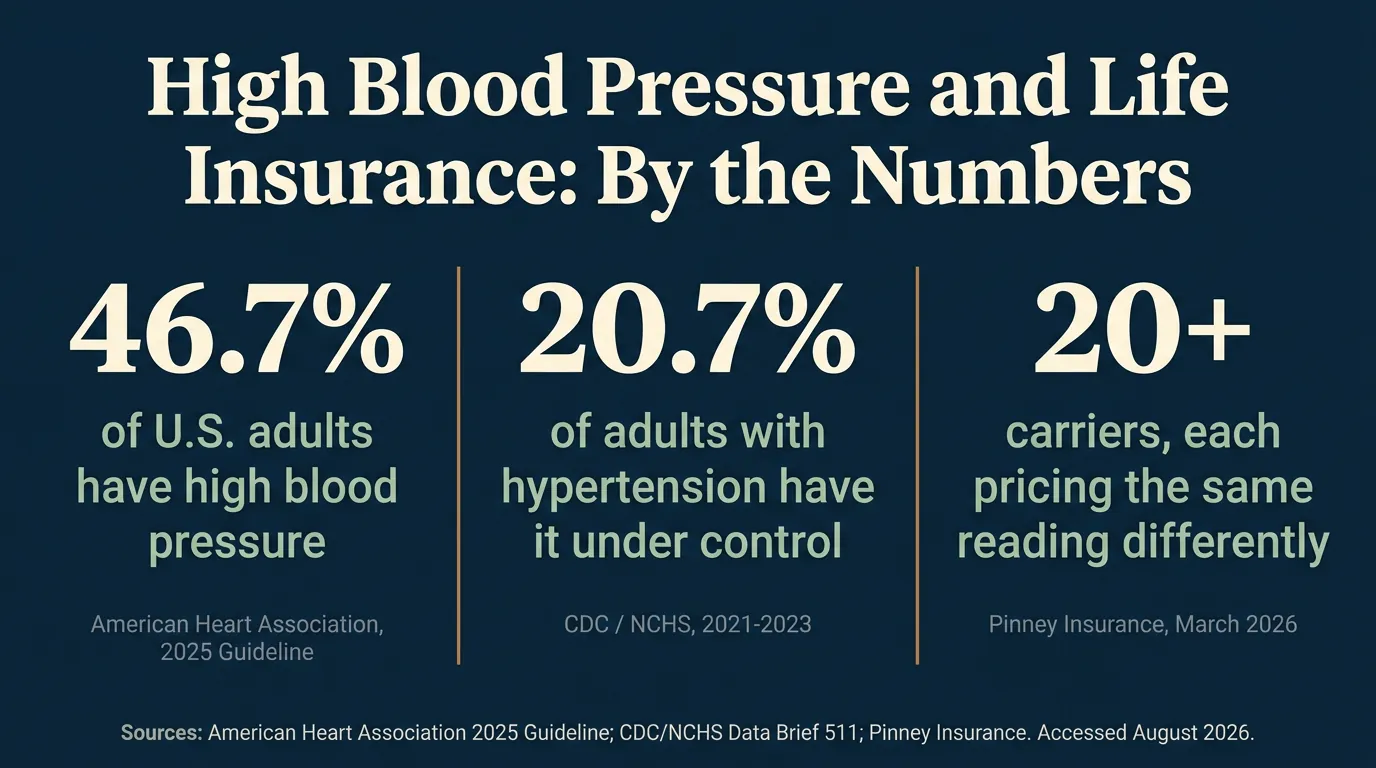
- Nearly half of U.S. adults, 46.7%, have high blood pressure under the American Heart Association's 2025 guideline — you are not an unusual applicant.
- Only about 1 in 5 adults with hypertension (20.7%) have it controlled to a healthy range, per the CDC's National Center for Health Statistics, August 2021–August 2023.
- Carriers do not use the same blood pressure thresholds. Per Pinney Insurance's March 2026 underwriting matrix, the same reading and medication history can land you in a top rate class at one company and a mid-tier class at another.
- Being on blood pressure medication does not automatically cost you a rate class — at some carriers it does, at others it doesn't, and the difference is carrier-specific, not universal.
- This article does not quote specific premium dollar amounts. It shows the mechanics you can check yourself, using real carrier data, before you talk to anyone.
What actually counts as “high blood pressure” in 2026?
It’s any reading that falls at or above 130/80 mm Hg, under the categories the American Heart Association and the American College of Cardiology set out in their 2025 high blood pressure guideline, published August 14, 2025. Blood pressure is written as two numbers: systolic (the pressure in your arteries when your heart beats, the top number) over diastolic (the pressure between beats, the bottom number). Both numbers matter on their own — a reading can cross into a higher category based on either one alone.
Under those categories, the American Heart Association’s own guideline states that high blood pressure is “the #1 preventable risk factor for cardiovascular disease” and “the leading cause of death in the U.S. and around the world.” That’s the reason underwriters ask about it at all: not because a single elevated number is alarming on its own, but because sustained high blood pressure over years raises the risk of stroke, heart attack, and kidney disease — the kinds of outcomes a life insurance policy exists to protect against financially.
Two things worth knowing before you look at your own numbers:
- A single reading isn’t the diagnosis. Blood pressure moves throughout the day, and a single high reading at a doctor’s office (sometimes called “white coat” elevation, from the anxiety of a medical visit) doesn’t necessarily mean you have hypertension. That’s part of why several carriers, as you’ll see below, average multiple readings over months rather than relying on one number.
- Stage 1 is not automatically a decline. A huge share of applicants who carry a hypertension diagnosis are Stage 1, well-managed, and routinely underwritten at good rate classes. The category alone tells you far less than your actual, current, treated numbers do.

Why does a number you can’t feel matter so much to an underwriter?
Because it’s one of the clearest, best-studied predictors carriers have of future risk, and because it’s measured directly rather than self-reported. When you apply for a fully underwritten life insurance policy, a few terms are worth pinning down before we go further:
- Underwriting class (rate class): the health and risk category a carrier assigns you after reviewing your application, medical history, and often a paramedical exam, which sets your premium relative to other applicants your age.
- Table rating: a priced step above an insurer’s standard rate class, used for applicants whose combined risk factors fall outside the ranges that qualify for standard or preferred pricing, without being high enough risk to decline.
- Contestability period: the window, typically the first two years a policy is in force, during which an insurer can investigate and potentially deny a claim if the application contained a material misrepresentation.
- Preferred vs. standard classes: most carriers offer a tiered set of non-tobacco rate classes, from their most favorable pricing tier down through a standard tier, each with its own health and lab thresholds. Blood pressure is one of the specific factors that sorts applicants between those tiers.
Here’s the part that surprises most applicants: carriers don’t just disagree on how much extra a high reading costs — they disagree on where “high” even starts for their best pricing tier. Pinney Insurance, a national insurance marketing organization that publishes carrier-by-carrier underwriting reference guides for brokers, maintains a guideline matrix specifically for blood pressure. The version current as of its last update on March 16, 2026 lists more than 20 individual carriers, each with its own systolic/diastolic thresholds, by age band, for each of its non-tobacco rate classes — and whether medication is allowed at each tier.
This article doesn't quote specific premium dollar amounts
What a table rating or a rate-class difference actually costs you in dollars depends on your age, sex, coverage amount, tobacco status, and the specific carrier and product — variables no article can responsibly guess at in advance. Instead, this guide shows you the mechanics using real, sourced carrier thresholds, so you can see where your own numbers likely land before you ever request a quote.
Not all carriers treat the same reading the same way
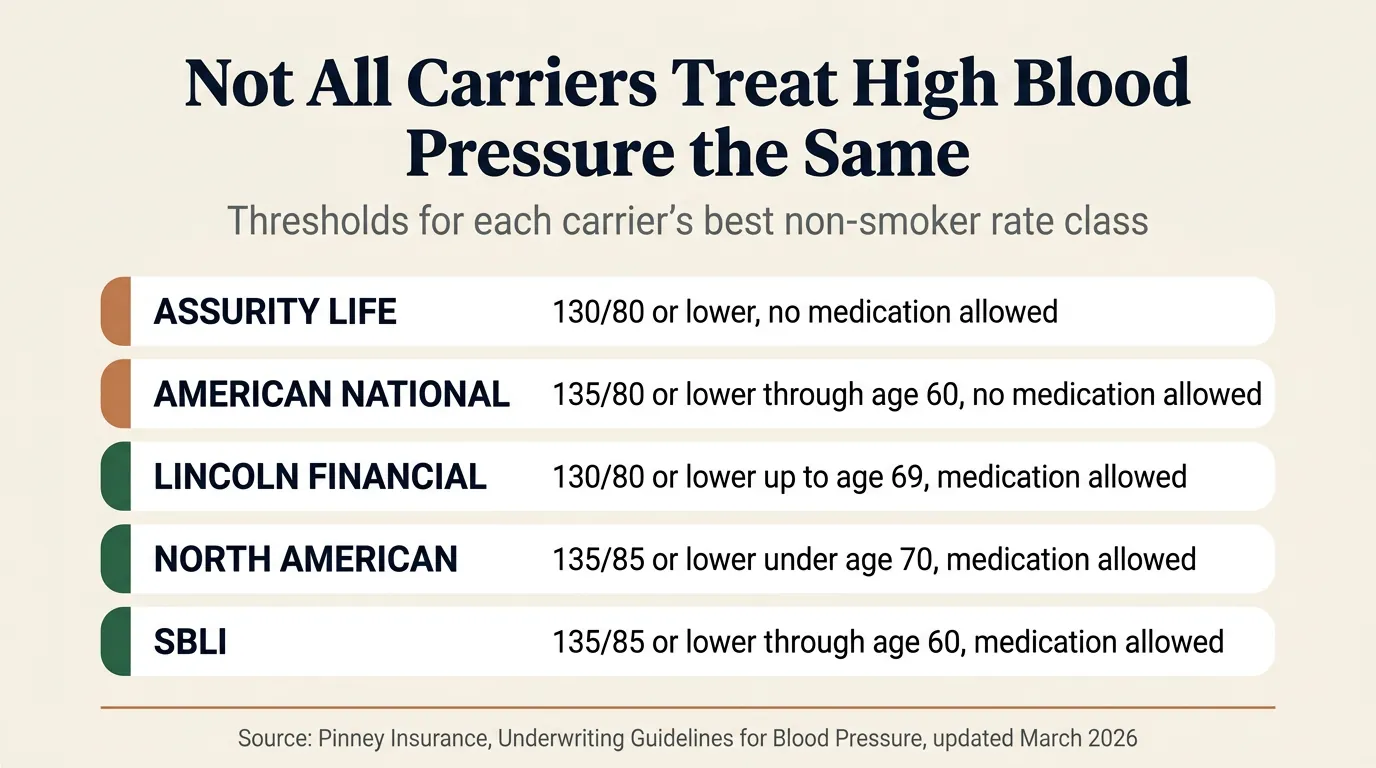
This is the single most useful thing to understand before you assume a diagnosis has settled your fate. Look at five carriers’ thresholds for their best available non-tobacco rate class, straight from Pinney Insurance’s March 2026 guidelines:
| Carrier | Best-tier threshold | Medication allowed at best tier? |
|---|---|---|
| Assurity Life | 130/80 or lower | No |
| American National | 135/80 or lower, through age 60 | No |
| Lincoln Financial | 130/80 or lower, up to age 69 | Yes |
| North American | 135/85 or lower, under age 70 | Yes |
| SBLI | 135/85 or lower, through age 60 | Yes |
Source: Pinney Insurance, Underwriting Guidelines for Blood Pressure, last updated March 16, 2026. Illustrative selection; the full guide covers more than 20 carriers and additional age bands. Accessed August 2026.
Notice the split. Assurity Life and American National both draw a hard line: any blood pressure medication at all moves you out of their best tier, regardless of how good your numbers look on treatment. Lincoln Financial, North American, and SBLI take the opposite approach — they’ll place a medicated applicant in their top tier as long as the reading itself clears the bar. Neither approach is “wrong.” They’re different business decisions about risk, and they mean the same applicant can get two very different first answers depending on which door they knock on.
A worked example: the same reading, six carriers, three different outcomes
Method beats theory here, so walk through an actual applicant. Say a 44-year-old South Dakotan takes one blood pressure medication and their most recent readings average 134/84. Using Pinney Insurance’s March 2026 thresholds for applicants under age 45–49 (the specific age band each carrier uses), here’s where that single reading and medication history lands at six different carriers:
| Carrier | Best-tier threshold at this age | Result at 134/84, medicated | Why |
|---|---|---|---|
| American General | 135/85, Rx OK, age ≤59 | Qualifies for best tier | Both numbers clear the threshold; medication is explicitly allowed |
| North American | 135/85, Rx OK, under 70 | Qualifies for best tier | Both numbers clear the threshold; medication is explicitly allowed |
| SBLI | 135/85, Rx OK, through age 60 | Qualifies for best tier | Both numbers clear the threshold; medication is explicitly allowed |
| American National | 135/80, no Rx, age 0–60 | Falls to second tier | Medication alone disqualifies this applicant from the top tier here |
| Assurity Life | 130/80, no Rx | Falls to second tier | Medication disqualifies from top tier; systolic also exceeds 130 |
| Prudential | 130/80, to age 49 | Falls to second tier | Systolic (134) exceeds this carrier's tighter under-50 threshold |
Illustration built from real carrier thresholds in Pinney Insurance's Underwriting Guidelines for Blood Pressure, last updated March 16, 2026. A hypothetical applicant profile; actual underwriting outcomes depend on your full file, not blood pressure alone. Not a quote or a guarantee of any outcome. Accessed August 2026.
The same person, the same reading, the same medication history — best available tier at three companies, second tier at three others. Nothing about that applicant changed between rows. Only the carrier did. That’s the entire case for shopping multiple carriers before accepting a first offer as the final word on what you qualify for.
A missed threshold at one carrier is rarely a missed threshold everywhere
Look back at the table: a reading that misses American National's and Assurity Life's best tier by a few points, and misses Prudential's tighter under-50 cutoff, still clears the identical bar at American General, North American, and SBLI without issue. The applicant didn't get healthier between rows — the carrier's line moved.
Why does hypertension get this much attention from underwriters in the first place?
Because of how common it is, and how much is actually at stake in outcomes it contributes to. 46.7% of U.S. adults have high blood pressure, according to the American Heart Association’s 2025 guideline — essentially a coin flip across the adult population. The CDC’s National Center for Health Statistics, using National Health and Nutrition Examination Survey data from August 2021 through August 2023, put adult prevalence at a very similar 47.7%, with a clear split by sex (50.8% of men, 44.6% of women) and a sharp rise by age: 23.4% of adults 18–39, 52.5% of adults 40–59, and 71.6% of adults 60 and older.
Hypertension prevalence rises sharply with age
Source: CDC/National Center for Health Statistics, NCHS Data Brief No. 511 (October 2024), using NHANES data from August 2021–August 2023. Accessed August 2026.
The reason carriers price this so specifically instead of treating it as a simple yes/no question: the CDC states that high blood pressure was a primary or contributing cause of 680,179 deaths in the United States in 2024, and estimates the annual economic cost associated with high blood pressure at $219 billion in 2019. Those are national, not South Dakota-specific figures — a South Dakota-specific hypertension prevalence rate isn’t reliably published at the state level in the sources checked for this article, so this guide sticks to the national data rather than guessing at a state number. But the mechanism is the same regardless of state: sustained high blood pressure meaningfully raises the risk of the outcomes life insurance is built to cover, which is exactly why it’s priced as specifically as the tables above show, rather than treated as an automatic decline.
Control is the other half of the picture, and it cuts against assuming the worst. Per the same NCHS data brief, 59.2% of adults with hypertension were aware of it, 51.2% were on medication for it, and 20.7% had it controlled to under 130/80 mm Hg. That control figure is genuinely low nationally — which means a large share of applicants who do get their numbers under control, and can show it, stand out from a big pool of applicants who haven’t.
How do you check where you likely stand, before you apply?
This is arithmetic and record-gathering you can do yourself in about twenty minutes, no underwriter required:
- Get your actual current average, not your worst single reading. A blood pressure cuff at home, taken a few times over a week or two at rest, gives you a realistic baseline. Several carriers explicitly average readings over 6 to 24 months rather than using one number, so a single bad day at the doctor’s office isn’t the whole story.
- Know your AHA/ACC category. Compare your average against the table earlier in this guide: Normal, Elevated, Stage 1, or Stage 2. This tells you roughly what range you’re working with, though it isn’t the same as any single carrier’s specific cutoff.
- Document your medication and how long you’ve been stable. Several carriers, including American General and Protective, specifically require that treated hypertension be stable for six months to a year before their better rate classes apply. “Just started medication last month” and “on the same medication and controlled for two years” are different underwriting stories even at the same reading.
- Compare your numbers against more than one carrier’s thresholds, since — as the tables above show directly — the same reading clears some carriers’ best tier and misses others’. A single company’s answer is not the market’s answer.
- Apply to the carrier likely to treat your specific numbers best, rather than the first company you think of or the one your neighbor used. This is the step where comparing carriers actually does something a single quote can’t.
Skipping the application because of a diagnosis
- Decides based on a diagnosis label, not your actual current readings
- Never checks whether medication genuinely costs you a rate class at the carriers you'd realistically use
- Leaves a real coverage gap in place indefinitely, based on a guess
Common outcomeGoing without coverage that a specific carrier would likely have offered
Comparing your real numbers against real carrier thresholds
- Uses your actual average reading and medication history, not a label
- Checks multiple carriers' specific cutoffs before assuming any one answer is final
- Applies to the carrier whose guidelines actually fit your file
Common outcomeA realistic first answer, from a carrier likely to price your file well
What if your numbers don’t clear anyone’s top tier right now?
That’s not the end of the conversation. A table rating (a priced step above standard) is still active coverage, not a decline — it means the carrier is accounting for added risk in the price rather than turning you away. If a fully underwritten policy genuinely isn’t pricing well anywhere right now, two other categories of product exist as backstops:
- Simplified-issue policies ask a shorter list of health questions, with no paramedical exam, in exchange for smaller available coverage amounts and a higher cost per dollar of coverage than fully underwritten policies.
- Guaranteed-issue policies accept applicants within an eligible age range regardless of health, typically with a graded death benefit — commonly two to three years — before the full payout applies for causes other than accidents.
Neither is automatically the right fit for a well-managed hypertension file that’s likely to underwrite well through the normal, fully underwritten path — but knowing they exist matters if you’ve been declined elsewhere or if your health picture is more complex than blood pressure alone.
A decline at one carrier is not a decline everywhere
Because thresholds genuinely differ by company, as the tables above show, a decline or an unfavorable rate class at one carrier reflects that carrier's specific guidelines applied to your file — not a verdict on your insurability generally. Reapplying with the same numbers at a different carrier, or after a documented period of improved control, commonly produces a different outcome.
How we help
We’re an independent agency, which matters directly for a condition like this, where the tables above show real, carrier-specific variation rather than one universal answer. When a South Dakotan comes to us with a blood pressure history, we don’t guess which company to apply to — we compare how the carriers we represent actually price your specific readings, medication history, and time under control, and aim your application at the one whose guidelines genuinely fit your file. Compare My Options.
What you get
A way to check your own numbers against real, sourced carrier thresholds before you ever request a quote, so you’re not deciding based on a guess. An honest explanation of why carriers disagree with each other on the same reading, instead of a single generic “here’s what hypertension costs” number that wouldn’t apply to your actual file anyway. And, if you want it, a comparison of how the carriers we work with would likely price your specific situation — checked against several companies at once instead of just the one you happened to call first.
A diagnosis on a chart and a rate class on a policy are two different things. Most people never find out how different until someone checks.
Mike MooreRelated reading
If a different health factor is part of your picture too, see our guides on life insurance with diabetes, life insurance and marijuana use, and does Ozempic affect your life insurance. For the broader picture of how carriers evaluate an applicant with any health condition, see getting life insurance after a health condition. And if you’re weighing whether a shorter health-question path fits your situation, see no-medical-exam life insurance: how it works.
Living with a health condition?
See how we work with people with health conditions to compare carriers that fit your specific file.
Curious what other conditions look like in underwriting?
See our guide to getting coverage after a health condition.
Not ready to talk to anyone?
Read how it works first and come back when you're ready.
Frequently asked questions
Can you get life insurance if you have high blood pressure?
In almost every case, yes. High blood pressure is one of the most common conditions life insurance underwriters see, not a rare red flag, and it typically affects your rate class rather than your eligibility. Nearly half of U.S. adults have high blood pressure (46.7%), according to the American Heart Association’s 2025 blood pressure guideline, so carriers have detailed, well-established rules for pricing it. The rate class you land in depends on your actual readings, whether you’re on medication, how long it’s been controlled, and which carrier evaluates your file.
Does taking blood pressure medication hurt your life insurance rate?
It depends entirely on the carrier, and this is one of the biggest places carriers disagree. Some companies, such as Assurity Life and American National, reserve their best available rate class for applicants who need no blood pressure medication at all, according to Pinney Insurance’s underwriting guidelines for blood pressure (updated March 2026). Others, including American General, North American, and SBLI, will place a medicated applicant in their top rate class as long as the readings themselves qualify. Being on treatment is not a red flag by itself. Which carrier you apply to changes whether it costs you a rate class.
What blood pressure reading disqualifies you from the best rate class?
There’s no single number, because every carrier sets its own cutoff, and the cutoffs vary by several points and by your age. Per Pinney Insurance’s March 2026 underwriting matrix, some carriers reserve their best class for readings at or below 130/80, while others allow up to 140/85 or higher at the same tier, and several raise the bar further once you pass age 60 or 70. A reading that misses one carrier’s best tier by a couple of points often still qualifies cleanly at a different carrier’s best tier.
Will every carrier rate my blood pressure the same way?
No. That’s the central fact this guide is built around. Pinney Insurance’s underwriting matrix lists more than 20 carriers, and no two use identical blood pressure thresholds for the same rate class. Two applicants with the exact same reading and medication history can land in different rate classes purely based on which company reviews the file, which is exactly the kind of variation an independent agency exists to shop for you.
Does South Dakota law require insurers to treat blood pressure the same for everyone?
No, and that’s not what South Dakota’s anti-discrimination rule protects against. SDCL 58-33-26 states that no insurer may make or permit unfair discrimination between insureds having like insuring or risk characteristics in premium, rates, or any other term or condition of insurance, and a violation is a Class 2 misdemeanor. That protects against arbitrary discrimination between people with genuinely similar risk profiles at the same company. It doesn’t require every carrier to use the same underwriting thresholds as every other carrier, which is exactly why the same reading can qualify for different rate classes at different, equally lawful companies.
Can a life insurance company retest your blood pressure after you apply?
Yes. A fully underwritten policy typically includes a paramedical exam where a nurse or technician takes your blood pressure directly, often more than once, rather than relying only on what you report on the application or what your doctor’s chart says. Several carriers in Pinney Insurance’s guidelines specifically average readings over time, such as a 2-year or 12-month average, rather than accepting a single reading at face value, which means a single unusually high or unusually good exam-day number isn’t necessarily the whole story either way.
Should you wait until your blood pressure is under control before applying?
That’s a decision to make with your doctor about your own health, not a rule this article can set for you, but it’s worth understanding the tradeoff either way. Only about 1 in 5 U.S. adults with hypertension have it controlled to under 130/80 mm Hg, according to the CDC’s National Center for Health Statistics (August 2021 to August 2023 data), so waiting for perfect control before applying would leave the large majority of people with hypertension without any coverage indefinitely. Many carriers underwrite well-managed, medicated hypertension at or near their best rate classes today; an independent agent can tell you realistically where your current numbers land before you decide whether to wait.
What if you don’t qualify for standard or better rates anywhere?
A decline or a higher-priced offer from one company is not a decline everywhere, and it isn’t the end of the options. Simplified-issue policies ask a shorter set of health questions with no medical exam, and guaranteed-issue policies accept applicants within an eligible age range regardless of health, though both typically come at a smaller coverage amount and a higher cost per dollar of coverage than fully underwritten policies. Comparing how carriers price your specific file, rather than accepting the first answer, is often the highest-leverage step available.
Sources
- American Heart Association — New high blood pressure guideline emphasizes prevention, early treatment to reduce CVD risk — 2025 blood pressure categories (Normal, Elevated, Stage 1, Stage 2), 46.7% adult prevalence; guideline published August 14, 2025; accessed August 2026
- CDC — High Blood Pressure Facts — 48.1% prevalence (NHANES 2017–March 2020); 50% men / 42.1% women (2021–2023); 680,179 deaths with high blood pressure as a primary or contributing cause (2024); $219 billion annual economic cost (2019); accessed August 2026
- CDC/National Center for Health Statistics — NCHS Data Brief No. 511, Hypertension Prevalence, Awareness, Treatment, and Control Among Adults — 47.7% overall prevalence, 50.8% men / 44.6% women, 23.4%/52.5%/71.6% by age group, 59.2% awareness, 51.2% treatment, 20.7% control; NHANES August 2021–August 2023; published October 2024; accessed August 2026
- Pinney Insurance — Underwriting Guidelines for Blood Pressure — carrier-by-carrier blood pressure thresholds by rate class and age band across more than 20 carriers; last updated March 16, 2026; accessed August 2026
- South Dakota Legislature — SDCL 58-33-26, Unfair discrimination as to terms and conditions of insurance as misdemeanor — full statute text and Class 2 misdemeanor classification; accessed August 2026
- National Association of Insurance Commissioners — Consumer guidance on life insurance — general underwriting and renewal-pricing mechanics; accessed August 2026
Related reading: Life insurance with diabetes, life insurance and marijuana use, does Ozempic affect your life insurance, getting life insurance after a health condition, and no-medical-exam life insurance. See who we help: people with health conditions.
Before you act on any of this
This article is general education, not insurance, legal, financial, medical, or tax advice. It does not diagnose, treat, or offer guidance on managing high blood pressure — talk with your doctor about your own health. Product availability, features, and rates vary by carrier and are subject to underwriting. No coverage exists until a policy is issued and in force. Any guarantees are subject to the claims-paying ability of the issuing insurer. The carrier thresholds cited here reflect one underwriting reference guide as of March 2026 and can change; they illustrate how underwriting works, not a promise of any specific outcome for you. Please review actual policy documents and speak with a licensed agent about your own situation.
A diagnosis is not the same thing as a decline
High blood pressure shows up on close to half of the applications life insurers see, and the industry has built detailed, carrier-specific rules for pricing it rather than treating it as a single yes-or-no gate. The number that actually determines your rate class isn’t your diagnosis label — it’s your current reading, your medication history, and which carrier’s specific thresholds you’re measured against. You can check your own numbers against the categories and thresholds in this guide this afternoon. Comparing how several real carriers would price your specific file is the part worth a second opinion.
Want to know where your numbers actually stand?
We'll compare how the carriers we represent price your specific readings and medication history, so you get a realistic answer instead of a guess.