
If you have type 2 diabetes and you are wondering whether you can still get life insurance with diabetes in South Dakota in 2026, the short answer is almost always yes. Diabetes is one of the most common conditions life insurance underwriters see, and in the large majority of cases it changes your rate class, not your eligibility. What decides the outcome is your A1C history, how long you have had the diagnosis, whether you have complications, and which carrier you apply to, since carriers do not treat the same diabetes file the same way. About 11% of South Dakota adults report a diabetes diagnosis, according to the South Dakota Department of Health, so this is not a rare edge case in this state. It is a routine part of underwriting that most people never get walked through before they assume the door is closed.
The short version
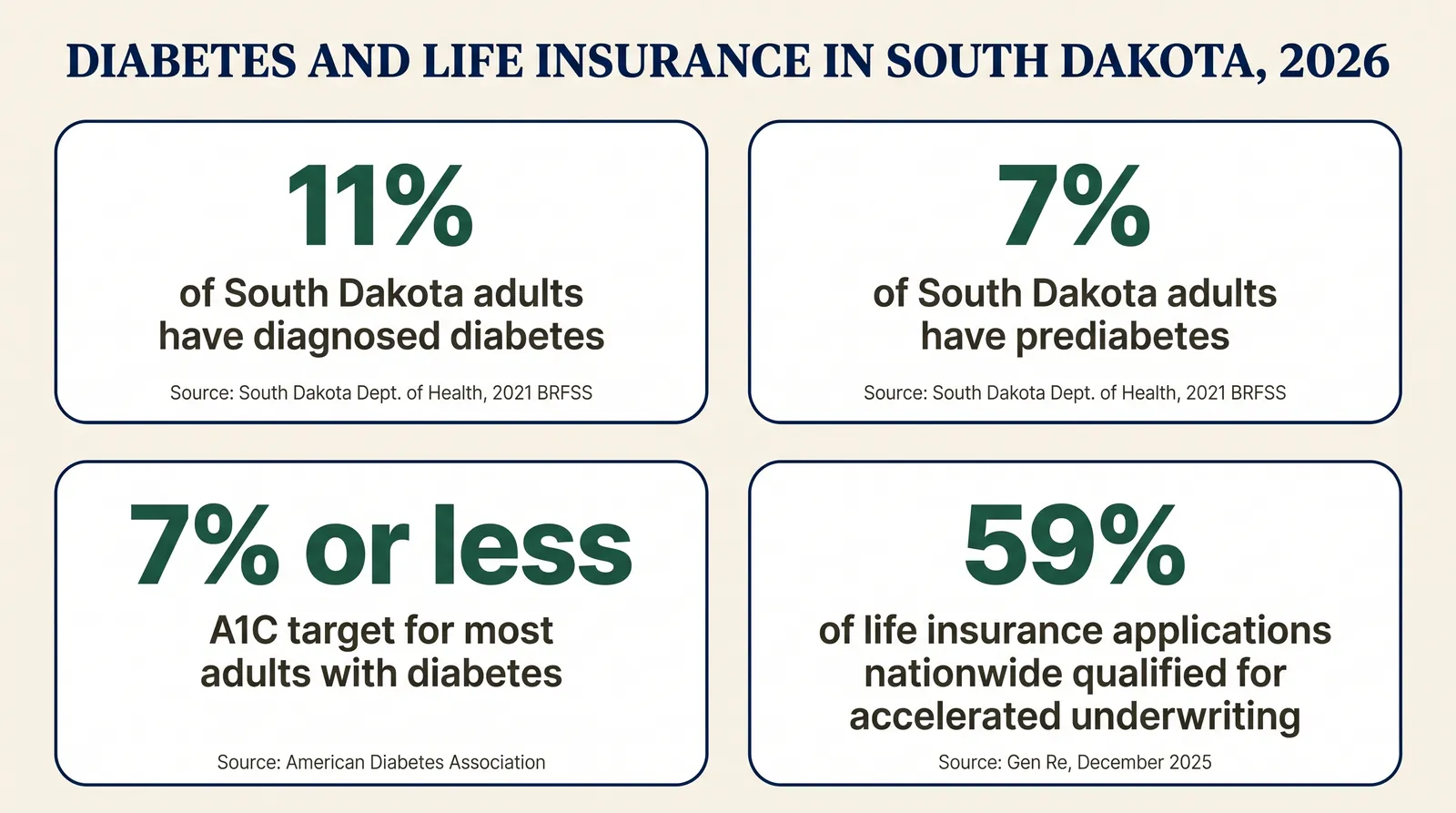
- About 11% of South Dakota adults have diagnosed diabetes and another 7% have prediabetes, per the South Dakota Department of Health's 2021 BRFSS survey.
- A1C, the three-month average blood sugar measure, is the number underwriters weigh most heavily; the American Diabetes Association's general target for most adults is 7% or less.
- Diabetes usually moves you into a table rating, a step above standard rates, rather than a decline. Carriers differ in how many table ratings they will offer and how they weigh your file.
- The Americans with Disabilities Act specifically permits insurers to underwrite based on health risk under state law (42 U.S.C. Section 12201(c)); it is not illegal discrimination, it is how insurance pricing works.
- An average of 59% of individual life insurance applications now qualify for an accelerated, no-exam underwriting path industry-wide, according to Gen Re's December 2025 survey of 30 carriers, though eligibility for any specific applicant still depends on the carrier's own guidelines.
The pain: you assume the diagnosis already answered the question
Somewhere between the doctor’s office and the life insurance application, a lot of people quietly decide the answer is no. You got the diagnosis, maybe years ago, maybe last spring, and you filed it away as one more thing that makes you different from the version of yourself who could just buy a policy without thinking twice. So you do not apply. Not because anyone told you no, but because you assumed it before anyone had the chance to.
That assumption usually costs more than the premium would have. A mortgage does not care whether the person who signed for it has diabetes. Neither does a car payment, a kid’s tuition, or the mental math your spouse would have to do if your income stopped showing up. The condition you are managing every day with a glucose meter or a pump has nothing to do with whether your family still needs your income replaced if something happens to you. Those are two separate questions, and treating the first as an answer to the second is where people end up underinsured for reasons that have nothing to do with what carriers will actually offer them.
This is general education, not a recommendation
Nothing here tells you what rate class you will receive or promises approval, a specific premium, or a specific underwriting timeline. It explains how the mechanics of diabetes underwriting actually work, using named sources, so you can understand your own file instead of guessing at it.
Why it happens: underwriters are pricing risk, not making a moral judgment
A life insurance underwriter’s job is narrow: estimate how your health history affects the odds you will die during the period the policy covers, and price accordingly. That is a mechanical, actuarial exercise, not a verdict on your character or your effort. It helps to define the terms that actually drive the outcome, since they get used loosely everywhere else.
- A1C. A blood test measuring your average blood sugar over roughly the prior two to three months, expressed as a percentage. It is the single number underwriters rely on most for diabetes risk, because it reflects a trend rather than a single day.
- Underwriting class. The risk tier a carrier assigns you after reviewing your application, medical records, and any lab work. Common classes run from preferred best, through preferred, standard plus, and standard, before dropping into table ratings.
- Table rating. A pricing step above standard, used when an applicant is insurable but carries more risk than a standard applicant. Carriers label these with letters or numbers, and each step generally adds to the premium over standard rates for the same age, sex, and coverage amount.
- Contestability period. The two-year window after a policy is issued during which the insurer can investigate and potentially deny a claim for a material misrepresentation on the application. It has nothing to do with your rate class; it is about honesty on the application itself.
- Accelerated underwriting. A process that replaces the in-person medical exam with data pulled from sources like prescription history, motor vehicle records, and prior medical records, allowing some applications to be decided in hours instead of weeks.
- Simplified issue and guaranteed issue. Products that ask few (simplified issue) or no (guaranteed issue) health questions, generally in exchange for lower coverage amounts and higher cost per dollar of coverage than fully underwritten policies.
Here is the part that tends to surprise people: none of this is illegal or unusual. The Americans with Disabilities Act, the federal law most people assume would prevent a company from charging more because of a health condition, specifically carves insurance out of that protection. Under 42 U.S.C. Section 12201(c), the ADA does not prohibit insurers from “underwriting risks, classifying risks, or administering such risks that are based on or not inconsistent with State law,” as long as the practice is not used as a subterfuge to evade the law’s broader purpose. Separately, the National Association of Insurance Commissioners’ unfair trade practices framework targets a different problem: treating two people in the same risk class differently, arbitrarily. It does not prohibit classifying people by actual health risk in the first place. Put together, both the federal disability law and the state insurance framework that governs South Dakota carriers say the same thing: risk-based pricing for a real medical condition is how the system is designed to work, not a loophole or an injustice being done to you.
What it costs to get wrong: the gap between assuming and applying
Let’s put a real South Dakota household in this picture instead of describing it abstractly. Say a 46-year-old in Aberdeen, in Brown County, has had type 2 diabetes for six years, takes metformin and a second oral medication, and has kept an A1C between 6.9% and 7.3% for the past two years with no diagnosed complications. Brown County shows one of the higher diabetes prevalence rates in the state’s data, at 10%, so this is not a hypothetical outlier for that part of South Dakota. This is an illustration of the underwriting mechanics only, not a projection of any specific offer.
That applicant has a $310,000 mortgage balance, a spouse who earns less, and two kids under 12. Nothing about that math changes because of the A1C reading. What can change is which rate class prices the coverage, and that gap is worth understanding in dollar terms, not just percentage terms.
| Rate class | What it generally signals to an underwriter | General cost direction vs. standard |
|---|---|---|
| Standard | Average risk for age and sex; well-controlled, moderate-duration diabetes with no complications is sometimes reachable here | Baseline |
| Table rating (mild, e.g. Table B/2) | Above-average risk; common outcome for consistent A1C control in the mid-to-high 7% range with no complications | Moderately higher than standard, varies by carrier |
| Table rating (higher, e.g. Table D/4 and above) | Elevated risk; more likely with a higher or unstable A1C, longer duration, or an early complication | Meaningfully higher than standard, varies significantly by carrier |
| Decline | Uncommon for diabetes alone; more associated with poorly controlled A1C combined with serious complications like advanced kidney disease | Not offered by that carrier; another carrier may still offer coverage |
General underwriting mechanics only. This table does not represent premiums, quotes, specific carrier guidelines, or a promise of any outcome. Actual rate class and pricing depend on the applicant's full medical history and the specific carrier's underwriting guidelines.
The actual cost of getting this wrong is not a number on a rate table. It is the cost of never finding out, which is the coverage gap itself: a $310,000 mortgage with nothing behind it, sized against an income that stops the day something happens. That gap does not shrink because someone assumed a table rating would be too expensive to bother comparing. It is worth working through your own numbers the same way we describe in our guide to figuring out how much coverage you actually need, separate from and before the underwriting conversation.
11%
of South Dakota adults have diagnosed diabetes, per SD Dept. of Health 2021 BRFSS
7% or less
A1C, the general target for most adults with diabetes, per the American Diabetes Association
59%
of individual life applications qualified for accelerated (no-exam) underwriting industry-wide, per Gen Re, Dec. 2025
The 2026 picture: prevalence is rising with age, and so is who is affected
Diabetes in South Dakota is not evenly spread across age groups, and that matters because it means a growing share of people applying for life insurance later in life, when coverage needs like a remaining mortgage or a spouse’s retirement income are often still very real, are doing so with a diagnosis already on the chart.
| Age group | Reported diabetes diagnosis |
|---|---|
| 18-29 | 2% |
| 30-39 | 3% |
| 40-49 | 7% |
| 50-59 | 12% |
| 60-69 | 16% |
| 70-79 | 22% |
| 80+ | 23% |
South Dakota Department of Health, Behavioral Risk Factor Surveillance System, 2017-2021 combined data.
Nationally, the picture is larger in raw numbers but tells the same story. An estimated 28.8 million U.S. adults age 18 and older had diagnosed diabetes as of the most recent data cited in the CDC’s National Diabetes Statistics Report, last updated January 2026 with figures drawn from 2023, and 12.0% of the total U.S. population had diagnosed or undiagnosed diabetes combined. Of adults with diagnosed diabetes, 1.8 million adults age 20 and older have type 1 specifically, according to the same report, which means the large majority of diagnosed cases in adults are type 2, the form most commonly evaluated in the underwriting scenarios this article covers. South Dakota’s 11% adult prevalence sits close to the nationwide median the state’s own report cites for the same survey period, so this state is not an outlier in either direction; it is a fair reflection of a genuinely common condition, which is exactly why carriers have well-established, if carrier-specific, ways of pricing it rather than treating it as exotic.
Diabetes doesn't usually close the door on life insurance. It changes which door you walk through, and that's a comparison question, not a yes-or-no question.
Mike Moore, Life Insurance AdvisorHow to work it out yourself: what to gather before you apply
You do not need anyone else to start this process. A few things you can pull together on your own will tell you more about your likely outcome than guessing ever will.
- Get your last two to three years of A1C readings, not just the most recent one. Underwriters look for a trend, not a snapshot. A steady 7.1% for three years reads very differently than a recent drop from 9.5% to 7.1%, even though the latest number is identical.
- Note your date of diagnosis and how it has been treated over time. Diet and exercise only, oral medication, or insulin, and whether that treatment has changed, all factor into the picture. A recent step-up in medication is not automatically a red flag; it may simply reflect proactive management.
- Ask your doctor directly whether you have any diagnosed complications: kidney involvement, retinopathy (eye involvement), neuropathy, or cardiovascular disease. These, more than the A1C number alone, are what push a file from a mild table rating toward a steeper one or, in less common cases, a decline from a particular carrier.
- Know your other numbers too: blood pressure, cholesterol, weight, and whether you use tobacco. Diabetes rarely arrives as the only factor in an underwriting file, and a strong picture on the rest can offset a diabetes-related table rating more than people expect.
- Understand that carriers are not interchangeable here. One company’s underwriting guidelines might rate a well-controlled A1C in the low 7s close to standard; another might automatically apply a table rating to any diagnosed diabetes regardless of control. This is the single biggest reason to compare more than one carrier rather than accept or assume based on one company’s guidelines.
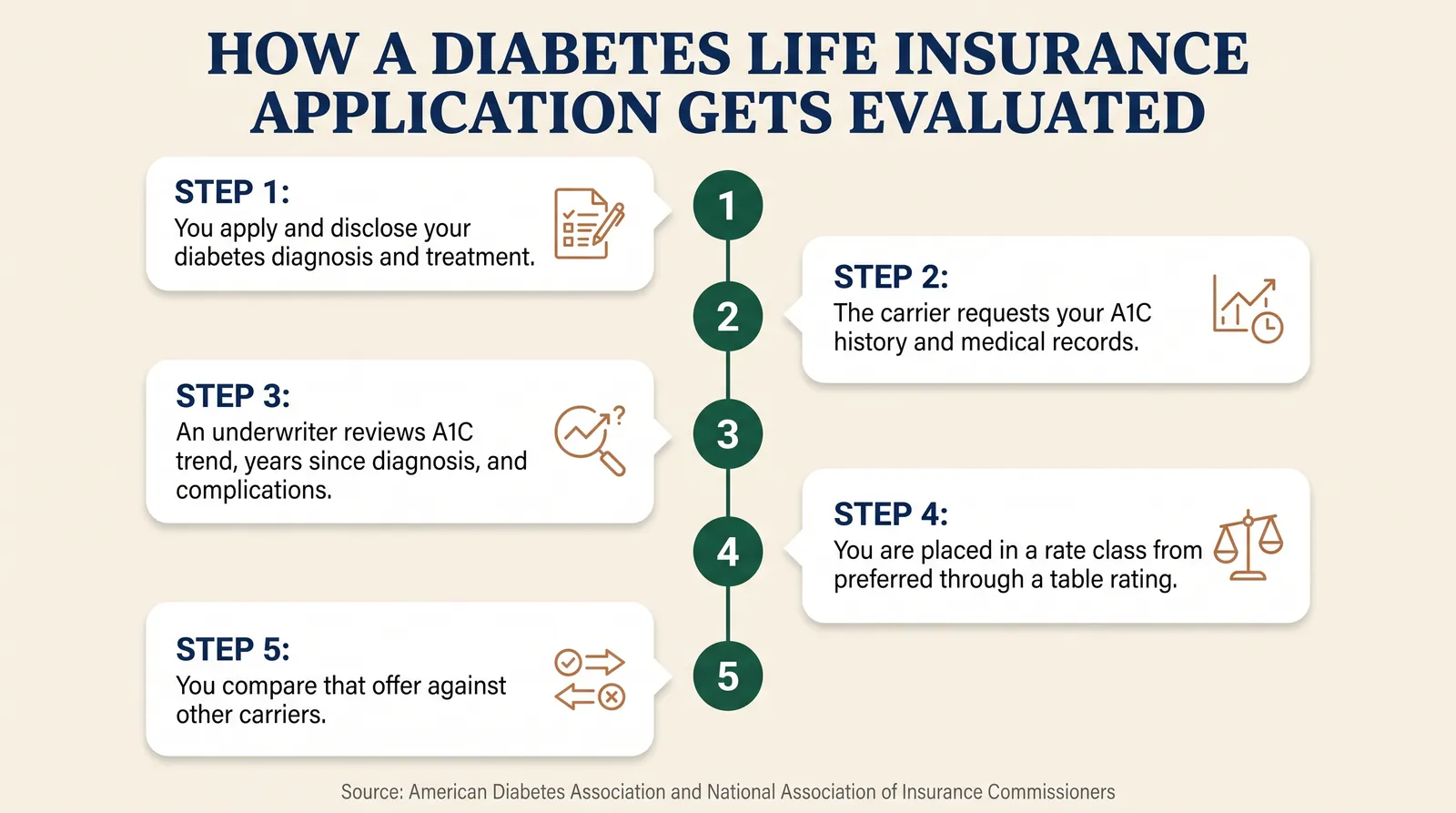
You can do steps 1 through 4 yourself, today
Most of this is information you already have access to through your patient portal or by asking your doctor's office for a printout. Where a second opinion tends to help most is step 5, comparing how different carriers actually price the same file, since that variation is the part no single company's website will show you.
No-exam paths exist, and they are not the same product
A meaningful and growing share of life insurance applications never involve a physical exam at all. An average of 59% of individual life insurance applications nationwide qualified for an accelerated underwriting path in 2025, according to a survey of 30 carriers representing more than 2 million paid policies published by Gen Re in December 2025. Accelerated underwriting replaces the exam with data pulled from sources like prescription history and motor vehicle records, evaluated against the carrier’s own models, according to the National Association of Insurance Commissioners.
That is a different thing from simplified-issue and guaranteed-issue products, which ask few or no health questions in exchange for smaller coverage amounts and a higher cost per dollar of coverage. All three of these no-exam paths are real categories that exist in the market today. Whether a particular one is available and priced well for your specific diabetes history depends on your age, coverage amount, and the individual carrier’s guidelines, which is not something any single company’s marketing page will tell you honestly, since each one is naturally describing its own product. If a fast, exam-free path matters to you, it is worth asking specifically which carriers’ accelerated or simplified-issue programs your file might fit, rather than assuming either that speed is guaranteed or that it is off the table because of the diagnosis.
What actually happens
- The coverage gap behind your mortgage or income stays exactly where it was
- You never learn your actual rate class from an actual carrier
- You cannot compare offers you never requested
- The assumption gets reinforced every year nothing changes
What actually happens
- You get a real rate class from a real underwriting file, not a guess
- You see how more than one carrier treats the same A1C history
- You find out whether a no-exam path fits your situation or not
- You either move forward with a number you understand, or decide the timing is wrong for a reason you actually know
If you would rather have someone local run this comparison with you than call carriers one by one, that is what we do: Compare My Options.
When waiting genuinely makes sense
It is worth saying plainly, because this is not a one-directional sales pitch: sometimes applying right now is not the right call. If your diabetes was diagnosed recently and your care team is still adjusting your treatment, your A1C may still be trending down from an initial high reading rather than sitting at a stable baseline. Most carriers weigh a stable trend far more favorably than a single improving-but-recent number, so an applicant six months into treatment sometimes gets a better outcome by waiting another six months to a year and applying with two consistent readings instead of one. That is not the same as waiting indefinitely out of fear the answer will be no; it is a specific, time-limited reason grounded in how the underwriting actually reads a trend.
On the other side, if you have had a stable, reasonably controlled A1C for a year or more, there is rarely a good reason to keep waiting. Diabetes tends to be a lifelong, managed condition rather than one that resolves, so “waiting until it’s better” often just means paying more later for coverage you could reasonably qualify for now, since rate class is also affected by your age at application. Our related guide on no-medical-exam life insurance goes deeper into the mechanics of the accelerated, simplified-issue and guaranteed-issue categories mentioned above if that is the path you are weighing.
How we help
We are independent, so we are not built around any single carrier’s diabetes guidelines. We start with your actual A1C history, complications, treatment, and coverage need, then compare how different carriers price that specific file rather than assuming one company’s guidelines apply everywhere. If a no-exam path genuinely fits your situation, we review it with you; if a fully underwritten application would get you meaningfully better pricing for the same coverage, we say that instead. If the honest answer for your file right now is to wait a few months for your A1C trend to settle, we say that too.
What you get
A clear read on how your actual diabetes history is likely to be evaluated, not a generic answer pulled from an average. A comparison across more than one carrier’s underwriting guidelines, since that variation is the single biggest lever in this decision and the one hardest to see on your own. And an honest answer about timing: whether applying now makes sense, or whether a short wait for a more stable A1C trend would genuinely serve you better.
Find out how your diabetes history is actually likely to be underwritten
Bring your A1C history and treatment timeline and we will walk through how different carriers are likely to price your specific file, and whether a no-exam path fits.
Not ready to talk to anyone yet? Read How It Works first and come back when you are. And if you are still working out how much coverage you actually need before worrying about the underwriting question, our life insurance needs calculator is a reasonable place to start that math on your own.
Frequently asked questions
Does having diabetes automatically disqualify you from life insurance?
No. Diabetes is one of the most common conditions underwriters evaluate, and it is priced, not automatically declined, in the great majority of cases. Underwriters look at your A1C history, how long you have had the diagnosis, whether you have complications, and how consistently you take insulin or oral medication, then place you in a rate class ranging from preferred through a series of table ratings. A decline is possible with poorly controlled diabetes plus serious complications, but for most applicants the real question is which rate class you land in and which carrier prices your specific file most favorably, not whether coverage exists at all.
How does A1C affect life insurance underwriting?
A1C is a blood test that reflects your average blood sugar control over roughly the prior three months, and it is the single number underwriters lean on most heavily when evaluating a diabetes application, according to the American Diabetes Association. The American Diabetes Association’s general target for most adults with diabetes is an A1C of 7% or less. A lower, more stable A1C over time signals better control and generally supports a better underwriting outcome; a higher or erratic A1C signals more risk to the underwriter and typically moves you into a lower rate class or a table rating. Carriers do not publish identical A1C cutoffs, and the same lab result can be treated differently company to company, which is exactly why comparing more than one carrier matters.
What is a table rating and how does it affect my premium?
A table rating is a step above standard rates that carriers assign when an applicant’s risk is higher than average but still insurable. Carriers use either letters (A through H, or similar) or numbers (1 through 8, or similar) to mark each step, and each step generally increases the premium over what a standard-rated applicant with the same age, sex and coverage amount would pay. Carriers differ in how many table ratings they are willing to offer before declining an application, and they differ in how they weigh A1C, complications, and years since diagnosis, so the same diabetes history can land at a mild table rating with one carrier and a steeper one with another.
Can I get no-exam life insurance if I have diabetes?
No-exam life insurance is a real category. It includes accelerated underwriting, which replaces the physical exam with data from sources like prescription history and motor vehicle records, and simplified-issue and guaranteed-issue products, which ask few or no health questions at all. Whether any specific no-exam product is available to you depends on your age, your coverage amount, your specific diabetes history, and the carrier’s own guidelines, and that varies enough between companies that it is worth reviewing your actual situation with someone who can compare carriers rather than assuming either that a fast path is guaranteed or that it does not exist.
Is it legal for a life insurance company to charge me more because I have diabetes?
Yes. The Americans with Disabilities Act explicitly permits insurers to underwrite, classify, and administer risks based on state insurance law, under 42 U.S.C. Section 12201(c), so long as the practice is not used as a subterfuge to evade the ADA’s purpose. State insurance codes, including South Dakota’s, separately prohibit unfair discrimination, which the National Association of Insurance Commissioners describes as treating people in the same risk class differently, not as prohibiting risk-based classification itself. In plain terms: a carrier cannot charge two people with identical diabetes histories different rates for no reason, but it can and does charge someone with diabetes more than someone without it, because the underlying mortality risk is genuinely different.
Does insulin use by itself disqualify you from life insurance?
No. Insulin use is one data point among several, not an automatic disqualifier. Underwriters weigh insulin use alongside your A1C trend, how long ago you started insulin, your age at diagnosis, your weight, blood pressure, and any complications like kidney or eye involvement. Someone on insulin with a well-controlled A1C and no complications can still land in a reasonable rate class; someone on oral medication only but with a poorly controlled A1C and complications can rate worse. The insulin itself is rarely the deciding factor.
How many South Dakotans actually have diabetes?
About 11% of South Dakota adults report having been diagnosed with diabetes, and another 7% report a diagnosis of prediabetes or borderline diabetes, according to the South Dakota Department of Health’s 2021 Behavioral Risk Factor Surveillance System survey. Prevalence rises sharply with age, from about 2% of adults age 18 to 29 to 22% to 23% of adults age 70 and older in the state’s 2017 to 2021 combined data. That means a large share of South Dakotans applying for life insurance later in life are doing so with a diabetes diagnosis already on their chart, which is exactly why understanding how the underwriting actually works matters.
Should I wait to apply until my diabetes is better controlled?
It depends on where you are. If your diagnosis is brand new and your A1C is still swinging while you and your doctor find the right treatment, some carriers will ask you to wait, often six months to a year, until your numbers stabilize, because a single recent lab value does not show a trend. If you have had a consistent, reasonably controlled A1C for a year or more, waiting usually just delays coverage you could already qualify for, often at a rate class you would still be glad to have locked in. The honest answer is to find out where your actual file stands rather than guess in either direction.
Before you apply
This article is general education, not insurance, legal, financial, or tax advice. Product availability, rate classes, underwriting outcomes, and premiums vary by carrier and are subject to underwriting and each applicant's specific medical history. No coverage exists until a policy is issued and in force. Any guarantees are subject to the claims-paying ability of the issuing insurer. Please review actual policy documents and speak with a licensed agent about your situation.
Sources
- South Dakota Department of Health — 2021 Behavioral Risk Factor Surveillance System, Diabetes — 11% of South Dakota adults diagnosed with diabetes (2021) and 7% with prediabetes; age and county breakdowns, 2017-2021 combined data. This is the state-level application of the CDC-administered BRFSS survey; no independent second dataset was found with a directly comparable South Dakota-specific figure.
- Centers for Disease Control and Prevention — National Diabetes Statistics Report — 28.8 million U.S. adults (18+) with diagnosed diabetes, 12.0% of the population with diagnosed or undiagnosed diabetes, and 1.8 million adults (20+) with type 1 diabetes; data period 2023, page updated January 21, 2026
- American Diabetes Association — Understanding A1C — general A1C target of 7% or less for most adults with diabetes
- National Association of Insurance Commissioners — Accelerated Underwriting — description of accelerated underwriting mechanics and regulatory focus on unfair discrimination
- Cornell Law School Legal Information Institute — 42 U.S.C. Section 12201 — ADA insurance safe harbor permitting risk-based underwriting under state law
- Gen Re — 2025 U.S. Individual Life Next Gen Underwriting Survey Results — 59% average accelerated underwriting qualification rate among 30 participating carriers, published December 17, 2025
Related reading: Getting Life Insurance After a Health Condition: 2026 Underwriting Trends, No-Medical-Exam Life Insurance: How It Works in 2026, and How Much Life Insurance Do You Actually Need?. See current options for no-medical-exam life insurance and guaranteed-issue coverage, or learn more about who we help.