
If you have chronic kidney disease, or you are on dialysis, and you are wondering whether life insurance is even possible, the short answer is: more often than people assume, yes, though the path depends heavily on where you are in the disease and how far along it is. Kidney disease covers an enormous range, from a mildly reduced filtration rate your doctor is simply monitoring to full kidney failure requiring dialysis three times a week. Underwriters price that range; they do not treat it as one yes-or-no question. About 3% of South Dakota adults, roughly 17,000 people, report ever being told they have kidney disease, according to the South Dakota Department of Health, and the real number with some degree of reduced kidney function is almost certainly higher, since most early kidney disease has no symptoms. If a diagnosis has made you assume the life insurance conversation is closed before you have even had it, this is the article that walks through why that assumption is usually wrong, and what the real options look like.
The short version
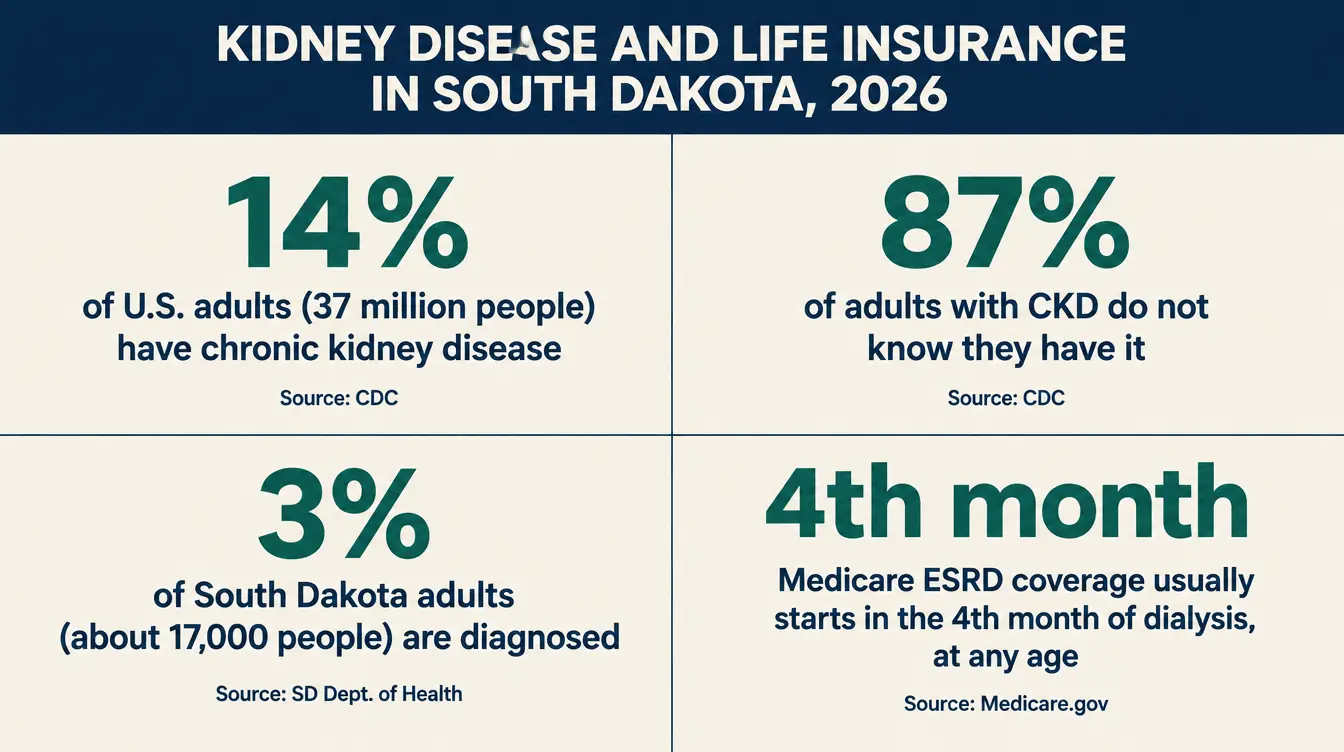
- About 3% of South Dakota adults (an estimated 17,000 people) report being told they have kidney disease, per the South Dakota Department of Health's BRFSS report; the CDC estimates 14% of U.S. adults (37 million people) actually have chronic kidney disease, because most of it is undiagnosed.
- Earlier, stable CKD is often priced as a table rating with a fully underwritten carrier. Dialysis and kidney failure narrow the realistic path toward simplified issue or guaranteed issue coverage.
- Guaranteed issue life insurance asks no health questions, so a kidney diagnosis cannot disqualify you from it, but it comes with smaller coverage amounts and a graded death benefit in the early years.
- Medicare covers people with end-stage renal disease at any age, not just 65+, once regular dialysis begins, usually starting the fourth month of treatment, according to Medicare.gov. That is a separate program from life insurance, and it covers medical costs, not your family's lost income.
- South Dakota law (SDCL 58-15-8.1) gives you 10 days after receiving any individual life insurance policy to return it for a full refund if you change your mind, no reason required.
The pain: a diagnosis that feels like it already answered the question
For most people, the moment they hear “your kidney function is down” or “you’ll need to start dialysis” is not a moment anyone is thinking about life insurance. It is a moment about dialysis schedules, diet changes, a transplant list maybe, and what this means for the next several years. Life insurance gets filed away under “things that probably aren’t possible for me anymore,” right alongside the assumption, and most people never come back to check whether that assumption was true.
It usually was not, at least not in the simple way it feels. A mortgage balance does not care what your eGFR reading is. Neither does a car payment, a kid’s remaining years of school, or what your spouse would actually have to cover if your income stopped the week you started dialysis. The medical reality and the financial reality are two separate questions, and treating a kidney diagnosis as the answer to both is exactly how people end up with a real, sized coverage gap behind a condition that, in a meaningful share of cases, would have priced as a table rating rather than a decline.
This is general education, not a recommendation
Nothing here promises a rate class, an approval, a specific premium, or a specific underwriting timeline for your situation. It explains how the mechanics of kidney disease underwriting generally work, using named sources, so you can understand your own file instead of guessing at it.
Why it happens: kidney disease is a spectrum, and underwriting treats it like one
Chronic kidney disease (CKD) means your kidneys have lost some ability to filter waste and excess fluid from your blood, and it is staged by severity rather than treated as a single condition. A few terms carry the whole conversation, so it is worth defining them plainly before anything else:
- eGFR (estimated glomerular filtration rate). A lab-calculated estimate of how well your kidneys are filtering blood, expressed as a number. A normal eGFR runs roughly 90 and above; CKD is generally staged from mild reduction down to kidney failure as the number drops. Underwriters look at your eGFR trend over time, not a single reading.
- CKD stage. A five-stage classification (often written 1 through 5, with 5 also called kidney failure or end-stage renal disease) based on eGFR and other markers like protein in the urine. Earlier stages are frequently monitored with lifestyle and medication changes; stage 5 generally means dialysis or a transplant is needed to sustain life.
- ESRD (end-stage renal disease). The medical and regulatory term for kidney failure, stage 5 CKD, where dialysis or a transplant becomes necessary rather than optional. This is also the term the federal Medicare program uses for its specific ESRD eligibility pathway.
- Dialysis. A medical procedure that filters waste and fluid from the blood mechanically, done either at a center (typically three times a week, hemodialysis) or at home (including peritoneal dialysis), when the kidneys can no longer do this job on their own.
- Table rating. A pricing step above standard rates that carriers assign when an applicant is insurable but carries more risk than average. Carriers mark these steps with letters or numbers, and each step generally raises the premium over what a standard-rated applicant of the same age and sex would pay for the same coverage.
- Guaranteed issue. A life insurance product that asks no medical questions and requires no exam. Approval is close to automatic within the product’s age and amount limits, but face amounts are smaller and the policy generally includes a graded death benefit.
- Graded death benefit. A limited-benefit period, commonly the first two to three years of a policy, during which a death from natural causes pays out less than the full face amount, often a refund of premiums paid plus interest, while accidental death is usually paid in full from the start.
- Simplified issue. A middle path that asks a short list of health questions (often including whether you are on dialysis) but skips the medical exam, with underwriting decided largely by your answers and a records check rather than new lab work.
What decides your outcome is rarely the single word “kidney disease” on an application. It is the stage, the eGFR trend, whether the cause is diabetes, high blood pressure, or something else, whether you are on dialysis or past a transplant, and how long your history has been stable. The CDC’s own data underlines why none of this is treated as rare or exotic by carriers: an estimated 14% of U.S. adults, about 37 million people, have CKD, based on National Health and Nutrition Examination Survey (NHANES) data collected August 2021 through August 2023, according to the CDC’s Chronic Kidney Disease Surveillance System. It is one of the more common chronic conditions underwriters evaluate, which is exactly why the industry has well-established, if carrier-specific, ways to price it rather than treating it as a single disqualifying flag.
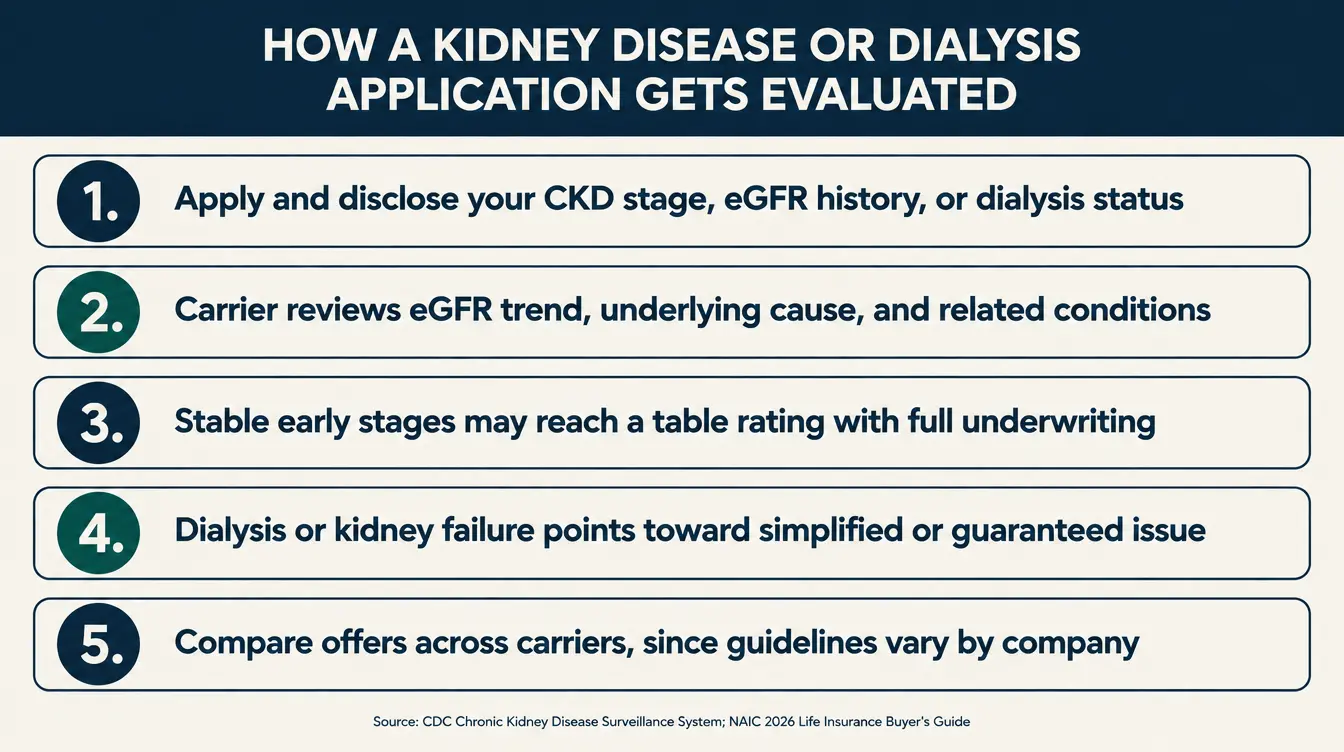
There is also real overlap with a condition we have covered before. The CDC estimates that about 4 in 10 adults with diabetes are estimated to have CKD, according to the same Chronic Kidney Disease Surveillance System data. If you are managing both, our guide on life insurance with diabetes covers the A1C side of that underwriting picture in more depth; the two conditions often get evaluated together on the same application, not as two separate strikes.
What it costs to get wrong: a real South Dakota household, worked out
Picture a 54-year-old in Rapid City with stage 3 CKD, found two years ago during a routine physical, cause attributed to long-standing high blood pressure that is now well controlled on medication. No dialysis, eGFR has held steady in a mid-range band for the past 18 months, and the applicant sees a nephrologist twice a year. This is an illustration of underwriting mechanics only, not a projection of any specific offer for any real applicant.
That person has a $180,000 mortgage balance with 11 years left, a spouse who earns about 40% of the household income, and two teenagers with five years of expenses ahead before both are through high school. None of that math changes because of the eGFR reading. What changes is which rate class, and which type of product, ends up pricing the coverage, and the gap between “I assumed I couldn’t qualify” and “I found out what I actually qualify for” is the real cost of never asking.
| Where you are | What it generally signals to an underwriter | Realistic path, in general terms |
|---|---|---|
| Early, stable CKD (no dialysis) | Reduced but adequate, stable kidney function; often managed with medication for the underlying cause | Fully underwritten coverage at a table rating is common; sometimes closer to standard with a strong overall file |
| More advanced CKD (no dialysis yet) | Declining eGFR trend, or CKD plus diabetes or cardiovascular disease | A higher table rating with some fully underwritten carriers; simplified issue is also worth comparing |
| On dialysis | Kidney failure (ESRD); high-risk for most fully underwritten carriers | Guaranteed issue is usually the realistic option; a small number of carriers may still consider fully underwritten applications case by case |
| Post-transplant, early | New anti-rejection medication regimen; function not yet proven stable long-term | Guaranteed issue in the near term; many carriers revisit fully underwritten applications after a stabilization period |
General underwriting mechanics only, based on how carriers commonly approach CKD risk. This table does not represent premiums, quotes, specific carrier guidelines, or a promise of any outcome. Actual rate class, product availability, and pricing depend on the applicant's full medical history and the specific carrier's underwriting guidelines.
The actual cost of getting this wrong is not a line on a rate table. It is the $180,000 mortgage with nothing behind it, and a spouse doing the math on 60% of the household income plus a decade of house payments, because the conversation never happened. If you have not worked out your own number yet, our guide on figuring out how much coverage you actually need walks through that math separately from, and before, any underwriting conversation.
14%
of U.S. adults (37 million) are estimated to have CKD, per the CDC's Chronic Kidney Disease Surveillance System, NHANES Aug. 2021–Aug. 2023
87%
of adults with CKD did not know they had it, per the same CDC data
3%
of South Dakota adults (about 17,000 people) report being diagnosed, per SD Dept. of Health BRFSS
The 2026 picture: South Dakota’s numbers, and why they look smaller than the national ones
South Dakota’s kidney disease numbers are worth reading carefully, because the state figure and the national figure measure two different things, and the gap between them is itself informative. According to the South Dakota Department of Health’s Behavioral Risk Factor Surveillance System (BRFSS) report, 3% of South Dakota adults, matching the nationwide median in that same self-reported survey, say a health professional has told them they have kidney disease. That is a self-reported diagnosis rate, and like most chronic conditions, it rises steadily with age.
| Age group | Reported kidney disease diagnosis |
|---|---|
| 18-29 | 1% |
| 30-39 | 1% |
| 40-49 | 2% |
| 50-59 | 2% |
| 60-69 | 4% |
| 70-79 | 6% |
| 80+ | 8% |
South Dakota Department of Health, The Health Behaviors of South Dakotans 2021, Behavioral Risk Factor Surveillance System, 2017-2021 combined data.
Reported kidney disease rises with age in South Dakota
South Dakota Department of Health, The Health Behaviors of South Dakotans 2021 (BRFSS), 2017-2021 combined data. Self-reported diagnosis rate, not a clinical prevalence estimate.
That 3% statewide figure has held essentially flat since 2011, per the same report. But it is a self-reported number: it only counts people who have actually been told their kidneys are affected. The CDC’s clinically estimated national figure, 14% of adults, is built from direct lab measurements in NHANES, not from asking people whether a doctor mentioned it to them, and the same CDC data finds that 87% of adults with CKD do not know they have it. Put the two together and the honest read is this: South Dakota’s diagnosed rate looks low next to the national clinical estimate not because South Dakotans have healthier kidneys, but because most CKD nationwide, and presumably in South Dakota too, has not been caught yet. That matters for an underwriting conversation, because it means a meaningful number of people reading this have reduced kidney function they do not know about, which is one more reason the usual advice to get regular bloodwork and not skip a physical applies here as much as anywhere.
Kidney disease isn't one diagnosis with one answer. It's a stage, a trend, and a cause, and underwriters price all three. The honest first step is finding out which combination you actually have on paper.
Mike Moore, Life Insurance AdvisorHow to work it out yourself: what to gather before you apply
You do not need anyone else to start this. A handful of things you can pull together on your own tell you far more about your realistic path than guessing does.
- Get your eGFR history, not just the most recent reading. Underwriters, like with A1C for diabetes, look for a trend. A stable eGFR in a mid-range band for two years reads very differently than the same number arrived at after a recent sharp drop.
- Know the underlying cause. CKD caused by well-controlled high blood pressure or a resolved acute injury is often viewed differently than CKD caused by poorly controlled diabetes or an ongoing autoimmune condition. Ask your nephrologist to put the cause in writing if it is not already clear in your chart.
- Note your dialysis status precisely: not started, recently started, or on a stable long-term schedule, plus whether it is in-center or home-based. This single fact is one of the biggest forks in which products are realistically available to you.
- If you have had a transplant, know the date and your most recent function numbers. Carriers weigh time since transplant and post-transplant stability heavily, and that picture changes every year it stays stable.
- Pull your related numbers too: blood pressure, A1C if you have diabetes, and any cardiovascular history. CKD rarely arrives alone in an underwriting file, and a strong picture on the rest of your health can offset a CKD-related table rating more than people expect.
- Compare more than one carrier before you conclude anything. One company’s guidelines might table-rate a stable stage 3 CKD close to standard; another might automatically push any CKD diagnosis to guaranteed issue regardless of the eGFR trend. That variation is the single biggest reason not to take one no from one carrier as the final answer.
You can gather steps 1 through 5 yourself, today
Most of this is already in your patient portal, or available by asking your nephrologist's office for a printout of your recent labs. Where a second opinion tends to help most is step 6, seeing how different carriers actually treat the same file, since no single company's website is going to volunteer how its competitors would have priced you.
Guaranteed issue, simplified issue, and what Medicare does and doesn’t cover
It helps to separate two things that get confused in this conversation: what Medicare covers, and what life insurance covers. They are not the same program solving the same problem, and understanding the difference changes how you think about what life insurance is actually for if you have kidney disease.
Medicare’s end-stage renal disease (ESRD) program is unusual among federal health coverage because it is not tied to age. According to Medicare.gov, you can qualify for Medicare at any age if you need regular dialysis or have had a kidney transplant and meet a work-credit, benefit, or family-member requirement. Coverage generally begins on the first day of the fourth month of regular dialysis treatments, a waiting period that runs whether or not you have signed up yet, though it can start sooner if you complete a Medicare-certified home dialysis training program in the first three months. If you apply after the fact, coverage can reach back up to 12 months before your application month. For a transplant, coverage can begin the month you are admitted for the transplant or related pre-transplant care, if the transplant happens that month or within the following two months.
That is real, and it matters, but it covers medical costs: the dialysis sessions, the transplant surgery, the follow-up care. It does nothing for the mortgage payment, the grocery bill, or your spouse’s income gap if you die. That is the specific hole life insurance is built to fill, and it is also exactly why a kidney diagnosis does not make life insurance irrelevant; if anything, it is the moment the rest of the household’s financial exposure becomes most worth looking at honestly.
On the life insurance side, guaranteed issue exists precisely for situations where fully underwritten coverage is not realistic. It asks no health questions, so dialysis or a recent transplant cannot disqualify you from it. According to the National Association of Insurance Commissioners’ 2026 Life Insurance Buyer’s Guide, a policy that does not require detailed health information will usually cost more and provide less coverage than one that does, which is the honest trade-off: guaranteed issue trades a smaller death benefit and a higher cost per dollar of coverage for the certainty of approval. Most guaranteed issue policies also include a graded death benefit in the first two to three years, meaning a natural-cause death in that window typically returns premiums paid plus interest rather than the full face amount, while accidental death is usually paid in full from day one.
Simplified issue sits between the two: a short list of health questions, no exam, and a faster decision, but not a guaranteed yes. Whether simplified issue or a fully underwritten table rating is realistically available to you depends on your specific CKD stage, your eGFR trend, and the individual carrier’s guidelines, and that is different enough carrier to carrier that it is worth asking directly rather than assuming either outcome.
What actually happens
- The coverage gap behind your mortgage or income stays exactly where it was
- You never learn your actual rate class or which product fits your file
- You cannot compare offers you never requested
- Medicare's ESRD coverage handles medical bills, but nothing is in place for lost income or debt
What actually happens
- You get a real answer from a real underwriting file, not a guess
- You see how more than one carrier treats your specific CKD stage and eGFR trend
- You find out whether fully underwritten, simplified issue, or guaranteed issue fits your situation
- You either move forward with coverage you understand, or decide the timing is wrong for a reason you actually know
If you would rather have someone local walk through this comparison with you than call carriers one by one, that is what we do: Compare My Options.
When waiting genuinely makes sense, and the 10-day window either way
This is not a one-directional pitch, so it is worth saying plainly: sometimes applying right now is not the best move. If a CKD diagnosis is brand new and your care team is still working out the underlying cause and treatment, your eGFR trend may still be settling rather than holding a stable baseline. Carriers weigh a stable trend far more favorably than a single recent reading, so someone a few months into treatment sometimes gets a meaningfully better outcome by waiting six months to a year for two or three consistent lab results instead of applying on one. That is different from waiting indefinitely out of fear the answer will be no; it is a specific, time-limited reason grounded in how the underwriting actually reads a trend.
On the other side, if your CKD has been stable for a year or more, or you are managing dialysis on a consistent long-term schedule, there is rarely a good reason to keep putting the conversation off. Rate class is also affected by your age at application, so waiting “until things feel more settled” with an already-stable file often just means paying more later for coverage you could reasonably access now.
Whichever way you decide, South Dakota law gives you a real safety net either way. Under SDCL 58-15-8.1, every individual life insurance policy delivered in South Dakota must carry a notice letting you return it within 10 days of actually receiving it, for any reason, for a full refund; the statute treats a returned policy as void from the start, as if it had never been issued. That protection applies whether you end up with a fully underwritten policy, simplified issue, or guaranteed issue, so applying and reviewing the actual policy document is not an irreversible decision.
Our related guide on no-medical-exam life insurance goes deeper into how the accelerated, simplified issue, and guaranteed issue categories work mechanically, if you want more detail on that part before deciding which path to pursue.
How we help
We are independent, so we are not built around any single carrier’s kidney disease guidelines. We start with your actual eGFR history, dialysis status or transplant timeline, and coverage need, then compare how different carriers are likely to price that specific file rather than assuming one company’s rules apply everywhere. If guaranteed issue is genuinely the realistic fit for where you are right now, we say that plainly instead of running you through a fully underwritten application likely to come back as a decline. If a fully underwritten or simplified issue path would get you meaningfully better coverage for the same cost, we say that instead.
What you get
A clear, honest read on how your actual kidney disease history is likely to be evaluated, not a generic answer built around an average case. A comparison across more than one carrier’s guidelines, since that variation is the biggest lever in this decision and the hardest one to see on your own. And a straight answer about timing and product type: whether applying now makes sense, whether to wait for a more stable eGFR trend, or whether guaranteed issue is the honest starting point for your situation today.
Find out how your kidney disease history is actually likely to be underwritten
Bring your eGFR history, dialysis status, or transplant timeline and we will walk through how different carriers are likely to price your specific file, and which type of policy realistically fits.
Not ready to talk to anyone yet? Read How It Works first and come back when you are. And if you are still working out how much coverage you actually need before worrying about the underwriting question, our life insurance needs calculator is a reasonable place to start that math on your own.
Frequently asked questions
Can you get life insurance if you have kidney disease?
In most cases, yes. Chronic kidney disease (CKD) covers a wide range, from mild, stable reductions in kidney function to full kidney failure, and underwriters price that range rather than treating every diagnosis the same way. Earlier-stage, stable CKD is often priced as a table rating, a step above standard rates, rather than declined. Later-stage CKD, dialysis, or a recent transplant narrows the field of carriers willing to offer fully underwritten coverage, which is when simplified issue and guaranteed issue products become the more realistic path. The honest answer depends on your specific lab history and which carrier reviews your file, not on the diagnosis alone.
Can you get life insurance while on dialysis?
It is harder, but guaranteed issue life insurance exists specifically for situations like this: it asks no health questions at all, so a dialysis diagnosis cannot disqualify you from it. The trade-off is a smaller death benefit than a fully underwritten policy and a graded death benefit period, meaning the full face amount generally is not payable for natural-cause death in the policy’s first two to three years, per the mechanics described in the NAIC’s 2026 Life Insurance Buyer’s Guide. Some applicants on dialysis with a stable, well-documented history may still find a fully underwritten carrier willing to table-rate them; it depends enough on the individual file and carrier that comparing more than one is the only way to know.
What is guaranteed issue life insurance and how does it work for kidney disease or dialysis?
Guaranteed issue life insurance asks no medical questions and requires no exam, so approval is not based on your kidney function at all. In exchange, face amounts are smaller, cost per dollar of coverage is higher, and nearly every guaranteed issue policy includes a graded death benefit: if you die of natural causes within the first two to three years, your beneficiary typically receives a refund of premiums paid plus interest rather than the full face amount, though accidental death is usually paid in full from day one. It is built for people whose health history makes fully underwritten coverage unlikely to be offered at a reasonable price, not as a first stop for everyone.
Does Medicare cover dialysis and kidney transplants regardless of age?
Yes. Under the federal end-stage renal disease (ESRD) program, you can qualify for Medicare at any age, not just 65 and older, once you need regular dialysis or have had a kidney transplant and meet a work-credit or family-member requirement, according to Medicare.gov. Coverage generally starts on the first day of the fourth month of regular dialysis treatments, though that waiting period can be shortened for home dialysis training and coverage can reach back up to 12 months retroactively once you do apply. This is a separate program from any life insurance decision, but it matters for the bigger financial picture: Medicare is built to help with the medical costs, while life insurance is about replacing your income or paying off debt your family would otherwise carry if you died.
How does the stage of chronic kidney disease affect life insurance underwriting?
Generally, earlier, more stable stages of CKD (reduced but adequate kidney function, typically monitored rather than treated with dialysis) are more likely to reach a table rating with a fully underwritten carrier, while later stages, dialysis, and kidney failure narrow the realistic options toward simplified issue or guaranteed issue products. Underwriters look at more than just the stage label: your eGFR (estimated glomerular filtration rate) trend over time, the underlying cause of the CKD, whether you also have diabetes or high blood pressure, and how consistently you have been monitored all factor in. Carriers do not publish identical cutoffs, so the same lab history can be treated quite differently company to company.
Can you get life insurance after a kidney transplant?
Many carriers want to see a stabilization period after a kidney transplant, often a year or more of consistent anti-rejection medication and stable kidney function, before fully underwritten coverage becomes realistic, though guidelines vary by carrier and no universal waiting period applies to every company. In the meantime, a guaranteed issue policy remains available regardless of transplant status, since it asks no health questions. As time passes with stable post-transplant lab results, re-applying with a fully underwritten carrier is often worth revisiting rather than assuming the guaranteed issue option is permanent.
How many South Dakotans actually have kidney disease?
About 3% of South Dakota adults, an estimated 17,000 people, report ever being told by a health professional that they have kidney disease, according to the South Dakota Department of Health’s Behavioral Risk Factor Surveillance System (BRFSS) report, with prevalence rising from about 1% of adults age 18 to 29 to 8% of adults 80 and older. That self-reported figure is well below the CDC’s clinically estimated national rate of 14% of adults, and the gap is not a contradiction: the CDC also estimates that 87% of adults with CKD do not know they have it, because early-stage kidney disease often causes no symptoms at all. The two numbers are measuring different things: who has been diagnosed and told, versus who actually has reduced kidney function whether or not it has been caught yet.
Before you apply
This article is general education, not insurance, legal, financial, medical, or tax advice. Product availability, rate classes, underwriting outcomes, and premiums vary by carrier and are subject to underwriting and each applicant's specific medical history. No coverage exists until a policy is issued and in force. Any guarantees are subject to the claims-paying ability of the issuing insurer. Please review actual policy documents and speak with a licensed agent, and with your physician, about your specific situation.
Sources
- Centers for Disease Control and Prevention — Chronic Kidney Disease Surveillance System, Data and Research — 14% of U.S. adults (37 million) estimated to have CKD; 87% of adults with CKD unaware they have it; about 4 in 10 adults with diabetes estimated to have CKD; data from NHANES August 2021-August 2023, page updated March 31, 2026
- South Dakota Department of Health — The Health Behaviors of South Dakotans 2021 (Behavioral Risk Factor Surveillance System) — 3% of South Dakota adults (approx. 17,000 people) report being told they have kidney disease, steady since 2011, matching the nationwide median; age-group breakdown, 2017-2021 combined data
- Medicare.gov — End-Stage Renal Disease (ESRD) — Medicare eligibility at any age for ESRD; coverage generally starts the fourth month of regular dialysis; up to 12 months of retroactive coverage; transplant-admission timing rules
- National Association of Insurance Commissioners — Life Insurance Buyer’s Guide (2026) — general underwriting mechanics; policies that skip detailed health information generally cost more and provide less coverage; standard policy review (“free look”) period of about 10 days
- South Dakota Legislature — SDCL 58-15-8.1 — South Dakota’s 10-day free-look / right-to-return requirement for individual life insurance policies delivered in the state on or after July 1, 1982
Related reading: Life Insurance With Diabetes: A 2026 South Dakota Guide, Getting Life Insurance After a Health Condition: 2026 Underwriting Trends, No-Medical-Exam Life Insurance: How It Works in 2026, and How Much Life Insurance Do You Actually Need?. See current options for no-medical-exam life insurance and guaranteed-issue coverage, or learn more about who we help.