
In most cases, yes. A COPD diagnosis does not automatically take life insurance off the table in South Dakota, though it does usually change which kind of policy fits. Chronic obstructive pulmonary disease, an umbrella term for lung diseases including emphysema and chronic bronchitis, affected 6% of South Dakota adults in 2024, or roughly 36,000 people, according to the South Dakota Department of Health’s Behavioral Risk Factor Surveillance System report. The overwhelming majority of those 36,000 people are not without options. What actually determines whether you qualify for a traditionally underwritten policy, a simplified version, or a guaranteed-issue final expense plan is the severity of the disease on paper, not the diagnosis code itself, and that distinction is worth understanding before you assume an answer you haven’t actually tested.
The short version
- 6% of South Dakota adults, about 36,000 people, had been told they have COPD, emphysema, or chronic bronchitis in 2024, versus a 7% nationwide median, according to the South Dakota Department of Health's BRFSS report.
- Severity, not the diagnosis alone, drives underwriting. Carriers weigh your spirometry (breathing test) results, oxygen use, exacerbation history, and smoking status, each by its own guidelines.
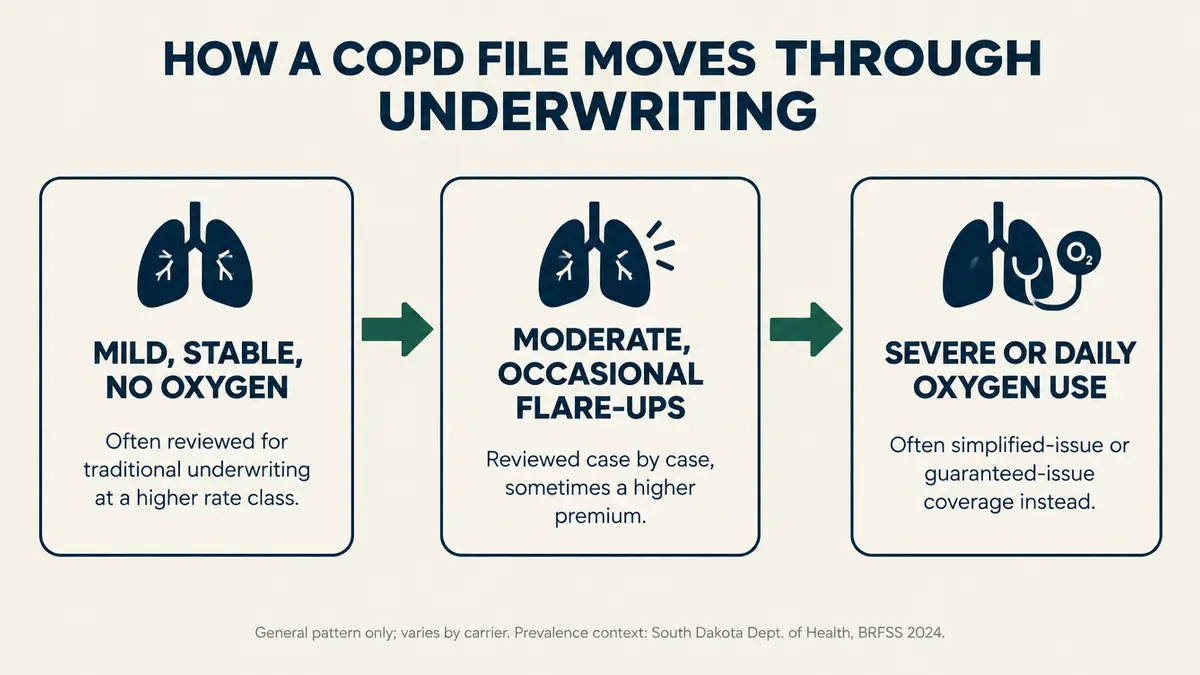
- Daily supplemental oxygen use typically points toward guaranteed-issue or simplified-issue products rather than traditional underwriting, but it rarely means no coverage at all.
- South Dakota law (SDCL 58-33-26) bars unfair discrimination between applicants with similar risk profiles, but it does not require every carrier to treat COPD identically, which is why comparing carriers changes outcomes here.
- 22% of South Dakotans who have had a heart attack also have COPD, and 48% of South Dakotans with COPD report fair or poor overall health, versus 13% of those without it, per the same BRFSS report, so other conditions are often part of the same file.
What is COPD, and why does it get its own underwriting conversation?
COPD is not one disease; it’s a category. Chronic obstructive pulmonary disease is an umbrella term that covers a group of lung conditions, mainly emphysema and chronic bronchitis, that make it progressively harder to move air out of the lungs. The South Dakota Department of Health’s own survey question defines it plainly: whether a doctor, nurse, or other health professional has ever told you that you have “Chronic Obstructive Pulmonary Disease, or COPD, emphysema or chronic bronchitis.” That’s a broad net, and it’s part of why “I have COPD” doesn’t tell an underwriter very much by itself. Someone diagnosed last year with mild symptoms and someone who has used daily oxygen for a decade both answer “yes” to that same survey question, and a life insurance application, but they are not remotely the same underwriting file.
That’s the entire reason this condition gets its own conversation instead of folding into a generic “pre-existing condition” bucket. Underwriters are not pricing the label; they’re pricing a trajectory. A stable, mild case that hasn’t required a hospital visit in years prices differently than a case with frequent flare-ups, and the tools underwriters use to tell those two files apart are specific and worth knowing before you apply.
How do underwriters actually measure COPD severity?
The main tool is a breathing test called spirometry. You exhale as hard as you can into a tube, and the machine measures FEV1, the forced expiratory volume in one second, which is the amount of air you can forcefully push out in that first second. Your result gets compared to what’s statistically expected for someone of your age, sex, height, and ethnicity, expressed as a percentage, “FEV1 percent predicted.” A reading close to 100% means your airflow is close to what’s typical for a healthy person your size; a much lower reading signals more obstruction.
Clinicians stage COPD severity, from mild to very severe, largely around that FEV1 percentage, combined with symptoms and how often the disease flares up, using criteria set out in the international GOLD framework (the Global Initiative for Chronic Obstructive Lung Disease). Underwriters use the same underlying information, spirometry results plus your medical history, but each insurance carrier sets its own internal guidelines for how to translate that information into a rate class, and those internal guidelines are proprietary and change over time. No public, universal “FEV1 score equals this price” table exists across the industry, which is a genuinely different situation than, say, a blood pressure reading or a cholesterol number, where published guideline ranges are more consistent carrier to carrier.
What is consistent across carriers is which facts they ask for. Expect an underwriter, directly or through a request for your medical records (an Attending Physician Statement), to want:
- Your most recent spirometry results and FEV1 percent predicted
- How long ago you were diagnosed, and whether the diagnosis has been stable or progressing
- Whether you currently use supplemental oxygen, and if so, how often
- How many exacerbations, flare-ups treated with steroids, antibiotics, an ER visit, or a hospital stay, you’ve had in the past 12 to 24 months
- Your current medications, including inhalers, and how well they’re controlling symptoms
- Your smoking history: current status, how much, for how long, and any quit date
- Your height and weight, and any other conditions on file, since COPD often travels with cardiovascular disease
How many South Dakotans are actually living with this?
More than you’d guess from how rarely it comes up in conversation. According to the South Dakota Department of Health’s 2024 BRFSS report, 6% of South Dakota adults, an estimated 36,000 people, have been told by a health professional that they have COPD, emphysema, or chronic bronchitis. That’s slightly below the 7% nationwide median the same report cites for 2024. A separate federal analysis, from the CDC’s Behavioral Risk Factor Surveillance System as compiled by America’s Health Rankings, put South Dakota’s 2024 adult COPD prevalence at 5.1%, against a 6.5% national rate, ranking the state 8th lowest in the country. The two surveys use slightly different methods and land on slightly different numbers, but they tell the same basic story: South Dakota’s COPD rate sits at or below the national figure, and it is still common enough that tens of thousands of South Dakotans are carrying this diagnosis into conversations about coverage.
| Age group | Percent with COPD |
|---|---|
| 18–29 | 1% |
| 30–39 | 3% |
| 40–49 | 3% |
| 50–59 | 5% |
| 60–69 | 11% |
| 70–79 | 14% |
| 80+ | 12% |
Source: South Dakota Department of Health, Behavioral Risk Factor Surveillance System, 2020–2024 pooled data, published in the 2024 BRFSS report. Figures are rounded; see the report for confidence intervals.
The age pattern matters for how you think about timing. COPD prevalence climbs sharply after 50, from 5% in the 50-59 bracket to 11% by the early 60s and 14% by the 70s, which lines up with how the disease typically develops over decades of airway damage before symptoms become hard to ignore. If you’re in your 50s or early 60s with a recent diagnosis, you are squarely inside the age range where term life insurance premiums are also rising fastest with every year you wait, so the cost of delaying a decision isn’t just about the lung disease.
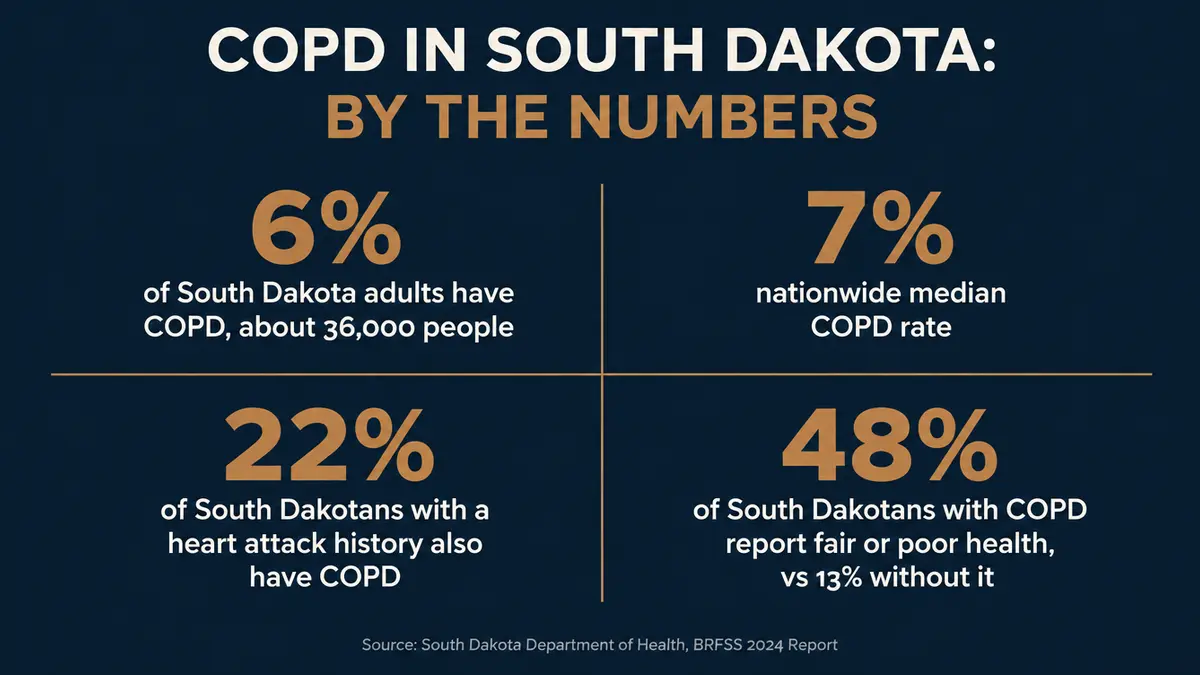
6%
of South Dakota adults have been told they have COPD, about 36,000 people (SD DOH BRFSS, 2024)
7%
nationwide median COPD prevalence for the same period, per the same BRFSS report
22%
of South Dakotans who've had a heart attack also have COPD (SD DOH BRFSS, 2020-2024)
48%
of South Dakotans with COPD report fair or poor health, vs. 13% without it (SD DOH BRFSS, 2020-2024)
COPD often shares a file with other conditions
The same BRFSS report found that 22% of South Dakotans who've had a heart attack also have COPD, and that people with COPD report meaningfully worse overall health (48% fair or poor) than people without it (13%). If you have COPD alongside a cardiac history, high blood pressure, or diabetes, an underwriter will review the whole picture together, not any one diagnosis in isolation. Our guides to life insurance with heart disease and life insurance with high blood pressure cover those conditions on their own terms.
What does it cost you to assume you’re uninsurable and never apply?
Not a dollar figure, because nobody can quote you a premium without underwriting your actual file, and guessing at one here would be the kind of unsupported number this guide is specifically trying to avoid. The real cost shows up somewhere else: in the gap between what a worst-case assumption tells you to expect and what a specific carrier’s current guidelines would actually offer someone with your exact history.
Picture two South Dakota residents, both 58, both diagnosed with COPD four years ago. One has had no hospitalizations, uses a daily inhaler, tests at a stable FEV1 reading each year, and has never needed supplemental oxygen. The other has had two hospital stays for flare-ups in the past year and started using oxygen at night six months ago. Both have the same diagnosis code on paper. Nothing about their underwriting outcomes should be assumed to be the same, and in practice they usually aren’t: the first case is a realistic candidate for a traditionally underwritten policy, likely at a higher rate class than someone with no lung disease, while the second is more likely to be guided toward a simplified-issue or guaranteed-issue product instead.
The actual risk of skipping the application isn’t that you’ll be rejected. It’s that you’ll never find out which of those two situations you’re actually closer to, and you’ll make a decision, to not bother, or to assume a worse answer than reality, based on no information at all. That’s a worse outcome than an honest decline, because a decline at least tells you something real about one specific carrier’s current guidelines, while assuming tells you nothing and still leaves your family with the same coverage gap.
"I have COPD, so there's no point applying"
- Never pulls spirometry results or a clean timeline together
- Treats one feared answer as the answer for every carrier
- Leaves the coverage gap exactly where it was, indefinitely
ResultA decision made with zero actual information
Gathers records, discloses fully, compares carriers
- Knows FEV1 trend, oxygen status, and exacerbation history cold
- Discloses the full picture instead of hoping it doesn't surface later
- Has an independent agent check which carriers' current guidelines fit that history
ResultA real answer, even if it's a different product than expected
How do you work this out for yourself before you apply?
You don’t need anyone’s help to build the picture an underwriter will eventually ask for. Doing it yourself first also makes any conversation with an agent faster and more useful.
- Pull your spirometry results. Ask your pulmonologist or primary care office for your most recent FEV1 percent predicted and whether it’s been trending stable, improving, or declining across your last few visits.
- Write down your diagnosis date and your flare-up history. Note every hospitalization, ER visit, or course of steroids for a COPD exacerbation in the past one to two years. A carrier’s underwriter will look for this specifically, and a vague “it’s been a while” answer reads very differently than a dated list.
- Know your oxygen status precisely. Are you on supplemental oxygen, and if so, is it continuous, nighttime only, or as-needed during exertion? This single fact does more to sort which type of product fits than almost anything else on the list.
- Line up your full smoking history, including any quit date. If you quit, the date matters on its own, separate from the COPD diagnosis. The National Heart, Lung, and Blood Institute notes that quitting smoking is one of the few interventions shown to change the disease’s course, and a documented quit date is something underwriters factor in.
- List your current medications, including every inhaler. What you’re on, and whether it’s controlling your symptoms, tells an underwriter more than the diagnosis code by itself.
- Decide what you’re actually solving for. If you need coverage sized to replace income or pay off a mortgage, you’re likely looking at traditional or simplified underwriting first. If you mainly want to make sure final expenses don’t land on your family, a guaranteed-issue policy may be the realistic, faster path, and that’s a legitimate choice, not a consolation prize.
- Compare more than one carrier’s current guidelines before accepting any single answer. Because no universal COPD rating table exists across the industry, the same file can be reviewed very differently company to company. This is the step that costs the most when it’s skipped.
How does South Dakota law factor into this?
South Dakota regulates how insurers can treat applicants who share similar risk profiles, but it does not force every company to underwrite COPD the same way. Under SDCL 58-33-26, no insurer may make or permit unfair discrimination between insureds having like insuring or risk characteristics, in the premium or rates charged for insurance, or in any other term or condition of the insurance; a violation is a Class 2 misdemeanor. That protects you from an arbitrary rule applied inconsistently within one carrier’s own book of business. It does not require Carrier A and Carrier B to reach the same conclusion about your file, because setting underwriting guidelines, including how to weigh FEV1 results, oxygen use, or exacerbation frequency, is a business decision each company makes for itself within the bounds of that law.
That’s exactly why a decline, or an offer you don’t like, from one carrier isn’t the final word. It’s one company’s current guidelines applied to your file, not a verdict on your insurability everywhere.
How we help
We’re an independent life insurance agency, which means we aren’t limited to one carrier’s view of what COPD means for your file. When a South Dakota applicant with a COPD diagnosis comes to us, we help lay out the actual medical picture, spirometry trend, oxygen status, exacerbation history, smoking timeline, and then compare how the carriers we represent are currently treating files that look like that one, rather than sending in a single application and hoping it lands somewhere favorable. Compare My Options.
What you get
A straight answer about where your specific file is likely to land, mild and stable versus oxygen-dependent are genuinely different conversations, instead of a guess based on the diagnosis alone. A method for organizing your own medical timeline clearly before anyone reviews it. And, if you decide to move forward, a side-by-side look at how more than one carrier’s current guidelines would treat your actual history, rather than a single company’s answer standing in for the whole industry.
Carriers aren't pricing the word "COPD." They're pricing your spirometry trend, your oxygen status, and how many flare-ups you've had. Get that picture straight before you let one company's answer settle the question for all of them.
Mike MooreRelated reading
This guide focuses on COPD specifically. If smoking history is part of your picture too, see our guides on life insurance and marijuana use and vaping and e-cigarettes for how nicotine classification works separately from a lung-disease diagnosis. For a condition that often travels alongside COPD, see life insurance with heart disease. If full underwriting isn’t the right fit, our guides to no-medical-exam life insurance and the underwritten-versus-no-exam tradeoff walk through the alternatives directly. For the broader picture on health-condition underwriting, see getting life insurance after a health condition.
Not sure what counts as a flare-up?
See what a life insurance medical exam actually tests for.
Have more than one health condition?
See how coverage works for people with health conditions.
Not sure where to start?
Read how it works first and come back when you're ready.
Frequently asked questions
Can you get life insurance if you have COPD?
In most cases, yes, though which kind of policy depends on how advanced the disease is. COPD affected 6% of South Dakota adults in 2024, or roughly 36,000 people, according to the South Dakota Department of Health’s BRFSS report, and the overwhelming majority of them are not shut out of coverage entirely. Mild, well-managed COPD with no oxygen use and a stable breathing-test history can often still qualify for a traditionally underwritten policy, usually at a higher rate class. More advanced COPD, especially with daily oxygen use, more often points toward simplified-issue or guaranteed-issue products instead of a decline with no options at all.
How does COPD affect your life insurance rate?
Underwriters look at how severe the disease is, not just that it exists on your medical record. The main tool is spirometry, a breathing test that measures FEV1, the amount of air you can forcefully exhale in one second compared to what’s expected for someone your age, sex, and height. A stable, mild reading with no hospitalizations typically prices very differently than a reading tied to frequent flare-ups or home oxygen. Carriers also weigh how long ago you were diagnosed, whether you still smoke, how many exacerbations you’ve had in the past year, and your overall build and other health history. None of these factors sits in a single public rate table; each carrier sets its own underwriting guidelines, which is exactly why comparing more than one company’s current approach matters.
Does using supplemental oxygen disqualify you from life insurance?
It usually rules out the most competitively priced, fully underwritten policies, but it does not usually rule out coverage altogether. Carriers treat oxygen dependence as a marker of more advanced disease, and applicants on daily supplemental oxygen are typically steered toward guaranteed-issue or simplified-issue final expense products rather than traditional term or whole life underwriting. Those products exist specifically for people whose health history makes standard underwriting unlikely to produce a competitive offer, and an independent agent can tell you which carriers currently write them in South Dakota without assuming in advance that you have no options.
Does it matter if your COPD came from smoking or something else?
Yes, on two separate underwriting questions. First, current or recent smoking is its own classification that affects your rate independent of the COPD diagnosis itself, and quitting matters to both questions. Second, the cause of the COPD can matter to how an underwriter reads your file: COPD tied to long-term heavy smoking often comes with other smoking-related risk factors an underwriter will also review, while COPD from a non-smoking cause, such as the genetic condition alpha-1 antitrypsin deficiency, or long-term occupational dust or fume exposure, gets evaluated on its own medical facts. The National Heart, Lung, and Blood Institute notes that cigarette smoke is the main driver of COPD in the United States, but that tobacco is linked to only about half of COPD cases worldwide, so a diagnosis alone does not tell an underwriter the whole story.
What if a fully underwritten policy isn’t available? What are your options?
A decline from one carrier’s full underwriting is not the end of the search. Simplified-issue life insurance asks a short list of health questions and skips the medical exam, trading some underwriting depth for a faster decision. Guaranteed-issue life insurance, generally a smaller final-expense policy, asks no health questions at all and cannot be declined for a medical reason, though it typically carries a graded death benefit for the first two to three years, meaning a death from natural causes in that window pays out a return of premiums rather than the full face amount. Our guide to no-medical-exam life insurance walks through how these products work and what they typically cost in flexibility compared to a fully underwritten policy.
Can a life insurance company deny you coverage just because you have COPD, and is that legal in South Dakota?
A carrier can decline an individual application under its own underwriting guidelines, which is a business decision each company makes for itself. What South Dakota law prohibits is unfair discrimination between applicants with similar risk characteristics. Under SDCL 58-33-26, no insurer may make or permit unfair discrimination between insureds having like insuring or risk characteristics, in the premium or rates charged for insurance, or in any other term or condition of the insurance, and a violation is a Class 2 misdemeanor. In practice, a decline has to trace back to that specific carrier’s stated underwriting rules, and because guidelines vary company to company, a decline at one carrier is often not a decline everywhere.
Does quitting smoking after a COPD diagnosis help your life insurance application?
It can help on both the smoking classification and, over time, the trajectory underwriters see in your medical records, even though it will not reverse existing lung damage. The National Heart, Lung, and Blood Institute notes that stopping smoking is one of the only interventions shown to change the course of COPD, and a documented quit date, especially one that’s held for a year or more, is something an underwriter can weigh. It will not turn severe, oxygen-dependent COPD into a standard-rate policy, but it is a real, honest factor working in your favor rather than against it.
How should you prepare before applying for life insurance with COPD?
Treat it like any health condition that needs documentation, not a guess. Pull your most recent spirometry results and know your FEV1 reading if your doctor has shared it, write down your diagnosis date, whether and how often you’ve been hospitalized or treated with steroids for a flare-up in the past year, your current medications and inhalers, your oxygen status, and your full smoking history including any quit date. Having that timeline in hand before you apply, rather than letting a carrier reconstruct it from scattered records mid-application, is the single biggest thing in your control.
Sources
- South Dakota Department of Health — 2024 Behavioral Risk Factor Surveillance System Report — South Dakota adult COPD prevalence 6% (approx. 36,000 adults) vs. 7% nationwide median; age-group breakdown (18-29: 1%, 60-69: 11%, 70-79: 14%, 80+: 12%); 22% comorbidity with heart attack history; 48% vs. 13% fair-or-poor health by COPD status; 2020-2024 pooled data; accessed 2026
- America’s Health Rankings (United Health Foundation), COPD measure, South Dakota — South Dakota adult COPD prevalence 5.1% vs. 6.5% national, South Dakota ranked 8th lowest; sourced to CDC Behavioral Risk Factor Surveillance System, 2024 data; accessed 2026
- National Heart, Lung, and Blood Institute (NIH) — COPD — cigarette smoking is the main cause of COPD in the United States and other high-income countries; tobacco is linked to about half of COPD cases worldwide; smoking cessation and oxygen therapy noted as treatment components; accessed 2026
- South Dakota Legislature — Codified Law 58-33-26, Unfair Discrimination as to Terms and Conditions of Insurance — prohibits unfair discrimination in premiums, rates, or terms between insureds with like risk characteristics; classifies a violation as a Class 2 misdemeanor; current codified law, accessed 2026
Related reading: Life Insurance With Heart Disease: A 2026 SD Guide, No-Medical-Exam Life Insurance: How It Works in 2026, and Getting Life Insurance After a Health Condition: 2026 Underwriting Trends. See who we help: people with health conditions and current options for term life insurance.
Before you act on any of this
This article is general education, not insurance, legal, financial, or medical advice. Coverage availability, features, and rates vary by carrier and state and are subject to underwriting. No coverage exists until a policy is issued and in force. Any guarantees are subject to the claims-paying ability of the issuing insurer. Nothing here should be read as medical guidance about managing COPD; that's a conversation for you and your doctor.
A diagnosis is a starting point, not a verdict
COPD changes the conversation about life insurance, but it doesn’t end it for most of the people living with it in South Dakota. What actually decides your outcome is the specific picture a carrier reviews, spirometry trend, oxygen status, exacerbation history, smoking timeline, and which company’s current guidelines get applied to that picture. Write down your real history, disclose it fully, and let more than one carrier weigh in before you accept any single answer, including the one you’ve been assuming in your head, as the final word.
Want a real answer instead of a guess?
We'll help you organize your medical history and compare how the carriers we represent currently treat it.