
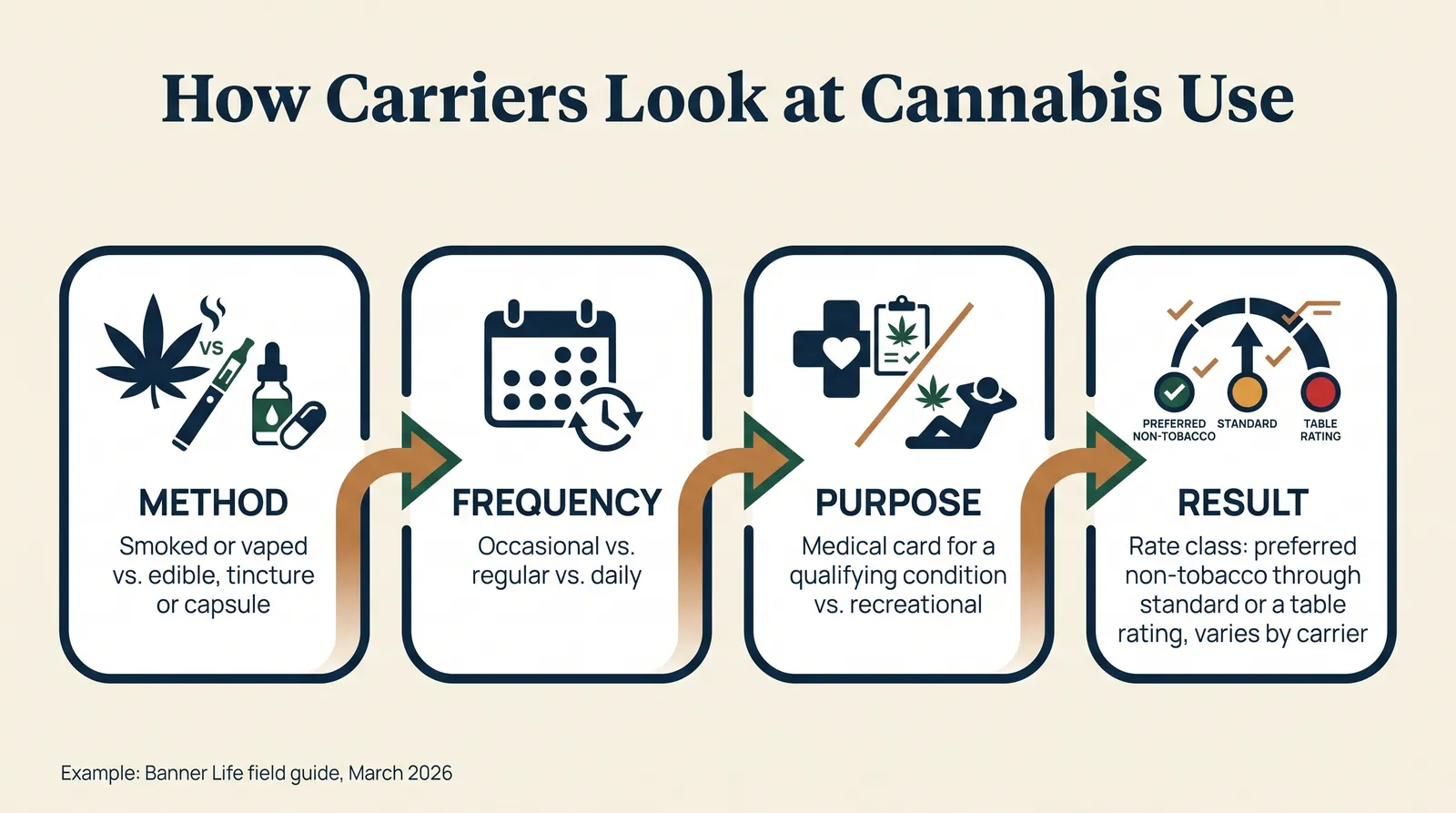
If you use marijuana, medically or recreationally, and you are wondering whether that closes the door on life insurance in South Dakota, the honest answer is: usually not, but which door you walk through depends on how you use it, how often, and which carrier you ask. Banner Life’s own March 2026 underwriting field guide states plainly that non-tobacco rates apply to marijuana use, and that preferred classes may be available for infrequent recreational use, while medicinal use is typically rated based on the underlying condition it treats. That is one carrier’s published rule, not a universal one. As of July 2026, 19,530 South Dakotans hold an active medical cannabis card, according to the South Dakota Department of Health, so a life insurance underwriter reading “yes” on the marijuana question is looking at a routine, common answer, not an exotic one. What decides your outcome is the specific facts of your use and which carrier’s guidelines you land in front of, not a blanket rule that either exists or does not.
The short version
- Marijuana use is priced, not automatically declined, at most carriers. Banner Life's March 2026 field guide states non-tobacco rates apply to marijuana use, with preferred classes available for infrequent recreational use.
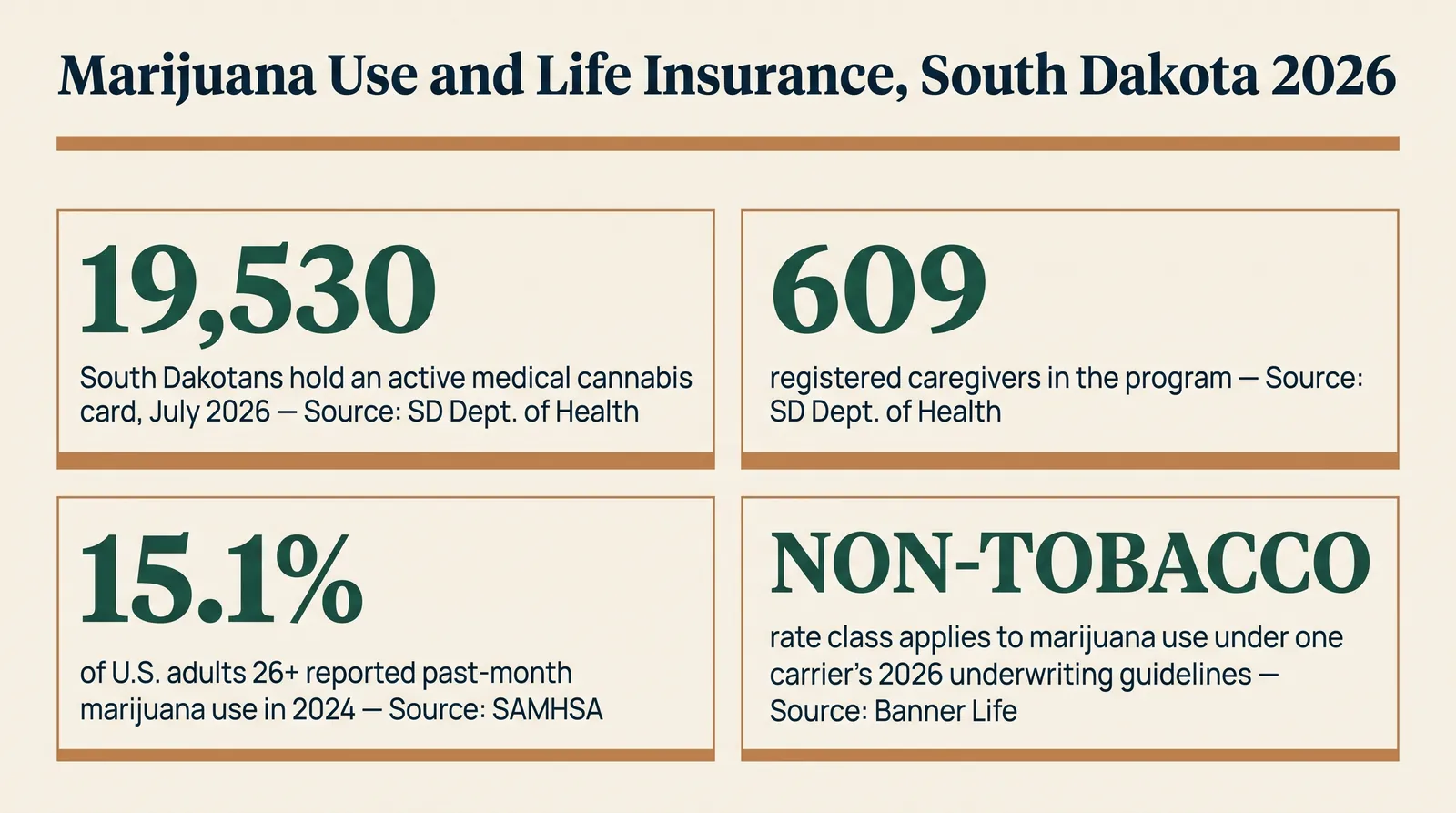
- South Dakota's medical cannabis program has grown to 19,530 patients and 609 caregivers as of July 2026, according to the South Dakota Department of Health, up from 18,036 patients in February 2026.
- Nationally, 15.1% of adults age 26 and older (34.3 million people) reported past-month marijuana use in 2024, according to SAMHSA's National Survey on Drug Use and Health.
- South Dakota Codified Law 58-33-12 permits risk-based pricing tied to real, disclosed risk factors; it prohibits arbitrary discrimination between people in the same risk class, not classification by actual risk.
- Carrier guidelines genuinely differ on frequency thresholds, method of use, and how a medical cannabis card is treated, which is the main reason to compare more than one company rather than assume one carrier's rule applies everywhere.
The pain: you assume the question on the form already has an answer
A lot of people never get to the life insurance conversation because they answer it for themselves first. You use marijuana, maybe with a South Dakota medical cannabis card for a documented condition, maybe recreationally on weekends, and somewhere along the way you decided the application would end in a decline, so you never started one. Nobody told you no. You told yourself no, based on a guess about how underwriting works that nobody ever actually walked you through.
That guess is usually wrong, and it is an expensive one to be wrong about. A mortgage balance does not check your MIB file. A spouse’s income gap if something happened to you does not care whether your evenings include an edible or a beer. The questions “do I use marijuana” and “does my family need my income replaced” are unrelated to each other, and treating the first as a final answer to the second is exactly how South Dakota households end up carrying a real financial exposure for a reason that, for most applicants, turns out not to be the roadblock they assumed it was.
This is general education, not a recommendation
Nothing here tells you what rate class you will receive or promises approval, a specific premium, or a specific underwriting timeline. It explains how carriers generally approach marijuana use in underwriting, using named sources, so you can understand your own situation instead of guessing at it. It is not legal advice about South Dakota's cannabis laws.
Why it happens: what underwriters are actually evaluating, and the words they use
An underwriter’s job is to estimate mortality risk and price accordingly. Marijuana use enters that calculation the same way tobacco use, a health condition, or a hazardous hobby does: as one input among several, evaluated on its own facts rather than treated as an automatic disqualifier. A few terms carry the whole conversation, and carriers do not always use them the way people expect.
- Underwriting class. The risk tier a carrier assigns after reviewing your application and any supporting records. Classes typically run from preferred best, through preferred, standard plus, and standard, before dropping into a series of table ratings.
- Non-tobacco rate. A pricing tier reserved for applicants who do not use tobacco or nicotine products. Whether marijuana use disqualifies you from this tier is a carrier-specific decision, not a universal rule. Banner Life’s published guidelines state that non-tobacco rates apply to marijuana use specifically, which means that carrier does not lump cannabis in with cigarettes by default.
- Table rating. A pricing step above standard, assigned when an applicant is insurable but carries more risk than a standard applicant. Each step generally adds to the premium over standard rates for the same age, sex, and coverage amount, and carriers differ in how many steps they offer before declining an application.
- Contestability period. The two-year window after a policy is issued during which an insurer can investigate a claim and potentially deny it over a material misrepresentation on the application. It is not about your rate class. It is about whether what you told the carrier was accurate.
- MIB. The Medical Information Bureau, a consortium of member life insurers that maintains a database of coded underwriting information, according to MIB’s own description of its role. When you apply, the carrier checks your file against this database and follows up on discrepancies; per MIB, carriers are not permitted to make underwriting decisions based on that file alone, without further investigation.
- Accelerated underwriting. A process that replaces the in-person medical exam with data pulled from sources like prescription history and motor vehicle records, letting some applications move faster than a fully underwritten one.
Here is the part that surprises people most: none of this is unusual or unfair under South Dakota law. South Dakota Codified Law 58-33-12 states, in full: “No person shall make or permit any unfair discrimination between individuals of the same class and equal expectation of life in the rates charged for any contract of life insurance or of life annuity or in the dividends or other benefits payable thereon, or in any other of the terms and conditions of such contract.” Read carefully, that statute protects against arbitrary treatment of people who share the same real risk profile. It does not say a carrier must ignore an actual, disclosed risk factor, whether that is marijuana use, tobacco use, or a medical diagnosis. Pricing based on real risk is the system working as designed, not a workaround being used against you.
What it costs to get wrong: the gap between assuming and applying
Picture a 34-year-old in Rapid City with a South Dakota medical cannabis card for a diagnosed seizure disorder, using a vaporized form of cannabis most evenings under a physician’s care. He has a $265,000 mortgage, a fiancée who earns less than he does, and a plan to marry next spring. He looked into life insurance once, found a form asking whether he uses marijuana, assumed the honest answer would end the application before it started, and closed the tab. This is an illustration of the underwriting mechanics only, not a projection of any specific offer for any real applicant.
Nothing about that math changed because of the card. The mortgage still needs to be paid if something happens to him. What changed is which rate class a real underwriter, at a real carrier, would actually assign, and that is not knowable from a guess. It is knowable from an application.
| Factor | What it can signal to an underwriter | General direction, based on Banner Life's published March 2026 guidelines |
|---|---|---|
| Infrequent recreational use | Occasional, non-daily use with no other risk factors disclosed | Preferred classes may be available, non-tobacco rates apply |
| Medical use for a qualifying condition | Card-based use tied to a documented diagnosis | Typically rated on the underlying condition itself, not the cannabis use |
| Regular or heavy use | Frequent use, which some carriers weigh independently of method | May move toward standard or a table rating, and varies significantly by carrier |
| Business involvement in marijuana operations | Ownership, growing, or distributing marijuana or THC-containing products as a business | Excluded from coverage under Banner Life's guidelines specifically for that business exposure |
Source: Banner Life family of companies, "Field guide for life insurance underwriting," March 2026. One carrier's published guidelines, shown as an illustrative example. This table does not represent premiums, quotes, or a promise of any outcome, and other carriers' guidelines differ.
The real cost here is not a number on that table. It is the cost of never finding out: a $265,000 mortgage with nothing behind it, sized against an income that stops the day something happens, sitting unaddressed because of an assumption that was never tested against an actual application. If you have not worked through how much coverage your household would actually need, our guide to figuring out how much coverage you actually need walks through that math separately from, and before, the underwriting question.
19,530
South Dakotans held an active medical cannabis card as of July 2026, per the SD Dept. of Health
15.1%
of U.S. adults 26+ reported past-month marijuana use in 2024, per SAMHSA's National Survey on Drug Use and Health
Non-tobacco
rate class that applies to marijuana use under Banner Life's March 2026 field guide, one carrier's published example
The 2026 picture: a growing, ordinary part of underwriting in South Dakota
South Dakota legalized medical cannabis by ballot measure in November 2020, and the program the South Dakota Department of Health administers has grown steadily since. It is not a shrinking or fringe category of applicant; it is a larger group of South Dakotans each month than it was the month before.
South Dakota active medical cannabis patients, February–July 2026
South Dakota Department of Health, Medical Cannabis Program monthly data reports, February through July 2026. No report was published for March 2026 on the department's site as of this writing.
Nationally, marijuana use has been rising for years across every adult age group, according to SAMHSA’s 2024 National Survey on Drug Use and Health, the federal government’s primary source for this kind of data.
| Age group | 2021 | 2024 |
|---|---|---|
| Adults 18-25 | Not cited in this source | 24.1% (8.4 million people) |
| Adults 26 and older | 12.3% (27.1 million people) | 15.1% (34.3 million people) |
| All people 12 and older | 13.2% (37.0 million people) | 15.4% (44.3 million people) |
Substance Abuse and Mental Health Services Administration, "Key Substance Use and Mental Health Indicators in the United States: Results from the 2024 National Survey on Drug Use and Health" (HHS Publication No. PEP25-07-007, NSDUH Series H-60), 2025.
That national trend matters for a South Dakota applicant for one practical reason: carriers that sell nationally are pricing this risk against a growing, well-studied applicant pool, not an unusual one. The health-risk research behind that pricing is real, too. The CDC states that cannabis “can make the heart beat faster and can raise blood pressure immediately after use,” and that it “could also increase risk of stroke, heart disease, and other vascular diseases,” while noting that most of the research behind that finding involves smoked cannabis specifically, and that more research is needed to fully understand cannabis’s cardiovascular and mortality effects. That is a general population-health finding from the CDC, current as of a February 2024 update to its cannabis and heart health page, not a specific underwriting rule any one carrier follows. It is useful context for why method of use, not just frequency, shows up in how some carriers evaluate an application.
Marijuana use doesn't usually close the door on life insurance. It changes which door you walk through, and how you use it matters more to most carriers than whether you use it at all.
Mike Moore, Life Insurance AdvisorSouth Dakota’s own legal landscape adds one more layer worth naming plainly. The state’s only legal path to cannabis use remains its medical cannabis program, administered under the framework voters approved in 2020; South Dakota has not established a legal recreational market. That legal distinction, medical card versus recreational use outside the program, is a separate question from how a life insurance underwriter evaluates your file, and it is not this article’s place to give legal advice about South Dakota’s cannabis laws. What matters for the underwriting conversation is answering the application’s questions honestly, whichever category your use falls into.
How to work it out yourself: what to gather before you apply
You do not need anyone else to start this process. A few things you can pull together on your own will tell you more about your likely outcome than guessing ever will.
- Write down your actual pattern of use, honestly: how often, by what method (smoked, vaped, edible, tincture, or capsule), and whether it is medical or recreational. Vague answers on an application create the kind of discrepancy MIB and a carrier’s follow-up process are built to catch.
- If you hold a South Dakota medical cannabis card, know your qualifying condition and how it is treated. Since carriers like Banner Life rate medicinal use based on the underlying condition rather than the cannabis use itself, the condition, its severity, and its treatment history often matter more to your outcome than the card.
- Separate your other health and lifestyle factors from the marijuana question. Blood pressure, cholesterol, weight, tobacco or nicotine use, and any other prescribed medications all factor into your file. Marijuana use rarely arrives as the only variable underwriters are weighing.
- Understand that carriers are not interchangeable here. One company’s guidelines may apply non-tobacco rates to marijuana use and offer preferred classes for infrequent recreational use, as Banner Life’s do. Another may still apply tobacco or smoker rates to any smoked substance, or set stricter frequency thresholds. This variation is the single biggest reason to compare more than one carrier rather than accept or assume based on one company’s rule.
- Plan to disclose accurately, every time. The two-year contestability period means an inaccurate answer discovered after a claim is a far worse outcome for your beneficiaries than an accurate answer priced honestly today.
You can do steps 1 through 3 yourself, today
Most of this is information you already know or can pull from your own records. Where a second opinion tends to help most is step 4, comparing how different carriers actually treat the same disclosed pattern of use, since that variation is the part no single company's website will show you.
No-exam paths exist here too, and they are not one product
A meaningful share of life insurance applications today skip the in-person medical exam entirely, through accelerated underwriting, which relies on data like prescription history and motor vehicle records instead. Simplified-issue products, a separate category, ask a shorter list of health questions in exchange for smaller coverage amounts and a higher cost per dollar of coverage. Whether either path fits an applicant who uses marijuana depends on the same variables that drive a fully underwritten decision: frequency, method, purpose, and the individual carrier’s own guidelines. None of that can be determined from a single company’s marketing claims, since each is naturally describing its own product favorably. If a faster, exam-free path matters to you, it is worth asking specifically which carriers’ accelerated or simplified-issue programs your actual pattern of use fits, rather than assuming a fast path is either automatically available or automatically closed.
What actually happens
- The coverage gap behind your mortgage or income stays exactly where it was
- You never learn your actual rate class from an actual carrier
- You cannot compare offers you never requested
- The assumption gets reinforced every year nothing changes
What actually happens
- You get a real rate class from a real underwriting file, not a guess
- You see how more than one carrier treats the same disclosed pattern of use
- You find out whether a no-exam path fits your situation or not
- You either move forward with a number you understand, or decide the timing is wrong for a reason you actually know
If you would rather have someone local run this comparison with you than call carriers one by one, that is what we do: Compare My Options.
When it genuinely makes sense to think twice
This is not a one-directional pitch, so it is worth saying plainly where caution is warranted. If your use is frequent, involves a business interest in growing or distributing cannabis products, or is combined with other significant health factors, it is realistic to expect standard rates or a table rating rather than a preferred class at most carriers, and a small number of carriers may decline that specific combination outright even though others would not. That is not a reason to avoid applying. It is a reason to apply with accurate expectations and, ideally, with someone who can tell you in advance which carriers’ guidelines are a poor fit before you spend a medical exam and weeks of underwriting time finding out the hard way.
It is also worth being honest about timing if your use pattern has recently changed, up or down. A newly increased frequency, or a recent switch from occasional to daily use, is the kind of change some carriers weigh differently than a long, stable pattern, similar to how a recently diagnosed health condition is weighed differently than a well-managed, long-standing one. If your pattern of use is genuinely still settling, that is useful context to bring into the comparison, not a reason to avoid the conversation.
How we help
We are independent, so we are not built around any single carrier’s marijuana guidelines. We start with your actual pattern of use, whether medical or recreational, your qualifying condition if you hold a South Dakota medical cannabis card, and your coverage need, then compare how different carriers price that specific file rather than assuming one company’s rule applies everywhere. If a non-tobacco or preferred classification genuinely fits your situation, we look for it. If a fully underwritten application would get you meaningfully better pricing than a no-exam product for the same coverage, we say that too.
What you get
A clear read on how your actual pattern of marijuana use is likely to be evaluated, not a generic answer pulled from an average. A comparison across more than one carrier’s guidelines, since that variation is the single biggest lever in this decision and the hardest one to see on your own. And an honest answer about which classification and which carrier are realistic for your specific situation, instead of a guess made from outside the application.
Find out how your marijuana use is actually likely to be underwritten
Bring your actual pattern of use, medical card if applicable, and coverage goals, and we will walk through how different carriers are likely to classify your file.
Not ready to talk to anyone yet? Read How It Works first and come back when you are. If you are still working out how much coverage you actually need before worrying about the underwriting question, our life insurance needs calculator is a reasonable place to start that math on your own.
Frequently asked questions
Does using marijuana automatically disqualify you from life insurance?
No. Marijuana use is a question underwriters evaluate and price, not an automatic decline. How it is treated depends on how you use it, how often, and whether it is medical or recreational use, and that varies by carrier. Banner Life’s own March 2026 underwriting field guide, for example, states that non-tobacco rates apply to marijuana use and that preferred classes may be available for infrequent recreational use, while medicinal use is typically rated based on the underlying condition it treats. Other carriers set different thresholds, which is exactly why comparing more than one company matters before you assume the answer is no.
Will I be charged smoker or tobacco rates if I use marijuana?
Not automatically, and not at every carrier. A growing number of insurers separate marijuana use from tobacco and nicotine use entirely, since smoked or vaped cannabis does not involve nicotine, the substance most tobacco classifications are actually built around. Banner Life’s published guidelines state plainly that non-tobacco rates apply to marijuana use. Other carriers still apply a smoker classification to any smoked substance regardless of what is being smoked. Because this genuinely differs company to company, it is one of the more valuable things to check before you apply anywhere, rather than assuming either outcome.
Does having a South Dakota medical cannabis card affect my life insurance application?
It can, but not in the way most people assume. Carriers do not treat a medical cannabis card as a red flag by itself. What they weigh is the qualifying condition behind the card. Banner Life’s guidelines state that medicinal marijuana use is typically rated based on the underlying condition, not the cannabis use itself, which means the real underwriting conversation is usually about whatever health issue, such as a seizure disorder, chronic pain, or PTSD, qualified you for South Dakota’s program in the first place. As of July 2026, 19,530 South Dakotans held an active medical cannabis card, according to the South Dakota Department of Health, so this is a routine underwriting scenario, not a rare one.
Does the method of use, smoking versus edibles, matter to underwriters?
It can. Underwriters generally pay closer attention to smoked or vaped cannabis than to edibles, tinctures, or capsules, largely for the same lung and cardiovascular reasons they scrutinize any smoked substance. The CDC notes that cannabis smoke contains many of the same harmful substances found in tobacco smoke, and that cannabis use can raise heart rate and blood pressure immediately after use and may increase the risk of stroke, heart disease, and other vascular disease. That is a general health-risk finding, not a specific underwriting rule, but it helps explain why the delivery method, not just the fact of use, shows up in how some carriers evaluate an applicant.
Do I have to disclose marijuana use on a life insurance application?
Yes, if the application asks about it, which nearly all fully underwritten applications do, and honestly, regardless of South Dakota’s medical cannabis program or any other state’s laws. Life insurance applications are governed by the contestability period, the two-year window after a policy is issued during which the insurer can investigate and potentially deny a claim over a material misrepresentation. Carriers also cross-reference applications against the MIB database, a consortium that member companies use to flag inconsistencies for follow-up, according to MIB’s own description of its role. Undisclosed use discovered later, especially after a claim, is a materially worse outcome than disclosed use priced accurately up front.
Is it legal for a life insurance company in South Dakota to charge me more because I use marijuana?
Yes, in the same sense it is legal to charge more for any factor that changes mortality risk. South Dakota Codified Law 58-33-12 prohibits unfair discrimination between individuals of the same class and equal expectation of life, meaning a carrier cannot arbitrarily charge two applicants with identical risk profiles different rates. It does not prohibit classifying applicants by an actual, disclosed risk factor such as substance use, smoked or otherwise. Risk-based pricing tied to a real behavior is how the underwriting system is built to work in South Dakota, not a loophole being used against you.
Can I get no-medical-exam life insurance if I use marijuana?
No-exam life insurance is a real product category that exists in today’s market, including accelerated underwriting, which replaces the physical exam with data such as prescription history and motor vehicle records, and simplified-issue products, which ask a shorter set of health questions. Whether a specific no-exam product is available to you, and at what classification, depends on your age, your coverage amount, how you use marijuana, and the individual carrier’s own guidelines, which is not something you can determine from any one company’s marketing page. It is worth reviewing your specific situation against more than one carrier’s actual guidelines rather than assuming a fast path is automatically open or automatically closed.
Does frequency of use matter more than whether I use it at all?
For most carriers that separate cannabis from tobacco, yes, frequency and method tend to matter more than the simple fact of any use. Under Banner Life’s published guidelines, for example, preferred classes may be available for infrequent recreational use, which signals that occasional use is treated differently than daily or near-daily use. Carriers that publish frequency-based guidelines generally look at how often you use, how you use it, and whether use is medical or recreational, together, rather than applying one flat rule to every applicant who checks the box.
Before you apply
This article is general education, not insurance, legal, financial, or tax advice, and it is not legal advice about South Dakota's cannabis laws. Product availability, rate classes, underwriting outcomes, and premiums vary by carrier and are subject to underwriting and each applicant's specific history. No coverage exists until a policy is issued and in force. Any guarantees are subject to the claims-paying ability of the issuing insurer. Please review actual policy documents and speak with a licensed agent about your situation.
Sources
- South Dakota Department of Health — Medical Cannabis Program — 19,530 patients, 609 caregivers, and 209 providers as of July 2026; monthly figures of 18,036 (February 2026), 18,867 (April 2026), 19,247 (May 2026), and 19,383 (June 2026); program established following voter approval of Initiated Measure 26 in November 2020. Accessed August 2026; no independent second dataset publishes South Dakota-specific medical cannabis enrollment, so this state figure relies on the Department of Health as the sole authoritative source.
- Substance Abuse and Mental Health Services Administration — Key Substance Use and Mental Health Indicators in the United States: Results from the 2024 National Survey on Drug Use and Health — 15.1% of adults 26+ (34.3 million people) and 24.1% of adults 18-25 (8.4 million people) reported past-month marijuana use in 2024; 12.3% of adults 26+ (27.1 million people) in 2021; HHS Publication No. PEP25-07-007, NSDUH Series H-60, published 2025
- Centers for Disease Control and Prevention — Cannabis and Heart Health — cannabis can raise heart rate and blood pressure immediately after use and may increase risk of stroke, heart disease, and other vascular disease; page last updated February 15, 2024
- South Dakota Legislative Research Council — Codified Law 58-33-12 — “Unfair discrimination as misdemeanor—Life insurance and annuities,” full statutory text on unfair discrimination in life insurance rates and terms
- Banner Life family of companies — Field Guide for Life Insurance Underwriting — March 2026 edition; non-tobacco rates apply to marijuana use, preferred classes may be available for infrequent recreational use, medicinal use typically rated on the underlying condition, and marijuana-related business operations are excluded from coverage. One carrier’s published guidelines, cited as an illustrative example; other carriers’ guidelines differ, and no directly comparable public field guide from a second carrier was located for independent corroboration of these specific thresholds.
- MIB — Facts About MIB — description of MIB’s underwriting database, its use by member carriers to flag application discrepancies for follow-up, and the requirement that carriers investigate further before making a decision based on an MIB Consumer File alone
Related reading: Getting Life Insurance After a Health Condition: 2026 Underwriting Trends, Life Insurance With Diabetes: A 2026 South Dakota Guide, No-Medical-Exam Life Insurance: How It Works in 2026, and How Much Life Insurance Do You Actually Need?. See current options for no-medical-exam life insurance, or learn more about who we help.