
Marriage does not touch your life insurance. No form updates, no beneficiary changes, no automatic increase in coverage because your household now has two incomes and, often, new debt. If you got married in South Dakota this year, there is a real chance that the person named on your policy is still your mother, your old roommate who cosigned a lease with you in your twenties, or nobody at all, and the only way that changes is if you change it yourself.
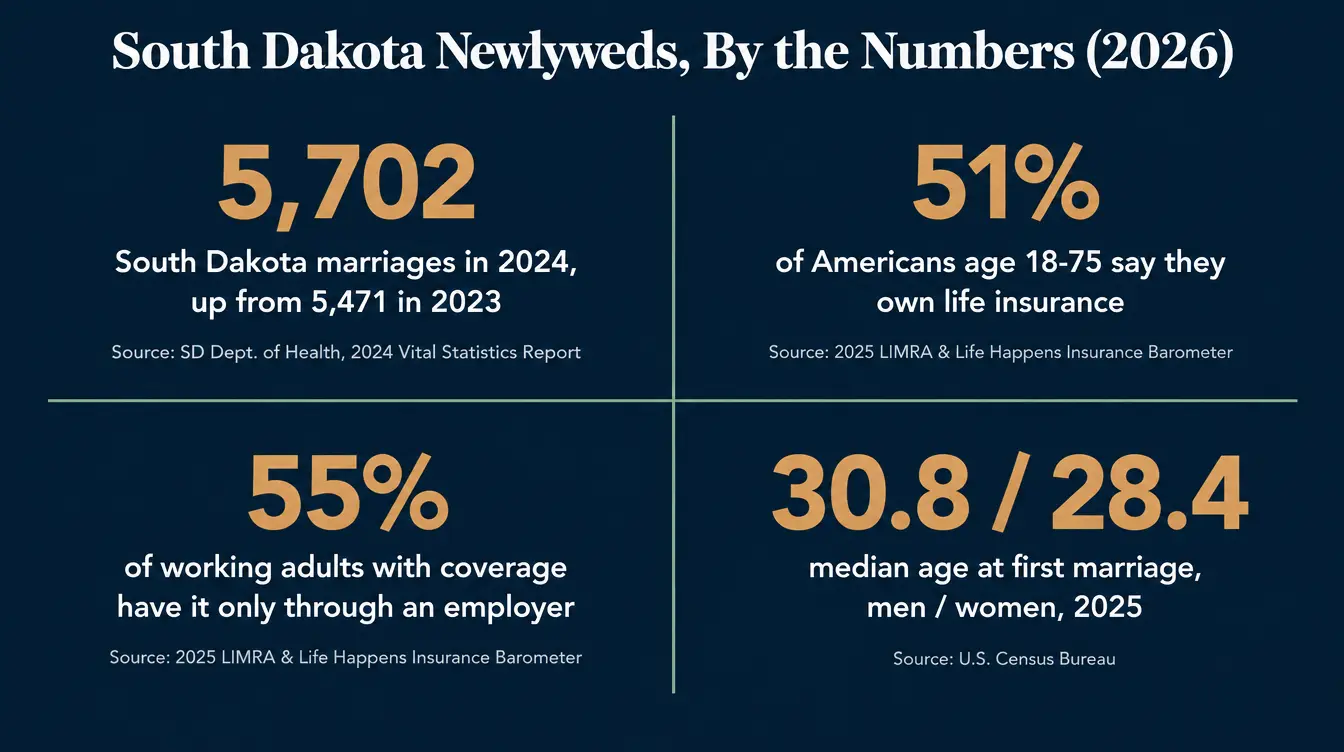
South Dakota recorded 5,702 marriages in 2024, up from 5,471 the year before, a rate of 6.2 per 1,000 residents, according to the South Dakota Department of Health’s 2024 Vital Statistics Report. Nationally, the median age at first marriage reached 30.8 for men and 28.4 for women in 2025, according to the U.S. Census Bureau, which means a lot of newlyweds are also several years into their working lives, with existing policies, existing beneficiaries, and existing assumptions about what’s covered that may no longer fit. This walks through exactly what to check, in what order, and gives you a method for sizing coverage together instead of guessing.
The short version
- Marriage does not automatically add your spouse as a beneficiary on any existing policy. South Dakota's automatic-revocation law, SDCL 29A-2-804, only runs on divorce, not marriage, per the South Dakota Legislature.
- 5,702 marriages occurred in South Dakota in 2024, a rate of 6.2 per 1,000 population, up from 6.0 in 2023, per the South Dakota Department of Health.
- 51% of Americans age 18 to 75 say they own life insurance, and 55% of working adults who have coverage have it only through an employer, per the 2025 LIMRA and Life Happens Insurance Barometer Study.
- Group life insurance through an employer is typically owned by the employer's plan, not the employee, so it does not update your beneficiary and usually does not move with you if you leave the job.
- Two individual policies, each sized to the income or role being protected, usually outperform a single joint "first to die" policy for most married couples.
The pain: you don’t actually know what’s covered anymore
Before the wedding, you each had your own financial life, maybe a small term policy from a few years back, maybe nothing at all, maybe just whatever your employer automatically enrolled you in. After the wedding, you have shared rent or a shared mortgage, maybe a car loan with both names on it, maybe a plan to have kids in the next few years, and a vague sense that “we should probably look at our insurance” that keeps sliding to next month.
Here’s what makes this worse than it sounds: nothing forces the issue. There’s no bill that comes due, no renewal notice that flags the mismatch, no system that checks your marriage license against your beneficiary forms. If you don’t go looking, an outdated beneficiary designation can sit there for years, through two moves and a kid, until the day it matters and the payout goes to the wrong person entirely.
This is general education, not advice
Nothing here tells you to buy a specific product or name a specific beneficiary. It explains how beneficiary designations, group coverage, and coverage sizing actually work, using primary sources, so you and your spouse can work through the first pass together and bring real numbers to a licensed agent or attorney if you want a second opinion.
Why it happens: the law runs one direction, not both
A few terms worth defining once, since the rest of this only makes sense with them straight:
- Beneficiary designation. The form on file with the insurance carrier naming who receives the death benefit. It is a contract instruction to the insurer, separate from your will, and in most cases it controls over what a will says.
- Revocable disposition. A legal term for an instruction, like a beneficiary designation, that the person who made it can change at any time while they’re alive. Most individually owned life insurance beneficiary designations are revocable.
- Contingent beneficiary. A backup beneficiary who receives the payout only if the primary beneficiary has already died. Newlyweds often update the primary beneficiary and forget the contingent line is still a parent or sibling from before the relationship.
- Group life insurance. Life insurance provided as an employee benefit, where the employer’s plan, not the employee, is typically the policyholder. Portability and conversion rules are set by the plan and by state law, not by the employee’s preference.
- Joint life insurance. A single policy covering two people, most commonly structured as “first to die,” meaning it pays out once, when the first insured person dies, and then the coverage ends.
South Dakota has a statute that automatically rewrites beneficiary designations, but it only runs in one direction. Under SDCL 29A-2-804, a finalized divorce automatically revokes a disposition to a former spouse in a “governing instrument,” a category that expressly includes individually owned life insurance beneficiary designations, according to the South Dakota Legislature’s codified laws. The moment the divorce decree is entered, your ex-spouse is legally treated as having predeceased you for purposes of that designation, with no form required.
There is no mirror-image statute for marriage. Nothing in South Dakota law adds your new spouse to an existing policy, updates a contingent beneficiary, or changes anything about a designation you made before the wedding. The same statute that is aggressive about removing an ex-spouse is completely silent about adding a new one. If you want your spouse named, on any policy you owned before the wedding, you file a new beneficiary form. That is the single most important fact in this entire guide, and it is the one most newlyweds don’t know until someone tells them.
What it costs to get wrong: the coverage gap you can’t see
Two separate gaps tend to show up after a wedding, and they compound each other. The first is the beneficiary gap described above. The second is a coverage-amount gap: a lot of newly married people are relying on employer coverage that was never designed to protect a household, and they don’t find out until they try to use it.
Only 51% of Americans age 18 to 75 say they own life insurance, and of the working adults who do have coverage, 55% have it only through an employer, with just under 40% having purchased an individual policy on the retail market, according to the 2025 Insurance Barometer Study from LIMRA and Life Happens. Group life insurance through an employer is typically owned by the employer’s plan rather than the employee, which means it usually doesn’t move with you if you change jobs, and our guide on what happens to coverage when you change jobs covers South Dakota’s conversion window for that situation specifically. For a newly married couple leaning on two separate employer plans, that’s two coverage amounts, two sets of portability rules, and two beneficiary forms, none of which were designed with a shared mortgage or a future kid in mind.
| Year | Marriages in South Dakota | SD rate per 1,000 population |
|---|---|---|
| 2024 | 5,702 | 6.2 |
| 2023 | 5,471 | 6.0 |
| 2022 | 5,826 | 6.4 |
| 2021 | 5,636 | 6.3 |
| 2020 | 5,359 | 6.0 |
Source: South Dakota Department of Health, Office of Health Statistics, 2024 Vital Statistics Report. June was the most common wedding month in 2024, with 844 of the year's 5,702 marriages, 14.8%.
Now let’s put real numbers on what “combined household” actually means for coverage sizing, using a worked example. This is an illustration built on stated assumptions, not a quote for any real policy or any real couple’s situation.
Say two South Dakota residents marry in their late twenties. One earns $58,000 a year; the other earns $44,000. Together they carry a $215,000 mortgage with 27 years remaining, a $9,000 car loan, and no kids yet, though they’d like two eventually. Before the wedding, each had a small individual term policy, roughly one times their own salary, bought years ago through a prior employer or a starter policy neither has looked at since.
Using the DIME method, debt, income replacement, mortgage, education, which our guide on how much life insurance Sioux Falls families need explains step by step, the math changes meaningfully once you’re running it as a household instead of two individuals:
$224,000
Combined non-mortgage debt and final-expense illustration: $9,000 car loan + $215,000 mortgage, before income replacement is added (illustrative example, stated assumptions only)
~1x
Typical old individual policy, bought as a single person years earlier, per this illustration's assumptions
2
Beneficiary forms that need updating per spouse if each owns one individual policy plus one employer group policy
A policy sized for one person’s old rent and old debt, bought before a mortgage and a spouse existed, usually falls well short of what the mortgage balance alone would require if that person died today, before even adding income replacement for the surviving spouse or future education costs for kids who aren’t born yet. The fix isn’t necessarily buying more insurance immediately; it’s running the numbers again with your real, current household picture instead of carrying forward a figure that was right for a different life stage.
Where working adults' life insurance actually comes from
Among working adults who report having life insurance coverage. Source: 2025 Insurance Barometer Study, LIMRA and Life Happens.
How to work it out yourselves
You can do all of this without anyone’s help. Set aside an evening and go through it together.
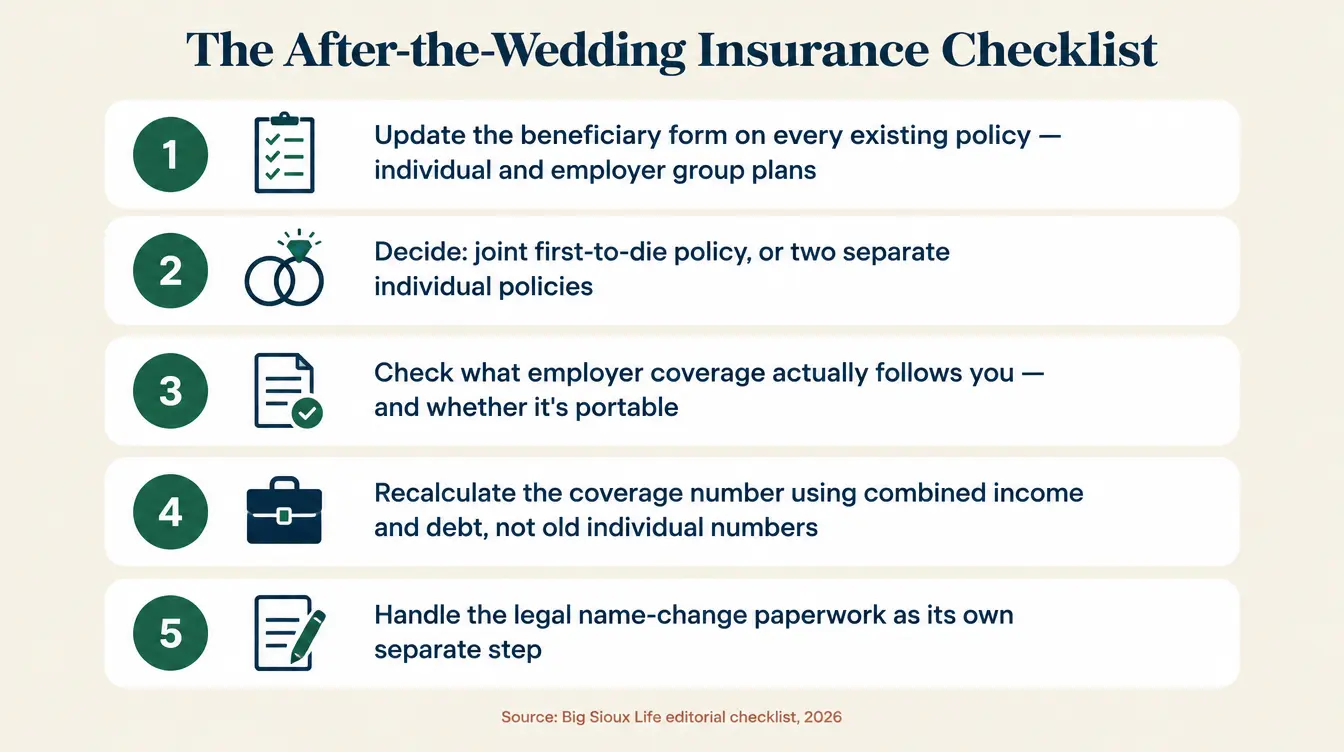
- Pull every existing policy, individual and group. List the carrier, the current beneficiary and contingent beneficiary on each, and whether it’s individually owned or through an employer.
- File a new beneficiary form on anything you want to change. This is almost always a short form through the carrier’s portal or HR system, separate from any underwriting or medical questions. Don’t forget the contingent beneficiary line; it’s the one people miss.
- Check what’s actually portable. Group coverage through an employer usually doesn’t follow you if you leave that job, and conversion windows are time-limited; our guide on coverage when you change jobs walks through South Dakota’s rules on that.
- Decide joint vs. separate, deliberately. A joint “first to die” policy pays once and then both of you are uninsured going forward; two individual policies, each sized to what that person’s income or role costs to replace, keep the survivor covered. Our term vs. whole life comparison covers the structural tradeoffs if you’re also deciding what type of policy to buy.
- Run the DIME math as a household, not as two individuals. Combine your debt, your income-replacement needs, your mortgage balance, and any education goals you share, using the method our Sioux Falls coverage guide walks through, with your own numbers.
- Match the term length to your actual timeline now, not your old one. A 27-year mortgage, a plan to have kids in a few years, or a retirement date you’re now planning jointly all argue for a different term length than whatever each of you picked as a single person. Our age-based cost guide shows how premiums move as you wait, if timing is a factor in your decision.
- Handle the legal name change as its own task. If either of you changed your legal name, update it on every policy separately from the beneficiary form, so your policy and your ID match before a claim is ever filed.
Steps 1 through 3 take about twenty minutes
Pulling your policies and filing updated beneficiary forms is paperwork, not a decision. Where a second opinion tends to help is step 4 through 6: deciding policy structure, running the combined coverage math, and comparing term lengths and carriers against your actual numbers.
Joint policy or two separate policies
This is the question we get asked most often by couples who’ve just gotten married, so it’s worth laying out plainly.
| Structure | How it pays out | What happens to the survivor's coverage | Where it tends to fit |
|---|---|---|---|
| Joint, first-to-die | One payout, triggered by the first death | Coverage ends; the survivor is uninsured going forward unless they buy a new policy, likely at an older age | A single shared debt that only needs one payout to resolve, like a specific loan |
| Two individual policies | Each pays out independently on that person's death | The survivor's own policy stays in force untouched | Most married households, especially once kids, a mortgage, or long-term income replacement are involved |
A joint policy can be priced attractively compared to two separate ones, which is part of why it gets pitched. But the math that matters isn’t just the premium; it’s what happens the day after the first death, when the survivor, who is now older, possibly grieving, and possibly solely responsible for a mortgage or kids, has zero coverage and has to start over. For most couples we’ve worked with, that tradeoff isn’t worth the premium savings. There are exceptions, mainly when the only goal is covering one specific, finite shared debt, but it’s worth deciding that on purpose rather than by default.
The law is thorough about removing an ex-spouse from your policy the moment a divorce is final. It has nothing to say about adding a new one. That gap is yours to close.
Mike Moore, Life Insurance AdvisorIf either of you is bringing a health condition or a past policy decline into the marriage
Marriage is also when a lot of couples finally talk about something one of them has been putting off: a health condition, a past decline, or just general anxiety about qualifying at all. Independent means we compare how different carriers underwrite the same situation rather than relying on one company’s answer. No-exam and simplified-issue products exist as categories in today’s market and are worth asking about when you compare options, though eligibility and terms depend on the carrier’s own underwriting at the time you apply. If one of you assumes a diagnosis or a past decline rules out coverage entirely, it’s worth asking before accepting that as settled.
How we help
We’re independent, so we’re not steering you toward one carrier’s version of a joint policy or one company’s group plan. We start with your combined numbers, your debt, your incomes, your plans for kids, your existing policies, and work through whether joint or separate coverage fits, how much makes sense given what you actually owe and earn together, and how the carriers you’re comparing differ on underwriting for any health history either of you is bringing into the marriage.
What you get
A clear picture of what’s actually named on every policy you already own, not a guess. A coverage number built from your combined household numbers using the DIME method, not a number carried over from when you were single. And a comparison across carriers, independent of any one company, if new or additional coverage turns out to make sense once you’ve run the math.
What's typically true right after a wedding
- Old beneficiary forms still point to a parent, a sibling, or an ex
- Coverage amounts reflect a single person's old rent and old debt
- Employer group coverage is assumed to be "enough" without checking the amount or the portability rules
- Contingent beneficiary lines haven't been touched in years
What changes
- Every policy, individual and group, names who you actually want named
- Coverage is sized to your combined mortgage, debt, and income replacement needs
- You know exactly what's portable and what isn't if either of you changes jobs
- Joint vs. separate was a decision you made, not a default you fell into
Run your combined numbers with someone local
Bring your existing policies and your current debt and income picture, and we'll work through beneficiary updates, coverage sizing, and carrier comparisons together.
Not ready to talk to anyone yet? Read How It Works first and come back when you are.
When this genuinely isn’t urgent
If you married your longtime partner and you’d already named each other as beneficiaries on everything while you were engaged or living together, most of this is already done; a quick review is still worth it, but you’re not starting from zero. If neither of you has much individual debt and you don’t yet own a home together, the coverage-sizing math in this guide matters less right now than simply getting the beneficiary forms correct, which takes minutes. And if one of you is a stay-at-home parent already or planning to be, the income-replacement math works differently than it does for two working spouses; our guide on coverage for a stay-at-home parent walks through how to value that role instead of treating it as zero income.
Frequently asked questions
Does getting married automatically add my spouse as my life insurance beneficiary in South Dakota?
No. Nothing about a wedding changes who is named on an existing life insurance policy. South Dakota’s revocation-on-divorce statute, SDCL 29A-2-804, automatically strips a former spouse off an individually owned policy the moment a divorce is finalized, but there is no equivalent statute that runs the process in reverse for marriage, according to the South Dakota Legislature’s codified laws. If you had a policy before the wedding and you want your spouse named, you have to file a new beneficiary designation with the carrier yourself.
Should married couples buy one joint life insurance policy or two separate individual policies?
Most couples are better served by two separate individual policies, each sized to what that person’s income or household role would cost to replace, because a joint “first to die” policy pays out once and leaves the survivor with no coverage of their own going forward. A joint policy can make sense for a narrow purpose, like covering a shared debt that only needs one payout, but it is worth comparing both structures against your actual numbers rather than defaulting to the joint option because it sounds simpler.
How much life insurance do newly married couples need?
There is no single number; it depends on what your household would need to replace if one of you died, including shared debt, future income, childcare costs if you plan to have kids, and final expenses. The DIME method, debt, income replacement, mortgage, and education, is a usable starting framework you can run yourselves with your real numbers, which our guide to how much coverage Sioux Falls families need walks through in detail.
What happens to my employer life insurance when I get married?
Nothing changes automatically there either. Group life insurance through an employer is typically owned by the employer’s plan, not by you, which means your spouse is not an automatic beneficiary and the coverage itself does not increase because your household status changed. You will need to update your beneficiary form through your employer’s benefits portal or HR department, separately from any individual policy you own.
Do I need to tell my life insurance company I got married or changed my name?
You do not legally have to report a marriage or a name change to keep an existing policy in force, but if you changed your legal name, your policy and your ID should match before a claim is ever filed, since a mismatch can slow down the claims process even when it does not block it outright. Most carriers handle a name-change request as a short form, separate from the beneficiary designation form.
When after the wedding should we actually deal with this?
There is no required deadline and no reason to treat it urgently in the sense of a countdown, but it is a task that is easy to let slide indefinitely once the wedding planning is behind you. Many couples handle it in the same pass as updating bank accounts, insurance cards, and other post-wedding paperwork, typically within the first few months.
If either of us already has no-exam or simplified-issue life insurance, does marriage change that?
Marriage does not change how an existing no-exam or simplified-issue policy already in force is underwritten. No-exam and simplified-issue products are categories in the market that skip or shorten the medical exam portion of underwriting; whether either of you qualifies for one going forward depends on the carrier’s own criteria at the time you apply, not on your marital status.
Does combining households change what term length we should buy?
It can. A term length is usually chosen to match how long an obligation will exist, a mortgage payoff timeline, the years until kids are grown, or the years until retirement, and marriage often resets those timelines because you are now planning around shared goals instead of individual ones. It is worth running the term-length question fresh rather than carrying over whatever each of you had as a single person.
Before you make a coverage decision
This article is general education, not insurance, legal, financial, or tax advice. Product availability, features, and rates vary by carrier and state and are subject to underwriting. No coverage exists until a policy is issued and in force. Any guarantees are subject to the claims-paying ability of the issuing insurer. Please review actual policy documents and speak with a licensed agent about your situation.
Sources
- South Dakota Department of Health, Office of Health Statistics — 2024 Vital Statistics Report — published December 2025; 5,702 marriages occurred in South Dakota in 2024 at a rate of 6.2 per 1,000 population, up from 5,471 (6.0 per 1,000) in 2023; June was the most common wedding month in 2024 with 844 marriages (14.8%)
- U.S. Census Bureau — Figure MS-2, Median Age at First Marriage: 1890 to Present — Current Population Survey, Annual Social and Economic Supplement, 2025; median age at first marriage of 30.8 for men and 28.4 for women
- LIMRA and Life Happens — 2025 Insurance Barometer Study — 2025; 51% of Americans age 18-75 report owning life insurance; among working adults with coverage, 55% have it only through an employer and just under 40% purchased an individual policy on the retail market; 54 million Gen Z and Millennial adults say they need life insurance or more coverage than they currently have
- South Dakota Legislature — South Dakota Codified Laws 29A-2-804 — revocation of probate and nonprobate transfers by divorce; automatic revocation applies to divorce and annulment of a marriage, with no equivalent provision triggered by marriage
Related reading: Life Insurance for Unmarried Couples in South Dakota (2026), Life Insurance Beneficiaries After Divorce: SD Law in 2026, Is Your Employer’s Life Insurance Enough? A 2026 SD Guide, and Life Insurance Before or After Baby Arrives: 2026 SD Guide. See current options for life insurance, or learn more about who we help: young families.