
If you got divorced in South Dakota and never touched your life insurance beneficiary form, here’s the direct answer: for most individually owned policies, state law already revoked your ex-spouse as beneficiary the day your divorce became final, under SDCL 29A-2-804. What that law can’t do is stop your insurance company from paying your ex anyway, because insurers are legally protected for paying whoever’s on file until someone sends them written notice of the divorce. And if your coverage runs through an employer, the military, or the federal government, South Dakota’s law may not apply to it at all. Automatic isn’t the same as automatic-and-done, and the gap between those two ideas is where families lose money that was never supposed to leave them.
The short version
- SDCL 29A-2-804 automatically revokes a former spouse's beneficiary designation on most individually owned South Dakota life insurance policies the moment a divorce or annulment is final, unless your decree or a court order says to keep it in place.
- Your insurer isn't liable for paying the beneficiary on file, ex-spouse included, until it receives written notice of the divorce by registered or certified mail, or service like a summons, under SDCL 29A-2-804(g). No notice means no protection, even though the law already revoked the designation on paper.
- Employer group life insurance governed by ERISA is not covered by South Dakota's law at all. The U.S. Supreme Court settled that in Egelhoff v. Egelhoff, 532 U.S. 141 (2001).
- Federal employee (FEGLI) and military (SGLI/VGLI) coverage follow separate federal rules, confirmed in Hillman v. Maretta, 569 U.S. 483 (2013), and 38 U.S.C. § 1970(a). Neither is touched by South Dakota's statute.
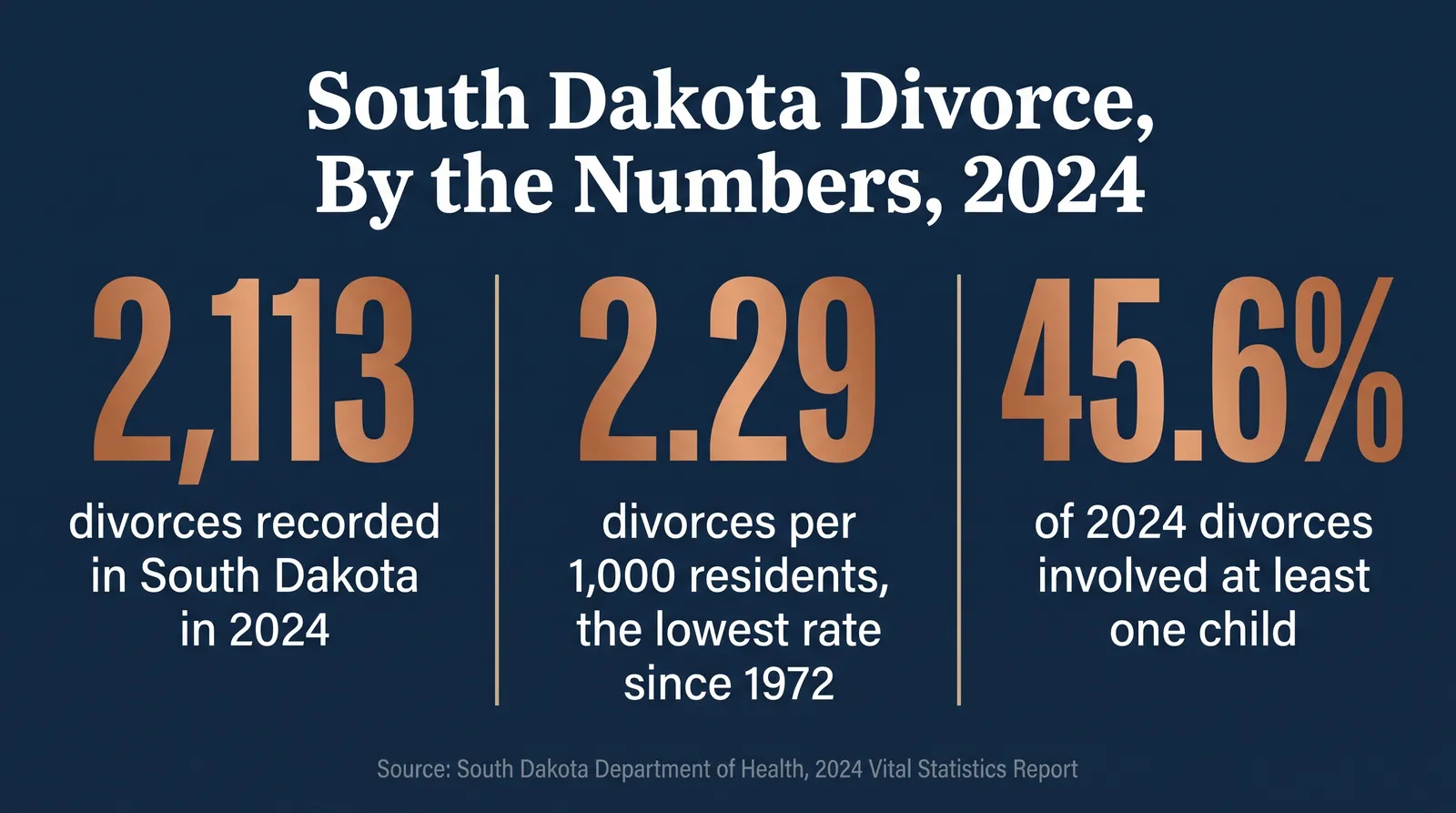
- 2,113 South Dakota marriages ended in divorce in 2024, the lowest crude divorce rate since 1972 at 2.29 per 1,000 residents, and 45.6% of those divorces involved at least one child, according to the South Dakota Department of Health's 2024 Vital Statistics Report.
The moment this actually shows up
Here’s how this usually surfaces, and it’s rarely at a good time. A man in Aberdeen dies at 58, still working, still carrying a $350,000 term policy he bought at 34, the year he and his first wife had their only child. He and that wife divorced when their daughter was eleven. He remarried four years later and stayed married for the rest of his life. He never once opened the folder with his life insurance paperwork in it, because nothing ever prompted him to.
His current wife, the one who lived with him for nineteen years, assumes she’s the beneficiary. She isn’t, at least not on the form the insurer has on file, which still lists the first wife by name from 2002. Whether the first wife actually gets paid depends on a detail almost nobody thinks to check: whether that policy is individually owned, in which case South Dakota law already revoked her as beneficiary the day the divorce was final, or whether it runs through his employer’s group plan, in which case a federal law called ERISA means South Dakota’s revocation statute never applied to it in the first place, and the first wife is still entitled to every dollar. Two policies that look identical on paper can resolve in opposite directions, and the difference isn’t something a grieving spouse figures out by guessing.
This isn’t a rare, unlucky scenario. It’s the ordinary consequence of a form nobody’s required to update and a habit almost nobody has: checking beneficiary designations the way people check a lease or a will. Divorce in South Dakota is common enough that this exact gap sits behind a meaningful share of the state’s in-force life insurance. The state’s Department of Health recorded 2,113 divorces in 2024, and just under half, 45.6%, involved at least one child, the group of policyholders most likely to have bought coverage in the first place.
Why the law revokes it, and why that isn’t the end of the story
Beneficiary, plainly, is the person or entity a policy owner names to receive the death benefit. Governing instrument is the legal term South Dakota uses for the document that creates that designation, and it’s a broader category than most people assume. Under SDCL 29A-1-201(19), a governing instrument explicitly includes “a deed, will, trust, insurance or annuity policy, POD account, security registered in beneficiary form (TOD), pension, profit-sharing, retirement, or similar benefit plan.” A life insurance policy’s beneficiary form is squarely inside that definition, right alongside a will.
SDCL 29A-2-804 is the section that acts on that definition. It says a divorce or annulment automatically revokes any revocable disposition a divorced person made to a former spouse in a governing instrument, “revocable” meaning the policy owner, at the time of the divorce, was legally free to change that designation on their own. Most individually purchased life insurance is revocable by default; the owner can swap beneficiaries at will unless they specifically made a designation irrevocable, which is uncommon and usually shows up only in policies tied to a legal settlement or business agreement.
The statute reaches further than most people expect, too. It doesn’t just wipe out the ex-spouse’s own designation; under SDCL 29A-2-804(b)(1)(iii), it also revokes any nomination naming your former spouse to serve in “any fiduciary or representative capacity, including a personal representative, executor, trustee, conservator, agent, or guardian.” If your ex-spouse was named as the trustee managing life insurance proceeds for your kids, that role gets revoked too, not just the beneficiary line.
| Statute | What it covers | Why it matters here |
|---|---|---|
| SDCL 29A-1-201(19) | Defines "governing instrument" to explicitly include an insurance or annuity policy | Confirms your life insurance beneficiary form is covered by the revocation statute below |
| SDCL 29A-1-201(32) | Defines "payor" to include an insurer | Your insurance company is the "payor" whose protections and duties are set out in 29A-2-804(g) |
| SDCL 29A-2-804(b) | Automatically revokes a revocable disposition, power, or fiduciary nomination naming a former spouse | This is the rule that removes your ex as beneficiary the day your divorce is final |
| SDCL 29A-2-804(e) | Remarriage to the same former spouse revives what this statute revoked | If you remarry your ex, the old designation comes back automatically |
| SDCL 29A-2-804(g) | Protects a payor from liability until it receives written notice of the divorce | This is why the automatic revocation alone doesn't stop a wrongful payout |
What it actually costs when nobody sends the notice
This is where the law’s protection and reality pull apart. SDCL 29A-2-804(g) says a payor, defined in SDCL 29A-1-201(32) to include an insurer, “is not liable for having made a payment… to a beneficiary designated in a governing instrument affected by a divorce… before the payor… has received written notice of the divorce.” That notice has to be formal: mailed by registered or certified mail with return receipt requested, or served the same way a summons is served in a civil case. A conversation with a claims representative, or an assumption that “they probably know,” doesn’t count.
So picture the ordinary sequence. A divorce becomes final. Nobody writes to the insurance company. Years pass. The policyholder dies. The insurer processes the claim exactly the way it’s supposed to: it looks at the beneficiary form on file, sees the ex-spouse’s name, and pays. Legally, that designation was already revoked the moment the divorce was final. Practically, the insurer had no way to know that, was protected for not knowing it, and the money is gone.
What happens next isn’t automatic either. SDCL 29A-2-804(h) says a former spouse who received a payment “not for value,” meaning they didn’t pay anything to get it, is personally obligated to return it, or is personally liable for its value, to whoever was actually entitled to it. That’s a real legal right. It is also a debt collection and, often, a lawsuit against a former spouse, arriving during the same weeks a family is grieving and settling an estate. It is a far harder, slower, more expensive path than filling out a form would have been.
2,113
South Dakota divorces in 2024 (SD Dept. of Health, 2024 Vital Statistics Report)
2.29
SD's 2024 crude divorce rate per 1,000 residents, its lowest since 1972
45.6%
Share of 2024 SD divorces that involved at least one child
12 yrs
Average duration of a South Dakota marriage ending in divorce in 2024
South Dakota divorces recorded, by year
Source: South Dakota Department of Health, 2024 Vital Statistics Report, Table 51. 2024 rate of 2.29 per 1,000 residents is the state's lowest since 1972.
The kinds of coverage this law does not touch
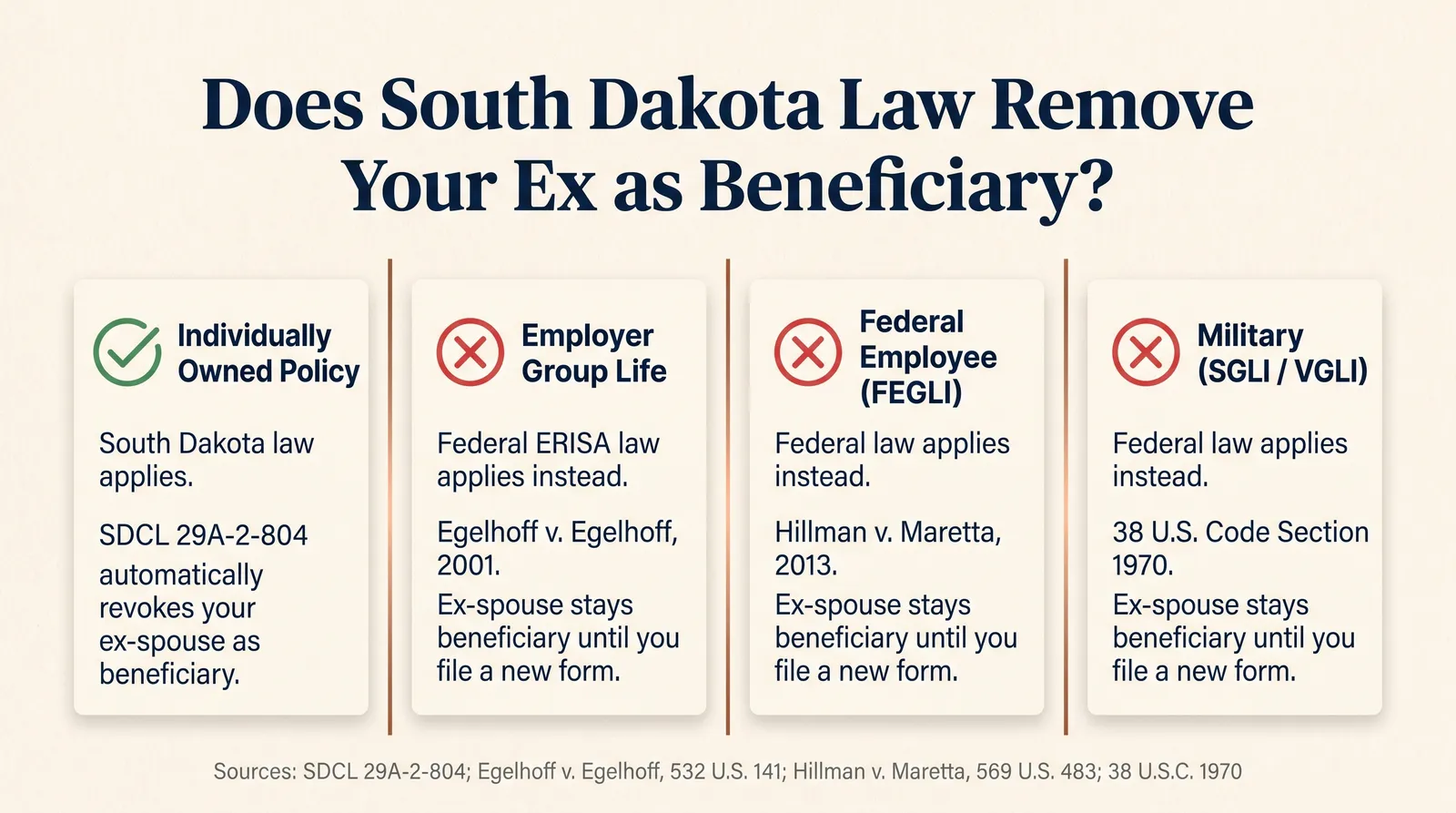
South Dakota’s automatic revocation is a state law, and state law only reaches as far as the U.S. Constitution’s preemption doctrine lets it. Three common kinds of life insurance are governed by federal law instead, and in each case, the federal rule wins.
Employer group life insurance. Most group life coverage offered through a private employer is governed by ERISA, the federal Employee Retirement Income Security Act. In Egelhoff v. Egelhoff, 532 U.S. 141 (2001), the U.S. Supreme Court struck down a Washington state law nearly identical in structure to South Dakota’s, holding that ERISA preempts a state statute that would change who an ERISA plan administrator has to pay. The plan pays whoever is named on its own beneficiary form, full stop, regardless of what South Dakota law says happened at divorce.
Federal employee coverage (FEGLI). Federal civilian employees, and many South Dakotans work for the VA, the Forest Service, the IRS, or another federal agency, are typically covered by the Federal Employees’ Group Life Insurance Act. In Hillman v. Maretta, 569 U.S. 483 (2013), the Supreme Court went a step further than Egelhoff: it struck down a Virginia law that tried to let the correctly intended beneficiary sue the wrongly paid ex-spouse for the money after the fact, ruling that federal law preempted even that fallback remedy. FEGLI’s own beneficiary form is the entire answer, with no state-law backstop at all.
Military coverage (SGLI and VGLI). Servicemembers’ Group Life Insurance and Veterans’ Group Life Insurance follow their own federal statute. Under 38 U.S.C. § 1970(a), proceeds are paid “first, to the beneficiary or beneficiaries as the member or former member may have designated by a writing received prior to death.” That designation controls. State divorce law doesn’t enter into it.
| Coverage type | Governed by | SD's automatic revocation applies? |
|---|---|---|
| Individually owned term, whole, or IUL policy | South Dakota state law | Yes, per SDCL 29A-2-804 |
| Employer group life insurance | Federal ERISA law | No, per Egelhoff v. Egelhoff |
| Federal employee coverage (FEGLI) | Federal FEGLIA | No, per Hillman v. Maretta |
| Military coverage (SGLI / VGLI) | 38 U.S.C. § 1970 | No, per federal statute |
Does it matter how old the policy is?
No, and this is worth knowing because it removes one excuse people reach for. Some policyholders assume a law like this can only apply going forward, to policies bought after it existed, not to a policy they took out years earlier. The Supreme Court addressed exactly that question in Sveen v. Melin, 584 U.S. 811 (2018), a case about Minnesota’s version of this same statute. The Court ruled 8-1 that applying a revocation-on-divorce law retroactively, to a policy purchased before the law was enacted, does not violate the Constitution’s Contracts Clause. The Court’s reasoning was that the law simply reflects what a divorced policyholder would presumably want, functions as a default rule, and can always be overridden by the policyholder submitting a new designation. South Dakota’s own statute has been in force since 1995, so this question mostly matters as reassurance: however old your individually owned policy is, SDCL 29A-2-804 still applies to it if it’s revocable and state-governed.
What if your divorce decree requires you to keep your ex as beneficiary?
This comes up more than people expect, and it’s the one situation where you specifically do not want the automatic revocation to apply. SDCL 29A-2-804(b) opens with a condition: the revocation happens “except as provided by the express terms of a governing instrument, a court order, or a contract relating to the division of the marital estate.” If your divorce settlement requires you to maintain life insurance naming your ex-spouse, often to secure ongoing child support or spousal support payments in case you die before the obligation ends, that requirement controls, and the automatic revocation doesn’t apply to that policy.
The complication is that this exception protects the requirement in the decree; it doesn’t automatically keep the beneficiary form itself correctly filled out. If your decree requires your ex to remain beneficiary, that’s exactly the kind of designation you should leave alone rather than accidentally changing. If you’re the one entitled to receive support and depending on this coverage, it’s worth confirming directly with the insurer, in writing, that your ex hasn’t quietly swapped in someone else, since nothing stops a policy owner from doing that unless the decree itself restricts it or the designation was made explicitly irrevocable.
How to actually fix this yourself
None of this requires an attorney to handle for most people. It requires contacting each insurer separately, because none of these systems talk to each other, and South Dakota’s statute, ERISA, FEGLIA, and 38 U.S.C. § 1970 are four different sets of rules that don’t share a database.
Start with a list of every policy you have, not just the one you remember. Individually owned coverage, anything through a current or former employer, and any military-related coverage if you served, are all handled separately and by different rules, as the table above shows.
For each individually owned policy, contact the insurer directly and ask for a beneficiary change form. Submit it in writing; most carriers now accept this online or by a signed paper form. Even though SDCL 29A-2-804 already revoked your ex-spouse’s designation by operation of law, submitting a new form accomplishes two things at once: it names who you actually want as beneficiary today, and it puts the insurer on notice in a way that ends any ambiguity, protecting whoever you name from the exact “no written notice” gap described above.
For employer group life insurance, contact your HR or benefits department, not your life insurance agent, since the plan administrator, not South Dakota law, controls who gets paid. Ask specifically for a new beneficiary designation form for your group life coverage; this is a completely separate process from any individual policy you own.
For SGLI, VGLI, or FEGLI, servicemembers and veterans update SGLI and VGLI designations through the Servicemembers’ Group Life Insurance Online Enrollment System or their servicing branch; federal civilian employees update FEGLI designations through their employing agency’s HR office, not through South Dakota’s court system or an insurance company.
Our own beneficiary checklist walks through this policy by policy if you’d rather work from a structured list than start from memory.
What if you remarry the same person?
SDCL 29A-2-804(e) covers this directly: a designation revoked solely by this statute is revived if the divorced individuals remarry each other. If you and your ex-spouse divorce, and later remarry one another without ever changing the beneficiary form in between, the original designation naming them comes back into force automatically. It does not apply if you remarry someone else; in that case, the revoked designation stays revoked, and if you want your new spouse named, or want to name your first spouse again after a different subsequent marriage ends, you still have to file a new form. The safest habit, honestly, is not to rely on any of this reviving or resolving itself. Check the form after every major change in your life, remarriage included.
A worked example: two South Dakota families, two different outcomes
Family one: Pierre, individually owned policy. A woman buys a $400,000 term policy on her own in 2015, names her husband as beneficiary. They divorce in 2020. Neither of them touches the form again. She dies in 2026, still unmarried. Because this was an individually owned, revocable policy governed by South Dakota law, SDCL 29A-2-804 already revoked her ex-husband’s designation the day the 2020 divorce was final. Under South Dakota’s intestate rules for a revoked designation, absent a valid living beneficiary form, the proceeds generally become payable to her estate, to be distributed according to her will or, without one, to her heirs under South Dakota’s intestacy statutes, not to her ex-husband. If she’d simply updated the form to name her children directly, the money would have reached them without going through her estate at all.
Family two: Sioux Falls, employer group life. A man carries $250,000 in group life insurance through his employer, on top of a smaller individual policy. He names his wife as beneficiary on both when he’s hired in 2010. He divorces in 2019, remarries in 2022, and dies in 2026 without ever updating either form. His individual policy resolves the way South Dakota’s statute intends: the first wife’s designation was automatically revoked at divorce, and, absent a new form, the proceeds go to his estate. His employer group policy resolves the opposite way. Because it’s governed by ERISA, South Dakota’s revocation statute never touched it, per Egelhoff v. Egelhoff, and the plan pays the first wife, the person actually named on the ERISA plan’s own beneficiary form, the full $250,000. His second wife has no claim to it.
| Policy | Governed by | Who actually gets paid |
|---|---|---|
| Individual $400,000 term policy, Pierre | SDCL 29A-2-804 | Estate, since the ex-spouse's designation was revoked and no new one was filed |
| Individual policy, Sioux Falls | SDCL 29A-2-804 | Estate, same reason |
| Employer group life policy, Sioux Falls | ERISA | First wife, the beneficiary still named on the plan's own form |
Old designation stays on file
- Individual policy: proceeds default to the estate once the ex's designation is revoked
- ERISA group policy: proceeds go to the ex-spouse, since state law never touched the designation
- Family finds out which rule applies only after a claim is filed
New form filed with each carrier
- Individual policy: named beneficiary receives proceeds directly, no estate involved
- ERISA group policy: named beneficiary receives proceeds directly, since the plan's own form now reflects it
- No ambiguity, no reliance on which statute happens to apply
You can do this yourself, for every policy you own, in less than an hour once you have your list. The paperwork is short. What takes longer is remembering to start, since nothing about divorce paperwork prompts you to think about a form you filled out years before the marriage ended.
How we help
We’re independent, so when someone comes to us mid-divorce or years past one, sorting out beneficiaries isn’t a script. We’ll go through your actual coverage, individual policies, anything through work, anything military or federal, and help you understand which rule governs each one and what updating it actually requires. We’re not attorneys and don’t interpret your divorce decree for you; if your decree has specific requirements about keeping a policy in force for a former spouse, that’s worth confirming with the attorney who handled your divorce. What we can do is make sure the coverage itself, and who’s actually named on it, matches what you intend today. Compare My Options.
What you get
Beneficiary designations that say what you actually mean, on every policy you hold, not just the ones you remembered to think about. Clarity on which of your coverage is state-governed and already protected by South Dakota’s automatic revocation, and which runs through federal rules that South Dakota’s law can’t reach, so you know exactly which forms still need your signature. And, if you’re reviewing or buying coverage at the same time, a policy set up correctly from the start instead of left as one more thing to circle back to later.
South Dakota's law does a lot of the work automatically. It can't send the letter for you, and it can't reach into an ERISA plan or a federal benefit at all. The form is still yours to file.
Mike MooreRelated reading
If you’re also sorting out who should hold the money if your kids are still minors, see naming a minor life insurance beneficiary in South Dakota. If your coverage runs through your job and you’re weighing whether it’s enough on its own, see is your employer’s life insurance enough. And if you served in the military, see what happens to your SGLI when you leave the military.
Naming your kids as beneficiary instead?
See naming a minor life insurance beneficiary in South Dakota before you file the new form.
Not sure your group coverage through work is enough?
Not ready to talk to anyone yet?
Read how it works first and come back when you are.
Frequently asked questions
Does divorce automatically remove my ex-spouse as my life insurance beneficiary in South Dakota?
For most individually owned policies, yes. SDCL 29A-2-804 automatically revokes a former spouse’s beneficiary designation the moment a South Dakota divorce or annulment is final, unless your divorce decree or a separate court order says otherwise. But automatic revocation under state law and your insurer actually knowing about it are two different things, covered below.
If the law already revokes my ex as beneficiary, why do I still need to update the form?
Because SDCL 29A-2-804(g) protects your insurer from liability for paying the beneficiary on file until it receives written notice of your divorce, sent by registered or certified mail or served like a summons. If your insurer never gets that notice, it can pay your ex-spouse in full and owe your correct beneficiary nothing, leaving your family to try to recover the money from your ex directly.
Does South Dakota’s revocation law apply to my employer’s group life insurance?
Usually not. Most employer-sponsored group life plans are governed by ERISA, a federal law, and the U.S. Supreme Court held in Egelhoff v. Egelhoff, 532 U.S. 141 (2001), that ERISA preempts state revocation-on-divorce statutes like South Dakota’s. Whoever is named on your ERISA plan’s beneficiary form gets paid, ex-spouse or not, unless you submit a new form.
What about federal employee (FEGLI) or military (SGLI and VGLI) life insurance?
Same problem, different federal law. FEGLI is governed by the Federal Employees’ Group Life Insurance Act, which the Supreme Court held preempts state beneficiary-revocation statutes in Hillman v. Maretta, 569 U.S. 483 (2013). SGLI and VGLI pay according to the beneficiary designation on file under 38 U.S.C. § 1970(a). Neither is touched by SDCL 29A-2-804.
Does this law apply to a policy I bought years before my divorce, or only new policies?
It applies regardless of when you bought the policy. The U.S. Supreme Court addressed exactly that question in Sveen v. Melin, 584 U.S. 811 (2018), and upheld a state’s revocation-on-divorce statute as applied retroactively to a policy purchased before the statute existed, ruling 8-1 that it didn’t violate the Constitution’s Contracts Clause.
What if my divorce decree requires me to keep my ex-spouse as beneficiary?
Then the automatic revocation doesn’t apply. SDCL 29A-2-804 explicitly yields to “the express terms of a governing instrument, a court order, or a contract relating to the division of the marital estate.” This comes up often when a policy is used to secure child support or alimony payments after divorce.
What happens if I remarry the same person I divorced?
Your original beneficiary designation comes back to life. SDCL 29A-2-804(e) says a revocation caused solely by this statute is reversed by the divorced individuals’ remarriage to each other. If you want your spouse as beneficiary again after remarrying someone else, or want to name a different person entirely, you still need to file a new form either way.
How do I actually update my beneficiary after a divorce in South Dakota?
Contact each insurer directly, ask for a beneficiary change form, and submit it in writing; a phone call alone usually isn’t enough. Do this for every policy separately: an individually owned term or whole life policy, any employer group life coverage, and any SGLI, VGLI, or FEGLI coverage, since each is governed by different rules and none of them talk to each other.
Sources
- South Dakota Legislative Research Council — Codified Law 29A-2-804 — automatic revocation of a revocable disposition, power, or fiduciary nomination naming a former spouse upon divorce; insurer protection until written notice; effective 1995; accessed September 2026
- South Dakota Legislative Research Council — Codified Law 29A-1-201 — general definitions confirming “governing instrument” includes an insurance or annuity policy and “payor” includes an insurer; accessed September 2026
- Cornell Law School Legal Information Institute — Egelhoff v. Egelhoff, 532 U.S. 141 (2001) — ERISA preempts state statutes automatically revoking a former spouse’s beneficiary designation on employer-sponsored group life plans; accessed September 2026
- Cornell Law School Legal Information Institute — Hillman v. Maretta, 569 U.S. 483 (2013) — the Federal Employees’ Group Life Insurance Act preempts state revocation-on-divorce statutes for FEGLI coverage; accessed September 2026
- Cornell Law School Legal Information Institute — Sveen v. Melin, 584 U.S. 811 (2018) — a state revocation-on-divorce statute may constitutionally apply retroactively to policies purchased before its enactment; accessed September 2026
- Cornell Law School Legal Information Institute — 38 U.S.C. § 1970 — SGLI and VGLI proceeds are paid according to the beneficiary designation on file, subsection (a); accessed September 2026
- South Dakota Department of Health — 2024 Vital Statistics Report — 2,113 South Dakota divorces in 2024, a crude rate of 2.29 per 1,000 residents (the lowest since 1972), average marriage duration of 12 years, and 45.6% of divorces involving at least one child, Tables 51 through 53; accessed September 2026
Related reading: naming a minor life insurance beneficiary in South Dakota, is your employer’s life insurance enough, and what happens to your SGLI when you leave the military.
Before you act on any of this
This article is general education, not insurance, legal, financial, or tax advice, and describes South Dakota and federal law as of the dates cited; consult the current codified law and a licensed attorney about your own divorce decree before relying on any of it. Product availability, features, and rates vary by carrier and are subject to underwriting. No coverage exists until a policy is issued and in force. Any guarantees are subject to the claims-paying ability of the issuing insurer. Please review actual policy documents and speak with a licensed agent about your own situation.
The form that outlives the marriage
Divorce paperwork is thick enough already, and a beneficiary form on a policy you bought years earlier is easy to leave out of the pile. South Dakota’s law does real work for you here, but it stops exactly where the insurer’s protection starts, and it stops completely at the edge of any employer, federal, or military plan. Pull up every policy you hold this week, individual and group both, and check the name on the form against the name you’d actually want there today.
Want help sorting out which of your policies South Dakota's law actually covers?
We'll go through your individual and employer coverage, explain which rule governs each one, and make sure the beneficiary on file is who you actually mean.