If you and your partner aren’t married and you own your South Dakota home together, the state’s default rule is that neither of you automatically inherits the other’s share of it. You likely hold the property as tenants in common, which carries no right of survivorship, and South Dakota’s intestate succession law only names a surviving spouse and blood relatives as heirs. If one of you dies without a will or a different deed, the survivor doesn’t get the house. They get a new co-owner: whichever parent, sibling, or other relative the law says inherits instead.
The short version
- South Dakota titles co-owned property as tenants in common by default. A joint tenancy, which carries a right of survivorship, is created only when a deed expressly says so, under SDCL 43-2-12 and 43-2-14.
- South Dakota has not recognized new common-law marriages since July 1, 1959, per SDCL 25-1-29. No amount of time together creates a legal marriage.
- Under South Dakota's intestate succession statutes, SDCL 29A-2-101 through 29A-2-103, an unmarried partner is not an heir at any point in the inheritance order, even after decades together.
- You can always name your unmarried partner as the beneficiary of a policy on your own life with no special requirement, under SDCL 58-10-3. Buying a policy that insures your partner's life is different and requires showing insurable interest under SDCL 58-10-4.
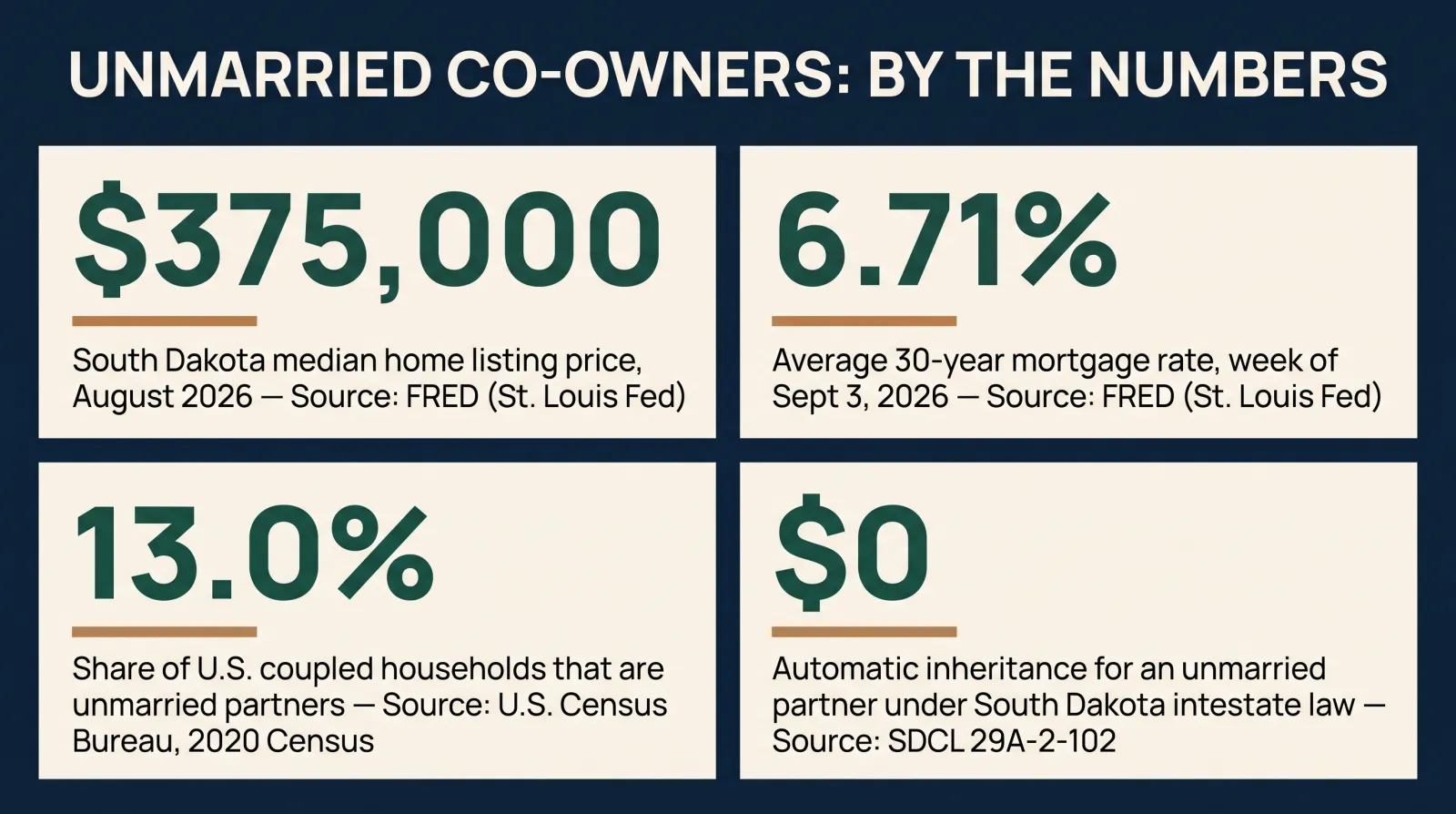
- South Dakota's median home listing price was $375,000 in August 2026, according to FRED (Federal Reserve Bank of St. Louis), and the average 30-year fixed mortgage rate was 6.71% for the week of September 3, 2026, also per FRED, both of which shape what a buyout or a refinance actually costs if you have to do one.
The pain: you’re on the mortgage together, but the law doesn’t treat you as a family
Picture two partners who’ve been together for eleven years, never married, who bought a home together outside Brookings four years ago. Both names are on the mortgage. Both names are on the deed. They split the property taxes, the insurance, and the grocery bill the same way any married couple would. Neither one has thought about what happens to any of it if one of them dies, because in every practical sense of the word, they already feel like family.
South Dakota law doesn’t see it that way. It sees two unrelated adults who happen to co-own a piece of real estate, and it applies the same default rules it would apply to two business partners or two siblings who bought a lake cabin together. That gap between how a relationship feels and how the law actually treats it is where the real risk sits, and it’s a gap most unmarried couples never find out about until someone has already died.
This is general education, not legal advice for your specific deed or estate
Nothing here tells you how your specific deed is titled, what your will does or doesn't say, or how South Dakota's intestate succession rules would actually apply to your estate. It walks through the mechanics and the named statutes so you can bring the right questions to a South Dakota estate attorney and to whoever holds your mortgage.
Nationally, this isn’t a fringe situation. Unmarried partners made up 13.0% of all coupled households in the United States, and 6.9% of all households, according to the U.S. Census Bureau’s analysis of 2020 Census data. That’s a lot of households built the same way, with the same blind spot.
Why it happens: property law and family law don’t update for how you actually live
Three separate bodies of South Dakota law intersect here, and each one needs its own explanation, because each one fails an unmarried couple in a slightly different way.
Your deed decides survivorship, and the default doesn’t favor you
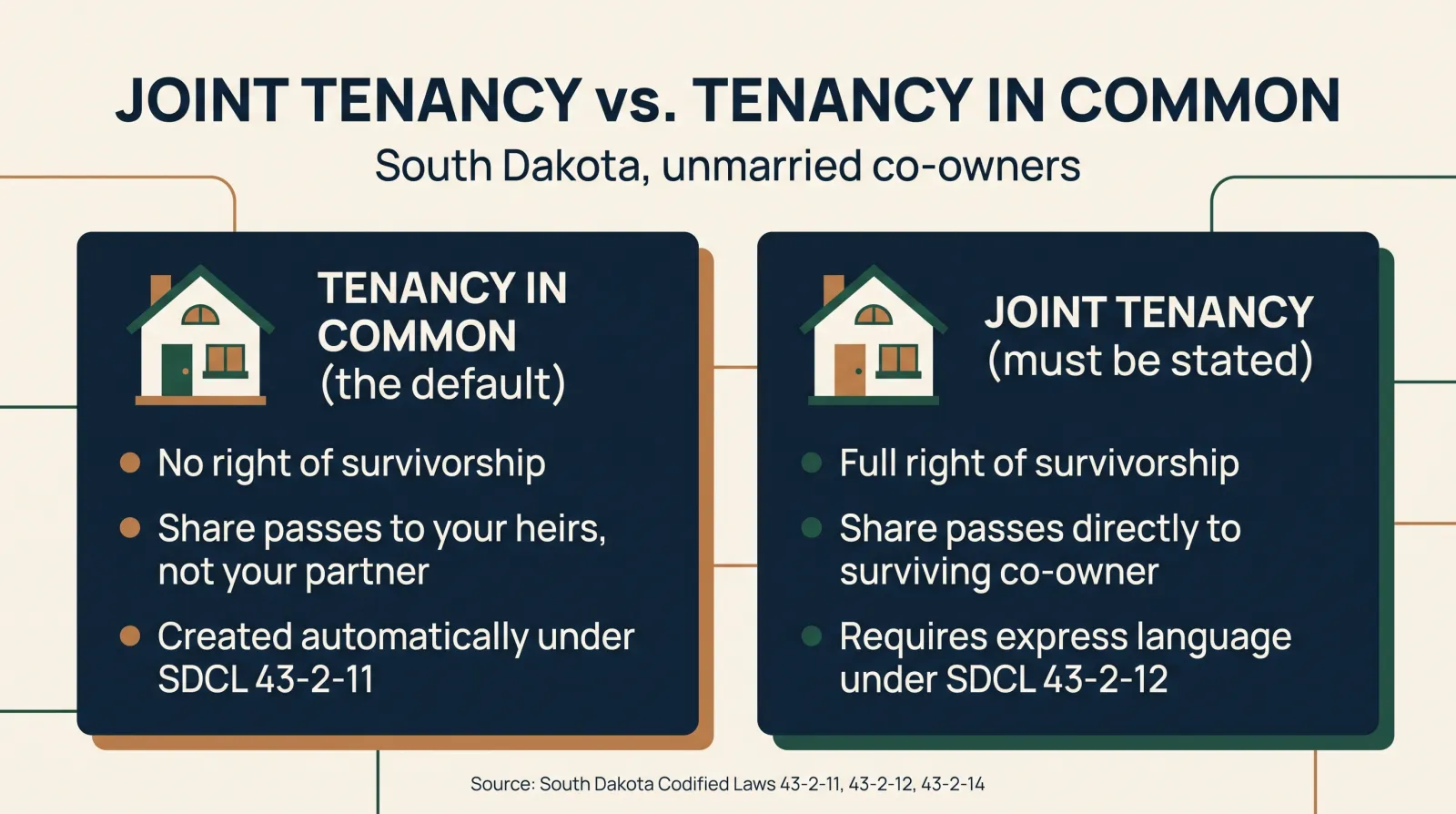
When two or more people buy real estate together, South Dakota law recognizes a short list of ownership structures. Under SDCL 43-2-11, ownership by several persons is either a joint interest, a partnership interest, or an interest in common. The one that matters here is the difference between a joint tenancy and a tenancy in common, and it comes down to one feature: the right of survivorship, meaning whether a deceased owner’s share automatically passes to the surviving owner without going through probate or inheritance law at all.
A joint tenancy has that right of survivorship built in. But South Dakota doesn’t hand it out by default. Under SDCL 43-2-12, a joint tenancy interest is created “when expressly declared in the will or transfer to be a joint tenancy,” and under SDCL 43-2-14, a deed to two or more grantees creates a joint tenancy only when the way it describes the grantees, or the language of its granting clause, “evinces an intent to create a joint tenancy.” Absent that specific language, what you have instead is an interest in common: a tenancy in common, where each owner holds a separate, freely transferable, freely inheritable share, and nothing automatically passes to the other owner when one of you dies.
Most South Dakota deeds for unmarried co-buyers are written as tenancy in common, either because a title company defaults to it or because nobody asked for anything different. If you’ve never specifically discussed joint tenancy with survivorship with whoever handled your closing, tenancy in common is the safer assumption until you’ve actually pulled your deed and checked.
There’s no common-law marriage to fall back on
Some unmarried couples assume that enough years together, or enough shared bills, eventually adds up to something the law recognizes as a marriage. In South Dakota, it doesn’t. SDCL 25-1-29 requires that a marriage be solemnized and recorded, and it preserves only common-law marriages “consented to and subsequently consummated prior to July 1, 1959.” No relationship formed after that date acquires marital status just by lasting a long time or looking like a marriage from the outside. Whatever protections a spouse gets under South Dakota law, an unmarried partner, no matter how long the relationship, does not get them by default.
Intestate succession skips you entirely
If your partner dies without a will, South Dakota’s intestate succession statutes decide who inherits, and the order is fixed by law, not by how close you actually were. Under SDCL 29A-2-102, a surviving spouse inherits first, and often inherits everything if there are no children from outside the marriage. But if there is no surviving spouse, SDCL 29A-2-103 sets the next order: first to the decedent’s children, then, if there are none, to the decedent’s parents, then to the decedent’s siblings, then to more distant relatives on both sides of the family. An unmarried partner does not appear anywhere in that list, at any step, regardless of how long you were together or how the household’s finances actually worked.
Here are the terms worth locking in before going further, since the rest of this depends on keeping them straight:
- Right of survivorship. The feature of a joint tenancy where a deceased owner’s share passes automatically and immediately to the surviving owner or owners, without probate.
- Intestate succession. The default legal order that decides who inherits a person’s property when they die without a valid will, set out in SDCL 29A-2-101 through 29A-2-103.
- Insurable interest. A legal requirement that the person buying a life insurance policy on someone else has a real financial or family stake in that person staying alive, as opposed to a benefit that only exists because they died. Required under SDCL 58-10-3.
- Partition action. A lawsuit one co-owner can file against another under SDCL 21-45-1 to force a division or a court-ordered sale of jointly held property when the owners can’t agree on what to do with it.
| Feature | Joint tenancy | Tenancy in common |
|---|---|---|
| Right of survivorship | Yes, automatic | No |
| How it's created in South Dakota | Deed must expressly declare it, per SDCL 43-2-12 and 43-2-14 | The default when a deed doesn't say otherwise |
| Where a deceased owner's share goes | Directly to the surviving co-owner, outside probate | Through the deceased owner's will, or intestate succession if there's no will |
| Can an unmarried partner inherit it automatically? | Yes, by the survivorship feature itself | No, unless named in a will |
| Each owner's shares can differ | No, joint tenants hold equal shares | Yes, shares can be unequal (50/50, 70/30, etc.) |
| Can one owner force a sale via partition | Yes, under SDCL 21-45-1 | Yes, under SDCL 21-45-1 |
Can you even insure each other? The insurable interest question
Before the money question, there’s a legal one: is an unmarried partner even allowed to buy life insurance involving the other? The answer splits into two very different situations, and conflating them is where a lot of confusion starts.
Insuring your own life, with your partner as beneficiary. This is the simple case, and it has never required marriage. Under SDCL 58-10-3, “any individual of competent legal capacity may procure or effect an insurance contract upon his own life or body for the benefit of any person.” You are the one being insured, so there’s no insurable interest question to satisfy; you can name your partner, a friend, a charity, or anyone else you choose. If you already have a life insurance policy and haven’t named your partner, or haven’t checked the form in years, that’s the easiest fix available, and it doesn’t touch the property questions above at all.
Buying a policy that insures your partner’s life. This is different, and it’s where insurable interest actually applies. Under SDCL 58-10-3, nobody can buy insurance on another person’s life “unless the benefits under such contract are payable to the individual insured or his personal representatives, or to a person having…an insurable interest in the individual insured.” SDCL 58-10-4 spells out what counts. Subsection (1) covers people “related closely by blood, marriage, or by law,” with a substantial interest engendered by love and affection, which automatically covers spouses and close relatives. An unmarried partner doesn’t fit that category. But subsection (2) provides a second, broader path: “a lawful and substantial economic interest in having the life…of the individual insured continue.” A shared mortgage, joint debt, or a household where one partner’s income supports the other is exactly the kind of economic interest this subsection describes. It isn’t automatic the way it is for a spouse, and an insurer will typically want to see documentation, like a mortgage statement with both names on it, but it’s a real and usable path, not a dead end.
Insurable interest is only a hurdle if you're insuring someone else's life. Naming your partner as the beneficiary of your own policy has never required a marriage license.
South Dakota Codified Law 58-10-3What this costs to get wrong: a worked example
Here’s the arithmetic, using a hypothetical unmarried South Dakota couple and numbers built for this illustration, not an actual home sale or estate. This shows the shape of the problem, not a valuation of any real property.
Say two partners, unmarried, buy a home together for $350,000, close to South Dakota’s $375,000 median home listing price in August 2026, according to FRED. They put down a modest payment and carry a mortgage balance of $260,000. Their deed doesn’t mention joint tenancy, so by default they hold the property as tenants in common, 50/50. Neither has a will.
| Item | Amount |
|---|---|
| Home value | $350,000 |
| Mortgage balance remaining | $260,000 |
| Total equity in the home | $90,000 |
| Deceased partner's 50% tenancy-in-common share of equity | $45,000 |
| Who inherits that $45,000 share, per SDCL 29A-2-103 (no will, no children) | The deceased partner's parents, not the surviving partner |
| What the survivor must pay the parents to buy full ownership | $45,000, plus whatever the property has appreciated since |
Author's calculation, structured consistent with SDCL 43-2-11, 43-2-12, and 29A-2-103. Illustrative numbers only, not a valuation of any specific property or estate.
Where the deceased partner's $45,000 equity share actually goes without a will or a different deed
Illustrative example only, structured consistent with SDCL 43-2-11, 43-2-12, and 29A-2-103. Not a valuation of any specific property or estate.
The surviving partner still owes the full $260,000 mortgage if their name is on the note, which it usually is when both partners bought the home together. They now also co-own the house with the deceased partner’s parents, who hold a legitimate, legally recognized $45,000 stake in a home they’ve likely never lived in. If the parents want their share in cash rather than staying on the deed indefinitely, and the survivor doesn’t have $45,000 available, the options narrow fast: refinance to pull out cash at whatever the going rate is, which was 6.71% for a 30-year fixed loan for the week of September 3, 2026, according to FRED, or sell the house and split the proceeds, which means the survivor loses the home entirely. If the parents and the survivor can’t agree at all, SDCL 21-45-1 lets any co-owner file a partition action asking a court to force a sale.
None of this happens to a married couple in the identical situation, because a surviving spouse who inherits under SDCL 29A-2-102 typically ends up with the whole estate, not a 50% stake shared with in-laws.
If you’d rather have someone local run the actual numbers on your mortgage and your deed instead of this hypothetical, that’s part of what we do. Compare your options.
$375,000
South Dakota median home listing price, August 2026, per FRED
6.71%
Average 30-year fixed mortgage rate, week of Sept 3, 2026, per FRED
13.0%
Share of U.S. coupled households that are unmarried partners, 2020 Census, per the U.S. Census Bureau
$0
What an unmarried partner automatically inherits under South Dakota intestate succession law, SDCL 29A-2-101 through 29A-2-103
How to check and fix your own situation
None of this requires waiting on anyone. Here’s the method, using documents you likely already have.
- Pull your actual deed. Your county Register of Deeds office keeps a public copy. Look for the words “joint tenants” or “joint tenancy with right of survivorship.” If you don’t see that specific language, you almost certainly hold the property as tenants in common by default, under SDCL 43-2-11.
- Find out whose name is on the mortgage note, separately from the deed. The deed decides who owns the property; the mortgage note decides who owes the debt. Both partners are often on the note even when the deed’s wording is ambiguous, which means a surviving partner can be fully liable for the mortgage while only owning half the house.
- Decide whether joint tenancy with survivorship fits your situation. If you want your partner to automatically inherit your full interest in the home, a title company or real estate attorney can prepare a new deed that expressly creates a joint tenancy under SDCL 43-2-12. This is a real property transaction, not a form you fill out yourself, and it has tradeoffs worth discussing, including that joint tenants must hold equal shares and that either owner can still sever the joint tenancy unilaterally in some circumstances.
- Look at South Dakota’s Transfer on Death Deed as an alternative. Under the South Dakota Real Property Transfer on Death Act, SDCL 29A-6-401 et seq., a property owner can record a deed naming a beneficiary who takes the property automatically at death, outside of probate, without giving that beneficiary any rights while the owner is alive. Under SDCL 29A-6-405, the deed stays fully revocable, so recording one doesn’t lock you into anything. This is a document your attorney records with the county, not an insurance product.
- Write a will, or update the one you have. A will doesn’t override how a joint tenancy or a Transfer on Death Deed already resolves ownership, but it controls your tenancy-in-common share if you don’t use either of those tools, and it covers everything else you own that a deed doesn’t touch.
- Size life insurance to the actual numbers, not a guess. If the survivor would need to buy out the deceased partner’s heirs, size coverage to a realistic buyout figure based on your home’s current equity, not what you paid years ago. If the survivor would need to keep making mortgage payments alone, size coverage to what’s actually left on the loan. These are two different numbers, and a policy sized for one doesn’t automatically cover the other.
- Name your partner directly, by name, on your own policy’s beneficiary form. This step alone needs no insurable interest and no deed change, per SDCL 58-10-3, and it’s worth double-checking even if everything else on this list already looks fine.
Steps 1, 2, and 7 take about twenty minutes with your deed and a beneficiary form in hand
Steps 3 and 4 involve real property documents your attorney needs to prepare and record correctly; they aren't insurance paperwork, and we don't draft them. Where a second opinion tends to help is sizing the coverage itself once you know your actual numbers. Not ready to talk to anyone yet? Read How It Works first and come back when you are.
What tends to happen
- Deed defaults to tenancy in common; nobody checked the actual wording
- No will, no Transfer on Death Deed, no updated beneficiary form
- A partner's death sends their share of the home to parents or siblings by default, per SDCL 29A-2-103
- The survivor is fully liable for the mortgage but now co-owns the house with in-laws
What tends to happen instead
- Deed either expressly creates a joint tenancy or the couple has consciously chosen tenancy in common with a will in place
- A Transfer on Death Deed or a current will directs the tenancy-in-common share where the owner actually wants it
- Each partner has named the other directly on their own life insurance, sized to the mortgage balance or a realistic buyout figure
- Nobody is guessing what South Dakota's default rules would do to the home
How we help
We’re independent, so we work through your actual mortgage balance, your actual deed situation, and what you’re both trying to protect, rather than defaulting to a one-size policy. We don’t draft deeds, wills, or Transfer on Death Deeds; that’s real estate and estate-planning work for a South Dakota attorney. What we do is size life insurance to the numbers that matter once you know them: the real mortgage balance if the goal is keeping the survivor from carrying it alone, or a realistic buyout figure if the goal is covering what a tenancy-in-common share could cost to clear. We can also help you think through whether your policy should be on your own life with your partner named directly as beneficiary, which needs no special showing, or whether you’re trying to insure your partner’s life specifically, which is the situation where insurable interest documentation actually comes into play.
What you get
A clear answer on how your home is actually titled and what that means if one of you dies without more planning. A coverage number based on your real mortgage balance and your real equity, not a guess pulled from a generic calculator. An honest explanation of when insurable interest actually matters and when it doesn’t, so you’re not assuming a problem exists where it doesn’t, or missing one where it does. And a beneficiary form that actually says what you want it to say.
Get your coverage sized to your actual mortgage and ownership situation
Bring your deed and your current mortgage statement, and we'll walk through what South Dakota law would actually do with your home, and what coverage would close the gap.
Not ready to talk to anyone yet? Read How It Works first and come back when you are. If your bigger question is whether mortgage protection or a level term policy fits your situation better, our guide on mortgage protection insurance versus term life walks through that comparison in detail. And if you’re working through what happens to a beneficiary designation after a life change, life insurance beneficiaries after divorce in South Dakota covers the parallel set of rules for a different kind of relationship change.
Frequently asked questions
Can I name my unmarried partner as the beneficiary of my life insurance policy in South Dakota?
Yes. Under South Dakota Codified Law 58-10-3, any individual may procure insurance on their own life for the benefit of any person they choose. There is no insurable-interest requirement when you are insuring yourself; the requirement only applies when someone tries to buy a policy on another person’s life. Naming an unmarried partner as beneficiary on your own policy has never required marriage.
Does South Dakota recognize common-law marriage?
No, not for relationships formed in the state today. Under SDCL 25-1-29, South Dakota marriages must be solemnized and recorded, and the statute preserves only common-law marriages that were lawfully entered into and consummated before July 1, 1959. Living together for any number of years, sharing a mortgage, or having children together does not create a legal marriage in South Dakota.
If my unmarried partner and I own our house together and one of us dies without a will, what happens to the house in South Dakota?
The deceased partner’s ownership share does not automatically go to the surviving partner. If the property is titled as tenants in common, the default under SDCL 43-2-11, the deceased partner’s share passes through intestate succession under SDCL 29A-2-103: first to their children, then to their parents, then to their siblings. An unmarried partner is not on that list at any step, so without a will or a different title structure, the survivor ends up co-owning the home with the deceased partner’s family.
Can I buy a life insurance policy on my unmarried partner’s life?
You can, but the insurer will ask you to show insurable interest, since South Dakota law does not automatically extend it to unmarried partners the way it does to spouses and blood relatives. Under SDCL 58-10-4(2), you can qualify through “a lawful and substantial economic interest” in your partner staying alive, such as a jointly held mortgage or shared household debt. Documentation like a mortgage statement with both names on it typically supports this.
What is the difference between joint tenancy and tenancy in common in South Dakota?
Joint tenancy carries a right of survivorship: when one owner dies, their share automatically passes to the surviving owner, outside of probate and outside of intestate succession law entirely. Tenancy in common has no right of survivorship; each owner’s share passes according to their will or, without one, through intestate succession. Under SDCL 43-2-12 and 43-2-14, South Dakota law creates a joint tenancy only when a deed expressly declares that intent. Without that language, unmarried co-owners hold as tenants in common by default.
How do I make sure my unmarried partner actually gets our house if I die?
Two of the more direct tools are a deed that expressly creates a joint tenancy with right of survivorship, and a Transfer on Death Deed recorded under South Dakota’s Real Property Transfer on Death Act, SDCL 29A-6-401 et seq., which names a beneficiary for the property outside of probate and can be revoked any time you’re both still living. A will naming your partner is a third layer, useful for anything a deed doesn’t cover. None of these are insurance products; they’re deed and estate documents an attorney prepares.
Do unmarried partners in South Dakota have any automatic inheritance rights at all?
No. South Dakota’s intestate succession statutes, SDCL 29A-2-101 through 29A-2-103, list a surviving spouse, descendants, parents, siblings, and more distant blood relatives as heirs, in that order. An unmarried partner, regardless of how long the relationship lasted or how the household’s finances were shared, is not included at any point in that order. The only way an unmarried partner inherits is through a will, a beneficiary-designated account, jointly titled property with survivorship rights, or a Transfer on Death Deed.
Before you change anything
This article is general education, not insurance, legal, financial, or tax advice. It does not replace review of your specific deed, mortgage, and estate documents by a South Dakota attorney. Product availability, features, and rates vary by carrier and state and are subject to underwriting. Any guarantees are subject to the claims-paying ability of the issuing insurer.
Sources
- South Dakota Legislature — SDCL 43-2-11, Ownership of property by several persons — the three categories of multi-person property ownership: joint interests, partnership interests, and interests in common
- South Dakota Legislature — SDCL 43-2-12, Joint tenancy interest, title created by will or transfer — a joint tenancy is created only when expressly declared in the will or transfer
- South Dakota Legislature — SDCL 43-2-14, Conveyance to two or more grantees creating joint tenancy — a deed to multiple grantees creates a joint tenancy only when it evinces intent to do so
- South Dakota Legislature — SDCL 25-1-29, Solemnization and recording of marriages required — common-law marriages are preserved only if consented to and consummated before July 1, 1959
- South Dakota Legislature — SDCL 29A-2-101, Intestate estate — property not disposed of by will passes by intestate succession to the decedent’s heirs
- South Dakota Legislature — SDCL 29A-2-102, Share of the spouse — the surviving spouse’s intestate share, including the $100,000-plus-half formula when the decedent has descendants outside the marriage
- South Dakota Legislature — SDCL 29A-2-103, Shares of heirs other than surviving spouse — the intestate order of descendants, then parents, then their descendants, then grandparents and their descendants
- South Dakota Legislature — SDCL 58-10-3, Procurement of insurance on own life or body for benefit of another — anyone may insure their own life for the benefit of any person; insuring another person’s life requires insurable interest
- South Dakota Legislature — SDCL 58-10-4, Insurable interest in personal insurance defined — insurable interest for close relations by blood, marriage, or law, and separately for a lawful and substantial economic interest
- South Dakota Legislature — SDCL 29A-6-401, Real Property Transfer on Death Act, short title and SDCL 29A-6-405, Transfer on death deed revocable — South Dakota’s Transfer on Death Deed law, enacted 2014, and its revocability
- South Dakota Legislature — SDCL 21-45-1, Property subject to partition or sale — a co-owner may sue to force a partition or sale of jointly held property
- FRED (Federal Reserve Bank of St. Louis) — Housing Inventory: Median Listing Price in South Dakota (MEDLISPRISD) — $375,000 median listing price for August 2026, sourced from Realtor.com
- FRED (Federal Reserve Bank of St. Louis) — 30-Year Fixed Rate Mortgage Average in the United States (MORTGAGE30US) — 6.71% average rate for the week ending September 3, 2026, sourced from Freddie Mac’s Primary Mortgage Market Survey
- U.S. Census Bureau — Same-Sex Couples Made Up 1.7% of All Coupled Households in 2020 — unmarried partners (opposite-sex and same-sex combined) made up 13.0% of coupled households and 6.9% of all U.S. households, 2020 Census
The illustrative worked example above uses hypothetical numbers built to show how South Dakota’s tenancy-in-common and intestate succession rules interact. It is the author’s own calculation, structured consistent with the cited statutes, and is not a valuation of any specific property, estate, or household.
Related reading: Mortgage Protection Insurance vs. Term Life and Life Insurance Beneficiaries After Divorce: SD Law in 2026. See current options for mortgage protection, learn more about how we help homeowners, or read how it works.