Before, in most cases, if you’re already planning ahead or already expecting. Buying while you’re in your current, documented health status locks that status in before pregnancy has a chance to add anything new to your file. That doesn’t mean coverage disappears if you wait. It means applying after delivery can mean explaining a cesarean, a case of gestational diabetes, or a postpartum depression diagnosis to an underwriter, instead of applying with a file that doesn’t have those questions on it yet. This guide walks through why that timing actually matters, what the numbers say about how often those things happen, and how to size coverage for a new baby using real South Dakota numbers, sourced this year.
The short version
- The primary cesarean delivery rate was 22.9% in 2024, up from 22.8% in 2023, according to the CDC's National Center for Health Statistics — more than 1 in 5 first-time deliveries.
- About 8% of U.S. women who had a live birth were diagnosed with gestational diabetes in 2021, per the CDC, and 13.2% of women across 31 states and territories reported postpartum depressive symptoms in a CDC analysis of 2018 data.
- None of those things are automatic declines. They're documentable events that can add a step to an application filed after they happen, which is the entire case for applying before they might.
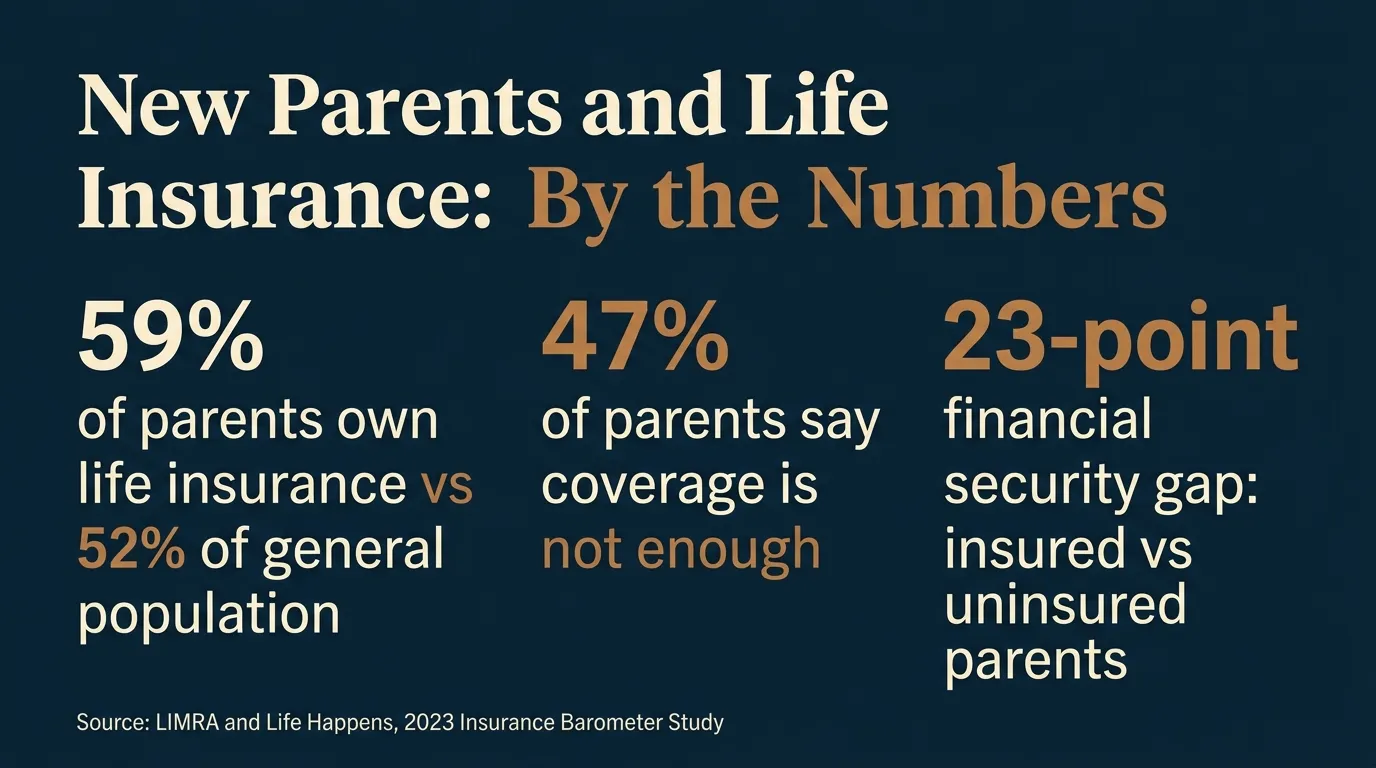
- Only 59% of parents with minor children own life insurance at all, versus 52% of the general population, and 47% of parents say their coverage isn't enough, according to LIMRA and Life Happens' 2023 Insurance Barometer Study.
- This article does not quote a premium you'd pay or promise any underwriting outcome. It shows the mechanics, sourced, so you can make your own timing call.
Why does timing matter at all?
Because life insurance underwriting is a snapshot of your health at the moment you apply, not a review of your life story. Underwriting class (sometimes called a rate class) is the risk category a carrier assigns you after reviewing your health, family history, and lifestyle; it’s the single biggest factor in what a policy costs you. Term life insurance is coverage for a fixed number of years — 10, 20, or 30 are the common lengths — that pays a death benefit if you die during that term and builds no cash value. A rider is an optional add-on to a policy, like extra coverage for a child, attached to a parent’s base policy rather than sold as its own contract.
Here’s the mechanism: every time you apply for a new policy, the carrier underwrites you as you are on that application, using your current medical records. Age matters, but it moves slowly and predictably — the Social Security Administration’s period life table, using 2023 mortality data as applied in the 2026 Trustees Report, puts a 28-year-old woman’s one-year probability of death at 0.074% and a 32-year-old woman’s at about 0.102%. That’s a real but small difference over four years. A new, documented health event is a different kind of change entirely, because it can shift which rate class you qualify for regardless of how old you are.
Pregnancy and delivery carry a real chance of producing exactly that kind of new, documented event. That’s not a reason to be afraid of applying after a baby arrives — most parents who apply after delivery are underwritten normally. It’s a reason to understand what you’re choosing between.

What actually shows up in a pregnancy or delivery file?
Three things come up often enough that they’re worth naming and defining, because a lot of the anxiety around this topic is about vague fear rather than the specific, documented facts underwriters actually work from.
Cesarean delivery. A surgical delivery, on its own, is a completed medical procedure, not an ongoing condition, and most underwriters treat a routine cesarean with a normal recovery as a non-issue once it’s healed. The primary cesarean rate — meaning a first cesarean, in someone without a prior one — reached 22.9% in 2024, up slightly from 22.8% in 2023, according to the CDC’s National Center for Health Statistics. The overall cesarean rate across all deliveries was 32.4%. What can complicate an application isn’t the surgery itself; it’s a documented complication during or after it, such as a significant infection or extended recovery, which is exactly the kind of thing an Attending Physician Statement — a records request a carrier’s underwriters send to your doctor to verify a specific detail — exists to sort out.
Gestational diabetes. This is diabetes that develops during pregnancy in someone with no prior diabetes diagnosis, and it typically resolves after delivery. About 8% of U.S. women who had a live birth in 2021 were diagnosed with it, according to CDC data. A resolved case with normal follow-up bloodwork is generally underwritten very differently than an unresolved case or one that persists as type 2 diabetes afterward — which is one more reason the specific documentation and timeline matter more than the diagnosis name alone.
Postpartum depression. A CDC analysis of Pregnancy Risk Assessment Monitoring System (PRAMS) data from 2018 found that 13.2% of women across 31 states and territories reported postpartum depressive symptoms, with state-level rates ranging from 9.7% in Illinois to 23.5% in Mississippi. Like any mental health treatment, a documented and treated episode becomes part of a medical record that a future application would disclose. Underwriters generally look at how recent it was, whether it resolved, and how consistently it was treated — not simply whether it’s mentioned in a chart.
None of this is a reason to panic, or to skip your own postpartum care
These are common, well-documented, and routinely underwritten events, not rare disqualifiers, and getting the medical care you need should never take a back seat to an insurance application. The point of this section is narrower: understanding what might show up on a file helps explain why applying earlier, when your file doesn't yet contain these items, is often the simpler path — not why you should avoid care or delay treatment to protect an application.
A side-by-side look: applying before versus after
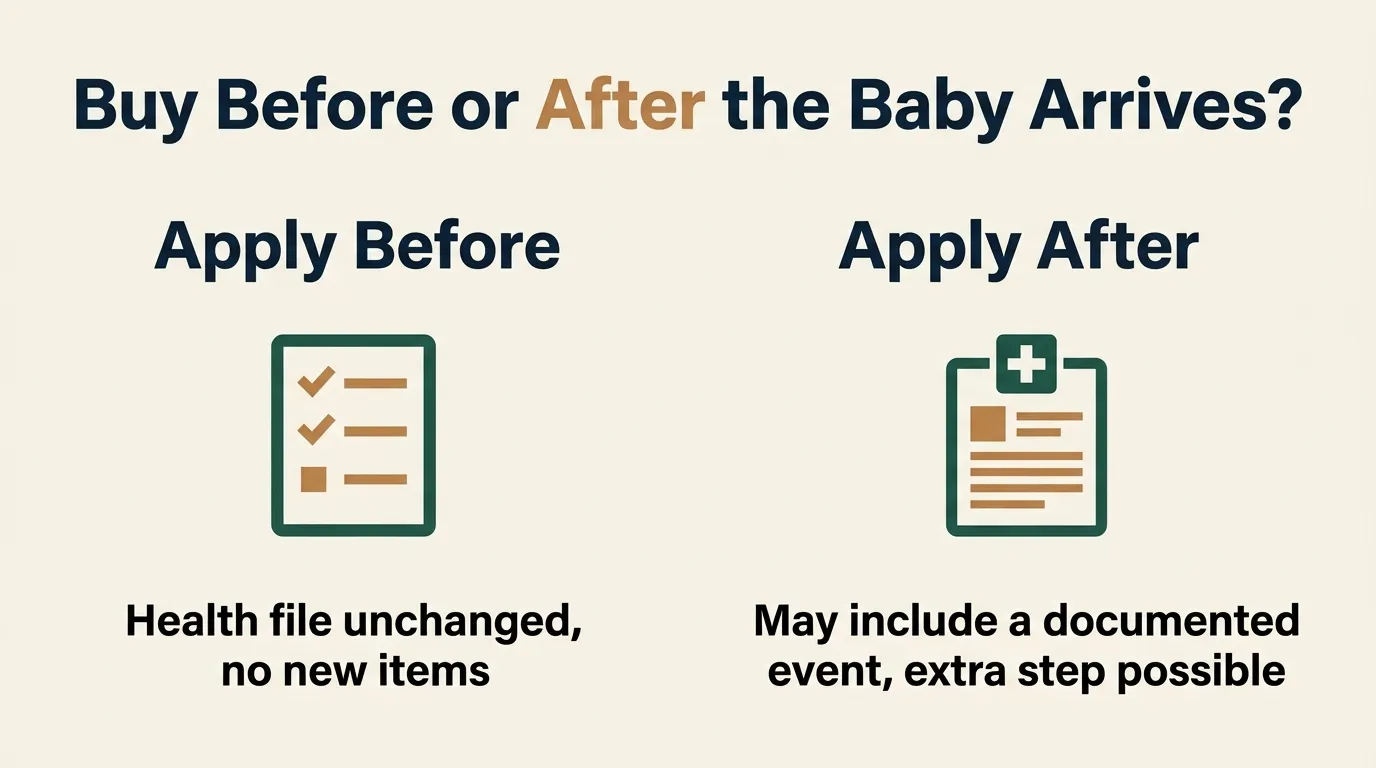
| What it affects | Apply before pregnancy or early in it | Apply after delivery |
|---|---|---|
| Underwriting basis | Your health file as it exists today, with no pregnancy-related items yet | Your file as it exists after delivery, including anything documented since |
| Possible new items | None specific to pregnancy or delivery yet | A cesarean, gestational diabetes, or postpartum depression, if any occurred |
| Extra steps sometimes required | Whatever your baseline health already requires — no change from this decision | Possibly an Attending Physician Statement to clarify a documented event |
| Timeline | Underwriting proceeds on the normal timeline for your health profile | Usually similar, though records requests can add time in specific cases |
Illustrative comparison built from general underwriting mechanics; specific requirements and timelines vary by carrier, product, and individual health file. Not a quote or guarantee of any outcome for any specific applicant.
Worth saying plainly: applying after delivery is entirely workable for most parents, and most cesarean deliveries, resolved gestational diabetes cases, and treated postpartum depression episodes do not result in a decline. What changes is that any of those, if they occurred, become part of the file the underwriter reviews, which can mean an Attending Physician Statement request or a short delay while records are gathered — an extra step, not a locked door.
Your file reflects today, not a delivery that hasn't happened yet
- Nothing pregnancy-related is in the record to review
- Your underwriting class is set before anything could change it
- You're covered for the delivery itself, not just for afterward
Common outcomeA file with no new pregnancy-related items to explain
Still workable, but your file may have new items to explain
- A cesarean, gestational diabetes, or postpartum depression, if any occurred, are now part of the record
- An Attending Physician Statement may be requested to clarify details
- Most cases are still underwritten successfully; it can simply take an added step
Common outcomeCoverage is still very often available, sometimes with an added documentation step
What it costs to guess wrong
The gap here isn’t hypothetical. According to LIMRA and Life Happens’ 2023 Insurance Barometer Study, only 59% of parents with minor children own any life insurance at all, compared with 52% of the general population — meaning parents own coverage at only a slightly higher rate than everyone else, despite having a dependent whose entire early life depends on their income. The same study found that 47% of parents who do own coverage say it isn’t enough, versus 41% of the general population. And when researchers asked what would happen if a primary wage earner died, only 60% of younger parents said their household would be financially secure — but that number splits sharply by insurance status: 71% of insured parents said they’d be financially secure, versus just 48% of uninsured parents.
That 23-point gap is the actual cost of waiting, guessing, or assuming you’re covered when you’re not. It isn’t a scare number; it’s what parents who already went through this reported about their own households.
There’s also a real dollar figure behind the ongoing cost of raising a child, even though it comes with real uncertainty about future inflation. Brookings Institution researchers recalculated the U.S. Department of Agriculture’s 2017 projection — originally $284,594 to raise a child born in 2015 through age 17 — using a higher 4% inflation assumption instead of the USDA’s original 2.2%, arriving at an updated estimate of about $310,605 for a middle-income, two-child family. That’s a projection built on inflation assumptions stretching out to 2032, not a fresh year-by-year audit, and actual costs for any one family will vary a great deal by location, childcare choices, and health needs. But even treated loosely, it puts a number on what a policy replacing a parent’s income is actually supposed to keep covering: housing, food, childcare, clothing, and the rest of it, for close to two decades.
How to work out how much coverage you actually need
You can do this arithmetic yourself, on paper, before you talk to anyone. Add these three pieces:
- What your mortgage or other major debts would take to pay off, from your current loan statement, not a guess.
- Roughly ten years of the income you’re protecting. Ten years is a rule of thumb, not a rule — some parents use fewer years if they expect to return to full income quickly, more if they want a longer runway.
- Anything else specific to your situation — money set aside for future childcare, or a plan to fund a chunk of future education costs — if you want the policy to cover it. Not everyone does, and that’s a legitimate choice, not a mistake.
Then subtract any group life coverage you already have through work, since that’s real coverage, just usually not enough on its own and not portable if you leave the job.
A worked example: expecting parents in Sioux Falls
Take a hypothetical: Emily is 29, expecting her first child, and earns $46,000 a year. She and her partner have a mortgage balance of $195,000. Emily has $50,000 of group life insurance through her employer and nothing else.
| Line item | Amount | Where it comes from |
|---|---|---|
| Mortgage balance to pay off | $195,000 | Current loan statement |
| Income replacement (10 years) | $460,000 | $46,000 annual income × 10 years |
| Subtotal need | $655,000 | Mortgage + income replacement |
| Less existing group coverage | −$50,000 | Employer-provided group life |
| Illustrative coverage gap | $605,000 | Subtotal minus existing coverage |
Hypothetical example for illustration only. Your own mortgage balance, income, years of replacement desired, and existing coverage will change every line of this math.
That $605,000 figure isn’t a number this article is telling Emily to buy. It’s what her own arithmetic produces, using her own debt and her own income. Someone with a smaller mortgage, a shorter desired replacement period, or more existing coverage will land somewhere else entirely — which is exactly why a generic “buy X times your salary” rule skips the actual math that matters.
Term life, or a rider for the baby?
Most new parents ask this question backward. The financial risk in a new household isn’t the infant’s life; it’s the parents’ income and the mortgage or rent that depends on it. A child term rider — typically $5,000 to $25,000 of coverage added to a parent’s own policy, without a separate exam for the child — exists mainly to cover funeral and related costs in the rare event of a child’s death, and some riders convert to a small permanent policy for the child later. That’s worth having, and it’s inexpensive to add. It is not a substitute for adequate coverage on the parents, which is what actually protects the household’s income and home if something happens to a wage earner.
For the parents’ own coverage, term life insurance — a policy covering a fixed number of years, commonly 20 or 30 for parents of young children, since that roughly spans the years until kids are grown — is the more common fit, because it delivers the most coverage per premium dollar for a temporary but very real need: the years your children depend on your income. Whole life builds cash value and lasts your entire life at a higher cost per dollar of coverage; it can be the right tool for some goals, like guaranteed lifelong coverage or estate planning, but it is not the more efficient way to cover 20 years of a mortgage and a child’s growing-up years for most new parents. If you’re weighing the two more deeply, our term versus whole life comparison walks through the full tradeoff.
You can run this math yourself in about twenty minutes
Pull your mortgage statement, your most recent pay stub, and your benefits summary from work. The three numbers in the worked example above are the only inputs you actually need to get a real, defensible starting figure — not a guess from a generic online calculator.
How we help
We’re independent, which matters here specifically because your timeline and your health picture are both moving targets during pregnancy and the first year of a baby’s life. If you’re planning ahead and want to apply before anything changes, we can help you move on your own schedule instead of a sales calendar. If you’re applying after delivery and a cesarean, gestational diabetes, or a treated postpartum depression episode is part of your file, we compare how the carriers we work with actually handle histories like yours, rather than sending every applicant to the same company by default. Compare My Options.
What you get
A real number for how much coverage your household needs, based on your own mortgage and income instead of a generic multiple. A clear picture of what pregnancy-related events can and can’t complicate in an application, so you’re not guessing or assuming the worst. And, if you want it, a comparison of carriers that fits your actual timeline, whether that’s this month or after your baby arrives.
The best time to apply is whenever your file is simplest. For a lot of expecting parents, that's right now — but "right now" for you might reasonably be next year, and that's your call to make with real information, not a countdown.
Mike MooreRelated reading
If you’re weighing whether one parent staying home changes the math, see does a stay-at-home parent need life insurance. For the broader four-bucket method behind the worked example above, see how much life insurance do I need in Sioux Falls. If a health condition beyond pregnancy is part of your picture, see getting life insurance after a health condition. And if your mortgage is the biggest single number in your own worked example, see mortgage protection insurance versus term life.
Expecting or already have a newborn?
See how we work with families to size coverage around your actual mortgage and income.
Want the underwriting picture for a specific condition?
See our guide to getting coverage after a health condition.
Not ready to talk to anyone?
Read how it works first and come back when you're ready.
Frequently asked questions
Should you buy life insurance before or after your baby is born?
Before, if you’re already planning the pregnancy or already expecting and in reasonably stable health, is usually the more straightforward path, because it locks in your current underwriting class before anything pregnancy-related has a chance to show up on your file. That said, plenty of parents apply successfully after the birth too. The real issue isn’t a hard deadline, it’s that pregnancy and delivery carry a measurable chance of a new, documentable health event: the primary cesarean delivery rate was 22.9% in 2024, according to the CDC’s National Center for Health Statistics, and about 8% of women with a live birth were diagnosed with gestational diabetes in 2021, per the CDC. Neither one closes the door on coverage. Both can add a step, like an Attending Physician Statement, to an application filed afterward.
Does pregnancy itself affect a life insurance application?
Being pregnant is not, by itself, a reason carriers decline an application, and it is not a medical condition underwriters treat the way they’d treat a chronic diagnosis. What can matter is a pregnancy-related complication that gets documented in your medical record, such as gestational diabetes, preeclampsia, or a difficult delivery with ongoing follow-up. Underwriters look at your file as it exists when you apply. Applying earlier in pregnancy, or before conceiving, generally means fewer new items for that file to contain.
What is gestational diabetes and how could it affect underwriting?
Gestational diabetes mellitus is a form of diabetes that develops during pregnancy in someone with no prior diabetes diagnosis, and it usually resolves after delivery. About 8% of U.S. women who had a live birth were diagnosed with it in 2021, according to the CDC. For life insurance underwriting, a resolved case, well-documented and without ongoing insulin use or complications, is typically far less of an issue than an unresolved or poorly controlled case would be. It’s the kind of thing an Attending Physician Statement is built to clarify, not an automatic barrier.
Can postpartum depression affect a life insurance application?
It can become part of your file if it’s diagnosed and treated, the same way any other documented mental health treatment would be. The CDC’s 2020 analysis of Pregnancy Risk Assessment Monitoring System data found that 13.2% of women across 31 sites reported postpartum depressive symptoms, ranging from 9.7% in Illinois to 23.5% in Mississippi, so it is common rather than rare. Underwriters generally look at how long ago it occurred, whether it resolved, and how consistently it was treated, not simply whether the words appear in a chart.
How much life insurance does a new parent actually need?
There’s no single number, but a workable starting method is to add what a mortgage or other major debt would take to pay off, plus roughly ten years of the income you’re protecting, then subtract any group life coverage you already have through work. A South Dakota family with a $195,000 mortgage balance and $46,000 of income to replace, for example, lands near $655,000 of need before subtracting existing coverage. Your own numbers depend on your actual debts, income, and how many years of support you want to provide.
What’s the difference between a child rider and buying your baby their own policy?
A child term rider is a small amount of coverage, commonly $5,000 to $25,000, added to a parent’s own term or permanent policy to cover a child’s final expenses if the unthinkable happened; it typically doesn’t require a separate application or exam for the child and often converts to a small permanent policy for the child later. A standalone juvenile policy is its own contract on the child, bought and underwritten separately. For most new parents, the actual financial priority is coverage on the parents, since the household’s income and mortgage depend on the adults, not the infant.
Is the life insurance from my employer enough once I have a baby?
For most new parents, no. Group life through an employer is commonly one to two times salary, it usually isn’t underwritten to your specific new obligations, and it ends the day the job does, which is a risk that increases right when a parent might be weighing reduced hours or a job change. It’s worth keeping as a supplement, but sizing your own portable coverage to your mortgage and income, separate from the job, is what actually protects a new family if employment changes.
Sources
- CDC/NCHS — Births in the United States, 2024, Data Brief No. 535 — primary cesarean delivery rate of 22.9% in 2024 (up from 22.8% in 2023); overall cesarean delivery rate of 32.4% in 2024; 3,628,934 total U.S. births in 2024; published July 2025; accessed August 2026
- CDC — Diabetes During Pregnancy — approximately 8% of U.S. women who had a live birth were diagnosed with gestational diabetes in 2021, citing CDC QuickStats, MMWR 2023;72:16; accessed August 2026
- CDC — Postpartum Depressive Symptoms and Provider Discussions About Perinatal Depression, MMWR 69(19) — 13.2% prevalence of postpartum depressive symptoms across 31 PRAMS sites using 2018 data, ranging from 9.7% (Illinois) to 23.5% (Mississippi); published May 15, 2020; accessed August 2026
- LIMRA — New Study Shows Interest in Life Insurance at All-Time High in 2023 — 2023 Insurance Barometer Study with Life Happens; 59% of parents with minor children own life insurance versus 52% of the general population; 47% of parents say their coverage isn’t enough versus 41% of the general population; 60% of younger parents say they’d be financially secure if a primary wage earner died, versus 71% of insured parents and 48% of uninsured parents; survey conducted January 2023, published April 24, 2023; accessed August 2026
- Brookings Institution — It’s Getting More Expensive to Raise Children, and Government Isn’t Doing Much to Help — estimated $310,605 to raise a child born in 2015 through age 17 for a middle-income, two-child family, recalculated from USDA’s 2017 estimate of $284,594 using a 4% inflation assumption projected to 2032; published 2022; accessed August 2026
- Social Security Administration, Office of the Chief Actuary — Period Life Table — one-year probability of death of 0.074% at age 28 and approximately 0.102% at age 32, for females, using 2023 mortality data as applied in the 2026 Trustees Report; accessed August 2026
Related reading: does a stay-at-home parent need life insurance, how much life insurance do I need in Sioux Falls, getting life insurance after a health condition, and mortgage protection insurance versus term life. See life insurance for families.
Before you act on any of this
This article is general education, not insurance, legal, financial, medical, or tax advice. It does not diagnose, treat, or offer guidance on managing any pregnancy-related or postpartum health condition — talk with your doctor about your own health and your baby's. Product availability, features, and rates vary by carrier and are subject to underwriting. No coverage exists until a policy is issued and in force. Any guarantees are subject to the claims-paying ability of the issuing insurer. The worked example in this guide is hypothetical and illustrative only, not a quote or a promise of any specific coverage amount, premium, or underwriting outcome for you. Please review actual policy documents and speak with a licensed agent about your own situation.
The honest version
There’s no perfect week to apply. What actually changes your odds of a smoother application is whether your file, at the moment you apply, already contains a documented pregnancy-related event or doesn’t yet. If you’re planning ahead, that argues for applying sooner. If your baby is already here and something came up, it argues for gathering your own records — the diagnosis, the treatment, the follow-up results — before you apply, the same way it would for any other health event. Either way, the arithmetic for how much you need is yours to run this week, with your own mortgage statement and your own pay stub.
Ready to see your own numbers?
We'll walk through your mortgage, your income, and your timeline, and compare carriers that fit where you actually are, before or after your baby arrives.