
Does a stay-at-home parent need life insurance? Usually, yes — because the household depends on unpaid work that would cost real money to replace, and most families never price that work until they have no choice. If you’re the working spouse in a South Dakota household with a stay-at-home partner, this is the arithmetic nobody hands you, and it changes what “enough coverage” actually means.
The short version
- South Dakota's 2024 average cost to replace full-time center-based care for two children under five is $16,702 a year — a sourced floor, not a ceiling, since it excludes household tasks and lost work flexibility.
- 51% of American adults report having some life insurance, but the working spouse usually gets it first, if anyone does, while the stay-at-home spouse gets skipped entirely (LIMRA & Life Happens, 2025).
- A non-earning spouse can still qualify for a policy — carriers size it off the household's insurance picture, not the applicant's paycheck.
- Term life matched to the years of child-rearing left usually fits this situation the same way it fits the working spouse.
Why the stay-at-home parent gets skipped
Ask a South Dakota family to insure “the breadwinner” and most can tell you a number within a few minutes — a multiple of salary, a mortgage balance, something a coworker mentioned. Ask the same family what it would cost to replace the parent who doesn’t earn a paycheck, and the conversation stops. There’s no salary to multiply, so there’s no obvious place to start.
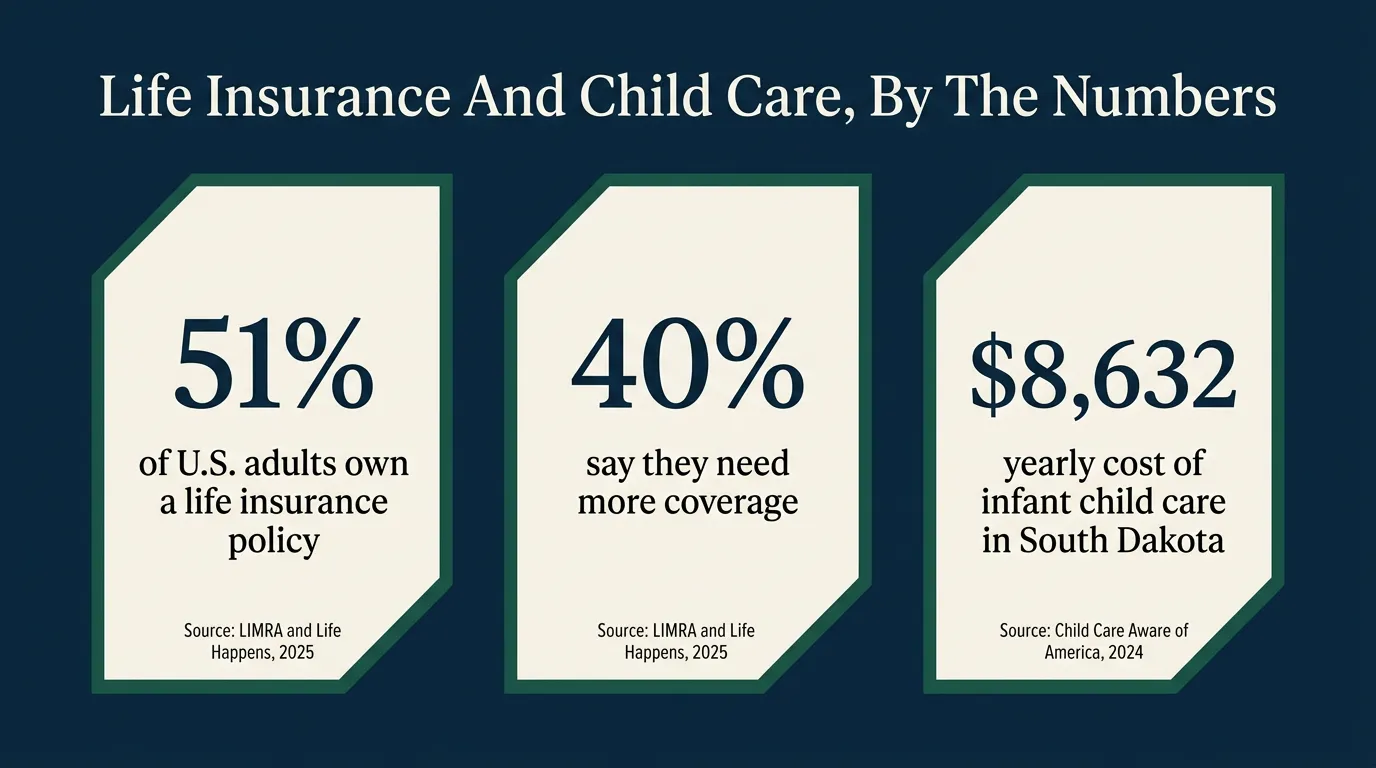
That gap shows up in the numbers. According to the 2025 Insurance Barometer Study, conducted jointly by LIMRA and Life Happens, 51% of American adults say they have some form of life insurance, and men are still more likely to report owning a policy than women — 54% versus 48%. None of that breaks out stay-at-home parents specifically. But the pattern in almost every South Dakota household we talk to is the same: the earner gets a policy, sometimes through work, sometimes on their own, and the parent managing the household and the kids gets whatever is left over, which is often nothing.
The reasoning usually sounds like this: “They don’t bring in income, so there’s nothing to replace.” That’s backwards. Income is one way a household loses money when someone dies. Losing free labor is another, and it’s just as real — it just doesn’t show up on a pay stub, so nobody prices it until they’re forced to pay someone else to do the job.
There’s a second reason it gets skipped, and it’s more mundane: insuring the earner feels urgent because the mortgage and the grocery bill depend on that paycheck showing up every two weeks. Insuring the stay-at-home parent feels optional because nothing visibly breaks the week they don’t get around to it. Nothing breaks until the day it does, and by then there’s no policy to fall back on — just a scramble to find and pay for full-time child care on short notice, on top of grief, on top of a job that still expects the surviving parent to show up.
This is general education, not a recommendation
Nothing here is a quote, an offer of coverage, or advice for your specific situation. Product availability, features, and pricing vary by carrier and are subject to underwriting. Talk with a licensed agent about what actually fits your household.
What the job actually is, in hours
Before you can price the work, it helps to see how much of it there actually is. The Bureau of Labor Statistics’ American Time Use Survey tracks how Americans spend their day, including time spent directly caring for children — feeding, bathing, supervising, driving them places.
According to the 2025 American Time Use Survey results, released by BLS in June 2026, adults living with children under age 6 spent 2.4 hours a day on primary child care on an average weekday and 2.0 hours on a weekend day. That’s just the primary activity — actively focused on the child, not childcare happening in the background while doing something else. Break it down by employment status and the gap gets sharper: non-employed adults with a child under 6 spent 3.3 hours a day on primary child care, compared with 1.7 hours for employed adults. The same data shows a gender split too — women living with children under 6 spent 2.8 hours a day on primary child care versus 1.7 hours for men, a 1.1-hour daily gap.
Multiply 3.3 hours a day by 365 and you get over 1,200 hours a year of direct, hands-on child care from the parent who isn’t earning a paycheck — and that’s before you count the housework, errands, and scheduling that keep a household running underneath it. None of that disappears if that parent dies. It gets handed to whoever is left, either as a bill or as fewer hours at their own job.
What it would cost to replace that work in South Dakota
Here’s where the number stops being abstract. If a stay-at-home parent in South Dakota died, the surviving parent’s most immediate, unavoidable cost is child care — someone has to supervise the kids during the hours the surviving parent is at work.
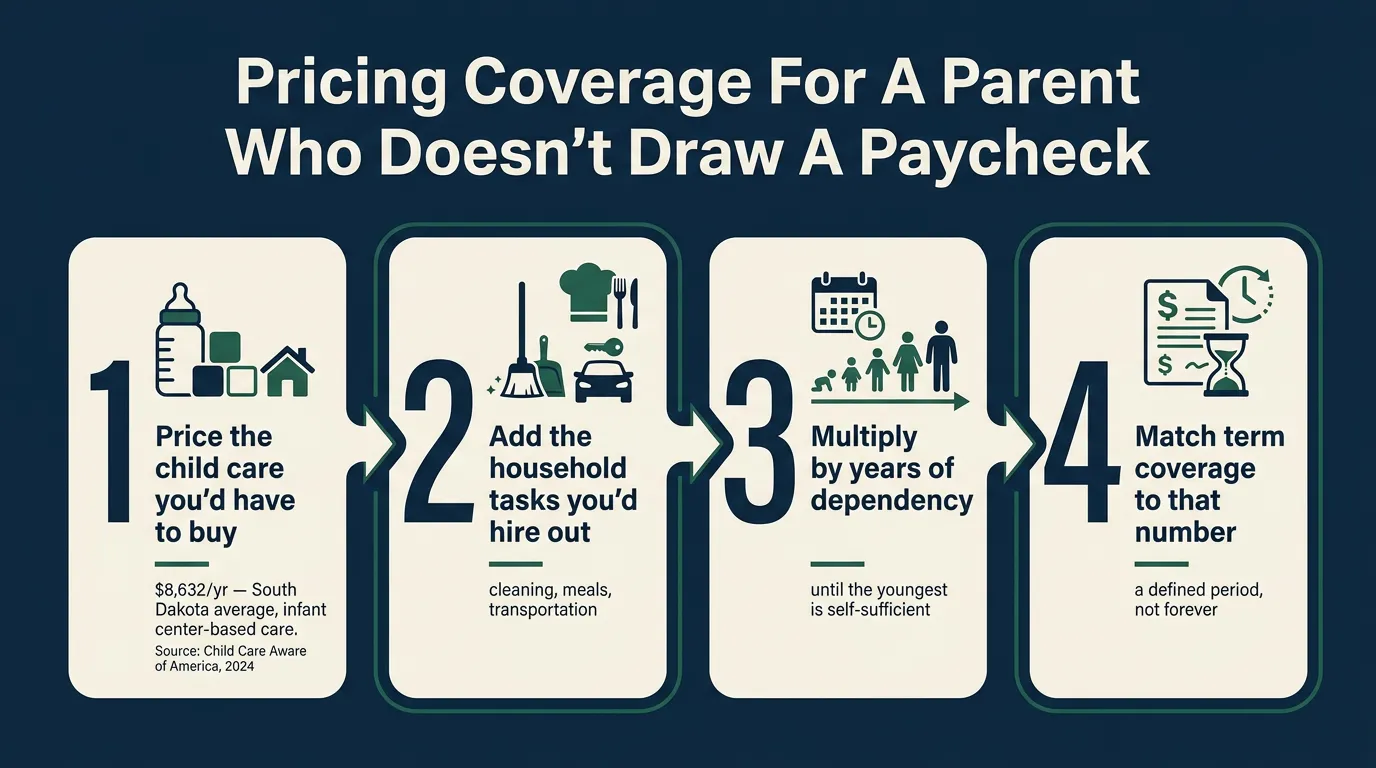
Child Care Aware of America surveys child care prices state by state every year through its network of Child Care Resource and Referral organizations. According to its “Child Care in America: 2024 Affordability Analysis,” South Dakota’s average annual price for full-time center-based care in 2024 was $8,632 for an infant, $8,632 for a toddler, and $8,070 for a 4-year-old. Family child care homes run somewhat less: $6,822 for an infant or toddler and $6,635 for a 4-year-old. For a family with two children under five, one in center-based infant or toddler care and one in center-based 4-year-old care, the combined annual price comes to $16,702 — the same report’s own combined figure for South Dakota.
That number is genuinely useful context: South Dakota is one of the least expensive states in the country for child care. The same report ranks South Dakota’s center-based infant care at 7.5% of married-couple median household income, the second-most-affordable rate in the nation, tied with Mississippi. America’s Health Rankings, compiling the same Child Care Aware data series, independently confirms the 7.5% figure for South Dakota infant care affordability. And nationally, the average annual price of child care in 2024 was $13,128, meaning South Dakota families pay roughly 34% less than the national average for center-based infant care.
Center-based infant child care: South Dakota vs. the national average (2024)
Source: Child Care Aware of America, "Child Care in America: 2024 Affordability Analysis" (South Dakota figure) and childcareaware.org/price-landscape24 (national figure). 2024 data.
Cheaper than the rest of the country still isn’t free. Even at South Dakota’s lower rates, that’s $16,702 a year in child care alone for two young kids, before you touch cleaning, meals, laundry, errands, or the hours a surviving parent might need to cut from their own job to manage the transition. We don’t have a sourced statewide figure for those categories, so rather than invent one, the honest answer is: price your own local rates for whatever you’d actually hire out, and treat the child care number as a floor, not the whole picture.
| Age of child | Center-based care | Family child care home |
|---|---|---|
| Infant | $8,632 | $6,822 |
| Toddler | $8,632 | $6,822 |
| 4-year-old | $8,070 | $6,635 |
| Before/after school | $5,460 | $4,836 |
Source: Child Care Aware of America, "Child Care in America: 2024 Affordability Analysis," Tables I and II (Child Care Resource and Referral state network survey, January 2025). 2024 data.
A worked example: two kids under five, Sioux Falls
Take a household with a working parent and a stay-at-home parent, a 2-year-old, and a 4-year-old. If the stay-at-home parent died, here’s the arithmetic the surviving parent would actually be doing.
| What it covers | How to price it | Annual figure |
|---|---|---|
| Child care bridge | Full-time center-based care, one toddler, one 4-year-old, South Dakota 2024 average | $16,702 |
| Years until both are in full-day school | Multiply the line above by the years remaining — five, in this example | × 5 |
| Subtotal — child care alone | The floor, before anything else is added | $83,510 |
| Household tasks you'd hire out | Cleaning, meals, laundry, errands — price your own local rates; no reliable statewide figure exists | your number |
| Work re-entry cushion | Weeks the surviving parent might reduce hours or take unpaid leave to manage the transition | your number |
| Final expenses | Funeral, medical, and estate settlement costs | your number |
| Indicated need, child care alone | The sourced floor for this example household | $83,510+ |
Notice what that table admits: the child care line is real and sourced, and the rest is genuinely up to your own situation. That’s not a dodge. A household with a grandparent nearby to help with pickups has a different number than one without any family in town. A household that could absorb a few months of reduced work hours needs less of a cushion than one living paycheck to paycheck. The point of the exercise isn’t a single perfect figure — it’s replacing a guess with a number you built yourself, and one you can defend if anyone asks how you got there.
Don't stop at the child care number
$83,510 is real money, and it's still a floor. It doesn't include the cost of the household work that isn't child care, and it doesn't include the emotional and logistical cost of a parent trying to do two jobs at once. Treat it as the minimum you're solving for, not the target.
The terms you’ll run into
A few words come up constantly once you start shopping, and they’re worth defining before you go further.
Term life is coverage for a fixed period — 10, 20, or 30 years — that pays a death benefit if the insured dies during that term and pays nothing if the term ends first. Level term means the premium and the death benefit both stay flat for the whole term, instead of stepping up or down.
Underwriting class is the risk category a carrier assigns an applicant after reviewing health, family history, and lifestyle factors — it’s what actually sets the premium, more than the coverage amount alone. A table rating is an additional pricing adjustment some carriers apply for a specific health condition, on top of the standard underwriting class.
The contestability period is typically the first two years a policy is in force, during which the insurer can investigate and deny a claim based on misstatements on the application. After that period closes, the insurer’s ability to contest a claim on those grounds narrows significantly.
A rider is an add-on to a base policy — a waiver-of-premium rider, for example, keeps the policy in force without further payments if the policyholder becomes disabled. Riders cost extra and aren’t automatic; you have to ask for them and confirm what they cover.
Two more worth knowing before you shop: a renewable term policy lets you continue coverage past the initial term, usually at a higher premium reflecting your age at renewal, without new medical underwriting. A conversion privilege lets you convert some or all of a term policy to a permanent policy before the term ends or a stated age, again without new medical underwriting — useful if health changes during the term make you want to lock in permanent coverage while you still can.
How the death benefit is actually taxed
This comes up as soon as someone starts picturing the payout in real numbers: does the surviving spouse get the full amount, or does a chunk of it go to taxes first? Under federal law, life insurance proceeds paid to a beneficiary by reason of the insured’s death are generally excluded from the beneficiary’s gross income — meaning the death benefit itself is not federal taxable income. That’s the general rule under 26 U.S.C. § 101(a) of the Internal Revenue Code.
There are exceptions worth knowing rather than assuming away. If the payout is deferred and accrues interest before it’s paid out, that interest is taxable, even though the underlying death benefit isn’t. And if a policy was transferred to someone else for money or other value — sold, in other words — the tax-free treatment can be limited under what’s called the transfer-for-value rule. Neither exception is common in an ordinary household policy bought directly from a carrier and kept in the original owner’s name, but it’s the kind of detail worth confirming with a tax professional if your situation involves a policy transfer, a trust, or deferred payout options — this article is general education, not tax advice.
What if the stay-at-home parent works part-time or freelances?
Plenty of households don’t fit neatly into “one earner, one stay-at-home parent.” A parent doing part-time retail work, freelancing a few hours a week, or running a small shop from home while also handling most of the child care doesn’t stop needing this coverage just because some income exists.
The honest approach is to treat it as a blend. Part of the picture is the same as any earner: some income is genuinely being replaced, and that portion can be sized the way you’d size coverage for any wage earner, using actual pay records. The other part is the unpaid labor this article is about — the child care hours, the household management — which doesn’t shrink just because a parent also works fifteen hours a week at a part-time job. Price both pieces separately rather than assuming the part-time income “covers” the situation, since a part-time paycheck rarely comes close to the child care bridge alone, let alone the household work on top of it.
Can a stay-at-home parent even qualify?
This is the question that stops most families before they start: “They don’t have income. How do you insure someone with no paycheck?”
You don’t underwrite it the way you’d underwrite the earning spouse. Carriers typically size and structure a non-earning spouse’s policy relative to the household’s overall insurance picture — often tied to how much coverage the working spouse already carries — rather than basing it on the applicant’s own income, since there isn’t one. How each carrier structures that differs. Some carriers are more comfortable than others insuring a non-earning spouse at a meaningful amount, which is exactly the kind of thing that’s worth comparing rather than assuming from a single conversation with a single company.
None of that is a promise about approval, timing, or which underwriting class you’d land in — those depend on health, family history, and the specific carrier’s guidelines, and they’re determined during underwriting, not before.
The objections, addressed honestly
“We can’t afford two policies.” Term life on a healthy adult is usually less expensive than people expect — the 2025 Insurance Barometer Study found that adults 18 to 30 overestimated the median cost of a $250,000, 20-year level term policy by 10 to 12 times its actual cost. That doesn’t mean your premium will be trivial, and we’re not quoting one here — it means the “we can’t afford it” conclusion is often reached before anyone actually priced it.
“My spouse’s group policy through work covers our family.” Usually it doesn’t extend to a stay-at-home spouse at any meaningful level. Group life through an employer typically covers only the employee; even where a spouse rider exists, it’s usually a small flat amount, not sized to replace a parent’s actual workload. Check your specific plan documents rather than assuming.
“If something happens, we’ll just figure it out.” That’s a legitimate choice for some families, and it’s worth saying plainly: if you have significant savings, family nearby who could step in for free, or a job that genuinely allows drastically reduced hours without financial strain, self-insuring this risk might be reasonable. Most households we talk to don’t have all three of those at once, which is exactly why running the numbers first is worth the twenty minutes it takes.
Insuring the paycheck only
- Coverage exists on the working spouse, none on the stay-at-home spouse
- Assumption: no income means nothing to replace
- Group coverage through one job treated as "enough"
- Never revisited as the kids' ages change the bridge
Unpriced riskThe bigger gap often goes unnoticed
Both parents priced honestly
- Child care bridge calculated from current local rates
- Household and re-entry costs estimated deliberately, not ignored
- Group coverage checked, not assumed
- Reviewed as children age toward full-day school
DefensibleA number built from your own household
$16,702
SD annual cost, center-based care for 2 kids under 5 (2024)
51%
Adults with any life insurance coverage (LIMRA, 2025)
1,200+
Hours/year of primary child care from a non-employed parent
10–12×
How much young adults overestimate term life cost (LIMRA, 2025)
How we help you price this
We’re independent, which means we’re not built around one carrier’s answer to how a non-earning spouse should be insured. We start with your actual household: the ages of your kids, what care costs where you live, and how long the bridge realistically needs to last. From there we compare how the carriers we represent handle sizing and underwriting a policy for the parent who doesn’t draw a paycheck, since they don’t all approach it the same way.
If you would rather have someone local run these numbers with you instead of building the table yourself, that is what we do. Compare My Options.
What you get
A coverage amount tied to what your household would actually have to pay for care and help — not a guess pulled from a multiplier that was built for the earning spouse. A side-by-side look at how different carriers price and structure coverage for a non-earning applicant, since that varies more than people expect. And a plan you can revisit honestly as your kids get older and the bridge you’re insuring gets shorter.
The stay-at-home parent isn't unpaid because the work has no value. It's unpaid because nobody sends an invoice.
Mike MooreRelated reading
If you haven’t worked through coverage for the earning spouse yet, start with how much life insurance you actually need — the same four-bucket logic applies, just with a paycheck to anchor it. It’s also worth reviewing your beneficiary designations any time you add a new policy, since a policy with an outdated or missing beneficiary can create exactly the kind of delay you bought the coverage to avoid. And if term life is new territory, our term life page walks through how level term actually works.
Not sure where to start?
Read how it works first and come back when you're ready.
Want the family-level view?
See how coverage fits together for families generally.
Rather run the numbers yourself first?
Our needs calculator is a reasonable starting point for either spouse.
Frequently asked questions
Does a stay-at-home parent need life insurance?
Usually, yes. A stay-at-home parent doesn’t draw a paycheck, but the household still depends on the work they do — child care, meals, transportation, running the home. If that parent died, the surviving parent would have to pay someone else to do most of it, or cut back on work to do it themselves. Life insurance on the stay-at-home parent covers that gap. This is education, not a recommendation for your specific situation, since the right amount depends on your family’s ages, income, and existing coverage.
How much life insurance does a non-working spouse need?
Start with what it would cost to replace their work for as long as the kids need it. Price full-time child care at current rates for your kids’ ages, multiply by the years until the youngest is reliably in school or self-sufficient, then add a cushion for the working parent to adjust their schedule and for final expenses. In South Dakota, replacing full-time center-based care alone for two children under five runs about $16,702 a year as of 2024, before you add anything else.
What would it actually cost to replace a stay-at-home parent’s work in South Dakota?
The clearest sourced number is child care. South Dakota’s 2024 average annual price for full-time center-based care is $8,632 for an infant or toddler and $8,070 for a 4-year-old, according to Child Care Aware of America. Two children under five together run about $16,702 a year. That figure doesn’t include cleaning, meals, errands, or the time cost of a parent cutting work hours, which most families have to price for their own situation since there isn’t a reliable statewide figure for those.
Can a stay-at-home parent even get a life insurance policy if they have no income of their own?
Yes, applicants without their own income can typically apply for life insurance. Carriers generally price and size a non-earning spouse’s policy off the household’s overall insurance picture rather than the applicant’s own paycheck, since there isn’t one to underwrite against. How each carrier structures that differs, which is one reason it’s worth comparing more than one.
Should a stay-at-home parent buy term or whole life insurance?
For most families, term life matched to the years the kids are dependent is the more direct fit, the same logic that applies to the working spouse. Whole life can make sense for specific goals like permanent coverage or cash value, but it costs more for the same death benefit. Compare the two against your actual timeline rather than picking based on which one an agent leads with.
Does my working spouse’s group life insurance at work cover me too?
Usually not automatically. Group policies through an employer typically cover only the employee, and even when a spouse rider is offered, it’s usually a small, flat amount, not sized to what replacing a stay-at-home parent’s work would actually cost. It’s worth checking your specific plan documents rather than assuming.
When should we revisit coverage on a stay-at-home parent?
Any time the arithmetic changes: a new child, a child aging out of full-time child care, a move to a higher-cost area, or the stay-at-home parent re-entering the workforce. The number is not fixed — it should shrink as the kids get older and the child care bridge gets shorter.
Is the life insurance death benefit taxable?
Generally no. Under 26 U.S.C. Section 101(a) of the Internal Revenue Code, life insurance proceeds paid to a beneficiary because of the insured’s death are typically excluded from the beneficiary’s federal gross income. Interest that accrues on a deferred payout, or proceeds affected by the transfer-for-value rule, can be exceptions. This is general education, not tax advice for your situation.
Sources
- LIMRA & Life Happens — 2025 Facts About Life Insurance — 2025 Insurance Barometer Study; ownership rate, gender gap, and need-gap figures
- LIMRA — Adults Age 30 and Younger Overestimate Life Insurance Cost by 10–12 Times — 2025 Insurance Barometer Study; cost-overestimation figure
- U.S. Bureau of Labor Statistics — American Time Use Survey — 2025 results, released June 25, 2026; hours per day spent on primary child care by employment status and gender
- Child Care Aware of America — Child Care in America: 2024 Affordability Analysis — South Dakota child care prices by age and setting, and affordability-as-percentage-of-income rankings
- America’s Health Rankings — Infant Child Care Affordability in South Dakota — independent confirmation of South Dakota’s affordability ranking, citing the same Child Care Aware data series
- Child Care Aware of America — Child Care in America: 2024 Price & Supply — national average child care price for comparison
- Internal Revenue Code, 26 U.S.C. § 101 — Certain Death Benefits — federal tax treatment of life insurance death benefits
Related reading: How Much Life Insurance Do You Actually Need? A Working Method. See our term life page, life insurance for families, and the beneficiary checklist.
Before you act on any of this
This article is general education, not insurance, legal, financial, or tax advice. Coverage availability, features, and rates vary by carrier and state and are subject to underwriting. No coverage exists until a policy is issued and in force. Any guarantees are subject to the claims-paying ability of the issuing insurer.
Do the arithmetic once
A stay-at-home parent’s work doesn’t stop being valuable because nobody writes them a check for it. Price the child care bridge with real South Dakota numbers, add your own honest estimate for the rest, and you’ll have a figure you can defend instead of a guess built around whoever happens to have a pay stub.
Want a second set of eyes on the number?
We'll work through the bridge with you and compare how the carriers we represent handle coverage for a non-earning spouse.