
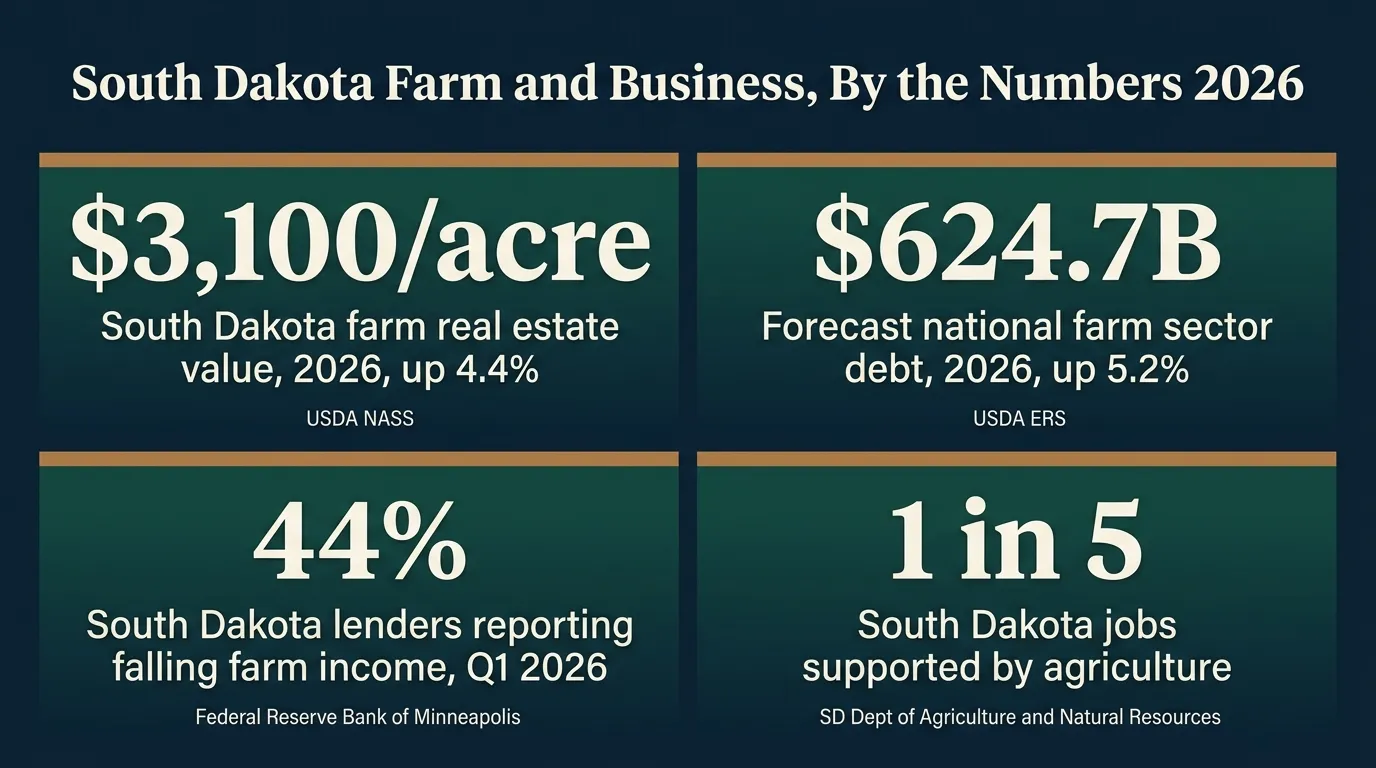
A South Dakota farm or small business does not fit the debt-plus-income math most “how much life insurance do you need” calculators use, because most of what a farm or business owns is not cash. It is land, equipment, and a network of relationships and know-how that took years to build, and if an owner dies, none of that converts to cash on its own. The honest way to size coverage is to add up three separate things that apply to a farm or business and rarely apply the same way to a household: the operation’s debt, what it would cost a surviving partner to buy out a deceased owner’s share, and, where relevant, what it would cost to cover the gap left by one person’s specific work. South Dakota farmland alone averaged $3,100 an acre in 2026, up 4.4% from the year before, according to USDA’s National Agricultural Statistics Service, which gives you a sense of how much value can sit in land that only a death benefit, not a land sale, can turn into cash fast enough to matter.
The short version
- South Dakota farm real estate averaged $3,100 an acre in 2026 (up 4.4% from 2025), cropland $4,770 an acre (up 3.5%), and pasture $1,400 an acre (up 4.5%), according to USDA's National Agricultural Statistics Service. Most of that value is illiquid until it is sold.
- National farm sector debt is forecast to reach $624.7 billion in 2026, up 5.2% from 2025, per USDA's Economic Research Service, split roughly $404.3 billion in real estate debt and $220.4 billion in operating debt.
- 44% of South Dakota agricultural lenders reported falling net farm income in the first quarter of 2026, and 43% reported the same for the fourth quarter of 2025, according to two consecutive Federal Reserve Bank of Minneapolis Ag Credit Surveys, evidence this is a sustained squeeze, not a single bad season.
- South Dakota law (SDCL 58-10-4) specifically recognizes an insurable interest between business or farm partners for the purpose of a buy-sell contract, which is the legal foundation that lets co-owners insure each other's lives to fund a buyout.
- Agriculture and related industries support about 1 in 5 South Dakota jobs and contribute $11.7 billion in value added to the state, according to the South Dakota Department of Agriculture and Natural Resources' 2021 economic contribution study, the most recent published.
The pain: your net worth is real, and none of it is cash
Ask most South Dakota farm and ranch families what they are worth, and the honest answer is “a lot, on paper, and almost none of it liquid.” The same is true for plenty of small business owners: a shop full of inventory and equipment, a building, a customer list, none of which turns into a check the day something happens to the person who runs it. Economists have a phrase for the farm version of this: land rich, cash poor. It describes an operation where the balance sheet looks strong because of appreciating land, while the checking account tells a tighter story every spring when input bills come due.
That gap becomes a crisis, not just an inconvenience, the day an owner dies. A surviving spouse or adult child does not inherit cash. They inherit acres, machinery, animals, contracts, and, often, a partner or sibling who now has a legal claim to half of it. If there is a mortgage on the land, the lender still wants a payment. If there is a business partner, that partner (or the deceased partner’s estate) has to be dealt with, one way or another, usually within a timeline nobody chose. Selling ground under pressure, at whatever price a rushed sale brings, is one of the more common and most painful ways families discover they were underinsured on the business side of their lives, even when their personal life insurance was fine.
This is not a hypothetical hand-wringing exercise. It is close to a description of how a lot of South Dakota operations are actually structured right now.
This is general education, not a recommendation
Nothing here tells you to buy a specific policy or amount. It walks through how business and farm life insurance actually works under South Dakota law and current federal agricultural data, so you can size your own coverage against your own balance sheet and decide what, if anything, makes sense for your operation.
Why it happens: three different jobs, three different kinds of coverage
Personal life insurance answers one question: what would your household need to replace if your income stopped? Business and farm coverage answers three separate questions, and conflating them is the single biggest reason operations end up either overinsured in the wrong place or completely uncovered in the one that mattered.
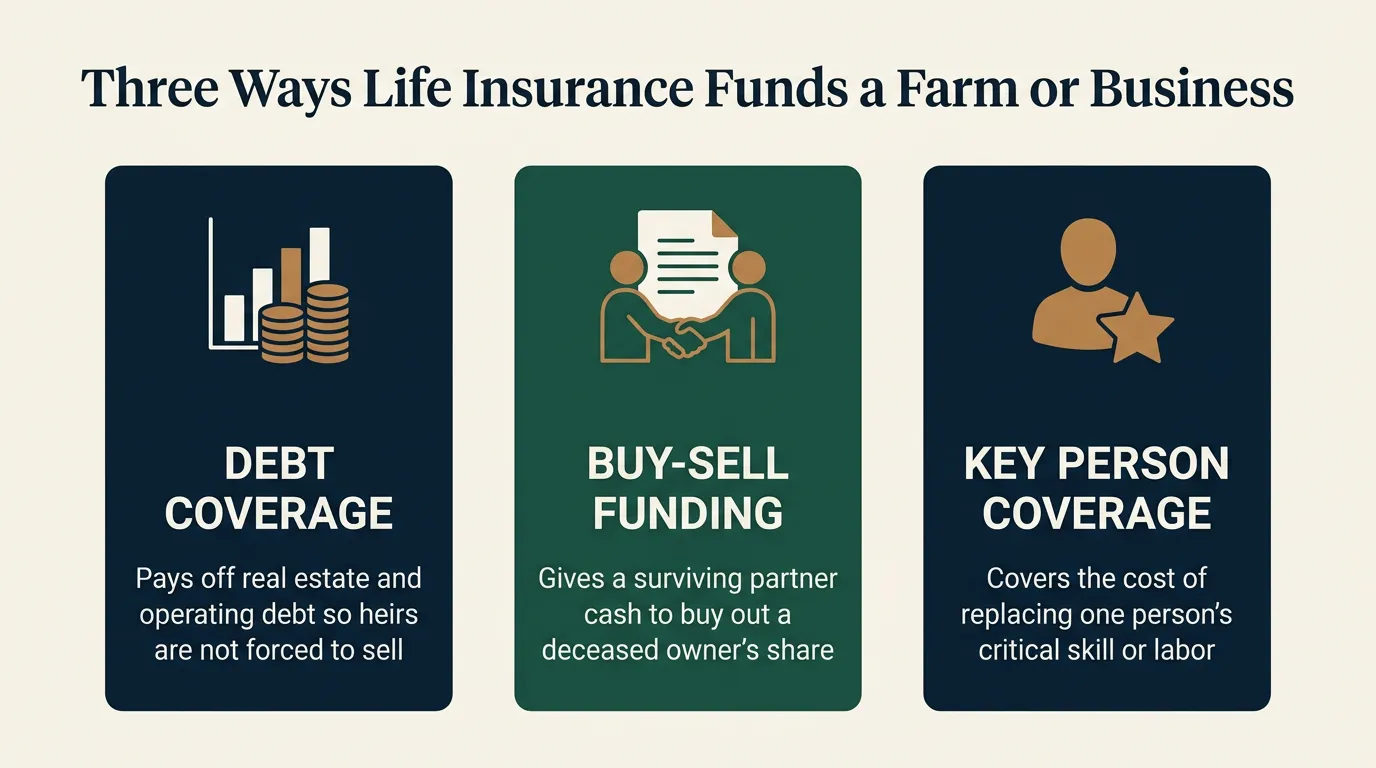
Debt coverage is the most familiar piece, because it works like a bigger version of mortgage protection. If the operation carries real estate debt, equipment loans, or an operating line of credit, that debt does not disappear at death; it becomes the estate’s problem, and eventually the surviving owner’s or heirs’ problem. Life insurance sized to the outstanding balance keeps a death from turning into a forced refinance or a forced sale.
Buy-sell funding is the piece almost no household-focused calculator touches. A buy-sell agreement is a contract among co-owners, whether that is two siblings running a family operation as a partnership, three business partners, or shareholders in a small corporation, that spells out what happens to an owner’s share if they die, become disabled, or want out. On its own, a buy-sell agreement is just words on paper. It becomes real the moment it is funded, meaning each owner carries a life insurance policy on each other owner (or the business carries one on each owner) sized to that person’s ownership share. When an owner dies, the death benefit gives the survivor the cash to buy the deceased owner’s share from their estate at a price the agreement already set, instead of negotiating with a grieving spouse under time pressure or, worse, ending up in a lawsuit over what the share was worth.
Key person coverage insures the value one specific person contributes that would be expensive or slow to replace: the operator who knows every field’s history and every piece of equipment’s quirks, the one salesperson who carries the customer relationships, the founder whose name is the business. The business owns the policy and is the beneficiary, and the payout covers the real cost of the gap: hiring a temporary manager, covering a season of reduced output, or simply buying time.
South Dakota law matters here in a way it does not for most personal coverage, because life insurance requires an insurable interest, a legal stake in the insured person’s life continuing, before a policy can even be issued. Under South Dakota Codified Law 58-10-4, that interest exists in a few specific forms relevant to a farm or business.
| Who has the interest | What the statute covers | Typical use |
|---|---|---|
| A party to a buy-sell contract or option | An insurable interest in the life of each other party to the contract, for the purpose of that contract | Buy-sell agreement funding between farm or business co-owners |
| Anyone with a lawful, substantial economic interest | An interest in having another person's life, health, or bodily safety continue | Key person coverage a business owns on an owner, manager, or critical employee |
| A financial institution owed a debt | An insurable interest in the borrower's life, to the extent of the debt owed | Lender-required coverage on some agricultural or commercial loans |
Source: South Dakota Legislature, SDCL 58-10-4, "Insurable interest in personal insurance defined." Current codified law, accessed August 2026. The person being insured must consent to the policy in every case.
The practical takeaway: South Dakota law does not treat “insuring your business partner” or “insuring your key employee” as some exotic maneuver. It is written directly into the state’s insurance code as a recognized, specific category, precisely because buy-sell and key person coverage are common enough that the legislature spelled out the rule decades ago.
South Dakota farm real estate value per acre, 2022–2026
USDA National Agricultural Statistics Service, "Land Values 2026 Summary" (July 2026), Farm Real Estate Average Value per Acre table, South Dakota row.
What it costs to get wrong: a worked example with real South Dakota numbers
Here is how this plays out with a hypothetical operation, using real South Dakota land values and real national debt figures for the parts that have a source, and clearly flagged assumptions for the parts that do not.
Say a brother and sister, Mark and Renae, formed a partnership when they took over the family operation from their parents, splitting ownership 50/50. Their operation runs 1,500 acres, close to South Dakota’s average farm size of 1,495 acres in 2024, the most recent figure available, according to USDA’s National Agricultural Statistics Service. For this illustration only, assume the land splits 900 acres cropland and 600 acres pasture, a mix chosen for this example and not a South Dakota average.
| Land type | Acres (illustrative split) | 2026 value per acre | Illustrative total |
|---|---|---|---|
| Cropland | 900 | $4,770 | $4,293,000 |
| Pasture | 600 | $1,400 | $840,000 |
| Total land value | 1,500 | — | $5,133,000 |
Per-acre values: USDA National Agricultural Statistics Service, "Land Values 2026 Summary" (July 2026), South Dakota cropland and pasture rows. The 900/600 acre split and the 1,500-acre total are assumptions chosen for this illustration, rounded from the South Dakota average farm size of 1,495 acres. This figure excludes equipment, livestock, and grain inventory, so it understates the operation's full net worth.
Now add debt. USDA’s Economic Research Service forecasts national farm sector debt will reach $624.7 billion in 2026, split $404.3 billion in real estate debt (about 65% of the total) and $220.4 billion in operating debt (about 35%). Applying that same national split to a hypothetical $1.8 million in total debt for Mark and Renae’s operation, purely for illustration, gives roughly $1,165,000 in real estate debt and $635,000 in operating debt.
A buy-sell agreement without a funded life insurance policy behind it is a plan with no money to pay for itself.
Mike Moore, Life Insurance AdvisorSubtract the illustrative $1.8 million in debt from the $5,133,000 land value, and the operation carries roughly $3,333,000 in equity, tied up in the land alone. Split 50/50 under the partnership, each sibling’s ownership stake is worth about $1,666,500. If Renae, the non-farming sibling, dies first, Mark needs roughly $1.67 million in cash to buy her share from her estate, so the land stays in one piece and her heirs are paid fairly, without Mark selling acreage or taking on new debt at whatever terms he could get in a rushed sale. That $1.67 million is the size of the buy-sell policy each of them would carry on the other, funding a buyout instead of forcing one.
None of this accounts for what happens if Mark, the sibling doing most of the physical operating work, dies instead. Renae inherits half of an operation she may not have the time, skill, or interest to run day to day. Hiring outside management, even temporarily, costs real money, and the specific figure depends heavily on the job and the year, which is why this article does not put a dollar amount on it: any number without a solid current source would be a guess dressed up as a fact. What is knowable is the shape of the problem: the business loses income-producing labor at the same time it loses a decision-maker, and key person coverage exists specifically to cover that combined gap while the family figures out the next chapter, whether that means hiring help, leasing out ground, or selling on their own terms instead of under pressure.
How to work it out yourself: four steps, no one else required
You can do the first three of these on your own this week.
- Pull a current balance sheet. Real estate debt, operating debt, equipment loans, everything the operation owes right now, not what you remember borrowing five years ago. If you do not have one, your lender likely does, or can help you build one.
- Get a real number for your land and major assets. USDA’s county-level land value data and your own knowledge of recent local sales are a starting point; a lender or appraiser can get you closer for planning purposes. Whatever the exact figure, get past “roughly what Dad thought it was worth” as the basis for anything important.
- If you have a co-owner, calculate the buyout number. Take total operation equity, divide it by ownership share, and that is roughly what a buy-sell policy on each owner needs to cover. Adjust for how your specific partnership or shareholder agreement actually splits value, since ownership percentage and profit-sharing percentage are not always the same thing.
- Decide whether key person coverage applies, and to whom. Ask honestly: if this specific person were gone tomorrow, what would it cost the operation in the first year, in hired help, lost decisions, or missed opportunities? If the honest answer is “not much,” you may not need it. If the honest answer makes you uncomfortable, that discomfort is useful information.
You can run this math yourself
The balance sheet and buyout arithmetic above just require your own numbers and honesty about your ownership structure. Where a second opinion tends to help most is drafting or reviewing the buy-sell agreement itself, since the legal document and the funding need to match, and comparing how different carriers underwrite larger policies on farm or business owners, since underwriting for higher face amounts varies more across carriers than smaller personal policies do.
The pressure behind the math: farm income has been falling, not flat
This is not an abstract planning exercise divorced from what is actually happening in South Dakota agriculture right now. Two consecutive quarterly surveys from the Federal Reserve Bank of Minneapolis, which covers South Dakota as part of its Ninth District, show sustained pressure on farm income rather than a single rough season.
| Metric | Q4 2025 (vs. Q4 2024) | Q1 2026 (vs. Q1 2025) |
|---|---|---|
| Lenders reporting decreased net farm income | 43% | 44% |
| Lenders reporting decreased loan repayment rates | 14% | Not reported |
| Lenders reporting increased loan demand | 29% | 33% |
| Lenders increasing collateral requirements | Not reported | 22% |
Source: Federal Reserve Bank of Minneapolis, Agricultural Credit Conditions Survey, "Strong harvests were cold comfort for district farmers" (Q4 2025 results) and "Higher input costs pressure district farmers" (Q1 2026 results). South Dakota-specific figures from the state fact sheets accompanying each release.
Rising loan demand alongside falling income and tighter collateral requirements is exactly the combination that makes a death in the ownership structure so dangerous financially: a lender who is already asking for more collateral and watching repayment rates soften has little patience for an estate that cannot make a payment while it sorts out who owns what. Coverage that turns an ownership transfer into a cash event, instead of a credit event, matters more in years like this one than in years when everything is easy.
When you might not need a separate business policy
It is worth saying plainly, because the point here is matching coverage to your actual structure, not maximizing how much insurance you carry. A sole proprietor with no business partner and no employees whose specific skill the operation depends on generally does not need buy-sell or key person coverage in the traditional sense, because there is no co-owner to buy out and no critical employee to insure. Personal life insurance sized to the operation’s debt and to what your household would need to replace still applies, the same as it would for any income earner, but a second, separate business policy may not add much. Similarly, if your farm or business carries little to no debt and you are the sole owner, the urgency here is lower than it is for a debt-heavy operation with more than one owner. Run your own numbers before assuming either way.
How we help
We are independent, so we are not pushing a specific policy structure to fit a quota. We help you separate the three questions, debt, buyout funding, and key person risk, figure out which ones actually apply to your operation, and then compare options across more than one carrier for the amounts involved. Larger face amounts common in farm and business coverage are underwritten differently, carrier to carrier, than a standard personal policy, which is exactly the kind of comparison an independent agency is built to do.
What you get
A clear picture of where your operation’s actual exposure sits, worked out against your real balance sheet instead of a generic calculator. If a buy-sell agreement makes sense for your ownership structure, a look at how it would be funded and what that costs across carriers. And a straight answer, without pressure, about whether your farm or business needs a separate policy at all, or whether your existing personal coverage already does the job.
Get a real number for your operation
Bring your balance sheet and ownership structure and we'll walk through the debt, buyout, and key person math together, then show you what funding it would look like across more than one carrier.
Not ready to talk to anyone yet? Read How It Works first and come back when you are. If your operation has a health condition in the mix that you assume complicates coverage, it’s worth asking rather than assuming; independent agencies see how different carriers underwrite the same file.
Frequently asked questions
How much life insurance does a South Dakota farm or small business need?
There is no single number, because a farm or business runs on different math than a household. Start with three separate figures: the operation’s real estate and operating debt (from a current balance sheet, not a memory of what was borrowed), the equity value a surviving partner would need to buy out a deceased co-owner without selling land or taking new debt, and, if one person’s labor or relationships are hard to replace, the cost of covering that gap for a year or two. Add what applies to your situation; skip what does not. A partnership with heavy land value typically needs more buy-sell coverage than debt coverage alone would suggest, because South Dakota farmland has risen to $3,100 an acre on average in 2026, up 4.4% from 2025, according to USDA’s National Agricultural Statistics Service.
What is key person insurance and does my farm or business need it?
Key person insurance is a policy a business owns on someone whose skill, relationships, or labor would be hard and expensive to replace, with the business itself as beneficiary. It is not for every employee. It fits when one person’s absence would create a real, specific cash gap, such as needing to hire outside help, delay decisions, or cover a loan default risk while the operation adjusts. A one-person sole proprietorship with no employees generally does not need it in the traditional sense, though the owner’s household coverage effectively serves a similar purpose. A multi-generation farm where one adult child does most of the physical operating work is a common case where it applies.
How does a buy-sell agreement work with life insurance?
A buy-sell agreement is a contract among co-owners of a business or farm partnership that spells out what happens to an owner’s share if they die, become disabled, or want to exit. Life insurance funds the cash side of it: each owner (or the business itself) owns a policy on each other owner, sized to that owner’s equity share. When an owner dies, the death benefit gives the surviving owner or owners the cash to buy the deceased owner’s share from their estate, at a price set in the agreement, without selling land, borrowing, or forcing a fire sale. Without funding, a buy-sell agreement is just a promise with no money behind it.
Does South Dakota law allow a business partner to buy life insurance on a co-owner?
Yes. Under South Dakota Codified Law 58-10-4, a person who is party to a contract or option for the purchase or sale of an interest in a business partnership, firm, or closed corporation has an insurable interest in the life of each other party to that contract, specifically for the purpose of that contract. The same statute recognizes a separate, broader insurable interest for anyone with a lawful and substantial economic interest in another person’s life continuing, which is the legal basis for key person coverage. In both cases, the person being insured has to consent to the policy.
Is life insurance for a farm or small business tax deductible?
Generally, no. Premiums on a policy that names the business as beneficiary, such as key person or buy-sell coverage, are not deductible as a business expense under the Internal Revenue Code, and the death benefit is generally received income-tax-free specifically because the premiums were not deducted. This trade-off surprises some owners who assume every business expense is deductible. It is not, for life insurance premiums, and the specific tax treatment of your policy structure depends on your circumstances. This is general education, not tax advice; talk to a tax professional about your specific situation.
What’s the difference between key person insurance and buy-sell insurance?
Key person insurance replaces the value one specific person contributes; the business owns the policy, is the beneficiary, and uses the payout to cover the cost and disruption of losing that person, such as hiring temporary help or absorbing lost income while things stabilize. Buy-sell insurance funds an ownership transfer; it exists specifically to give a surviving owner the cash to buy a deceased owner’s share of the business or farm at a price already agreed to, so the ownership question does not turn into a forced sale or a drawn-out estate dispute. A single farm or business can reasonably use both at once, for different reasons.
Can life insurance keep a family farm from being sold to pay off debt after an owner’s death?
It can address the liquidity problem behind many forced land sales, though it is not automatic. Farm real estate debt is forecast to reach $404.3 billion nationally in 2026, up 4.8% from 2025, according to USDA’s Economic Research Service, and much of a farm’s net worth typically sits in land value rather than cash. Life insurance sized to the operation’s debt, or to a partner’s buyout obligation, gives an estate cash on hand so heirs are not forced to sell acres at whatever price the market offers that season just to cover a mortgage balance or buy out a sibling. Whether it is the right tool depends on the specific debt, ownership structure, and family goals.
Should a sole proprietor carry the same kind of coverage as a partnership or corporation?
Not exactly. A sole proprietor with no co-owners does not need buy-sell coverage, since there is no other owner to buy out, though estate and succession planning for passing the operation to an heir is still worth thinking through separately. Personal life insurance sized to the operation’s debt and to what the owner’s household would need to replace still matters, the same as it would for any income earner, and if a sole proprietor employs someone whose specific skill keeps the operation running, key person coverage on that employee can still make sense even without a co-owner in the picture.
Before you decide anything
This article is general education, not insurance, legal, financial, or tax advice. Product availability, features, and rates vary by carrier and are subject to underwriting. No coverage exists until a policy is issued and in force. Any guarantees are subject to the claims-paying ability of the issuing insurer. Please review your actual plan documents and speak with a licensed agent, attorney, and tax professional about your situation.
Sources
- USDA National Agricultural Statistics Service — Land Values 2026 Summary — published July 31, 2026; South Dakota farm real estate, cropland, and pasture value per acre, 2022–2026
- USDA Economic Research Service — Farm Sector Income & Finances: Assets, Debt, and Wealth — 2026 forecast published May 19, 2026; total farm sector debt, real estate debt, and non-real estate debt
- Federal Reserve Bank of Minneapolis — Higher input costs pressure district farmers — Q1 2026 Agricultural Credit Conditions Survey, South Dakota state fact sheet
- Federal Reserve Bank of Minneapolis — Strong harvests were cold comfort for district farmers — Q4 2025 Agricultural Credit Conditions Survey, South Dakota state fact sheet
- USDA National Agricultural Statistics Service — South Dakota Farm Numbers Unchanged — published February 16, 2024; number of farms, average farm size, and total land in farms
- South Dakota Department of Agriculture and Natural Resources — 2021 Economic Contribution Study of South Dakota Agriculture, Ethanol and Forestry — published July 2021, the most recent published edition; jobs and value-added contribution of agriculture to the state economy
- LIMRA — 2024 Life Insurance Fact Sheet — January 2024 survey; U.S. life insurance ownership and coverage gap figures
- South Dakota Legislature — SDCL 58-10-4, Insurable interest in personal insurance defined — current codified law, accessed August 2026
- Internal Revenue Service — Publication 535, Business Expenses — tax treatment of life insurance premiums where the business is a beneficiary
- South Dakota Division of Insurance — Consumer Information — state insurance regulator contact information
Related reading: How Much Life Insurance Do You Actually Need?, Mortgage Protection Insurance vs Term Life: Which Is Better? and Term vs. Whole Life in 2026: A Data-Driven Comparison. See current options for business life insurance, or learn more about how we help business owners.