Credit life insurance is a policy sold alongside a loan that pays off some or all of the remaining balance to your lender if you die before the debt is gone, and in South Dakota it is priced under a rule that only requires, at minimum, half of every premium dollar to be designed to come back as a claim. That’s not a criticism invented for this article. It’s the state’s own benchmark, written into South Dakota’s administrative rules, for deciding whether a credit insurance rate is reasonable at all. This guide walks through what credit life insurance actually is, what South Dakota’s pricing rule says about it, how it compares structurally to a term life policy you choose yourself, and how to work out which one actually fits your situation.
The short version
- Credit life insurance pays your lender, not your family, and the death benefit shrinks on a fixed schedule set when you buy it, regardless of what you actually still owe.
- South Dakota's ARSD 20:06:06:01 sets a 50 percent anticipated loss ratio as the basic reasonableness benchmark for credit insurance rates, and allows commissions and acquisition costs up to 40 percent of the premium dollar.
- The last published state-by-state comparison, a 1997 Consumer Federation of America and U.S. PIRG report using 1993-95 data, found South Dakota's actual credit life loss ratio at the time was 34 percent, against a national average of 43 percent and an NAIC-recommended minimum of 60 percent.
- South Dakota's credit insurance statute, SDCL 58-19-3, generally applies to loans of ten years or less. A standard 30-year mortgage usually falls outside this specific chapter, so the product most people meet in practice is tied to auto loans, personal loans, and retail financing.
- No lender can make credit life insurance a flat condition of a loan, and South Dakota law specifically bars that condition on leases under SDCL 58-19-5.1.
What credit life insurance actually is
Credit life insurance is coverage tied to one specific debt. South Dakota law defines it as “insurance on the life of a debtor pursuant to or in connection with a specific loan, lease, or other credit transaction,” under SDCL 58-19-2. If you die while the policy is in force, it pays some or all of the remaining loan balance, and the payment goes to the lender rather than to a beneficiary you chose.
The U.S. Consumer Financial Protection Bureau describes the broader category this way, in its consumer guidance on credit insurance for an auto loan: it is “optional insurance that is designed to make payments to your lender” if you die, lose your job, or become disabled. Credit life specifically “pays off all or some of your loan if you die.” The CFPB groups it alongside credit disability insurance, involuntary unemployment insurance, and credit property insurance (sometimes called GAP coverage) as add-on products typically offered at the same counter where you sign for the loan itself.
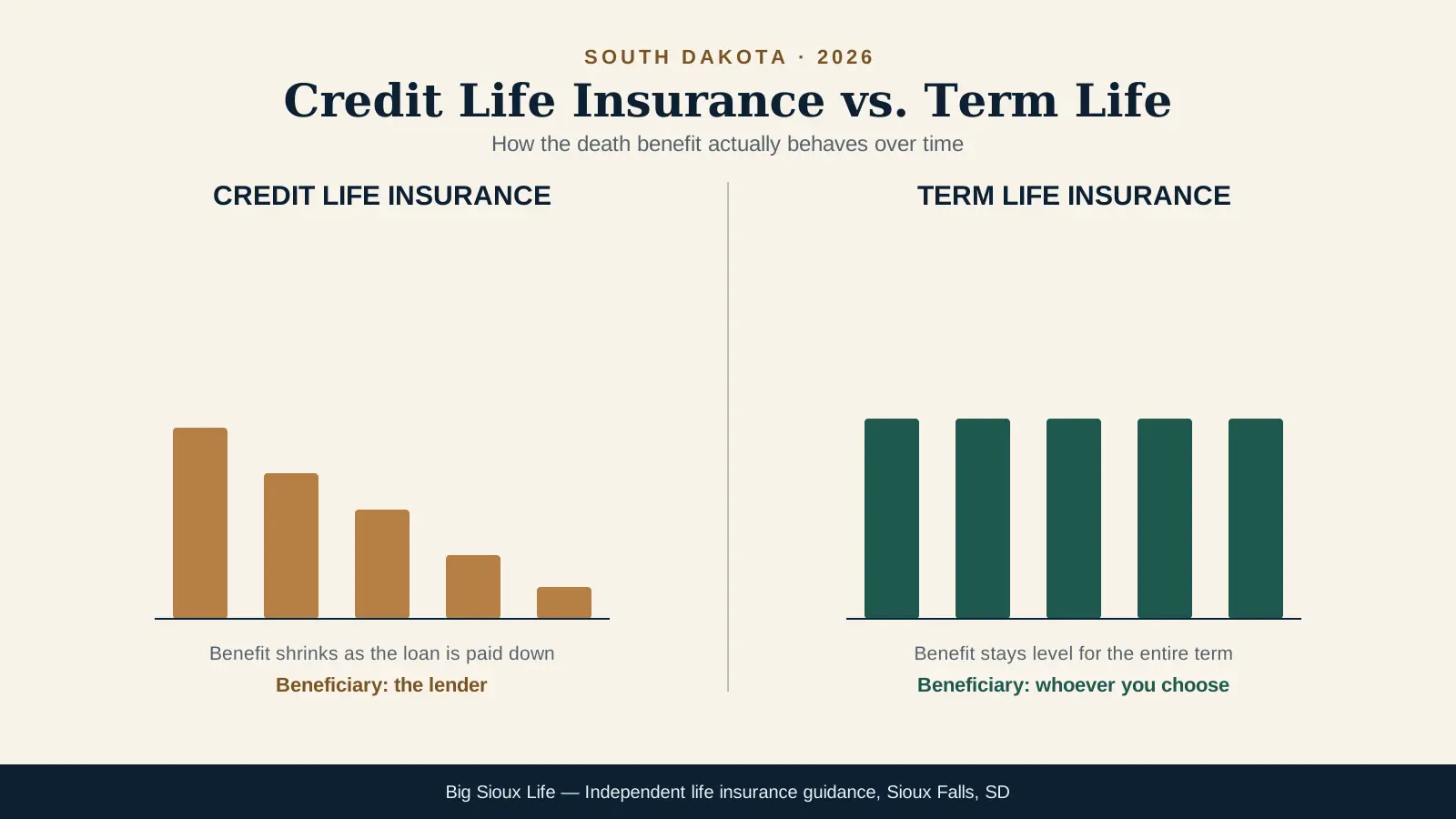
Structurally, credit life insurance is almost always decreasing-benefit coverage. The death benefit is scheduled at purchase to track your original loan’s amortization, so it’s largest on day one and falls toward zero as the loan matures, according to the CFPB’s guidance. The premium is usually a single sum, calculated once and folded directly into the loan amount, which means you finance the cost of the insurance at the same interest rate as the loan itself, and pay interest on the premium along with everything else you borrowed.
Not the same thing as mortgage protection insurance
South Dakota's credit insurance statute, SDCL 58-19-3, generally applies chapter 58-19 (and the pricing rule built on it) to life insurance connected with "a loan or other credit transaction" of ten years or less. A standard 30-year mortgage typically runs well past that window, so what gets marketed as "mortgage protection insurance" on a long home loan is usually sold and regulated as an individual life insurance policy, not as credit life insurance under this specific chapter. We cover that comparison separately in our mortgage protection insurance vs. term life guide. This article is about the shorter-term product: the add-on offered on auto loans, personal loans, retail financing, and similar credit, where the ten-year-or-less test is almost always met.
The other products sold alongside it
Credit life insurance rarely shows up alone. The CFPB’s consumer guidance on credit insurance for an auto loan groups it with three close relatives, and it’s worth knowing the difference before you’re asked to decide on all of them at once in a finance office. Credit disability insurance makes your loan payments for you if you become too ill or injured to work, on the policy’s own definition of disability. Involuntary unemployment insurance makes payments if you lose your job through no fault of your own. Credit property insurance, sometimes sold as GAP coverage, pays toward the vehicle itself if it’s stolen or totaled, generally the lesser of the vehicle’s value or the loan balance. Each is priced and regulated somewhat differently, but all four share the same basic shape: optional, tied to one specific debt, sold at the point of the loan, and paid to the lender rather than to you or anyone you’d choose.
The CFPB’s cost caution applies across all four: adding any of them increases your loan amount, which means you pay interest on the premium for as long as the loan runs, on top of whatever the coverage itself costs. None of them replace what a life insurance policy, a disability income policy, or your own auto insurance already does; they overlap with those existing protections to varying degrees, which is exactly why comparing before saying yes matters more than it looks like it does in the moment.
Why it’s sold at the counter instead of compared at the kitchen table
Credit life insurance is sold by the people arranging your credit, not by someone whose job is to compare carriers for you. A dealer, bank loan officer, or retailer presents the add-on at the exact moment you’re focused on driving away with the car or finishing the paperwork on a personal loan, and the pitch is simple: a small monthly amount, folded into a payment you’re already making, and the loan is “handled” if something happens to you.
That convenience is real. So is the fact that the seller has a financial stake in whether you say yes. Insurers compete for a dealer’s or lender’s business by offering commissions on credit insurance sales, a dynamic regulators and consumer researchers have long called “reverse competition,” because the competition happens between insurers trying to win over the seller, not between insurers trying to win over you as the actual insured. You, the person whose life is being insured, are the one party in the transaction with no seat at that negotiation.
South Dakota’s own law pushes back on part of this dynamic. No lessor may require a lessee to buy credit insurance as a term or condition of a lease, under SDCL 58-19-5.1. More broadly, the CFPB’s guidance is direct: if a lender tells you credit insurance is required to get the loan, you can file a complaint with the CFPB, your state insurance commissioner, or the Federal Trade Commission. Being offered the product is normal. Being told it’s mandatory generally is not.
What South Dakota’s own rule says the money is built to do
Every state sets some standard for judging whether an insurance rate is reasonable. For most individual life insurance, states rely on competitive markets and actuarial filing review rather than a fixed loss-ratio formula. Credit insurance is different: because the product is sold through a lender with its own financial incentive rather than shopped directly by the insured, South Dakota regulates it with an explicit, numeric benchmark.
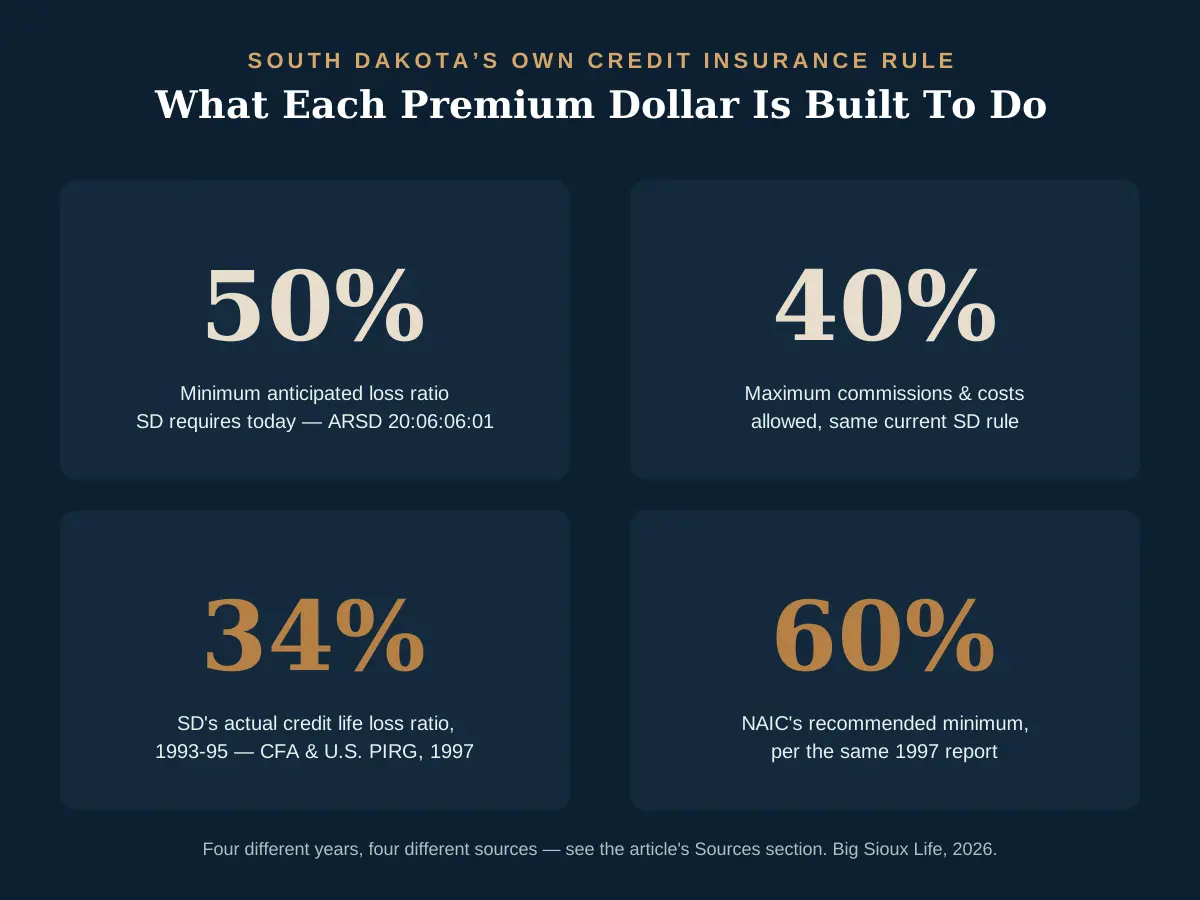
That benchmark is ARSD 20:06:06:01, titled “Premium rates — Fifty percent loss ratio benchmark.” Its text sets the baseline this way: “A basic test of the reasonableness of the relation of benefits to the premium charged shall be the development of an anticipated loss ratio of claims incurred to premiums earned of at least 50 percent.” The same rule adds a ceiling on the other side of the ledger: “Commissions, including retrospective premium refunds, bonuses, or acquisition expenses, shall not exceed 40 percent” of the premium dollar.
Read plainly, that means South Dakota’s regulatory floor treats a credit life rate as acceptable on its face as long as the insurer anticipates at least half of what it collects in premium will eventually be paid out in claims, while up to 40 cents of every premium dollar is allowed to go toward commissions and the costs of acquiring the business. The rule sits inside the Division of Insurance’s broader rate-filing framework for credit insurance, administered under SDCL 58-19-34, whose stated purpose, per the statute, is protecting debtors from excessive rates and forced sales of credit insurance in the first place.
That 50 percent floor is itself lower than the standard the industry’s own national association has recommended. A 1997 press release from the Consumer Federation of America and the U.S. Public Interest Research Group, titled “Most Credit Life Insurance Still a Rip-Off,” stated that “the National Association of Insurance Commissioners’ model standard for credit life insurance contains a minimum 60% loss ratio.” The same report found that, in practice, nationwide loss ratios ran well below even that lower bar: “In the nation as a whole, in 1993-95 the loss ratio was 43%,” and named South Dakota specifically among more than a dozen states with a loss ratio under 35 percent at the time, at 34 percent.
That 1990s data is old, and this article is not claiming it describes 2026 South Dakota. No more recent state-by-state public comparison turned up in this research. What it does establish, honestly dated, is that the general pattern behind South Dakota’s 50 percent regulatory floor, a product that has historically returned less to policyholders than regulators elsewhere consider ideal, isn’t a new or invented concern. It’s the reason the floor exists.
Share of each premium dollar designed or observed to come back as a claim
South Dakota 1993-95 actual: Consumer Federation of America & U.S. PIRG, press release, January 29, 1997. South Dakota current minimum: ARSD 20:06:06:01, fetched 2026. NAIC recommended minimum: same 1997 CFA/U.S. PIRG release, citing NAIC's model standard. Not a claim about current South Dakota loss ratios, which were not available for this article.
Credit life insurance and term life insurance, built differently
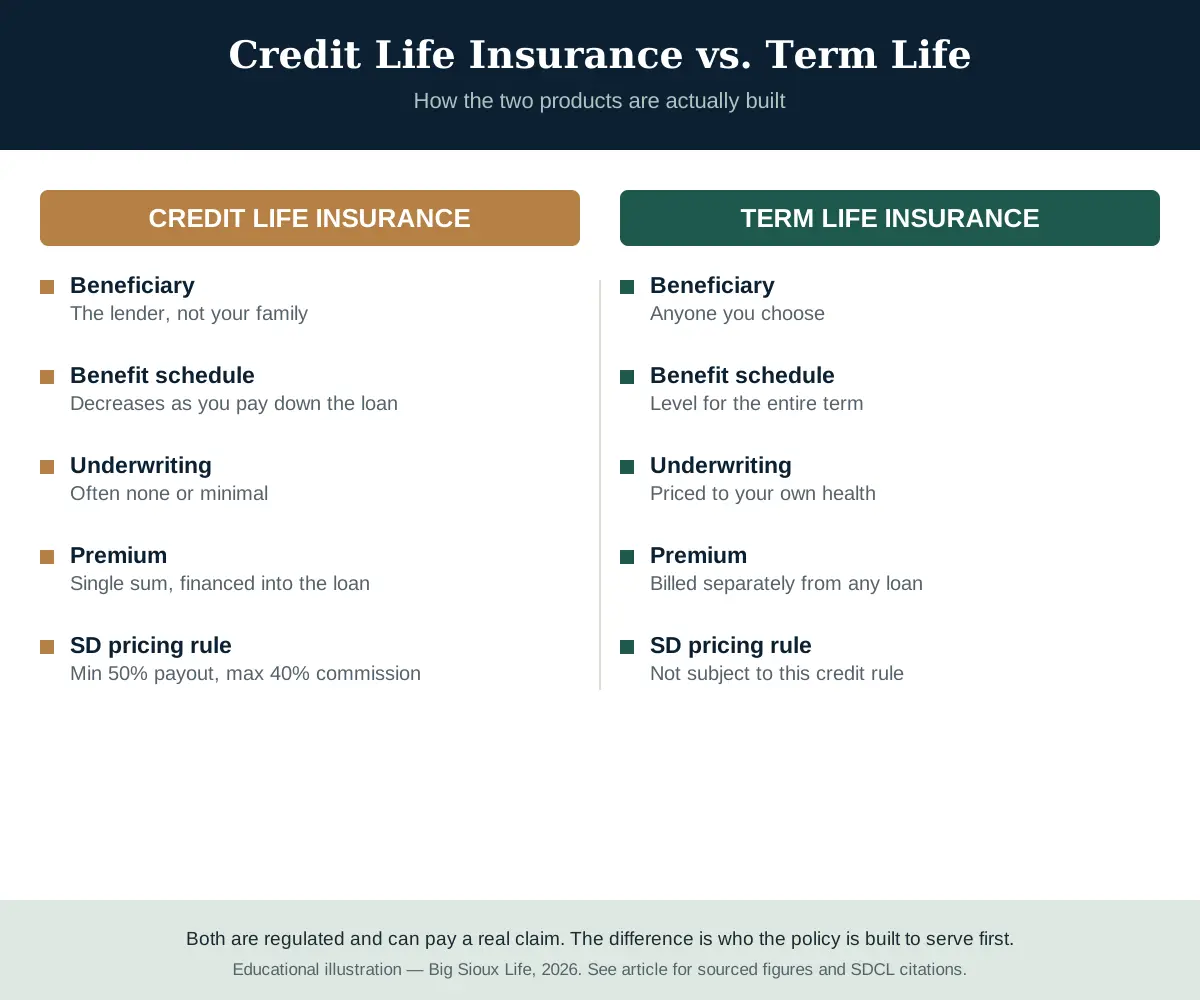
How it's built
- Beneficiary is the lender, up to the remaining balance
- Death benefit decreases on a schedule fixed at purchase
- Priced under a 50% loss-ratio floor and a 40% commission ceiling in South Dakota
- Usually little or no individual medical underwriting
- Single premium, typically financed into the loan at the loan's interest rate
- Sold by the lender or dealer at the point of the loan
How it's built
- Beneficiary is whoever you name, for whatever amount you choose
- Death benefit stays level for the full term you select
- Priced against your own medical and lifestyle risk, not a blended loan pool
- Typically fully underwritten, which rewards good health with a lower price
- Premium billed on its own schedule, separate from any loan
- Shopped across carriers you choose, independent of any single lender
The gap between these two products isn’t that one is honest and the other is a scam. Both are regulated, both can legitimately pay a claim, and both exist because dying with debt outstanding is a real risk. The gap is in who the policy is built to serve first. Credit life insurance is built around the lender’s convenience and the loan’s amortization schedule. A term policy you apply for yourself is built around your own choices: your beneficiary, your amount, your term length, and a price that reflects your individual health rather than an average across every borrower who said yes at the counter.
A worked example
Suppose a South Dakota household finances a $28,000 vehicle on a 6-year loan and is offered credit life insurance at the dealership, priced as a single premium added to the loan balance. Under South Dakota’s current rule, the insurer only has to anticipate paying back 50 cents of every premium dollar as claims, and up to 40 cents of every dollar can go to commissions and acquisition costs that make the sale easy to close in the finance office. That leaves, at minimum, roughly 10 cents of every premium dollar for the insurer’s own margin and other expenses, on top of the 40 cents already allowed for selling the policy.
Compare that to the same household instead applying for a $30,000, 10-year level term policy sized to cover the loan (rounding up slightly for a cushion) through fully underwritten term life insurance. If either spouse is in reasonably good health, the insurer prices the policy against their actual medical profile rather than a blended pool that includes less healthy borrowers who also said yes at other dealerships. The beneficiary is named by the household, not defaulted to the lender, so if the car loan happens to be paid off or refinanced by the time of death, the payout still goes to the family rather than evaporating because the collateral changed. And because the policy isn’t tied to this one loan, it keeps protecting the household even after the car is sold or traded in.
| Feature | Credit life insurance at the dealership | Individually underwritten term life |
|---|---|---|
| Who is named beneficiary | Lender, up to the loan balance | Spouse, family member, or anyone chosen |
| Benefit if the loan is paid off early | Coverage ends or shrinks with the loan | Full death benefit continues regardless |
| Underwriting basis | Blended pool across all borrowers who opt in | Your own age, health, and history |
| How the premium is paid | Single sum, financed into the loan at loan interest | Billed separately, not financed at loan interest |
| SD regulatory loss-ratio floor | 50% anticipated minimum, 40% commission cap | Not priced under this credit-insurance rule |
This is not a quote for any specific policy
The loan amounts above are an illustration, not a rate quote. Actual pricing for term life insurance depends on your age, health, tobacco use, the carrier, and underwriting outcome. Coverage availability, features, and rates vary by carrier and state and are subject to underwriting.
Is your loan even covered by South Dakota’s credit insurance rules?
This is the question most people financing something never think to ask, and it changes which comparison actually applies.
| Credit transaction | Typically within chapter 58-19? |
|---|---|
| Auto loan, 10 years or less | Yes |
| Personal or signature loan, 10 years or less | Yes |
| Retail or furniture installment financing | Yes |
| Vehicle lease | Covered by the chapter, but a lessor cannot require it (SDCL 58-19-5.1) |
| Mortgage, more than 10 years | Generally no — excluded by SDCL 58-19-3's ten-year test |
SDCL 58-19-3 applies the chapter, and the pricing rule built on it, to “life insurance… in connection with loans or other credit transactions,” but excepts “a loan or other credit transaction of more than ten years’ duration.” Most auto loans, personal loans, and retail financing run well under that window, which is exactly where credit life insurance shows up most often in practice. A standard 30-year mortgage almost always runs past it, which is why mortgage protection insurance on a home loan is a different regulatory animal, covered in our separate guide rather than this one.
How to compare it yourself before you sign
None of this requires taking anyone’s word for it. The comparison is arithmetic and a phone call.
Get the credit life quote in writing
Ask the lender or dealer for the exact premium, whether it's single-sum or financed, and the declining benefit schedule, before you agree to anything.
Price a term policy for the same amount
Apply for (or at least quote) an individually underwritten term policy sized to the loan balance, with a term at least as long as the loan.
Check who's named as beneficiary
If keeping the house or car in the family matters more than retiring the specific debt, a policy that pays a person you choose does more for them.
Ask what happens if you pay the loan off early
Per the CFPB's guidance, you can generally cancel credit insurance at any time and may be owed a refund if you sell, refinance, or prepay. Confirm the specific terms in your contract.
You can run this yourself first
Steps one and two take about twenty minutes with the loan paperwork in hand. Where a second opinion tends to earn its keep is comparing what different carriers actually offer once you apply, since underwriting guidelines for the same health history can differ meaningfully between companies. Not ready to talk to anyone yet? Read How It Works first and come back when you are.
The finance-office pitch is solving for "the loan gets handled." It isn't solving for who your family actually wants to receive the money, or whether you'd qualify for something that costs less once somebody actually checks.
Mike Moore, Life Insurance AdvisorWhen credit life insurance might be the reasonable choice
It would be dishonest to call this product wrong for everyone. If a health history makes fully underwritten term genuinely unavailable to you at a workable price, and the credit life add-on offered at the loan is what’s actually in front of you, taking coverage that exists over coverage that doesn’t is a defensible call. The same is true if you’ve looked at the numbers above deliberately and decided the convenience of “this one loan is handled, full stop” is worth more to you than a flexible policy, rather than landing there because nobody ever asked.
What’s harder to defend is saying yes at the counter without ever finding out what an individually underwritten policy would have cost for the same protection. That comparison takes an application and a little patience, and it’s worth doing before assuming the add-on in front of you is the only option.
How we help
We’re independent, so we’re not selling any single carrier’s credit insurance add-on or any one company’s version of term life. We work through the actual loan or debt you’re trying to protect, your health history, and your budget, then compare options across the carriers we represent so you can see what fully underwritten term looks like alongside whatever simplified options genuinely fit, instead of assuming the first offer in the finance office is the only one available. Compare options across carriers here.
What you get
A beneficiary you actually chose, instead of a lender by default. A death benefit that doesn’t evaporate just because you refinanced, sold the car, or paid the loan off faster than planned. And a price shaped by your own health, not a blended pool that includes every other borrower who said yes without comparing.
Compare credit life add-ons and term life side by side
We'll walk through the debt you're trying to protect and your health history, and show you what fully underwritten term actually costs, so the choice at the loan counter is informed instead of automatic.
Frequently asked questions
What is credit life insurance?
Credit life insurance is a policy tied to one specific loan or lease. If you die before the debt is paid off, it pays some or all of the remaining balance directly to the lender, according to the Consumer Financial Protection Bureau’s consumer guidance on credit insurance. South Dakota law defines it narrowly, as insurance on a debtor’s life connected to a specific loan, lease, or other credit transaction, under SDCL 58-19-2.
Is credit life insurance required to get a loan in South Dakota?
No lender can require it as a blanket condition of the loan, and South Dakota law specifically bars lessors from requiring it as a term of a lease under SDCL 58-19-5.1. The CFPB describes credit insurance generally as optional coverage, and notes that if a lender insists on it, you can file a complaint with the CFPB, your state insurance commissioner, or the FTC.
Is credit life insurance a good deal compared to term life insurance?
For a healthy applicant, usually not, on a dollar-for-dollar basis. South Dakota’s own administrative rule for credit insurance, ARSD 20:06:06:01, sets a 50 percent anticipated loss ratio as the basic reasonableness test, with commissions and acquisition costs allowed up to 40 percent of the premium dollar. Individually underwritten term life insurance doesn’t carry that same structural ceiling on what reaches the policyholder, because a healthy applicant is priced against their own medical risk rather than a blended pool that includes less healthy borrowers.
Does South Dakota’s credit insurance rule apply to my 30-year mortgage?
Usually not directly. SDCL 58-19-3 applies chapter 58-19, and the loss-ratio rule built on it, to life insurance connected to a loan or credit transaction of ten years or less. A 30-year mortgage normally falls outside that specific chapter. What’s marketed as mortgage protection insurance on a long mortgage is typically sold and regulated as ordinary individual life insurance instead, which is a different comparison covered in our mortgage protection insurance guide.
Can I cancel credit life insurance after I buy it?
Generally yes. The CFPB’s consumer guidance on credit insurance says you can cancel at any time, and you may be due a refund if you sell the vehicle, refinance, or pay off the loan early. Confirm the specific cancellation and refund terms in your own policy and loan documents, since contract language varies.
Who gets the payout if I die with credit life insurance in force?
The lender, up to the remaining loan balance, not your spouse, your kids, or your estate. That’s the core structural difference from a term life policy, where you name the beneficiary and the payout goes to that person regardless of whether any debt is still outstanding.
Should I buy credit life insurance if I think I’d be declined for regular term life?
It’s worth checking before assuming that. Credit life insurance is commonly sold with little or no medical underwriting, which is a real advantage if you have a health condition. But independent agencies shop multiple carriers, and underwriting guidelines for the same condition can differ meaningfully between companies, so a health history that feels disqualifying is worth asking about before defaulting to the loan add-on.
Does credit life insurance cover my whole loan balance the entire time I owe it?
Usually not. Credit life insurance is typically decreasing-benefit coverage: the death benefit schedule is set at purchase based on your original loan amount and term, and it declines on that fixed schedule whether or not your actual balance tracks it. If you refinance, make extra payments, or extend the loan, the coverage schedule does not automatically adjust to your new balance.
Before you sign anything
This article is general education, not insurance, legal, financial, or tax advice. Product availability, features, and rates vary by carrier and state and are subject to underwriting. No coverage exists until a policy is issued and in force. Any guarantees are subject to the claims-paying ability of the issuing insurer. Please review actual policy documents and speak with a licensed agent about your situation.
Sources
- South Dakota Legislature — ARSD 20:06:06:01, Premium rates — Fifty percent loss ratio benchmark — fetched October 2026, current rule text
- South Dakota Legislature — SDCL 58-19-2, Definitions — fetched October 2026, current statute text
- South Dakota Legislature — SDCL 58-19-3, Life and health insurance connected with credit transactions subject to chapter — Exceptions — fetched October 2026, current statute text
- South Dakota Division of Insurance — Individual Credit Health filing page — fetched October 2026, citing SDCL 58-19-34 and ARSD 20:06:06
- Consumer Financial Protection Bureau — What is credit insurance for an auto loan? — fetched October 2026
- Consumer Federation of America & U.S. PIRG — “Most Credit Life Insurance Still a Rip-Off,” press release, January 29, 1997 (hosted copy) — 1993-95 loss-ratio data, fetched October 2026
- FRED (Federal Reserve Bank of St. Louis) — All-Transactions House Price Index for South Dakota (SDSTHPI) — 642.50 index value, Q2 2026, base 1980:Q1=100, sourced from the Federal Housing Finance Agency
The worked example above uses illustrative loan amounts, not a quote for any specific policy. South Dakota statute and rule citations reflect the text as published on sdlegislature.gov at the time of research and may be amended; consult the Division of Insurance or current session laws for the governing version.
Related reading: Mortgage Protection Insurance vs. Term Life: Which Is Better? and No-Medical-Exam Life Insurance: How It Works in 2026. See current options for term life and mortgage protection, or learn more about coverage for homeowners. You can also work through your own numbers with our life insurance needs calculator.