
Usually, no, not much. If nobody’s income depends on yours, nobody would inherit your debt, and your family could cover your final expenses without strain, the standard case for life insurance is genuinely thin. But “single with no kids” gets treated as a single category when it actually hides at least three separate financial exposures: a co-signed loan, funeral costs your family would absorb, and your own future insurability. Check those specifically before you assume the answer is zero, because for a meaningful share of single South Dakotans, it isn’t.
The short version
- The traditional case for life insurance, replacing lost income for dependents, genuinely doesn't apply if you have no dependents. That part of the "you don't need it" advice is correct.
- What that advice usually skips: co-signed debt survives you and lands on your co-signer, not your estate, according to the Consumer Financial Protection Bureau.
- LIMRA reported that 59% of American adults own life insurance while seven in 10 say they believe they need it, a gap worth understanding before you assume you're in the group that genuinely doesn't.
- South Dakota gives every buyer a 10-day "free look" period to cancel any life insurance policy for a full refund, under state law (SDCL 58-15-8.1), so a small policy isn't a locked-in decision.
- The one thing not to do: decide based on your relationship status alone instead of your actual debt and support obligations.
What does “need” actually mean for life insurance?
Life insurance replaces something specific: money that would have kept flowing, or an obligation that would otherwise fall on someone else, if you died. It isn’t protection for you. You don’t collect on your own policy. It’s protection for whoever would have to absorb the financial hole you’d leave, whether that’s a spouse who counted on your paycheck, a child who needs to be raised, or, less obviously, a parent who co-signed a loan or would end up paying for a funeral.
A few terms come up constantly in this conversation, so let’s define them once. Term life insurance is coverage that lasts for a set period, usually 10, 20, or 30 years, and pays a fixed death benefit if you die during that term; it’s the cheapest form of coverage per dollar of protection and the one that fits most of the scenarios in this article. A beneficiary is the person, people, or entity you name to receive the payout; South Dakota doesn’t require a beneficiary to be a spouse or relative, and you can name a parent, sibling, friend, trust, or charity, or split the benefit across more than one. Insurable interest is the legal requirement that whoever buys a policy on your life has to have a genuine financial stake in you staying alive, which is why a stranger can’t insure you, but a co-signing parent or a business partner generally can. And the free-look period is a window, set by state law, during which you can cancel a new policy and get every dollar of premium back, no penalty, no questions.
With those defined, the actual test isn’t “am I single” or “do I have kids.” It’s: if you died next month, would anyone be financially worse off because of it, beyond grief? For a genuinely unattached 24-year-old with no debt and a family that could handle a modest funeral bill without strain, the honest answer is close to no. For a lot of other people who’d describe themselves the same way, single, no kids, the honest answer is yes, and the reason is almost never a spouse or a kid.
Why “no dependents” isn’t the whole picture
The advice “you don’t need life insurance if you’re single with no kids” gets repeated because it’s mostly right for the median case and easy to say. It skips three situations that are common enough to name specifically, and none of them require a spouse or a child to be real.
Co-signed or jointly held debt. If a parent, grandparent, or anyone else co-signed a loan with you, private student loans and some auto loans are the most common examples, that debt does not disappear when you die. It becomes their debt to finish paying, in full, on their own credit. The Consumer Financial Protection Bureau is direct about this: when someone dies, their money and property go toward repaying their debt, and if the estate can’t cover it, unsecured debt usually goes unpaid with nobody else on the hook, unless that person was a co-signer on a loan or a joint account holder, in which case they remain personally responsible for that specific balance. The Federal Trade Commission’s 2011 policy statement on collecting debts of the deceased makes the same point from the regulator side: family members typically aren’t obligated to pay a deceased relative’s debts from their own assets, with jointly held debt and co-signed obligations carved out as the exception debt collectors are allowed to pursue.
Final expenses your family would otherwise absorb. Your estate pays first. If there isn’t enough in it, whoever arranges the funeral, usually a parent or sibling, is the one who ends up closing the gap, because funeral homes generally require payment or a signed payment plan before or shortly after services are rendered. Nobody is legally forced to pay out of pocket for a relative’s funeral unless they signed the funeral home’s own contract, but in practice, most people don’t leave a body unclaimed over a bill; they pay it. The bill itself is also shifting: the National Funeral Directors Association projects the U.S. cremation rate will reach 63.4% in 2025, against a 31.6% burial rate, which changes what “final expenses” typically means for a single person with no spouse to plan a traditional service, though the exact cost still depends entirely on the arrangements your family chooses.
Your own future insurability. This isn’t a countdown and it isn’t a reason to rush. It’s a fact worth knowing before you decide to wait indefinitely: term life insurance premiums are priced heavily on current age and health at the time you apply. A diagnosis, a new medication, or simply getting older between now and whenever your life changes, marriage, a mortgage, a kid, can mean the same coverage costs more later, or requires a different rate class, than if you’d locked it in earlier. That’s a real tradeoff to weigh against the cost of a small policy now, not a scare tactic; plenty of people reasonably decide to wait and it works out fine for them.
| Measure | Figure | Period / source |
|---|---|---|
| Adults who own some form of life insurance | 59% | LIMRA, reported 2024 |
| Adults who say they believe they need life insurance | Seven in 10 (70%) | LIMRA, reported 2024 |
| Consumers who cite other financial concerns as the reason they haven't bought | 36% | LIMRA, reported 2024 |
| Consumers who overestimate the actual cost of coverage | 72% | LIMRA, reported 2024 |
Source: LIMRA, "New Life Insurance Ownership Data Suggests a Need for New Strategies to Engage Consumers," 2024, accessed 2026.
This is general education, not a review of your specific situation
Whether any of this applies to you depends on your actual debts, obligations, and family circumstances. Nothing here is a recommendation to buy or not buy coverage; it's a way to check your own exposure before you decide either way.
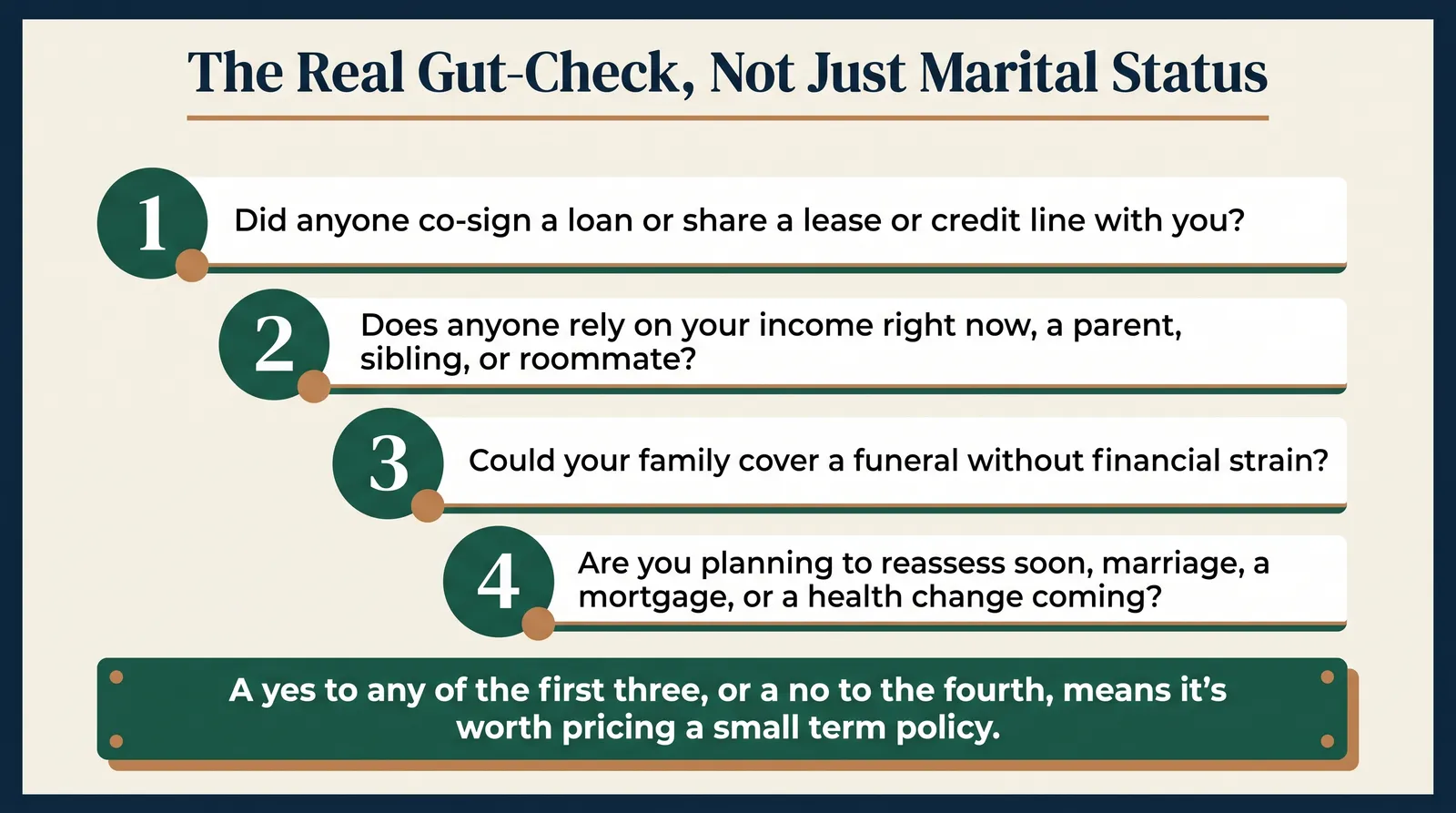
If you have no co-signed debt, no one relying on your income today, and a family that could handle final expenses without strain, all three questions genuinely point toward “not much reason to buy right now,” and that’s a legitimate answer, not a failure to be sold something. The point isn’t that everyone single needs coverage. It’s that “single” and “no dependents” aren’t the same fact, and the second one is the one that actually matters.
If you’d rather have someone walk through your specific debts and obligations with you instead of running the checklist alone, that’s a conversation we have with people in exactly this spot: Compare My Options.
What it actually costs to guess wrong
There’s no single dollar figure here, because it depends entirely on the size of the debt or the funeral bill in question, and nobody should quote you a number without knowing your situation. But the shape of the cost is worth working through with a real example.
Say a 26-year-old in Sioux Falls has $28,000 remaining on a private student loan her mother co-signed, has no other debt, and has no life insurance. This is a hypothetical to illustrate the mechanics, not a survey figure. If she died in a car accident next year, her mother wouldn’t inherit that debt through some abstract legal process, she’d simply still owe the lender the remaining balance, on her own credit, with her own future income, because her name was on the loan from day one. A $28,000 term policy naming her mother as beneficiary would, in that scenario, pay off the loan in full and leave her mother’s finances exactly where they were before her daughter died. Without it, her mother is repaying a loan for a degree she isn’t using, on top of grieving.
Compare that to a second 26-year-old with the same income and job, no co-signed debt anywhere, renting solo, and a family that has enough saved to cover a funeral without touching their own bills. For that person, a term policy protects almost nothing that isn’t already covered, because there’s no gap for it to fill. Same age, same marital status, same absence of kids, genuinely different answer, because the debt and the family’s financial cushion are different, not because one of them is “more responsible” than the other.
That’s the actual cost of skipping the check: not a wasted premium, but a real debt that lands on a specific person who didn’t sign up to carry it alone, discovered at the worst possible time to discover it.
How to work this out for yourself
This doesn’t require anyone else’s help to get a first, honest answer. Same method either way.
- List every loan or line of credit with someone else’s name on it. Co-signed private student loans, a car loan a parent helped you get, a joint credit card, a lease with a roommate whose name is also on the lease. Anything where someone else agreed to be responsible if you didn’t pay.
- Check whether each one actually transfers on death. Federal student loans are generally discharged when the borrower dies, and a co-signer usually isn’t involved in the first place because most federal loans don’t require one. Private loans are contract-specific; call the lender or read the promissory note rather than assuming either way.
- Ask, honestly, who relies on your income today. Not “who would miss me,” but who would have a real financial gap: a parent you help with rent, a sibling with a disability, a partner who isn’t a legal spouse but shares your lease and your budget.
- Estimate what your family would actually have to cover for final expenses. Not a national average, your family’s actual capacity. Some families could absorb it without noticing. Others would have to put it on a credit card. Our guide to final expense planning in South Dakota walks through how to size that specific number.
- Decide whether you’re likely to reassess soon anyway. Getting married, buying a house, planning kids, or a health change on the horizon are all reasons the answer might shift in the near term, which is useful to know even if you don’t act on it today.
- Add it up. If every answer above comes back “nobody, nothing, and we’re fine,” you’ve got a legitimate, checked answer that a small policy probably isn’t worth the premium right now. If any answer surprised you, that’s worth pricing, not necessarily buying.
You can run this in about ten minutes with your loan statements open. If you’d rather have someone confirm the math, or shop what a small policy would actually cost across more than one carrier once you know your number, that’s what an independent agency does: Compare My Options.
| Situation | Who actually carries the risk | Worth pricing coverage? |
|---|---|---|
| Parent co-signed a private student loan or auto loan | The co-signer, personally, per CFPB guidance | Usually yes, sized to the loan balance |
| Joint lease, joint credit card, or shared auto loan with a roommate or partner | The other account holder | Worth checking the specific balance owed |
| Supporting a parent or sibling financially now | Whoever you support, going forward | Usually yes, sized to what you contribute |
| No co-signed debt, family could cover final expenses easily | No one, in practice | Genuinely optional right now |
| Planning marriage, a mortgage, or kids within a year or two | Future dependents, not current ones | Worth knowing your health/age timeline either way |
Source: Big Sioux Life analysis, built from Consumer Financial Protection Bureau and Federal Trade Commission guidance on debt after death, cited above. Not a substitute for reviewing your own loan agreements.
The say-do gap, and why it matters here
LIMRA’s research puts a number on something worth sitting with: 59% of American adults own life insurance, but seven in 10, about 70%, say they believe they need it. That’s roughly an 11-point gap between what people think is true about their own situation and what they’ve actually done about it. Some of that gap is people who genuinely don’t need coverage and know it, which tracks with a chunk of the single, no-dependents population. But LIMRA also found that 36% of consumers cite other financial concerns as the reason they haven’t bought, and 72% overestimate the actual cost of coverage, which points to a different explanation for at least part of that gap: not “I checked and I’m fine,” but “I assumed it was expensive and moved on.”
The say-do gap: belief versus ownership
Source: LIMRA, "New Life Insurance Ownership Data Suggests a Need for New Strategies to Engage Consumers," 2024, accessed 2026.
59%
of American adults own life insurance (LIMRA, 2024)
70%
say they believe they need it (LIMRA, 2024)
72%
overestimate what coverage actually costs (LIMRA, 2024)
10 days
South Dakota's free-look period to cancel any policy for a full refund (SDCL 58-15-8.1)
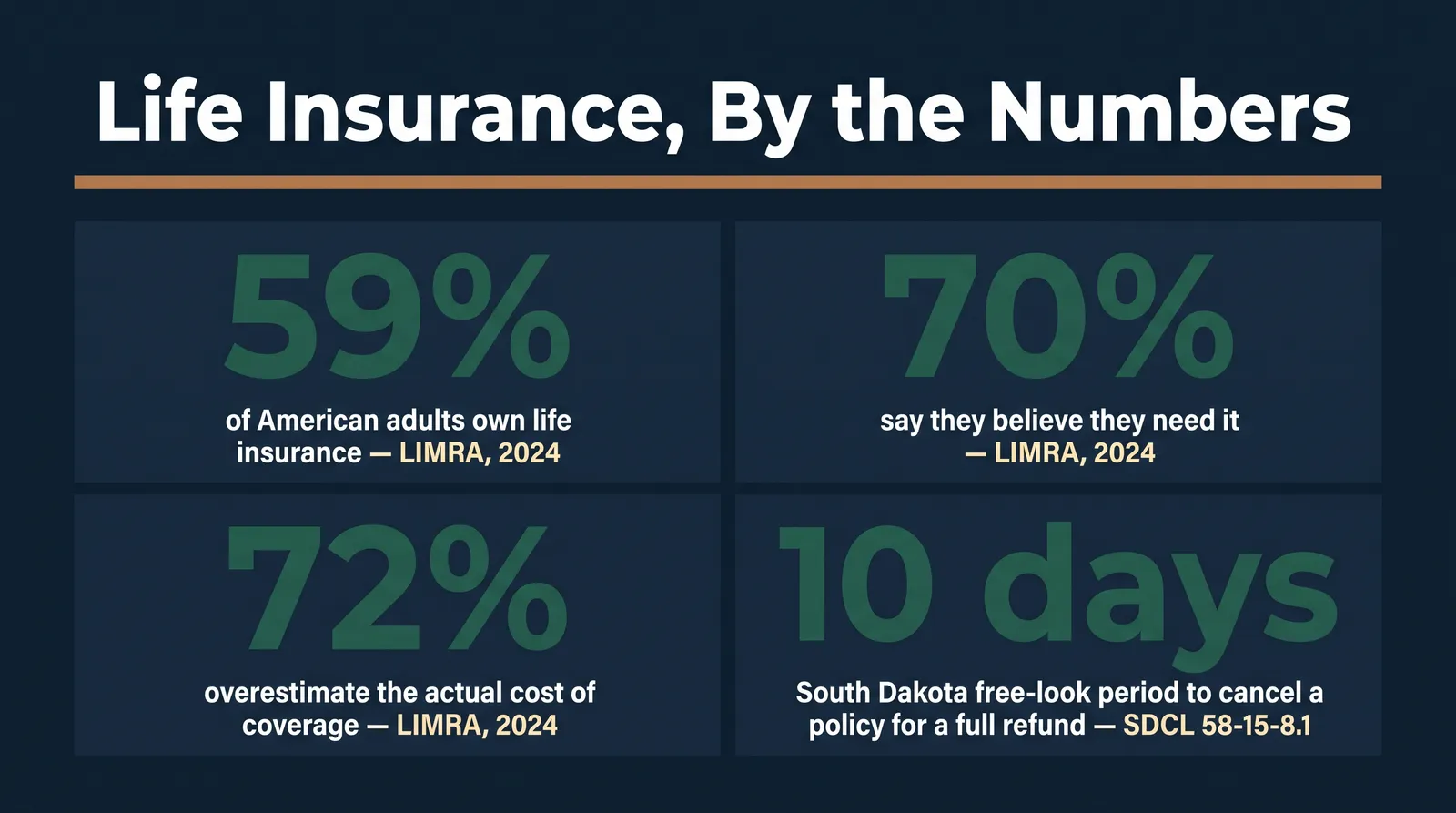
That gap is exactly why “just check your own exposure” beats “single people don’t need it” as a rule. Some of the 70% who believe they need coverage but haven’t bought it are single people with no kids who genuinely have a co-signed loan or a family that couldn’t absorb a funeral bill, and who’ve been sorted into “doesn’t need it” by a rule of thumb that never asked about their actual debt.
"I'm single with no kids, so I don't need this"
- Never checks whether a parent co-signed anything
- Assumes final expenses are the family's problem to solve, not something to plan for
- Overestimates the cost of a small policy and never gets a real number
ResultA guess based on relationship status, not actual exposure
Runs the four-question check before deciding
- Knows exactly which debts have someone else's name on them
- Has a real number for what final expenses would cost their family
- Gets an actual quote before assuming coverage is unaffordable
ResultA decision built on their own numbers, not a rule of thumb
How does South Dakota law factor in?
South Dakota doesn’t require anyone to carry life insurance, and there’s no state rule tied to marital or parental status either way. What state law does set is consumer protection once you decide to buy. Under SDCL 58-15-8.1, every individual life insurance policy issued in South Dakota has to include a notice giving the purchaser 10 days from actual receipt of the policy to return it and get every premium dollar refunded, no reason required. That matters specifically for someone deciding on a small policy while genuinely unsure whether they need it: buying doesn’t lock you in immediately, and if you change your mind after seeing the actual paperwork, you have a real, legally guaranteed window to undo it.
South Dakota law also doesn’t restrict who you can name as a beneficiary. You aren’t required to have a spouse or child to buy or benefit from a policy; you can name a parent, a co-signer directly, a sibling, a friend, a trust, or a charitable organization, and naming a beneficiary directly means the payout reaches them without first passing through probate.
How we help
We’re an independent life insurance agency in Sioux Falls, which matters here specifically because the honest answer for a single person with no kids is often “you probably don’t need much, if anything,” and we’ll say that plainly instead of steering you toward a policy that doesn’t fit. When someone in this situation does have a real exposure, a co-signed loan, a family member they support, we help size a policy to that specific number rather than a generic recommendation, and because we aren’t tied to one carrier, we compare options instead of presenting one company’s answer as the only one. Compare My Options.
What you get
A straight answer, not a sales pitch, about whether your specific situation has real exposure or not. A method for checking that yourself in about ten minutes, using your own loan statements. And if a real number turns up, a comparison of what a small policy sized to that number would actually cost across carriers we work with, so you’re deciding on real numbers instead of an assumption about what coverage costs.
"Single with no kids" tells you about your relationship status. It doesn't tell you whether a debt with someone else's name on it survives you. Check the second thing before you trust the first one to answer for you.
Mike MooreRelated reading
For how pricing actually works once you decide to price a policy, see our guide to life insurance cost by age. If your family would have to cover final expenses, our final expense planning guide for South Dakota walks through sizing that number. If your employer offers group coverage and you’re wondering whether that’s enough on its own, see is your employer’s life insurance enough. And if your situation changes toward a mortgage or a family, our guide on how much life insurance Sioux Falls families need picks up from there.
Not sure what a term policy actually costs?
See real pricing mechanics in our life insurance cost by age guide.
Self-employed with a co-signed loan?
See our guide for self-employed South Dakotans.
Not sure where to start?
Read how it works first and come back when you're ready.
Frequently asked questions
Do you need life insurance if you’re single with no kids?
Usually not much, if anything, but “usually” isn’t “always.” If nobody would inherit your debt, nobody depends on your income, and your family could cover your final expenses without strain, the traditional case for life insurance is genuinely weak. What changes the answer is a co-signed loan, a joint lease or credit line, a parent or sibling you actually support, or final expenses your family would otherwise have to absorb. Check those four things specifically before assuming the answer is zero.
If I die with no dependents, does my debt just disappear?
Debt owed by you personally is paid out of your estate first; if the estate can’t cover it, unsecured debt like most credit cards usually goes unpaid and nobody else has to pay it out of pocket, according to the Consumer Financial Protection Bureau. The exception is debt someone else co-signed or held jointly with you. A co-signer or joint account holder remains legally responsible for that specific debt, which is exactly the debt life insurance can be sized to cover.
Does my parent still have to pay my student loan if I die?
If they co-signed a private student loan with you, yes, in most cases. The Consumer Financial Protection Bureau states that a co-signer on a loan with outstanding debt is responsible for it, and that principle applies to private student loans the same as any other co-signed debt. Federal student loans are different; most federal loans are discharged on the borrower’s death and a co-signer generally isn’t involved in the first place. Check your specific loan type before assuming either answer.
Is life insurance a waste of money for someone in their 20s with no dependents?
Not automatically, but it can be if you buy it for the wrong reason. A 20-something with no co-signed debt, no one depending on their income, and a family that can absorb final expenses without strain has a genuinely thin case for coverage right now. Someone the same age with a parent’s name on a private student loan, or who’s the person a sibling with a disability depends on, has a real case. The mistake is deciding based on age or relationship status instead of actually checking your own exposure.
Who pays for my funeral if I don’t have life insurance and no spouse or kids?
Your estate pays first, out of whatever assets you have. If the estate falls short, the person who arranges the funeral, often a parent or sibling, is typically the one who ends up covering the gap, since South Dakota funeral homes generally require payment or a signed payment agreement before or shortly after services. Nothing legally forces a family member to pay from their own pocket, but in practice, most do rather than leave it unresolved.
Should I buy life insurance now or wait until I’m married or have kids?
That depends on what you’re weighing it against, not on a rule that says wait. If you have no dependents and no co-signed debt today, there’s no urgent reason to buy before you need it. The tradeoff worth understanding, not a reason to rush, is that term life insurance premiums are priced substantially on current age and health, so a policy bought later, after a health change, generally costs more or requires a different rate class than the same coverage bought earlier. That’s a fact to factor into your own timeline, not a countdown.
What does a small policy actually cost for a healthy single person?
It depends entirely on your age, health, coverage amount, and the carrier, and nobody can respond to that question with a specific number before underwriting. What’s true in general is that term life insurance is priced far lower for younger, healthier applicants than most people assume; LIMRA’s research found 72% of consumers overestimate the actual cost of coverage. Our guide to life insurance cost by age walks through how the pricing mechanics work at different ages.
What is a beneficiary if I don’t have a spouse or kids?
A beneficiary is simply whoever you name on the policy to receive the payout; South Dakota law doesn’t require it to be a spouse, child, or even a relative. You can name a parent, a sibling, a friend, a trust, or a charity, and you can name more than one and split the payout by percentage. If you have a co-signer on a debt, naming them directly means the payout reaches them without going through probate first.
Sources
- LIMRA — New Life Insurance Ownership Data Suggests a Need for New Strategies to Engage Consumers — 59% of American adults own life insurance; seven in 10 believe they need it; 36% cite other financial concerns as the reason they haven’t bought; 72% overestimate the actual cost of coverage; published 2024, accessed 2026
- Consumer Financial Protection Bureau — Does a person’s debt go away when they die? — debt is paid from the estate first; unsecured debt with no estate assets usually goes unpaid; co-signers and joint account holders remain personally responsible; accessed 2026
- Federal Trade Commission — FTC Issues Final Policy Statement on Collecting Debts of the Deceased — family members typically aren’t obligated to pay a deceased relative’s debts from their own assets, except jointly held assets and co-signed debt; published July 20, 2011, accessed 2026
- South Dakota Legislature — Codified Law 58-15-8.1, “Free look” provision — every individual life insurance policy issued in South Dakota must allow a 10-day right of cancellation with a full premium refund; current codified law, accessed 2026
- National Funeral Directors Association — NFDA Releases 2025 Cremation & Burial Report — projected 2025 U.S. cremation rate of 63.4% and burial rate of 31.6%; accessed 2026
Related reading: Life Insurance Cost by Age: 30, 40 and 50 in 2026, Final Expense Planning in 2026: Rising Funeral Costs in South Dakota, and Is Your Employer’s Life Insurance Enough?. See how it works and current options for term life insurance in South Dakota.
Before you act on any of this
This article is general education, not insurance, legal, financial, or tax advice. Whether you need coverage depends on your own debts, obligations, and family circumstances. Coverage availability, features, and rates vary by carrier and state and are subject to underwriting. No coverage exists until a policy is issued and in force. Any guarantees are subject to the claims-paying ability of the issuing insurer. Speak with a licensed agent or an attorney about debt, estate, or loan questions specific to your situation.
The relationship status was never the real question
“Single with no kids” describes who you live with, not what you owe or who’s counting on you. Run the actual check, a co-signed loan, someone who relies on you now, what your family could absorb without strain, and you’ll get a real answer instead of a guess borrowed from your relationship status. For a lot of people, that real answer is still “you’re fine without it.” For some, it isn’t, and the only way to know which one you are is to check.
Want a second opinion on whether you actually need coverage?
We'll help you check your real exposure and, if it's worth pricing, compare a small policy across carriers.