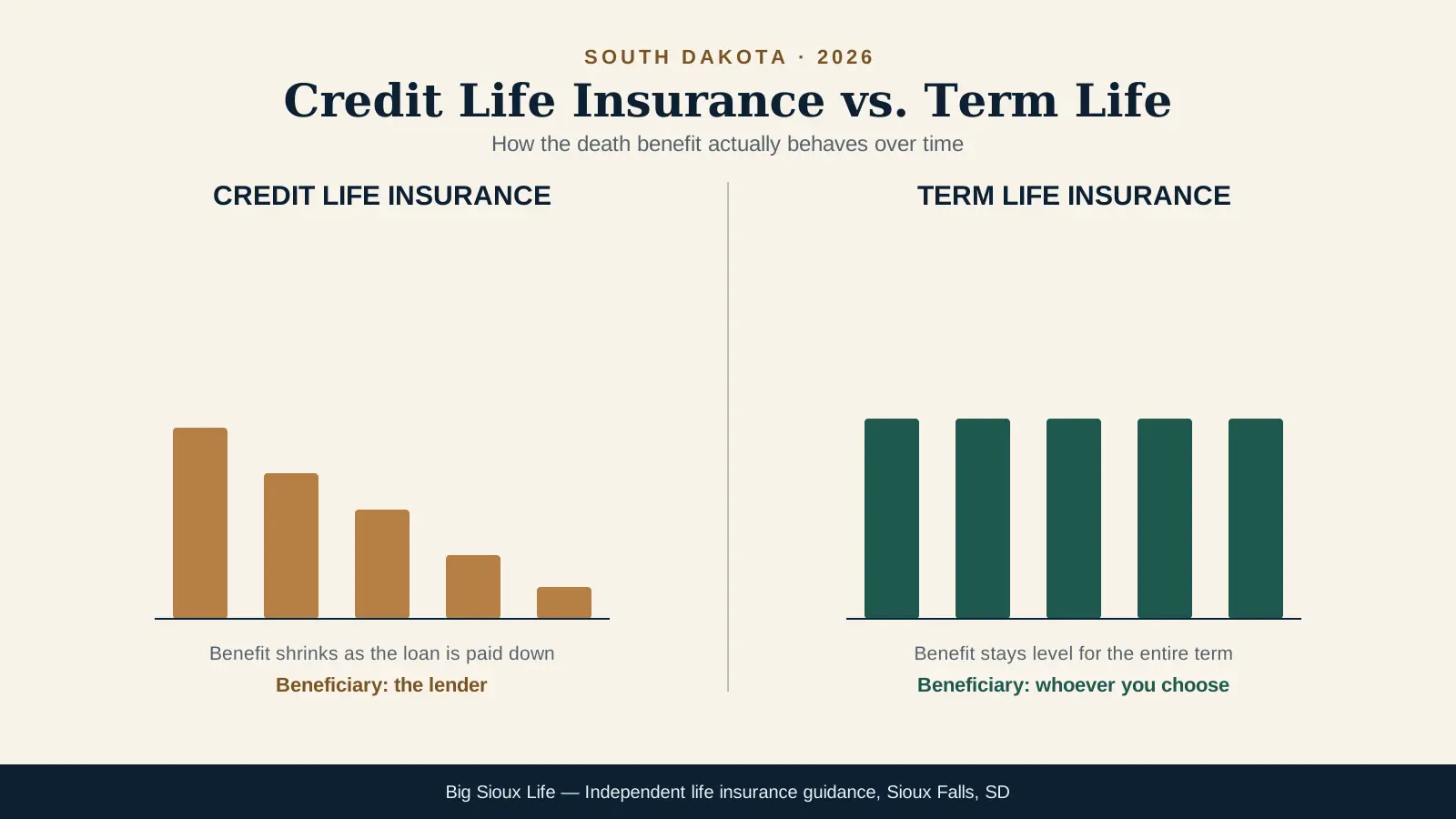
Do empty nesters still need life insurance? Often, yes, but usually not the same policy, and not for the same reasons, that you bought at 32 with a new mortgage and a toddler. The two things most people say justified their coverage, replacing income for dependent kids and protecting a house payment, have often shrunk or disappeared by the time the last child moves out. That’s the moment a lot of South Dakota households cancel a policy, or just let a term lapse without thinking much about it. Some of them are right to. Many aren’t, because the arithmetic that replaces the old reasons never got run.
The short version
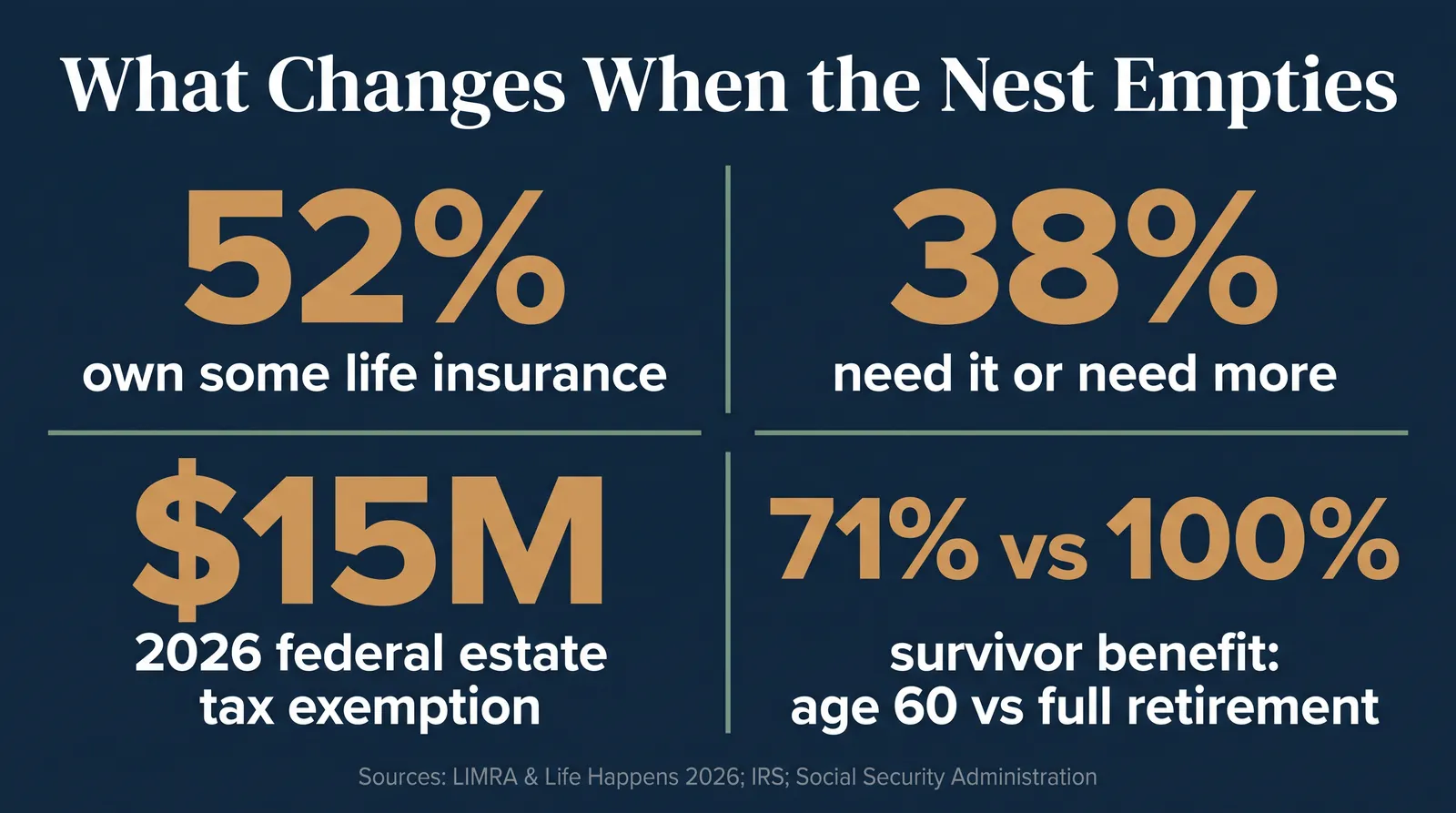
- 52% of U.S. adults report owning some life insurance, and 38% say they need life insurance or need more of it, roughly 98 million people combined, per LIMRA and Life Happens' 2026 Insurance Barometer Study.
- A surviving spouse who claims Social Security survivor benefits at age 60 gets about 71% of the deceased worker's benefit, versus 100% at full retirement age, a permanent gap of up to 29 percentage points (Social Security Administration, 2026).
- South Dakota has no state estate or inheritance tax, and the 2026 federal estate tax exemption is $15,000,000 per person, so estate-tax avoidance is rarely the right reason to keep a policy for most South Dakota families.
- The right question isn't "keep it or cancel it," it's what specific gap remains once the mortgage and the kids are no longer the reason, and whether your other assets already cover it.
Why so many people cancel the week the last kid moves out
Ask most South Dakota households why they first bought life insurance, and the answer clusters around two things: a mortgage that would otherwise fall on one income, and kids who couldn’t yet support themselves. Both are concrete, both have an end date you can practically picture, and both are the reasons an agent probably led with when the policy was sold in the first place.
So when the mortgage gets paid off and the youngest kid takes a job and moves out, it feels like the contract is fulfilled. The premium notice arrives, and for a lot of people the instinct is simple: the thing I was insuring against no longer exists, so why keep paying for it. That instinct isn’t wrong on its own terms. It’s incomplete, because it treats “the mortgage and the kids” as the entire reason life insurance exists for a household, when for most couples in their fifties and sixties, it’s the reason the original policy amount was set that high, not the entire case for having coverage at all.
The problem shows up in the trend line, not in any one household’s story. LIMRA and Life Happens run the Insurance Barometer Study every year, and their own 16-year trend shows the share of U.S. adults who say they need life insurance or need more of it has stayed stubbornly high even as it’s edged down slightly in the past two years.
| Year | Say they need life insurance or need more |
|---|---|
| 2011 | 35% |
| 2024 | 42% |
| 2025 | 40% |
| 2026 | 38% |
Source: LIMRA and Life Happens, "2026 Insurance Barometer Study: Rethinking Your Life (Insurance)," presented at the 2026 Life Insurance and Annuity Conference. 16-year trend data.
The 2026 study puts total ownership at 52% of U.S. adults, and the need gap, people who say they need coverage or need more than they have, at 38%, which the study translates to roughly 74 million Americans who need life insurance plus another 24 million who need more of it, about 98 million people combined. That figure isn’t broken out by whether someone still has kids at home. It includes plenty of people whose kids are grown and whose houses are paid off, which is the whole point: the need doesn’t automatically disappear with the mortgage, it just changes shape.
This is general education, not a recommendation
Nothing here is a quote, an offer of coverage, or advice for your specific situation. Product availability, features, and pricing vary by carrier and are subject to underwriting. Talk with a licensed agent about what actually fits your household.
What actually changes, and what doesn’t, once the nest is empty
Before you can decide what to do with a policy, it helps to separate what genuinely goes away at this life stage from what just changes size.
What usually shrinks or disappears: income replacement for dependent children (they’re earning their own money now), a mortgage payment that would have fallen on one spouse (if the house is actually paid off, not just close), and the years-remaining math that a term policy was originally sized around.
What usually stays or shows up new: a gap between your household income and what a surviving spouse’s own income, pension, or Social Security survivor benefit would replace; whatever debt isn’t the mortgage, a car loan, medical debt, a home equity line; final expenses, funeral and estate settlement costs that don’t shrink just because the kids grew up; and, for some households, a specific goal like leaving a set amount to children or grandchildren outside of other assets.
A few terms are worth defining before you go further, since they come up constantly in this decision. A term life policy covers a fixed period, 10, 20, or 30 years, and pays a death benefit only if the insured dies during that term. Permanent life insurance, including whole life and indexed universal life, is designed to last your entire life as long as premiums are paid, and it builds cash value, a savings-like component inside the policy that grows over time and that you can typically borrow against or withdraw from while you’re alive. A conversion privilege lets you convert some or all of a term policy to permanent coverage before the term ends, without new medical underwriting, which matters most if your health has changed since the original application. Your beneficiary is who the death benefit goes to, and it’s worth checking that designation any time your household changes, since an outdated beneficiary can delay a payout regardless of how well the coverage amount was calculated.
The estate-tax myth that talks people out of keeping coverage, and into it
One reason this decision gets confusing is that “estate planning” gets used as a catch-all justification, in both directions. Some people cancel coverage assuming there’s no estate to plan for. Others keep an expensive permanent policy assuming it’s protecting their heirs from a tax bill that, for the overwhelming majority of South Dakota households, doesn’t exist.
South Dakota has no state estate tax and no state inheritance tax. Voters repealed the state inheritance tax effective July 1, 2001, according to the South Dakota Department of Revenue, and the state has not reinstated an estate tax since. At the federal level, the IRS set the basic exclusion amount for estates of decedents who die in 2026 at $15,000,000 per person, up from $13,990,000 in 2025, per Revenue Procedure 2025-32. A married couple can shelter up to $30,000,000 combined with portability between spouses. The federal annual gift tax exclusion for 2026 is $19,000 per recipient.
What this means in practice
Unless your estate is realistically approaching eight figures, buying or keeping life insurance specifically to cover a South Dakota estate tax bill isn't solving a problem you actually have. That doesn't mean permanent life insurance has no place in estate or legacy planning, it can be a deliberate way to pass a set amount to heirs. It means the "we need it for taxes" reasoning, on its own, usually doesn't hold up for a typical South Dakota household, and it's worth naming your real goal instead.
What it costs to guess wrong
The clearest, most quantifiable cost of under-planning at this stage isn’t a hypothetical, it’s built into how Social Security survivor benefits work. If one spouse depended partly on the other’s income and that spouse dies, the survivor doesn’t automatically get the full replacement income; how much of it they get depends heavily on when they claim.
According to the Social Security Administration’s official Survivors Benefits publication, a surviving spouse who claims at full retirement age, 66 for people born 1945 through 1956, rising gradually to 67 for anyone born in 1962 or later, receives 100% of the deceased worker’s basic benefit amount. A surviving spouse who claims between age 60 and full retirement age receives between 71% and 99% of that amount, on a sliding scale tied to exactly how early they claim. A surviving spouse can start reduced benefits as early as age 60 (age 50 if disabled), which is often the point where a widow or widower with bills to pay and no other income bridge feels forced to claim early, locking in the lower percentage for life unless they later qualify for a higher benefit on their own work record.
Surviving spouse's Social Security benefit: claiming at 60 vs. full retirement age
Source: Social Security Administration, "Survivors Benefits" (Publication No. 05-10084), April 2026 edition. Percentage of the deceased worker's basic benefit amount.
That gap, up to 29 percentage points, is permanent income, not a one-time cost. A household that assumed “Social Security will cover the difference” without checking the claiming-age math can be off by nearly a third of the benefit for the rest of a surviving spouse’s life. Life insurance, sized correctly, is one of the few tools that can bridge exactly that gap, either by replacing income until the survivor can afford to claim at full retirement age, or by covering the permanent shortfall if they claim early out of necessity.
There’s a second, harder-to-verify pattern worth naming honestly rather than dressing up with a number that doesn’t fit it precisely. The Social Security Administration’s own population research, in its “Marital Status and Poverty” profile, reports that among Americans age 65 and older, 14.8% of widowed individuals lived below the poverty threshold compared with 5.0% of married individuals, using 2014 income data, the most recent breakout of this kind the agency has published. That’s older data, and it covers age 65 and up rather than the fifties and early sixties specifically, so we’re citing it as the one source we could verify rather than a current, precisely-matched figure. The mechanism it points to, a household’s income position getting materially worse after a spouse’s death, is the same mechanism at work today; the exact percentage today may differ.
52%
U.S. adults who own some life insurance (2026)
38%
Say they need life insurance or need more, ~98M adults (2026)
$15M
Federal estate tax exemption per person (IRS, 2026)
62
Median age of repeat homebuyers, a rough empty-nest proxy (NAR, 2025)
A worked example: a couple in their late fifties, mortgage paid off, Sioux Falls
Take a household that matches the profile this article is written for. Both spouses are in their late fifties. The mortgage has been paid off for three years. Both kids are in their late twenties, working, and financially independent. One spouse earns most of the household’s $79,850 income, South Dakota’s median household income as of 2024 according to Census Bureau data. The other spouse works part-time. They’re the household this whole question is aimed at: no more mortgage, no more dependent kids, and a life insurance policy from twenty years ago that’s about to expire.
Here’s the arithmetic worth running before deciding to let it lapse.
| What to check | How to price it | This household |
|---|---|---|
| Household income to replace | South Dakota median household income, as an anchor for illustration | $79,850 |
| Surviving spouse's own income | What the survivor earns or draws on their own, before any benefit | your number |
| Social Security survivor benefit | 71% of the deceased worker's benefit if claimed at 60, up to 100% at full retirement age | 71%–100% |
| Remaining non-mortgage debt | Car loans, medical debt, home equity lines, anything the mortgage payoff didn't touch | your number |
| Final expenses and estate settlement | Funeral costs, legal and administrative costs of settling the estate | your number |
| Specific legacy goal, if any | A set amount you want to pass to kids or grandkids outside other assets | your number |
The point of laying it out this way isn’t to hand this household a single number, it’s to show that “the mortgage is paid off, so we’re done” skips five of the six rows in that table. If the surviving spouse’s own income plus a reduced Social Security survivor benefit still falls well short of $79,850, and there’s a car loan and a legacy goal on top of that, this household may still need meaningful coverage, just probably not the amount they were carrying when the kids were small and the mortgage had 25 years left on it. If their retirement accounts and other assets already cover every row, letting the policy lapse might be the right call. The only way to know which situation you’re in is to fill in the “your number” rows honestly.
Don't stop at the mortgage question
"Is the house paid off" is one input, not the whole answer. A household can be mortgage-free and still have a real income-replacement gap if one spouse's Social Security survivor benefit, claimed early out of necessity, comes in well under the household's actual living costs.
How to work out your own number in twenty minutes
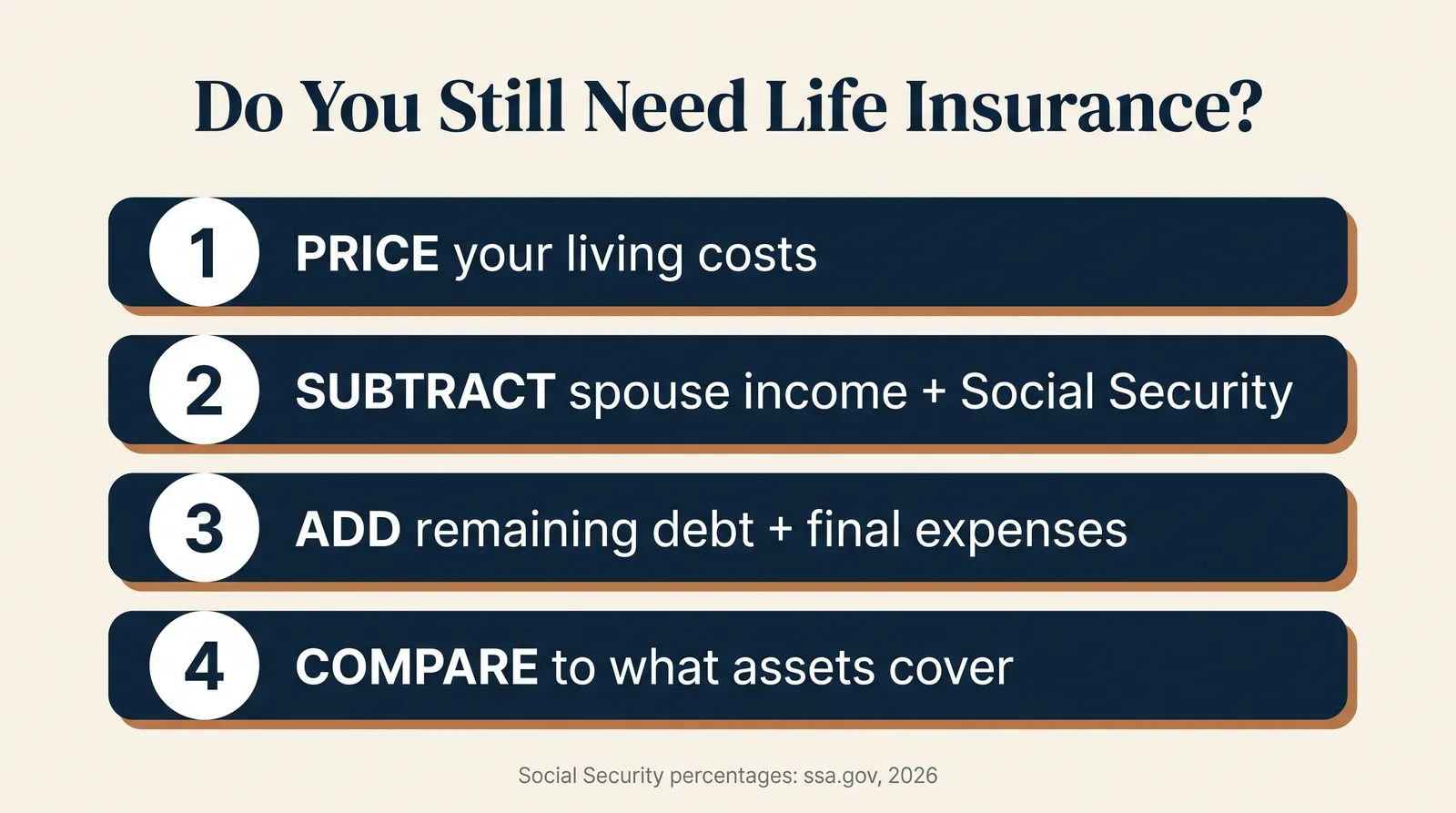
The method is the same one that applies at any life stage, it just has different inputs once the kids are grown. Start with what your household actually spends to live, not what it earned at its peak. Subtract what the surviving spouse would have coming in on their own: their own income if they work, any pension, and their Social Security survivor benefit at the age they’d realistically claim it, not the optimistic full-retirement-age number if bills would force an earlier claim.
Whatever’s left is the income gap. Add remaining debt that isn’t the mortgage, add final expenses, and add any specific legacy amount you want to guarantee regardless of how long you live or how markets perform. That total is a reasonable starting point for how much coverage, if any, still makes sense. Compare it against what your other assets, retirement accounts, a paid-off home, savings, could realistically cover without a policy. If your assets already clear the number, that’s a legitimate reason to reduce or drop coverage. If they don’t, the gap is real, even with no mortgage and no kids at home.
Timing matters here in a way it didn’t when you were insuring against a 20-year mortgage. A guaranteed insurability rider, where available, lets a policyholder increase coverage at set points without new medical underwriting, and it’s the kind of feature that mattered more when major life changes, marriage, a new baby, a bigger house, were still ahead of you. At this stage the more relevant timing question is usually the opposite: how much longer does an existing term policy run, and does converting some of it to permanent coverage before it expires make sense given your current health, versus letting it lapse and potentially needing to apply for new coverage later at an older age and, possibly, a different health picture.
Four situations, and how the math changes
Not every empty-nest household is in the same spot. Four patterns come up often enough to be worth naming directly.
Cancel because the mortgage is gone
- Decision triggered by one event: the payoff letter or the last kid's move-out date
- No check of the surviving spouse's actual income gap
- No check of the Social Security claiming-age reduction
- Legacy or final-expense goals never separately named
UntestedFeels resolved, was never calculated
Recalculate what's actually left
- Income gap priced using real household numbers, not the original 20-year-old figure
- Survivor benefit checked at a realistic claiming age, not the optimistic one
- Remaining debt and final expenses added explicitly
- Coverage reduced, converted, or kept based on what the math actually shows
DefensibleA number you can explain, either way
A household with two solid pensions and a paid-off house may genuinely need close to nothing. A household where one spouse’s income has always carried more of the load, and where the survivor would likely claim Social Security early out of necessity, may need more coverage than they assume once the mortgage stops being the anchor for the calculation. A household with a term policy about to expire and a health change since the original application has a real decision to make about conversion before that window closes. And a household with a specific goal, an amount for grandkids, funding a certain gift, is solving a different problem than income replacement entirely, and should size coverage against that goal specifically rather than reusing an old mortgage-era number.
How we help you sort out which situation you’re in
We’re independent, which means we’re not built around one carrier’s default answer for what an empty-nest household should do with an existing policy. We start with your actual numbers: what your household spends, what a surviving spouse’s income and Social Security survivor benefit would realistically be, what debt and expenses are actually left, and whether you have a specific legacy goal. From there, we compare how the carriers we represent handle reducing coverage, converting a term policy before it expires, or writing new coverage for a smaller, more specific need, since they don’t all approach it the same way.
If you’d rather have someone local run these numbers with you than build the table yourself, that’s what we do. Compare My Options.
What you get
A coverage amount, or a clear decision to reduce or drop coverage, tied to what your household actually needs today, not the multiplier that made sense when the mortgage had two decades left on it. A side-by-side look at whether converting an expiring term policy or writing new, smaller coverage fits your situation better, since that depends on your current health and goals. And a plan you can revisit again as Social Security claiming decisions, retirement account balances, and your own goals for your kids and grandkids keep changing after this one.
The mortgage being paid off answers one question. It was never the only one.
Mike MooreRelated reading
If you’re the one weighing whether to convert an expiring policy, start with what happens when term life insurance expires, which walks through renewal, conversion, and reapplying in more detail. If your original coverage amount was built around raising kids, how much life insurance you actually need shows the same method this article uses, aimed at the earlier life stage. And if permanent coverage or cash value is part of what you’re weighing, our whole life page walks through how that works.
Not sure where to start?
Read how it works first and come back when you're ready.
Later in life?
See how coverage fits together for seniors specifically.
Rather run the numbers yourself first?
Our needs calculator is a reasonable starting point.
Frequently asked questions
Do empty nesters still need life insurance?
Often, yes, though usually less than they carried while raising kids. The reasons people bought coverage in their thirties, replacing income for young children, tend to shrink once the kids are grown. But new reasons can take their place: a surviving spouse’s Social Security benefit is smaller than the household income it replaces, a mortgage may be paid off but other debt might not be, and someone still has to cover final expenses. The honest answer is to run the numbers again rather than assume either way.
When can I safely reduce or drop my life insurance coverage?
When you’ve priced what a surviving spouse would actually need and your other assets, savings, a paid-off house, retirement accounts, cover that number without the policy. That’s a specific calculation, not a birthday or an anniversary. Some empty nesters can responsibly reduce coverage in their late fifties; others still need most of what they had, because the original math never accounted for the Social Security survivor benefit reduction or because a term policy is the only thing standing between a spouse and a lower income for the rest of their life.
How much does claiming Social Security survivor benefits early actually cost?
A surviving spouse who claims at age 60 receives about 71% of the deceased worker’s benefit amount, compared with 100% at full retirement age, 66 or 67 depending on birth year, according to the Social Security Administration’s Survivors Benefits publication. That’s roughly a 29-percentage-point gap for claiming at the earliest possible age, and it’s permanent unless the surviving spouse later qualifies for a higher benefit on their own record.
Will my estate owe taxes if I still have life insurance when I die?
For most South Dakota families, no. South Dakota has no state estate or inheritance tax; the state repealed its inheritance tax effective July 1, 2001, according to the South Dakota Department of Revenue. At the federal level, the IRS set the 2026 estate tax exemption at $15,000,000 per person, meaning a married couple can shelter up to $30,000,000 with portability. Very few South Dakota estates come close to that threshold, so buying or keeping life insurance specifically to cover an estate tax bill is rarely the right reason for most families here.
Should I convert my term policy to permanent coverage instead of letting it expire?
It depends on what you’re solving for. A conversion privilege lets you convert some or all of a term policy to permanent coverage before the term ends, without new medical underwriting, which matters most if your health has changed since you first applied. If your only goal was income replacement for dependent children and that need is gone, letting the term expire or reducing it may be the more direct fit. If you want coverage that lasts your whole life, for final expenses, an estate goal, or a health change that makes new underwriting a real concern, conversion is worth pricing before the term runs out.
What if my mortgage is paid off and my kids are financially independent?
Paying off the traditional two reasons people buy life insurance doesn’t mean the number goes to zero. Price what’s left: any remaining debt, the gap between your household income and what a surviving spouse’s own income plus Social Security survivor benefits would replace, and final expenses. For a lot of empty-nest households, that remaining number is real but meaningfully smaller than what they carried at 35, which is exactly why it’s worth recalculating instead of assuming the answer is either “keep everything” or “cancel it all.”
Does life insurance still make sense for leaving money to adult children or grandchildren?
It can, but it’s a different goal than income replacement, and it’s worth naming that goal specifically rather than keeping an old policy on autopilot. Permanent life insurance can be a way to pass a set amount to heirs outside of other assets, sometimes with fewer strings than an inherited retirement account. Whether it’s the right tool compared with other options depends on your full financial picture, which is exactly the kind of question worth comparing carriers and product types on rather than deciding from a single conversation.
Sources
- LIMRA & Life Happens — 2026 Insurance Barometer Study: Rethinking Your Life (Insurance) — 2026 ownership rate, need-gap figures, and 16-year trend data
- Social Security Administration — Survivors Benefits (Publication No. 05-10084) — April 2026 edition; survivor benefit percentages by claiming age
- Social Security Administration — Marital Status and Poverty — poverty rates for widowed vs. married individuals age 65+, 2014 data
- IRS Newsroom — Tax inflation adjustments for tax year 2026 — Revenue Procedure 2025-32; 2026 federal estate tax exemption and gift exclusion
- South Dakota Department of Revenue — Individuals: Taxes — confirmation that South Dakota has no state estate or inheritance tax
- National Association of REALTORS — 2025 Profile of Home Buyers and Sellers — median age of repeat and first-time homebuyers, survey period July 2024–June 2025
- FRED (Federal Reserve Bank of St. Louis) — Median Household Income in South Dakota — U.S. Census Bureau data, 2024
Related reading: What happens when term life insurance expires; how much life insurance South Dakota families need. See our whole life page and life insurance for seniors.
Before you act on any of this
This article is general education, not insurance, legal, financial, or tax advice. Coverage availability, features, and rates vary by carrier and state and are subject to underwriting. No coverage exists until a policy is issued and in force. Any guarantees are subject to the claims-paying ability of the issuing insurer.
Do the arithmetic once, then let it rest
The mortgage payoff letter and the last kid’s move-out date both feel like a finish line. For life insurance, they’re really just a signal to recalculate, not a green light to cancel without checking. Price what’s actually left, the survivor benefit gap, the remaining debt, the final expenses, any legacy goal, and you’ll land on a number you can defend instead of a decision made on a feeling.
Want a second set of eyes on the number?
We'll work through the arithmetic with you and compare how the carriers we represent handle reducing, converting, or replacing coverage at this stage.