
If you named your child as your life insurance beneficiary and stopped there, the short answer is: South Dakota law won’t let the insurance company hand that money to a minor directly. Payouts to anyone under 18 either go to an adult custodian you named under South Dakota’s Uniform Transfers to Minors Act, or, if you didn’t name one, to a conservator the circuit court appoints under SDCL chapter 29A-5, a process that takes time, costs money, and may put someone other than your first choice in charge. None of this means naming your kids was a mistake. It means one more step, choosing who actually holds the money until they’re old enough for it, still needs to happen, and most parents who’ve done the first part have never been told about the second.
The short version
- A South Dakota life insurer cannot pay proceeds directly to a beneficiary under 18. If you named your child but no custodian or trust, the money goes to a court-appointed conservator instead, under South Dakota's Guardianship and Conservatorship Act, SDCL chapter 29A-5.
- You can name a custodian right on the beneficiary form, at no extra cost, using the exact language South Dakota's Uniform Transfers to Minors Act sets out: "as custodian for [child's name] under the South Dakota Uniform Transfers to Minors Act," per SDCL 55-10A-9.
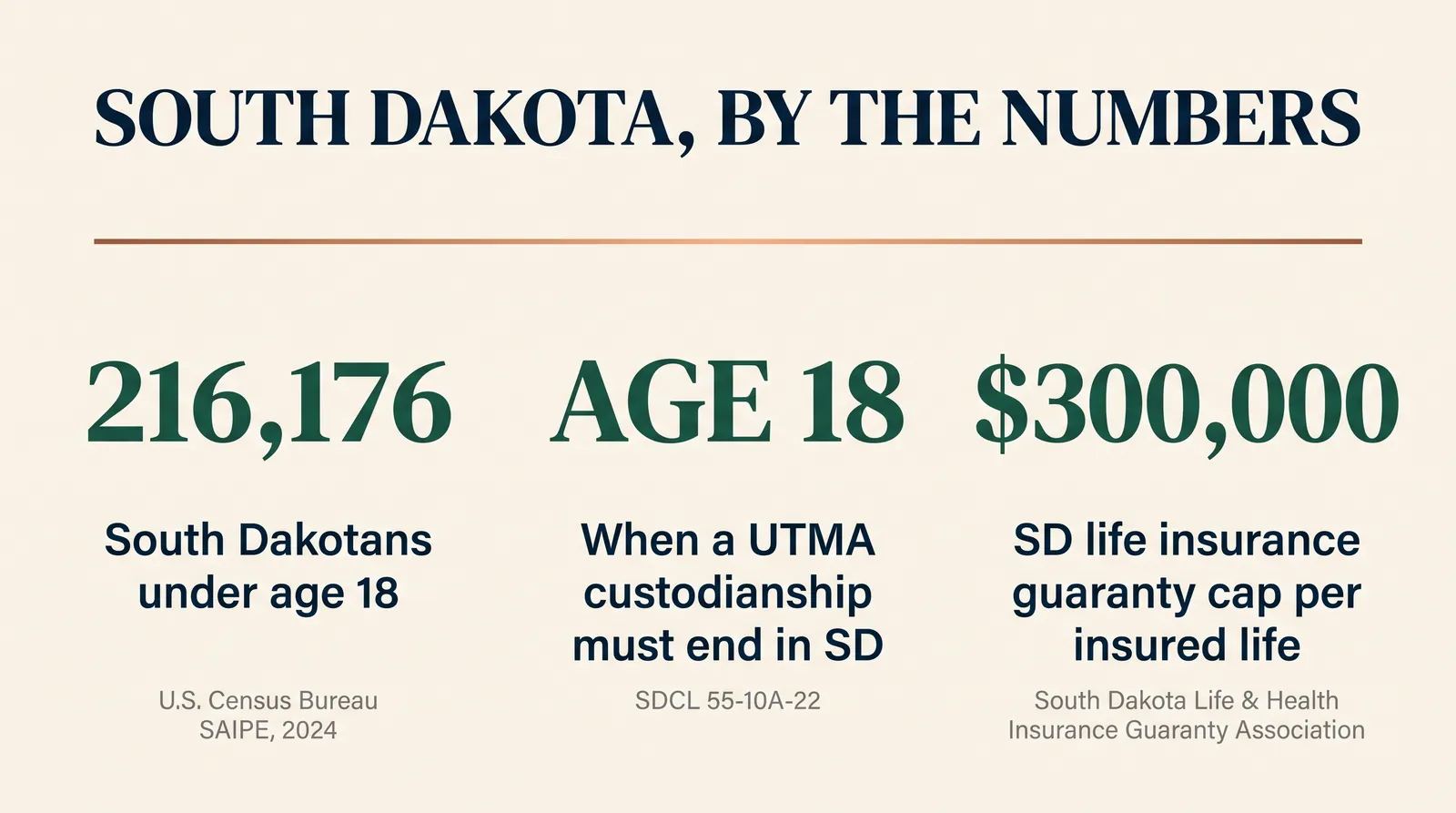
- A UTMA custodianship in South Dakota ends at 18, not 21, under SDCL 55-10A-22. Your child gets full, unsupervised control of whatever's left at that age, with no phase-in.
- 216,176 South Dakotans were under age 18 in 2024, according to the U.S. Census Bureau's Small Area Income and Poverty Estimates program. A meaningful share of this state's life insurance beneficiary designations involve a minor.
- The South Dakota Life & Health Insurance Guaranty Association caps its protection at $300,000 in death benefit and $100,000 in cash surrender value per insured life, per the Association's published FAQ. Coverage above that isn't backstopped if a carrier fails.
The moment this actually shows up
Here’s the scenario that turns this from a paperwork detail into a real problem: a parent in their thirties, married or not, dies with a $400,000 term policy in force. The beneficiary line reads “Sarah Johnson,” their nine-year-old daughter. It felt like the obvious, protective choice when they filled out the form five years ago, and in one sense it was, naming your own child ahead of anyone else is the instinct almost every parent has.
What happens next is the part nobody explained. The insurer’s claims department reviews the form, sees a minor named with no custodian and no trust attached, and cannot cut a check to a nine-year-old. The surviving parent, or a grandparent, or whoever is raising Sarah now, has to go to circuit court and ask to be appointed conservator of her estate under South Dakota’s Guardianship and Conservatorship Act. That means a petition, a sworn financial statement, notice to interested parties, and a hearing, all while also handling a funeral, a job, and a grieving household. The money isn’t gone. It’s just not available the week it’s needed most, and the person who ends up managing it is whoever the court appoints, which is usually the natural choice but isn’t guaranteed to be.
This isn’t a rare edge case. Parents of minor children are one of the largest groups of life insurance buyers in this state. The U.S. Census Bureau’s Small Area Income and Poverty Estimates program put South Dakota’s population age 0 to 17 at 216,176 in 2024, out of a state with under a million people total. A meaningful share of the beneficiary forms sitting in force behind South Dakota life insurance policies name one of those kids, and a share of those forms, nobody tracks exactly how many, name the child with nothing else specified.
Why an insurer can’t just hand the check to a nine-year-old
Beneficiary, for anyone who wants the plain definition, is the person or entity a policy owner names to receive the death benefit when the insured dies. Nothing in South Dakota law stops you from writing a minor’s name on that line. The trouble is a separate, older legal principle: a minor generally can’t sign a valid release or receipt for money in their own name, and an insurer that pays a large sum directly to a child hasn’t actually discharged its legal obligation, because the child couldn’t legally accept it on their own behalf. Insurers built their claims procedures around that reality decades ago, and South Dakota’s own statutes reinforce it by spelling out exactly how property, including life insurance proceeds, can be legally transferred for a minor’s benefit.
That’s where South Dakota’s Uniform Transfers to Minors Act, codified at SDCL chapter 55-10A, comes in. It lets a policy owner name a custodian, an adult (or a trust company) who holds and manages property for a minor without ongoing court supervision. SDCL 55-10A-9 spells out exactly how to create that arrangement for a life insurance policy: the beneficiary designation is registered “as custodian for [name of minor] under the South Dakota Uniform Transfers to Minors Act,” using that phrase in substance. Once that language is on the form, the custodian can receive and manage the death benefit the day a claim is approved, no court filing required.
If no custodian is named and there’s no trust either, the fallback is South Dakota’s Guardianship and Conservatorship Act, SDCL chapter 29A-5. A conservator is a person the circuit court appoints and supervises to manage a minor’s (or another protected person’s) financial affairs. SDCL 29A-5-201 sets out how that appointment happens: petition, a filed statement of financial resources, notice, and a hearing. Once appointed, the conservator’s duties are defined by SDCL 29A-5-404, which lets them apply the estate’s income and principal toward the minor’s support, care, health, and education without needing separate court approval for every expense, while requiring them to act in the minor’s best interest with reasonable care.
| Statute | What it covers | Why it matters here |
|---|---|---|
| SDCL 55-10A-9 | How to create a UTMA custodianship, including on a life insurance policy or annuity contract | This is the exact form language for naming a custodian on your beneficiary designation |
| SDCL 55-10A-14 | A custodian's duties, including limits on investing custodial funds in life insurance | Sets the standard of care a custodian must follow once they're holding the money |
| SDCL 55-10A-22 | Termination of a custodianship | Fixes the handoff age at 18, with no built-in option to delay it |
| SDCL 29A-5-201 | Appointment of a guardian or conservator for a minor | This is the court process that kicks in if no custodian or trust was named |
| SDCL 29A-5-404 | A minor's conservator's duties and standard of care | Governs how a court-appointed conservator, once in place, must manage the funds |
What it actually costs when nobody named a custodian
The cost here isn’t abstract, it breaks into three concrete pieces: time, control, and, for larger payouts, an insurance-specific limit that most parents have never heard of.
Time. A conservator appointment under SDCL 29A-5-201 requires a petition, a financial statement, notice to interested parties, and a hearing before the circuit court will issue letters of conservatorship. None of that happens instantly, and it’s all happening on top of a death in the family. A custodian named directly on the beneficiary form skips every one of those steps; the insurer pays the custodian once the claim is approved, the same way it would pay any adult beneficiary.
Control. This is the part that surprises people most. Whether the money passed through a court-appointed conservator or a UTMA custodian you chose yourself, South Dakota law hands it to your child, in full, with no strings and no phase-in, the day they turn 18. SDCL 55-10A-22 doesn’t allow a delayed release at 21 or 25 the way some other states’ versions of this law do. An 18-year-old a few months out of high school can end up in sole control of a six-figure sum with no obligation to spend it on tuition, a first apartment, or anything else you might have pictured when you bought the policy.
The guaranty limit. This one applies whether or not a minor is involved, but it matters more for parents of young children because their coverage amounts tend to be larger relative to what they’ve saved elsewhere. If a life insurer becomes insolvent, the South Dakota Life & Health Insurance Guaranty Association steps in, but its protection isn’t unlimited. Per the Association’s own published FAQ, coverage tops out at $300,000 in death benefit and $100,000 in cash surrender value per insured life. A $500,000 or $750,000 term policy, common for a parent with a mortgage and two kids, has real dollars sitting above that ceiling.
216,176
South Dakotans under age 18 (U.S. Census Bureau, SAIPE, 2024)
Age 18
When a UTMA custodianship must end in South Dakota, no exceptions (SDCL 55-10A-22)
$300,000
SD guaranty association's death benefit protection cap per insured life
$100,000
SD guaranty association's cash surrender value protection cap per insured life
South Dakota guaranty association protection, per insured life
Source: South Dakota Life & Health Insurance Guaranty Association, FAQ, "Are all policies fully protected?" Figures are per insured life, not per policy or per beneficiary.
Three ways to name a minor as beneficiary in South Dakota, and how to actually do each one
None of what’s below requires an attorney to get started, though a trust is worth a short consult before you finalize it. Here’s the full method for each option.
Option one: name the child directly, with nothing else. This is what most people do by default, usually without realizing it’s a choice at all. It’s legal. It’s also the option that routes the payout through South Dakota’s conservatorship process if you die while your child is still a minor, with the time and control tradeoffs covered above. If your kids are already adults, this section doesn’t apply to you; this is specifically about beneficiaries who are still minors when a claim would be filed.
Option two: name a UTMA custodian right on the form. Call your insurer, or check your policy’s online portal, and ask to update your beneficiary designation. Instead of listing your child alone, you name an adult you trust, most often the child’s other parent, a grandparent, or a sibling, using language that mirrors SDCL 55-10A-9: “[Custodian’s full name], as custodian for [child’s full name] under the South Dakota Uniform Transfers to Minors Act.” Most carriers have a standard field or format for exactly this. There’s no extra cost, no separate legal document, and no court process. Your named custodian receives and manages the money the same way any adult beneficiary would, but is legally bound by SDCL 55-10A-14 to a “prudent person” standard of care and must keep the funds separate and identifiable as the child’s property. The one fixed limitation: SDCL 55-10A-22 hands the child full control at 18, no matter how large the balance is or how ready you think they’ll be.
Option three: name a trust as beneficiary. A trust, for anyone new to the term, is a legal arrangement where a trustee holds and manages assets according to written instructions you create, called the trust document, for the benefit of someone else, here, your minor child or children. Naming a trust as beneficiary costs more upfront, since it requires drafting the trust itself, but it removes the one fixed limit a UTMA custodianship carries: you decide the distribution age or ages (a third at 25, a third at 30, the rest at 35 is a common pattern), and you can add conditions, like releasing funds for college costs before a set age. This option makes the most sense as your coverage amount grows, or if you specifically don’t want an 18-year-old holding six figures with no restrictions.
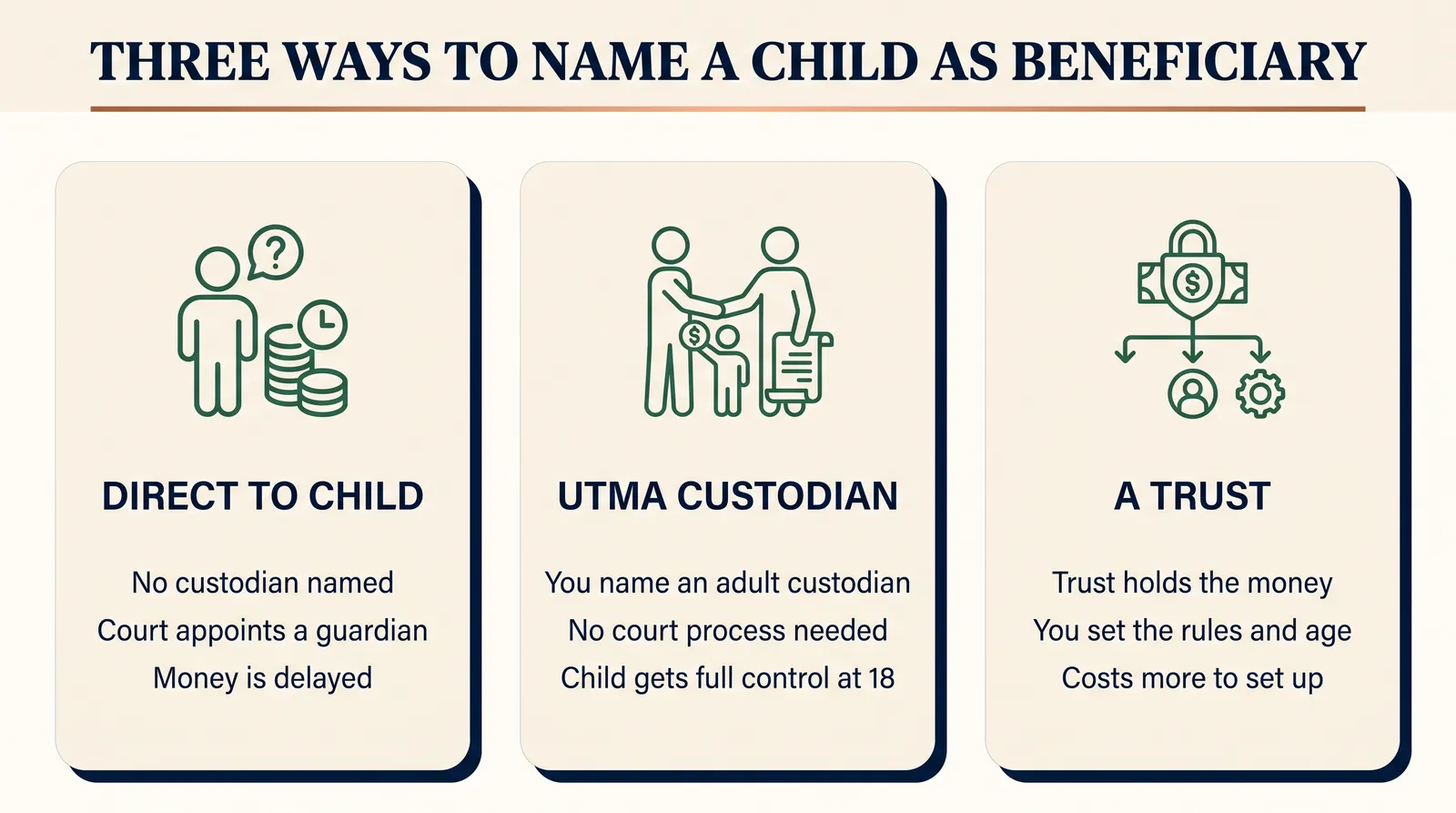
| Method | Who controls the money until then | When your child gets full control | Cost to set up | Court involved? |
|---|---|---|---|---|
| Child named directly, nothing else | Whoever the circuit court appoints as conservator | 18, after the conservatorship ends | None upfront; court and conservator costs apply after a claim | Yes |
| UTMA custodian named on the form | The adult custodian you chose | 18, fixed by SDCL 55-10A-22 | None | No |
| A trust named as beneficiary | The trustee you named, per the trust's instructions | Whatever age or ages you specify | Higher; requires drafting the trust document | No |
Child named, no custodian
- Insurer can't release funds directly to your child
- Family petitions circuit court for a conservator under SDCL 29A-5-201
- Notice, a financial statement, and a hearing come before the money moves
UTMA custodian named
- Custodian named in the exact language of SDCL 55-10A-9
- Insurer pays the custodian once the claim is approved
- No petition, no hearing, no waiting on the court's calendar
You can run through options two and three on your own, in about twenty minutes, without anyone’s help: pull up your policy, find the beneficiary change form, decide whether a UTMA custodian is enough for your situation or whether the amount and your wishes call for a trust instead, and pick the actual person or trustee you’d name. Most people find the harder decision isn’t the paperwork, it’s deciding who that person should be, which is worth sitting with rather than rushing.
Not ready to make either call today? How it works walks through what working with us actually looks like, with no obligation attached to reading it.
A worked example: two kids, one policy, one custodian question
Take a couple in Brookings with a $500,000 term policy on the primary earner and two kids, ages 4 and 7. The policy currently names both kids as co-beneficiaries, 50% each, with no custodian language on file. Here’s how the choice actually plays out for this family.
Naming a single UTMA custodian, say the other parent, for both kids is the simplest fix and the one most families in this situation choose. South Dakota’s UTMA statute doesn’t require a separate custodian per child, so the form can read “[Custodian’s name], as custodian for [Child 1’s name] under the South Dakota Uniform Transfers to Minors Act” and repeat the pattern for the second child, naming the same adult for both. If something happens to both parents, the form should also name a successor custodian, since SDCL 55-10A doesn’t automatically substitute one if the first custodian is unavailable; most insurers’ beneficiary forms have a field for exactly this.
The number that actually changes the decision for this family is the payout size relative to each child’s age gap to 18. The 7-year-old is 11 years from a lump-sum handoff with no strings attached; the 4-year-old is 14 years out. A UTMA custodian works fine for a $50,000 or $100,000 policy. At $250,000 per child, split evenly from a $500,000 policy, some parents in this exact situation decide the amount is large enough that a trust, with staggered distributions instead of one release at 18, is worth the extra drafting cost. There’s no fixed dollar line where that decision flips; it’s a judgment call based on your own comfort with an 18-year-old holding that specific number.
| If they choose | Each child receives | Fully released |
|---|---|---|
| No custodian, no trust | $250,000, held by a court-appointed conservator | Age 18 |
| UTMA custodian named | $250,000, held by the chosen custodian, no court process | Age 18 |
| Trust as beneficiary | $250,000, held by the trustee per the trust's schedule | Whatever ages the parents choose |
Edge cases worth naming honestly
You’re a single parent with no obvious second choice. A UTMA custodian doesn’t have to be the child’s other parent. It can be a sibling, a parent, a close friend, anyone you trust with money and with your child’s interests, as long as they’re an adult willing to serve. If you genuinely can’t think of anyone, that’s worth raising directly in a conversation with an agent or attorney rather than leaving the field blank; naming no one defaults you back to the court process this whole guide is about avoiding.
Your kids are different ages with a big gap between them. Nothing in SDCL 55-10A requires identical treatment. You can name different custodians for different children if that makes sense for your family, or use a trust with different distribution ages tailored to each child, since a trust document is written to your specifications rather than a one-size statute.
You’re recently divorced and your ex is currently named as custodian. This is exactly the kind of designation that goes stale. Nothing changes automatically when a divorce is finalized; the old form stays in force until you submit a new one. If your circumstances changed, check this specific field, not just the primary beneficiary line, since it’s easy to update one and forget the other.
Your named custodian dies or becomes unable to serve before your child turns 18. Naming a successor or backup custodian on the same form prevents this from reopening the exact court-conservator process a UTMA custodian was meant to avoid. Not every insurer’s standard form has a dedicated successor field; if yours doesn’t, ask how to add one in writing.
What happens in South Dakota’s guardianship court process, step by step
If you’re the surviving parent or relative facing this without a named custodian, here’s what the process under SDCL chapter 29A-5 actually involves, so it isn’t a surprise on top of everything else. First, someone, usually a close relative, files a petition asking the circuit court to appoint them conservator of the minor’s estate, along with a sworn statement of financial resources, both required under SDCL 29A-5-201. Interested parties get notice, and the court holds a hearing before issuing letters of conservatorship. Once appointed, the conservator can apply the funds toward the child’s support, care, health, and education without asking the court’s permission for each individual expense, per SDCL 29A-5-404, but remains accountable to the court, including through periodic accountings, which the court can waive or reduce in frequency under SDCL 29A-5-409 when the administrative burden outweighs the benefit.
The court usually appoints a sensible choice, but it isn't automatic
In most families, the court appoints the surviving parent or an obvious close relative, and the outcome looks similar to what a named custodian would have done anyway. The difference is that with a conservator, that outcome runs through a petition and a hearing instead of being settled in advance, and the court, not you, makes the final call on who's appointed if more than one relative steps forward.
This is also why insurers built UTMA custodian language into their own beneficiary forms in the first place: it lets a family skip this exact process. Several national carriers’ own beneficiary and claims documentation describes the same mechanics South Dakota’s statute sets out, that a minor beneficiary’s payout is generally directed to a named UTMA custodian if one exists, and to a court-appointed guardian or conservator of the minor’s estate if one doesn’t.
How we help
We’re independent, which means the beneficiary conversation isn’t a one-size-fits-all script. When someone comes to us with young kids, we walk through their actual policy amount, their actual family situation, who they’d trust to hold money for their kids, and whether a UTMA custodian is enough or a trust makes more sense given the amount involved. We’re not attorneys and don’t draft trust documents ourselves, but we can point you toward what your situation likely calls for and help make sure the beneficiary designation on your actual policy matches the plan you land on. Compare My Options.
What you get
A beneficiary designation that actually does what you think it does, instead of one that quietly defaults to a court process you never chose. A named custodian or trust, on file, so the money reaches the person you’d want holding it, on the timeline you’d want, without your family navigating a conservatorship petition during the worst week of their lives. And, if you’re buying or reviewing coverage at the same time, a policy sized with this question already answered instead of left for later.
Naming your kid as beneficiary is the right instinct. It's just not the whole form. One more line, a custodian's name, is what actually gets the money to them the way you pictured it.
Mike MooreRelated reading
If you’re weighing how much coverage to buy in the first place, see how much life insurance Sioux Falls families need. If you just had a baby or are planning to, see life insurance before or after baby arrives. And if one parent stays home with the kids, see does a stay-at-home parent need life insurance.
Not sure how much coverage you actually need?
See how much life insurance Sioux Falls families need before you touch the beneficiary form.
Planning around final expenses too?
See final expense planning and rising funeral costs in South Dakota.
Not ready to talk to anyone yet?
Read how it works first and come back when you are.
Frequently asked questions
Can a minor be named as a life insurance beneficiary in South Dakota?
You can name a minor on the form, but a South Dakota life insurer cannot pay policy proceeds directly to someone under 18. Without a named custodian or trust, the payout goes to a court-appointed conservator instead, under South Dakota’s Guardianship and Conservatorship Act, SDCL chapter 29A-5. Naming the minor is legal; it’s just not the same as making sure the money reaches them smoothly.
What is a UTMA custodian on a life insurance beneficiary form?
Under South Dakota’s Uniform Transfers to Minors Act, SDCL 55-10A-9, you can name an adult (or a trust company) to hold life insurance proceeds for a minor by registering the designation as “[Custodian’s name], as custodian for [child’s name] under the South Dakota Uniform Transfers to Minors Act.” The custodian manages the money without court supervision until the child turns 18, per SDCL 55-10A-22.
At what age does a South Dakota UTMA custodianship end?
- SDCL 55-10A-22 requires the custodian to transfer the property to the minor, or to the minor’s estate if the minor has died, at the earlier of the minor turning 18 or the minor’s death. South Dakota does not offer the age-21 extension some other states allow under their own UTMA statutes.
What happens if I name my minor child as beneficiary and don’t name a custodian?
The insurer generally cannot release the money to the child, so it’s held while an adult, often a parent, grandparent, or other relative, petitions the circuit court to be appointed conservator of the minor’s estate under SDCL 29A-5-201. That requires filing a petition and a financial statement, giving notice, and a hearing before the court, and the person the court appoints may not be who you would have chosen.
Is a trust better than a UTMA custodian for a life insurance payout?
It depends on the amount and what you want controlled. A UTMA custodian is simpler and free to set up, but hands the child full, unsupervised control at 18. A trust costs more to draft but lets you set your own age or ages for distribution, and name conditions, which matters more as the payout gets larger relative to what an 18-year-old should reasonably manage alone.
Does South Dakota’s insurance guaranty fund protect the full death benefit if my insurer fails?
Only up to a limit. The South Dakota Life & Health Insurance Guaranty Association protects up to $300,000 in life insurance death benefits and up to $100,000 in cash surrender value per insured life if a member insurer becomes insolvent, according to the Association’s published FAQ. A policy larger than $300,000, common for parents of young children, has an amount above that limit that isn’t backstopped by the guaranty fund.
Can I change my life insurance beneficiary designation later if my kids grow up?
Yes, as long as you own the policy and didn’t name an irrevocable beneficiary. Beneficiary designations are one of the easiest parts of a policy to update: most carriers let you submit a new form any time, and it’s worth revisiting after a birth, a divorce, a custodian’s death, or simply when your named custodian is no longer the right choice.
Sources
- South Dakota Legislative Research Council — Codified Law 55-10A-9 — manner of creating custodial property, including on a life or endowment insurance policy, under South Dakota’s Uniform Transfers to Minors Act; accessed September 2026
- South Dakota Legislative Research Council — Codified Law 55-10A-14 — a custodian’s standard of care and limits on investing custodial funds in life insurance on the minor’s life; accessed September 2026
- South Dakota Legislative Research Council — Codified Law 55-10A-22 — termination of a custodianship at the minor’s attainment of eighteen years of age or death; accessed September 2026
- South Dakota Legislative Research Council — Codified Law 29A-5-201 — appointment of a guardian or conservator of a minor by petition, financial statement, notice, and hearing; accessed September 2026
- South Dakota Legislative Research Council — Codified Law 29A-5-404 — a minor’s conservator’s responsibilities and standard of care; accessed September 2026
- U.S. Census Bureau — Small Area Income and Poverty Estimates, Poverty Universe Age 0-17, South Dakota — 216,176 South Dakotans age 0-17, 2024 estimate; accessed September 2026
- South Dakota Life & Health Insurance Guaranty Association — FAQ — $300,000 per-insured-life death benefit cap and $100,000 cash surrender value cap; accessed September 2026
Related reading: how much life insurance Sioux Falls families need, life insurance before or after baby arrives, does a stay-at-home parent need life insurance, and final expense planning and rising funeral costs in South Dakota.
Before you act on any of this
This article is general education, not insurance, legal, financial, or tax advice, and describes South Dakota statutes as of the dates cited; consult the current codified law and a licensed attorney before drafting or relying on a trust document. Product availability, features, and rates vary by carrier and are subject to underwriting. No coverage exists until a policy is issued and in force. Any guarantees are subject to the claims-paying ability of the issuing insurer. Please review actual policy documents and speak with a licensed agent about your own situation.
One line on a form, decided now instead of decided by a court later
Most parents who name their kids as beneficiary never revisit the form again, because nothing prompts them to. The naming isn’t the problem. The blank custodian field is. Pull up your policy this week, check whether a custodian is named next to your child’s name, and if it isn’t, decide who you’d actually want holding that money and add it. It takes less time than most of the errands already on your list.
Want help matching coverage and beneficiaries to your actual family?
We'll walk through your policy amount, your kids' ages, and who you'd trust to hold the money, and make sure your beneficiary designation says what you actually mean.