
Yes, many people living with HIV can qualify for life insurance today, though not automatically and not from every carrier. Since December 2015, at least one major U.S. life insurer has published underwriting criteria specifically for HIV-positive applicants, according to a Pennsylvania Insurance Department announcement, and other carriers have built out programs of their own since. What determines your outcome is not the diagnosis by itself, it is your CD4 count, whether your viral load is undetectable, how long you have been stably treated, and what else is on your medical chart. This guide walks through how that underwriting actually works, what South Dakota law specifically protects when you apply, and the honest numbers behind a topic most people never see explained in plain language.
The short version
- A major national carrier began offering term life insurance to certain HIV-positive applicants in December 2015, based on age, CD4 count, treatment duration, and viral suppression, according to a Pennsylvania Insurance Department announcement covering that carrier's published criteria.
- South Dakota Division of Insurance Bulletin 87-1 (May 6, 1987), still published on the division's website, requires written consent before an AIDS-related test, limits adverse decisions to results from an established test protocol, and bars any question aimed at determining sexual orientation.
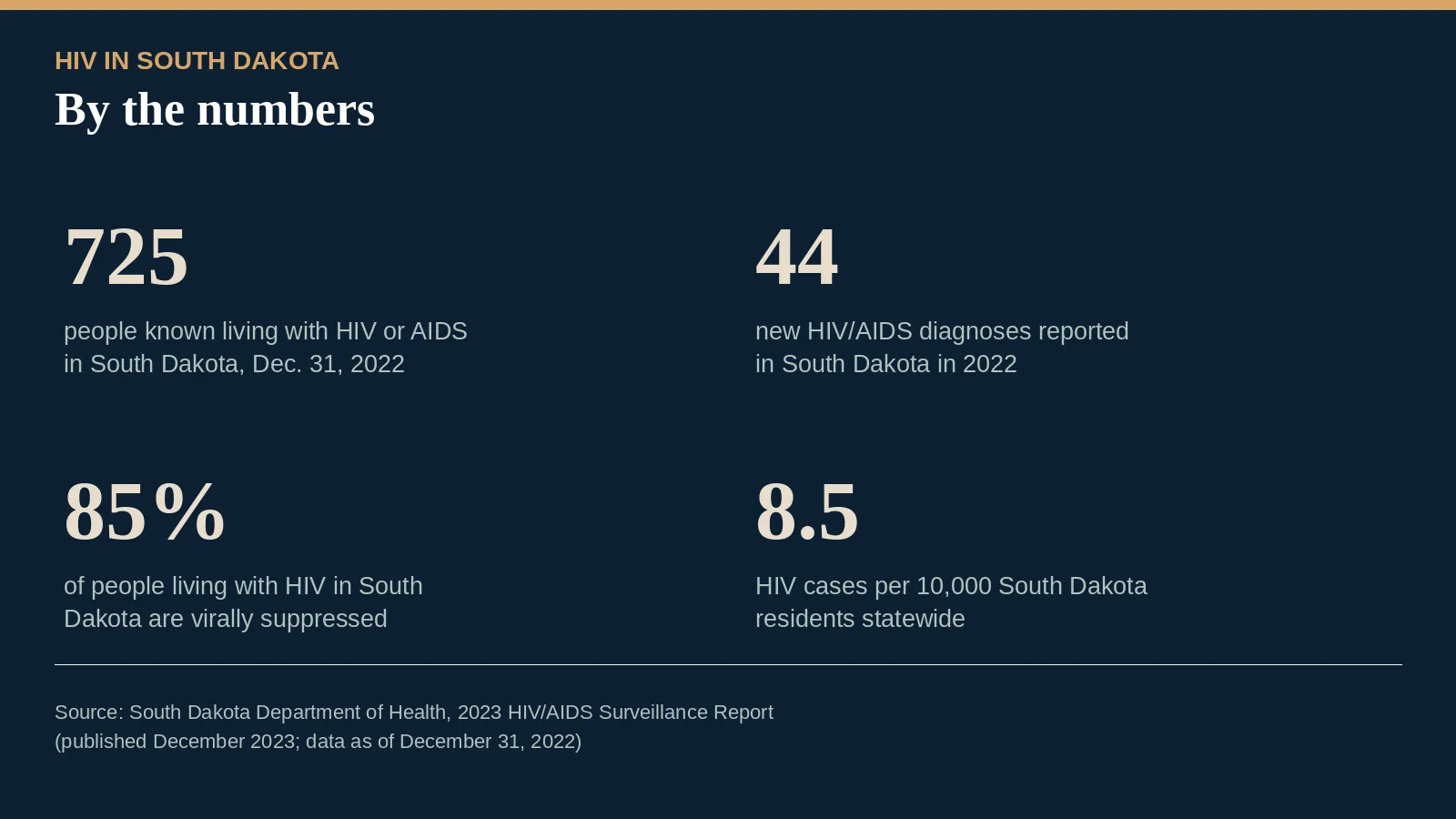
- 725 people were known to be living with HIV or AIDS in South Dakota as of December 31, 2022, with 44 new diagnoses that year, and 85% of people living with HIV in the state were virally suppressed, according to the South Dakota Department of Health's 2023 HIV/AIDS Surveillance Report.
- A 2012 UK Collaborative HIV Cohort Study found a 35-year-old starting treatment with a CD4 count of 350 or higher had a projected life expectancy to about 77 (men) or 79 (women), against a 2024 U.S. life expectancy at birth of 79.0 years, per the CDC.
- Nationally, 38,793 people received an HIV diagnosis in 2024, and an estimated 1.16 million people were living with diagnosed HIV in the United States at the end of that year, according to the CDC's National HIV Surveillance System.
The pain: assuming the answer is no before you ever ask
Most people who carry an HIV diagnosis and think about life insurance do their thinking alone, based on what they remember hearing decades ago, not on anything current. The story most people absorbed came from the 1980s and early 1990s, when a positive test meant an almost certain decline from every carrier, full stop, no exceptions, no path forward. That was the reality then. It has not been the reality for a while, and the gap between what people assume and what is actually available has become its own quiet barrier, one that keeps people from ever filling out an application in the first place.
The people this affects are not a small or unusual group. They are a parent in Rapid City managing an undetectable viral load for a decade who has never once looked into whether coverage exists, because the last thing they read about it was old news from a relative’s magazine. They are a self-employed contractor in Sioux Falls who assumed a diagnosis meant automatic disqualification and stopped researching after the first search result confirmed the fear. They are a spouse who wants to protect a mortgage and a family’s future income and has simply never asked, because asking felt like it would only produce a rejection they already expected.
None of this is irrational. For a long stretch of life insurance history, the assumption was correct. What has not caught up is the underwriting reality behind it, which has moved substantially since modern antiretroviral therapy became the standard of care. The confusion is not a personal failing. It is that almost nobody explains, in plain terms, what changed, when it changed, and what a carrier is actually evaluating today when this question comes up on an application.
This is general education, not medical or insurance advice
Nothing here diagnoses, treats, or recommends a course of medical care, and nothing here promises that any specific carrier will approve any specific applicant. It is a plain explanation of how underwriting for HIV has changed, sourced from state and federal records and a documented industry announcement, so you can see the landscape clearly before you decide whether to apply.
Why it happens: what changed, and what underwriters actually evaluate
Life insurance underwriting is, at its core, a mortality estimate. A carrier is pricing the statistical likelihood that it will pay a death benefit within a given period, and it prices coverage based on how that risk compares to a large pool of similar applicants. For most of the AIDS epidemic’s first two decades, there was no meaningful way to underwrite HIV as anything other than an automatic decline, because the mortality data at the time did not support any other conclusion. Modern antiretroviral therapy (ART), the combination of medications that suppress HIV to undetectable levels in the blood, changed the underlying math the same way any major medical advance eventually reshapes an actuarial table. It simply took the insurance industry years to build underwriting programs around it.
A handful of terms come up constantly in this specific underwriting conversation, and they are worth defining once, since a carrier’s application or field guide will use them without translation:
- CD4 count measures the number of CD4 cells (a type of white blood cell) per cubic millimeter of blood, an indicator of immune system strength. A higher, stable CD4 count over time is generally viewed as a favorable sign in underwriting.
- Viral load measures the amount of HIV genetic material in the blood. An undetectable viral load means the virus is suppressed below the level standard lab tests can measure, generally interpreted as effective treatment response.
- Antiretroviral therapy (ART) is the standard medication regimen for treating HIV. How long an applicant has been on a stable ART regimen, without recent changes, is a common underwriting factor.
- AIDS-defining condition refers to any of a specific set of illnesses the CDC uses to classify a case as having progressed to AIDS. Its presence or absence on your history is typically a major factor in whether a carrier will consider an application at all.
- Underwriting class (or rate class) is the risk tier a carrier assigns an approved applicant, which sets the premium. HIV-positive applicants who qualify are generally priced in a specialized or substandard class reflecting elevated but insurable risk, not the standard classes offered to applicants without a chronic condition.
- Contestability period is the window, typically two years from a policy’s issue date, during which an insurer can investigate a claim and deny it if it finds a material misstatement on the original application. This is why accurate disclosure at application time matters regardless of what you assume the outcome will be.
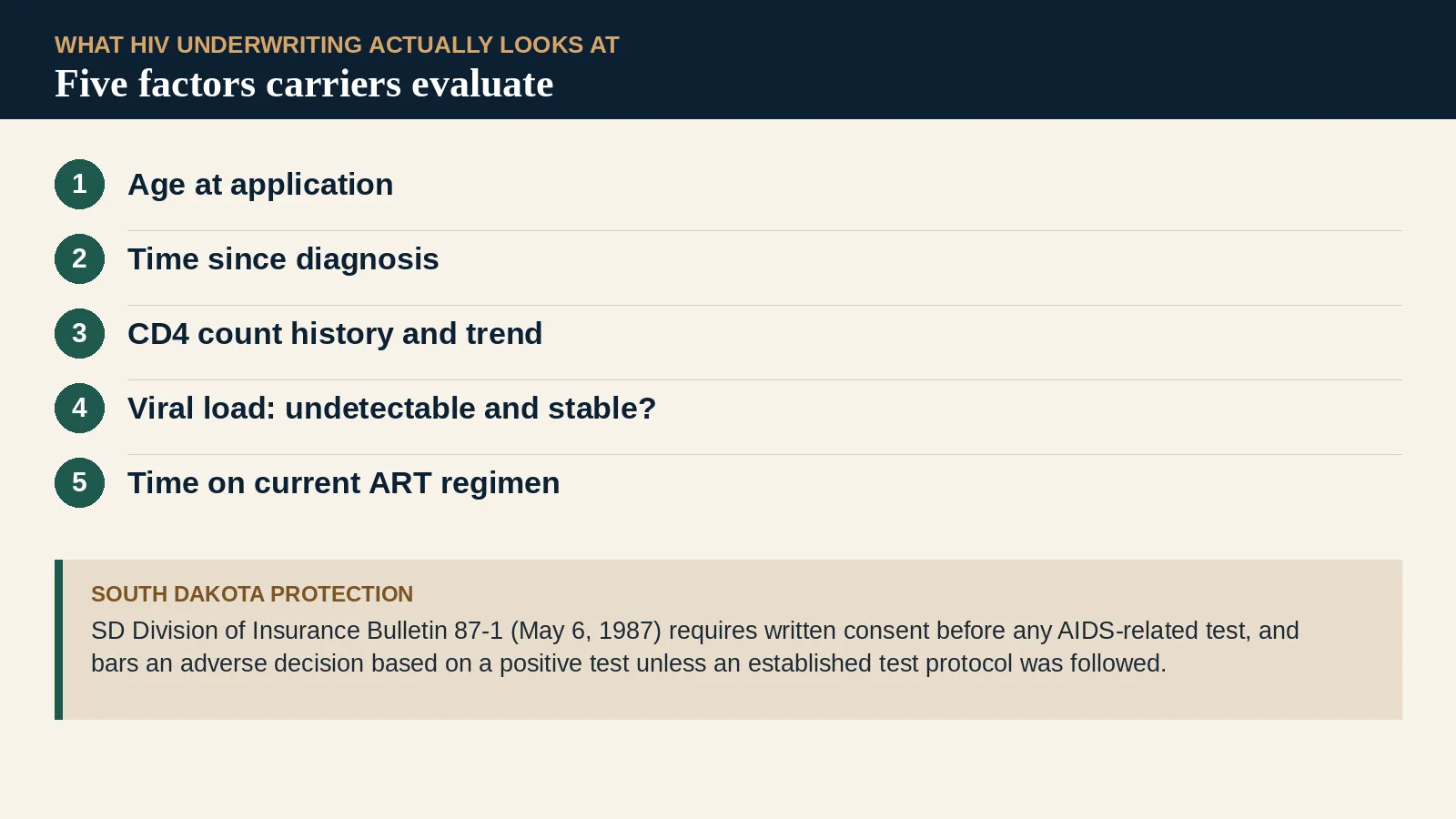
The shift in underwriting became publicly visible in December 2015, when a major national carrier announced it would offer individual term life insurance to certain HIV-positive applicants, a first for a large insurer of its size. The Pennsylvania Insurance Department’s December 2, 2015 announcement, commending the carrier’s move, described the published eligibility framework at the time: applicants had to be U.S. residents between ages 30 and 60, have a CD4 count above 200 with no history of an AIDS-defining condition, and have been diagnosed more than one year earlier with, if on treatment, more than six months on their current ART regimen. That specific 2015 framework is an illustrative historical example, not a current universal standard. Underwriting guidelines are set by each carrier individually, get revised over time, and vary in ways an applicant cannot predict from a single company’s published criteria years later. What the 2015 announcement demonstrates reliably is the shift itself: HIV moved, for at least some applicants, from an automatic decline to a condition carriers actively underwrite using medical benchmarks, the same category treatment most other chronic conditions on this blog, like diabetes or heart disease, already receive.
What South Dakota specifically protects when you apply
South Dakota has its own, specific, and still-published regulatory guidance on this exact question, and it predates the 2015 shift in national carrier practice by nearly three decades. Division of Insurance Bulletin 87-1, “Medical/lifestyle questions on applications and underwriting guidelines affecting AIDS and ARC,” issued May 6, 1987 by then-Director of Insurance Mary Jane Cleary, remains posted on the South Dakota Division of Insurance’s official bulletins page. It was written at the height of the AIDS crisis, when insurers nationally were grappling with how to handle applications from people with HIV or AIDS, and several of its provisions still describe real, current consumer protections a South Dakota applicant can point to:
- Written consent is required. Whenever an applicant is asked to take an AIDS-related test as part of an insurance application, the insurer must disclose that fact and get written consent first.
- A positive test alone is not enough. No adverse underwriting decision may be made on the basis of a positive AIDS-related test unless an established test protocol was followed. The bulletin’s 1987 text describes that protocol using the testing technology of its era; modern HIV testing has advanced since, but the underlying principle, that a single unconfirmed result cannot be the sole basis for a decline, remains the bulletin’s operative standard.
- Seeking counseling cannot be held against you. An insurer cannot make an adverse decision because medical records show an applicant sought counseling for AIDS-related concerns from a health care professional, distinct from actually seeking treatment or diagnosis.
- No question may target sexual orientation. The bulletin bars any application question, medical inquiry, or investigation designed to establish an applicant’s sexual orientation, and bars using sexual orientation in underwriting at all.
These are not abstract legal footnotes. If a South Dakota applicant is ever asked to test without being told why, or is declined based on an unconfirmed result, or faces a question that reads as fishing for something other than a medical fact, Bulletin 87-1 is the specific, named state authority describing what is and is not permitted, and it has been sitting on the state’s own website, unrepealed, for nearly forty years.
What it costs to get wrong: the numbers behind the assumption
The clearest way to see how far underwriting and medical treatment have moved is to look at the actual data, not the decades-old assumption. Start with where things stood at the start of the epidemic: someone diagnosed with AIDS in the 1980s, before effective antiretroviral treatment existed, could expect to live only one to two years after diagnosis, according to HIV.gov, the federal government’s HIV information site. That is the origin of the “automatic decline, no exceptions” assumption, and it was, at the time, an accurate reflection of the underlying mortality risk.
Modern treatment changed that curve substantially. A 2012 analysis by the UK Collaborative HIV Cohort (UK CHIC) Study, published in the Journal of the International AIDS Society, modeled projected life expectancy for people who started antiretroviral therapy with a CD4 count of 350 cells per cubic millimeter or higher, generally considered a favorable starting point for treatment. For a 35-year-old in that category, the study projected roughly 42 additional years of life for men (to about age 77) and 44 additional years for women (to about age 79). For comparison, U.S. life expectancy at birth for the general population was 79.0 years in 2024, up from 78.4 in 2023, according to the CDC’s National Center for Health Statistics. That 2012 projection is not a promise about any individual’s outcome, treatment has continued to improve since, and every person’s health picture differs, but it illustrates why underwriters now have a very different mortality curve to work from than they did in the 1980s.
| Measure | Figure |
|---|---|
| Life expectancy after AIDS diagnosis, pre-treatment era (1980s) | 1 to 2 years |
| Projected life expectancy, 35-year-old man starting ART with CD4 ≥350 (UK CHIC Study, 2012) | to about age 77 |
| Projected life expectancy, 35-year-old woman starting ART with CD4 ≥350 (UK CHIC Study, 2012) | to about age 79 |
| U.S. life expectancy at birth, general population, 2024 | 79.0 years |
HIV.gov, "Aging with HIV," accessed 2026; UK Collaborative HIV Cohort (UK CHIC) Study, Journal of the International AIDS Society, 2012; CDC/NCHS, "Mortality in the United States, 2024," NCHS Data Brief No. 548, January 2026. Illustrative population-level projections, not individual guarantees.
The scale of who this affects is not small, nationally or in South Dakota. Nationally, 38,793 people received an HIV diagnosis in 2024, and an estimated 1.16 million people were living with diagnosed HIV in the United States at the end of that year, according to the CDC’s National HIV Surveillance System. In South Dakota specifically, the state’s own numbers tell a similarly concrete story.
New HIV/AIDS diagnoses reported in South Dakota, selected years
South Dakota Department of Health, 2023 HIV/AIDS Surveillance Report (published December 2023, data through 2022). Figures combine cases classified as HIV and as AIDS at diagnosis, by gender assigned at birth as reported.
The same report’s HIV Care Continuum data, a standard federal framework for tracking outcomes among people already diagnosed, shows how far treatment engagement has come in South Dakota specifically: of people known to be living with HIV in the state as of December 31, 2022, 98% had received care, 93% were retained in ongoing care, 94% had been prescribed ART, and 85% had achieved viral suppression.
| Stage | Share of cases |
|---|---|
| Diagnosed | 100% |
| Received care | 98% |
| Retained in care | 93% |
| Prescribed ART | 94% |
| Virally suppressed | 85% |
South Dakota Department of Health, 2023 HIV/AIDS Surveillance Report (published December 2023).
The real cost of getting this wrong is not a number on a spreadsheet, it is the coverage gap created when someone assumes an outcome and never applies to find out. Given how many South Dakotans are living with HIV, stably treated, and virally suppressed, per the state’s own data, an untested assumption that “there’s no point applying” is very likely wrong for a meaningful share of that group, particularly anyone who has been stable on treatment for a while.
How to work it out yourself: five things to gather before you apply
You do not need anyone’s help to get a clear, honest picture of where you stand before you talk to a carrier or an agent. This takes about twenty minutes if you already see a provider regularly.
- Confirm your diagnosis date. How long it has been since diagnosis is one of the most common factors in whether a carrier will consider an application at all, so know the actual date, not an approximate year.
- Pull your recent CD4 count history. A single number matters less than the trend. A stable or rising CD4 count over your recent lab history reads differently to an underwriter than a recent, unexplained drop.
- Confirm your current viral load status. Whether your viral load is undetectable, and how long it has stayed that way, is typically one of the most heavily weighted factors in this specific type of underwriting.
- Document your ART regimen and how long you have been on it. A regimen that has been stable for a meaningful stretch, without a recent change, is generally viewed more favorably than one still being adjusted.
- List everything else on your chart honestly. Coinfections such as hepatitis B or C, any AIDS-defining condition history, and any other chronic conditions all factor into the full underwriting picture, and leaving one out does not make the eventual answer more favorable, it just risks a contestability problem later.
You can gather all of this yourself first
Steps 1 through 5 just require your own medical records and a few minutes with your provider portal. Where a second opinion tends to help most is comparing how different carriers actually treat the same file, since underwriting guidelines for HIV vary significantly company to company and change over time, in a way that is very hard to research alone from the outside.
If you would rather have someone local go through that comparison with you, that is what we do: Compare My Options.
A worked example: a stable, treated diagnosis in Sioux Falls
Take a hypothetical 41-year-old in Sioux Falls, diagnosed with HIV eight years ago, who has been on the same ART regimen for the last four years without a change, has an undetectable viral load documented at every check for the last three years, and has no AIDS-defining condition or coinfection on record. This person has a $180,000 mortgage balance and two kids in elementary school, the same kind of obligations that drive most life insurance decisions in this state, regardless of health history.
| Factor | This applicant's profile |
|---|---|
| Time since diagnosis | 8 years |
| Time on current ART regimen | 4 years, no changes |
| Viral load | Undetectable for 3+ years |
| AIDS-defining condition history | None on record |
| Coinfections (hepatitis B/C, TB) | None on record |
Hypothetical illustrative example only, not a quote or a guarantee of any outcome. Actual underwriting decisions depend on the applicant's full medical record, the specific carrier, and factors beyond those listed here.
Under the general shape of the criteria a major carrier published when it opened this category of underwriting in December 2015, age, CD4 status, viral suppression, time since diagnosis, and time on stable treatment, a profile like this one sits closer to the favorable end of what carriers in this space have historically evaluated. It is not a guarantee: coverage amount, premium, and the final decision depend on the specific carrier’s current guidelines, this applicant’s full chart, and the underwriting outcome, which can only be determined by actually applying. What the example shows is the difference between a genuinely unfavorable file and a stable, well-documented one, a distinction that gets lost entirely if the application is never submitted.
The mistake isn't applying and getting a difficult answer. It's assuming the answer and never finding out what it actually is.
Mike Moore, Life Insurance AdvisorHow we help
We are independent, so we are not tied to the one or two carriers that were first to build HIV underwriting programs, and we are not selling a single company’s guidelines as the only answer. We start with your actual diagnosis history, treatment record, and what you are trying to protect, whether that is a mortgage, years of income for a spouse, or your kids’ remaining years at home, and compare how the carriers we work with actually evaluate a file like yours. Underwriting guidelines in this specific area vary more than almost any other condition we cover on this blog, and they change as carriers update their programs, which is exactly the kind of moving target an independent agency is positioned to track on your behalf rather than you tracking it alone from a single company’s outdated web page.
What you get
A clear, honest read on how your specific diagnosis history, CD4 and viral load trend, and treatment duration line up against what carriers are actually looking for right now, not what the internet assumed in 2004. A comparison across more than one carrier’s underwriting approach, instead of a single company’s yes or no treated as the final word. And South Dakota’s own Bulletin 87-1 protections explained plainly, so you know what an insurer is and is not allowed to ask or do during the process.
Find out what your options actually look like
We will go through your diagnosis history, treatment record, and what you need to protect, and show you how the carriers we work with actually evaluate a file like yours.
Not ready to talk to anyone yet? Read How It Works first and come back when you are.
Frequently asked questions
Can you get life insurance if you have HIV?
For many people, yes, though not from every carrier and not automatically. Since 2015, at least one major national carrier has published underwriting criteria for offering term life insurance to HIV-positive applicants who meet specific health benchmarks, according to a Pennsylvania Insurance Department announcement from December 2, 2015. Other carriers have since developed their own criteria. Outcomes depend on your CD4 count, viral load, how long you have been diagnosed and treated, and whether you have other conditions, so the honest answer is “it depends on your specific file,” not an automatic yes or no.
What do underwriters actually look at for an HIV-positive applicant?
Based on the criteria a major carrier published when it first opened this coverage in 2015, common factors include your age, how long it has been since diagnosis, how long you have been on antiretroviral therapy (ART), your CD4 count history, whether your viral load is undetectable and stable, and whether you have an AIDS-defining condition or a coinfection such as hepatitis. Every carrier sets its own underwriting guidelines, and these 2015 criteria are an illustrative example, not a universal or current standard for every company.
Does South Dakota have any specific protections for HIV-related life insurance applications?
Yes. South Dakota Division of Insurance Bulletin 87-1, issued May 6, 1987 and still published on the division’s website, sets rules that remain relevant today: an insurer must get your written consent before requesting an AIDS-related test, cannot make an adverse underwriting decision based on a positive test unless an established test protocol was followed, cannot penalize you for having sought AIDS-related counseling, and cannot use any question to determine your sexual orientation.
How does life expectancy on treatment compare to the general population?
It has changed enormously since the 1980s and 1990s. A 2012 analysis by the UK Collaborative HIV Cohort (UK CHIC) Study, published in the Journal of the International AIDS Society, found that a 35-year-old who started antiretroviral therapy with a CD4 count of 350 or higher had a projected life expectancy to about age 77 for men and age 79 for women. For comparison, U.S. life expectancy at birth for the whole population was 79.0 years in 2024, according to the CDC’s National Center for Health Statistics. Individual outcomes vary with how early treatment starts and how consistently it is taken.
Is HIV common in South Dakota?
It is present in every part of the state, though less concentrated than in larger metro areas. As of December 31, 2022, 725 people were known to be living with HIV or AIDS in South Dakota, with 44 new diagnoses reported that year, according to the South Dakota Department of Health’s 2023 HIV/AIDS Surveillance Report. Statewide prevalence was 8.5 cases per 10,000 residents, and 85% of people living with HIV in South Dakota were virally suppressed as of that report.
Will I have to disclose HIV status on a life insurance application?
Yes. Life insurance applications ask direct health questions, and most policies carry a contestability period, typically two years, during which an insurer can investigate and deny a claim over a material misstatement. Answering honestly matters more than trying to guess which answer sounds better, especially since South Dakota’s Bulletin 87-1 limits how AIDS-related questions can be asked and how a positive test can be used.
What should I actually do before applying?
Gather your specifics first: diagnosis date, current CD4 count and trend, whether your viral load is undetectable, how long you have been on your current ART regimen, and any other conditions on your chart. Underwriting guidelines vary significantly by carrier, so comparing more than one company, rather than assuming a single “no” from one carrier applies everywhere, is the step most people skip.
Before you apply
This article is general education, not insurance, legal, financial, medical, or tax advice. Product availability, features, underwriting criteria, and rates vary by carrier and are subject to underwriting; a specific outcome for any individual applicant cannot be predicted or guaranteed. No coverage exists until a policy is issued and in force. Any guarantees are subject to the claims-paying ability of the issuing insurer. Please speak with a licensed agent and your health care provider about your specific situation.
Sources
- South Dakota Department of Health — 2023 HIV/AIDS Surveillance Report — published December 2023, updated 12/04/2023; South Dakota prevalence, new diagnoses, viral suppression, and HIV Care Continuum figures, data through December 31, 2022
- South Dakota Division of Insurance — Bulletin 87-1, Medical/lifestyle questions on applications and underwriting guidelines affecting AIDS and ARC — issued May 6, 1987, still published on the division’s bulletins page
- Pennsylvania Insurance Department, via PR Newswire — “Pennsylvania Insurance Commissioner Commends Prudential Insurance for Making Life Insurance Available to HIV-Positive Applicants” — published December 2, 2015
- Centers for Disease Control and Prevention — HIV Diagnoses, Deaths, and Prevalence, National HIV Surveillance System — 2024 data; 38,793 new diagnoses and approximately 1.16 million people living with diagnosed HIV
- CDC, National Center for Health Statistics — Mortality in the United States, 2024, NCHS Data Brief No. 548 — published January 2026; U.S. life expectancy at birth, 79.0 years in 2024
- UK Collaborative HIV Cohort (UK CHIC) Study — Life expectancy of HIV-1-positive individuals approaches normal conditional on response to antiretroviral therapy, Journal of the International AIDS Society — 2012
- HIV.gov — Aging with HIV — accessed 2026; historical life expectancy in the pre-treatment era
Related reading: Getting Life Insurance After a Health Condition: 2026 Underwriting Trends, Life Insurance With Diabetes: A 2026 South Dakota Guide, and Life Insurance After Cancer: A 2026 South Dakota Guide. See our page for people with health conditions, current options for term life, or learn more about how it works.