
If you already have whole life, universal life, or indexed universal life insurance and someone has told you that you can turn it into a personal bank, the honest, mechanical answer is: yes, up to a point, and it costs more than the pitch usually says. South Dakota law lets a life insurance company loan you money against your own policy’s cash value, at an interest rate the same law caps, and the IRS generally does not tax that loan while the policy is in force. But the loan is still debt, it still accrues interest against your own death benefit, and if it grows large enough to swallow the cash value, the policy lapses, your coverage ends, and the IRS can tax you on money you never spent. None of that shows up in a slide deck about “infinite banking.”
The short version
- Only permanent life insurance with cash value can be borrowed against. South Dakota Codified Law 58-15-20 specifically exempts term insurance from every policy-loan provision in state law, so a term policy has no loan value at any age.
- South Dakota Codified Law 58-15-15.6 caps policy loan interest at a fixed 8% per year, or an adjustable rate limited under 58-15-15.7 to the Moody's Corporate Bond Yield published monthly average plus a small margin over what the policy credits your cash value.
- A policy loan is generally not taxable while the policy stays in force. It becomes taxable under 26 U.S.C. 72(e) the moment the policy lapses or is surrendered with the loan still outstanding, because the loan is then folded into the "amount received" the IRS uses to calculate gain.
- A joint Society of Actuaries Research Institute and LIMRA study covering 135.9 million individual life policies from 2015 through 2022 recorded 5.4 million lapses and surrenders, representing $1.4 trillion of the $30.6 trillion in face amount the study tracked, work roughly 4 in every 100 policy-years ending early.
- An unpaid loan reduces your death benefit dollar for dollar, under South Dakota Codified Law 58-15-18, so your family collects less than the policy's face amount if you never repay it.
The pain: someone told you your whole life policy is “your own bank,” and you cannot tell what is real
This usually starts one of two ways. Either you already own a whole life or IUL policy, a friend or a financial personality online mentioned borrowing against it, and now you are looking at your own annual statement wondering what the “loan value” line actually means. Or you are being pitched a new policy specifically as a wealth-building tool, told you can “be your own banker,” and the pitch sounds less like insurance and more like a savings account with a life insurance wrapper stapled to it. Both situations produce the same question: is this actually a good deal, or is it a good deal for the person explaining it to me.
The frustrating part is that neither instinct is entirely wrong. Permanent life insurance really can hold cash value you can borrow against. South Dakota really does cap what an insurer can charge you in loan interest. And the loan really is not taxable income in most ordinary situations. Those are true, verifiable facts, and a well-run online pitch leans on them. What that same pitch usually skips is the part where the cash value took years to build in the first place, the interest on an unpaid loan compounds against the very death benefit you bought the policy for, and if the math ever runs the wrong way, you can lose the coverage and get a tax bill in the same year, on money that never touched your bank account.
This is general education, not a recommendation
Nothing here recommends taking a policy loan, buying whole life insurance as a banking strategy, or avoiding one. It explains the actual mechanics under South Dakota law and federal tax rules so you can evaluate a pitch, or your own policy statement, with real numbers instead of a slogan.
Why it happens: cash value is real, but it is not a bank account
The first H2 of this piece has to answer the plainest version of the question: can you actually do this? Yes, with one large asterisk. A policy loan is only possible on a policy that builds cash value, and cash value only accumulates inside permanent life insurance, never inside term insurance. South Dakota Codified Law 58-15-20 states this directly: the entire block of policy-loan statutes, 58-15-14 through 58-15-19, “shall not apply to term policies,” full stop. A 20-year level term policy, however long you have owned it and however much you have paid in premiums, has no cash value and no loan provision, because term insurance is built to do one thing, pay a death benefit during a fixed period, and nothing else.
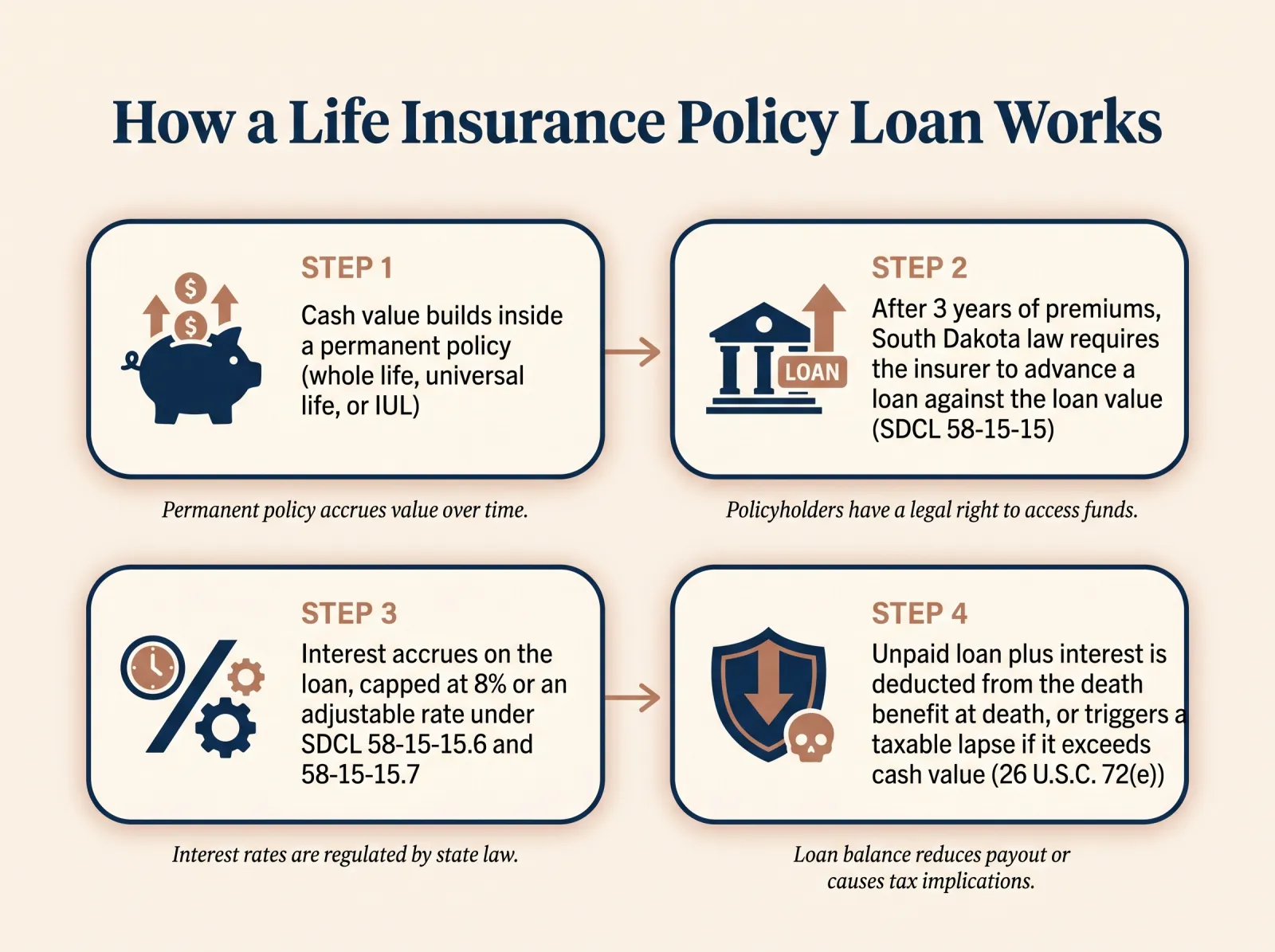
Permanent insurance works differently. A portion of every whole life premium, after the insurer’s cost of providing the death benefit and covering its own expenses, is credited to a cash value account inside the policy, which grows on a schedule the insurer guarantees at a minimum rate, with the possibility of more through dividends on participating policies. Indexed universal life and universal life credit cash value on a different formula tied to an index or a declared rate, discussed in more detail in our guide to indexed universal life insurance. Whatever the crediting method, once enough cash value exists, South Dakota Codified Law 58-15-15 requires the insurer to advance a loan against it, provided three conditions are met: at least three full years of premiums have been paid, the policy has an actual cash surrender value, and no premium is currently in default beyond the grace period. Meet those, and the insurer must lend you up to the policy’s “loan value,” a defined figure in the contract, not the full face amount and not your total premiums paid.
A handful of terms make the rest of this article make sense, and they are worth defining once, plainly, since the language on a policy loan disclosure rarely translates itself:
- Cash value is the savings-like account inside a permanent life insurance policy, built from premiums after the insurer’s costs, that grows over time and belongs to you as the policyholder while the policy is in force.
- Loan value is the specific, usually smaller, portion of your cash value the insurer will actually lend against, defined in the policy contract, not a number you set yourself.
- Policy loan is money the insurer advances to you, secured entirely by your own cash value, that accrues interest at a rate governed by South Dakota Codified Law 58-15-15.6 and 58-15-15.7.
- Modified endowment contract (MEC) is a permanent life insurance contract that has been funded too quickly under a federal test, after which loans and withdrawals lose their normal tax treatment, discussed fully below.
- Lapse is what happens when a policy’s cash value, reduced by an outstanding loan and its accumulated interest, can no longer cover the policy’s ongoing costs, at which point the insurer terminates the coverage.
- “Infinite banking” is a marketing term, not a legal or actuarial one, for a strategy of intentionally overfunding a whole life policy and routinely borrowing against it in place of using a bank or other lender.
None of these terms are secret. They are printed in your policy’s loan provision and disclosed at issue. What changes the outcome for different people is not the rules, which are the same for everyone under South Dakota’s insurance code, but whether the loan actually gets repaid, or at minimum, whether the interest gets paid so it stops compounding.
The rules on a policy loan are the same for everyone. What changes the outcome is whether the loan, or at least the interest on it, ever actually gets paid back.
Mike Moore, Life Insurance AdvisorWhat it costs to get wrong: the interest rate, the tax trap, and the lapse numbers
This section answers, within its first two sentences, the question that matters most: what does an unpaid policy loan actually cost you? Two mechanisms drive the answer, an interest rate that is capped but not zero, and a federal tax rule that only bites at the worst possible moment, when the policy lapses.
The interest rate is capped, not free
South Dakota Codified Law 58-15-15.6 requires that any policy issued in this state on or after July 1, 1982, cap policy loan interest at one of two structures: a flat maximum of 8% per year, or an adjustable rate. If the insurer uses the adjustable option, South Dakota Codified Law 58-15-15.7 sets the ceiling: the rate cannot exceed the higher of the published monthly average of Moody’s Corporate Bond Yield for the calendar month ending two months before the rate is set, or the rate the insurer is currently crediting to your cash value, plus one percentage point. In practice, this means your loan rate is disclosed, capped, and tied to a public benchmark rather than picked at random, but it is rarely zero, and it is charged whether or not you are actively using the borrowed money for anything.
| Rate structure | Maximum allowed under South Dakota law |
|---|---|
| Fixed rate | Not more than 8% per year |
| Adjustable rate | The higher of: (a) Moody's Corporate Bond Yield published monthly average, two months prior, or (b) the policy's cash value crediting rate plus 1 percentage point |
| Rate changes | Must be disclosed to the policyholder; policy sets the frequency of adjustment |
| Applies to | Whole life, universal life, indexed universal life, and other cash-value policies issued on or after July 1, 1982 |
| Does not apply to | Term life insurance (SDCL 58-15-20) |
South Dakota Codified Laws 58-15-15.6 and 58-15-15.7, South Dakota Legislature.
The mechanism that surprises people is not the rate itself. It is that unpaid interest does not get billed to you the way a credit card statement would. Under the same statutes, unpaid interest is simply added to the loan balance and starts accruing interest of its own the following year. Nobody calls to collect. The debt just grows quietly against your own cash value, and the policy keeps functioning normally right up until it cannot anymore.
The tax trap: not taxable, until it is
Under normal circumstances, a policy loan is not reported as income, and you will not get a 1099 for taking one. That is because, under the general rule in 26 U.S.C. § 72(e), a policy loan is treated as a loan, a debt against your own asset, not a distribution. Insurers do not withhold tax on it, and it does not appear on your return.
That protection has two exceptions, both of which matter more than the marketing usually lets on. First, if the policy has become a modified endowment contract, meaning it was funded faster than the federal “seven-pay test” under 26 U.S.C. § 7702A allows, loans lose that favorable treatment entirely and are taxed as distributions, gain first, under the same rule that governs early annuity withdrawals. Second, and this applies to every cash-value policy, MEC or not, if the policy ever lapses or is surrendered while a loan is outstanding, 26 U.S.C. § 72(e) requires the insurer to treat the canceled loan as part of the “amount received” for purposes of calculating gain. If your cash value exceeds what you paid into the policy in premiums, that gain is taxable income in the year the policy lapses, even though the “income” is really just debt disappearing, not cash landing in your account. People describe this, accurately, as a phantom income tax bill: a real 1099 for money you never got to spend.
The lapse numbers are not rare
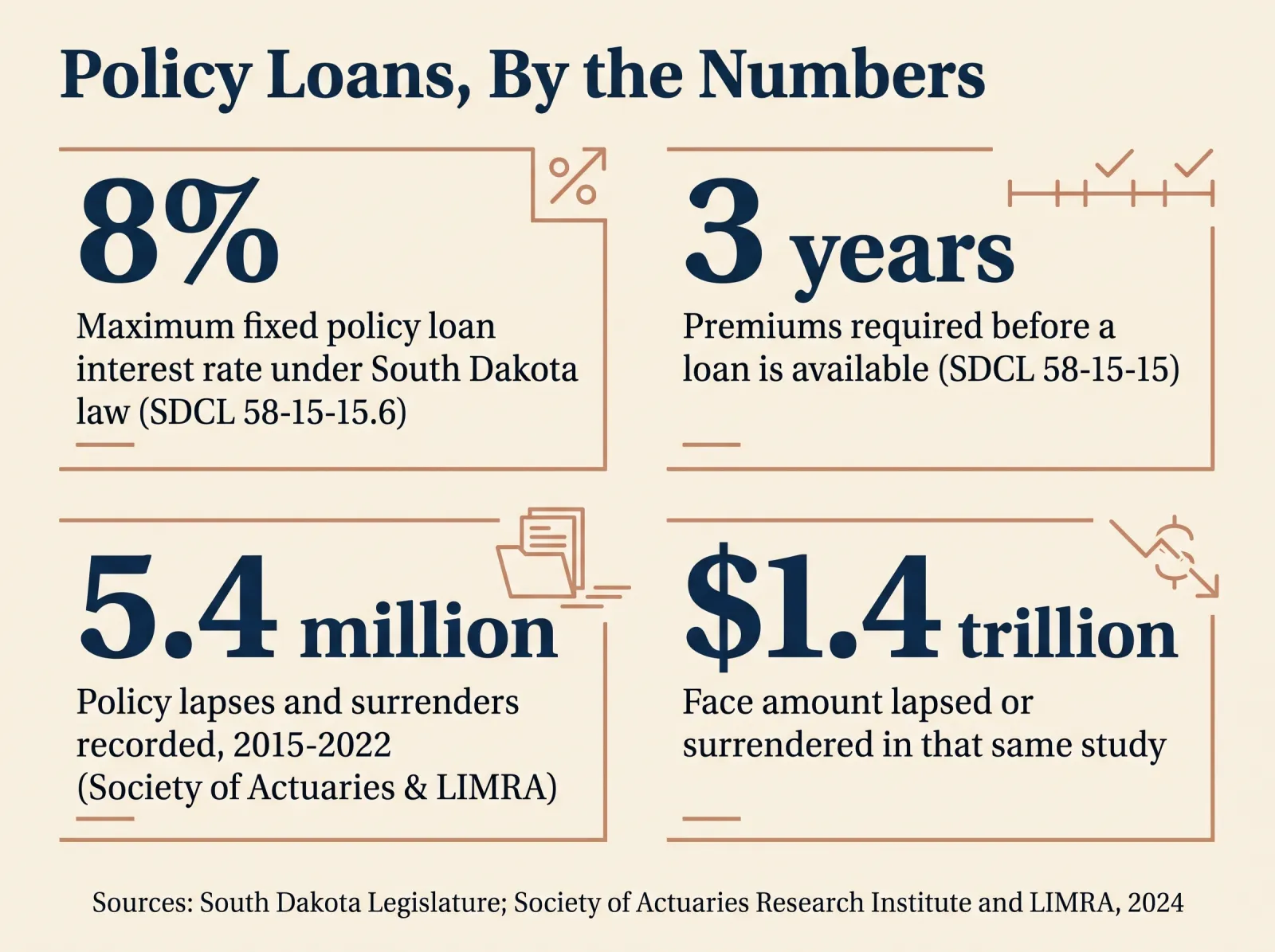
How often does a policy actually lapse before the death benefit pays out? A joint study from the Society of Actuaries Research Institute and LIMRA, covering data from 28 individual life insurers for the seven-year period from policy anniversaries in 2015 through anniversaries in 2022, tracked 135.9 million policies exposed and recorded 5.4 million lapses and surrenders during that window, representing $1.4 trillion of the $30.6 trillion in face amount the study covered. Worked as a share, that is roughly 4 in every 100 policy-years in the study ending in a lapse or surrender rather than a death claim or a fully paid-up policy. The study does not isolate how many of those lapses involved an outstanding policy loan specifically, but every one of those 5.4 million events represents a family that stopped, for one reason or another, being covered by the death benefit they originally bought.
2015-2022 lapse and surrender experience across 135.9 million individual life policies
Society of Actuaries Research Institute and LIMRA, "2015-2022 Term and Whole Life Lapse and Surrender Experience," 2024. Figures cover 28 contributing individual life insurers over the study's seven-year window.
A worked example: what an unpaid loan does to a policy over time
Take a hypothetical $250,000 whole life policy with $60,000 in current cash value, owned by someone who borrows $30,000 against it to cover an expense and, for whatever reason, life gets busy and the loan is never actively repaid. This is an illustration built from the statutory rate ceiling, not a quote or a projection for any real policy; actual crediting rates, loan rates, and cash value growth vary by carrier, product, and issue date.
| Year | Loan balance (interest compounding, unpaid) | What it means |
|---|---|---|
| Year 1 | $30,000 | Loan taken; death benefit already reduced by $30,000 if death occurred today |
| Year 5 | ~$44,100 | Four years of compounding interest at the 8% statutory maximum, added to principal |
| Year 10 | ~$64,800 | Loan balance has more than doubled from the original $30,000 borrowed |
| Year 15 | ~$95,100 | Balance now exceeds the policy's starting $60,000 cash value; risk of lapse depends on how much cash value has grown in the meantime |
Illustrative math only, compounding a $30,000 balance annually at 8%, the statutory maximum fixed rate under SDCL 58-15-15.6. Not a quote, projection, or guarantee for any specific policy; actual results depend on the policy's own crediting rate, loan rate structure, carrier, and whether any interest is ever paid.
The point of this table is not the exact numbers, which will differ for every real policy. It is the shape of the problem: an unpaid loan does not sit still. It grows every year against a policy whose cash value is also trying to grow, and whichever line moves faster determines whether the policy survives or lapses. Paying at least the interest each year, even without touching principal, keeps the loan from compounding against itself and is the single easiest way to avoid the lapse scenario entirely.
How to work it out yourself: five checks before you borrow, or before you buy a policy to borrow against
You do not need anyone’s help to answer most of this. Pull your most recent policy statement and check these five things.
- Confirm you actually have a permanent policy. If your coverage is term life, there is no cash value and no loan provision to check, per SDCL 58-15-20. If you are unsure, your annual statement will either show a cash value figure or it will not.
- Find your current loan value, not just your cash value. The loan value is usually a defined percentage of cash value, set in your contract, and it is the real ceiling on what the insurer must lend you.
- Check whether any loan is already outstanding, and its current balance. Older policies, especially ones bought decades ago, sometimes carry a loan the owner forgot about entirely, quietly growing every year.
- Ask your carrier directly what interest rate structure applies to your policy and its exact current rate. South Dakota Codified Law 58-15-15.6 sets the ceiling; carriers can and do charge less, and only your specific contract shows what you are actually paying.
- Decide, honestly, whether you will pay at least the annual interest. If the answer is no, model out where the balance lands in ten and twenty years using your policy’s actual numbers, not a hypothetical one, before you borrow another dollar.
You can run this yourself
All five steps just require your policy statement and a phone call to your carrier's service line, asking for your current loan value, outstanding balance, and interest rate. Where a second opinion tends to help is step 5: comparing what that math looks like against your policy's actual guarantees, and whether the coverage still does what you originally bought it to do.
If you would rather have someone local look at your specific policy with you instead of guessing at the math, that is what we do: Compare My Options.
”Infinite banking,” in plain terms
“Infinite banking” is not a product, a regulation, or a term that appears anywhere in South Dakota’s insurance code. It is a marketing name for a strategy: buy a whole life policy designed to build cash value quickly, pay premiums well above the minimum, and then routinely borrow against that cash value for expenses instead of using a bank, with the idea that your money “keeps working” inside the policy even while you are using it elsewhere.
The individual pieces of that pitch are real. South Dakota law does require insurers to make loans available against sufficient cash value. The interest rate genuinely is capped, under 58-15-15.6 and 58-15-15.7. A properly structured, non-MEC loan genuinely is not taxed while the policy stays in force. What the pitch tends to leave out is threefold: the policy’s own internal costs are highest in the early years, meaning cash value builds slowly at first regardless of how the strategy is marketed; overfunding a policy too aggressively risks tripping the seven-pay test under 26 U.S.C. § 7702A and turning it into a modified endowment contract, which erases the tax advantage the whole strategy depends on; and every dollar borrowed and left unpaid compounds against the death benefit the policy was originally sold to provide, which is a real cost even when nobody bills you for it directly.
None of this means whole life insurance or its cash value feature is a bad product. For some households, particularly ones already maximizing other tax-advantaged savings and who want permanent coverage anyway, the cash value and loan provision are a genuine, useful feature of a policy they would own regardless. The distinction worth holding onto is the difference between “this feature exists and can be useful” and “this replaces a bank,” which is a much larger claim than South Dakota’s own loan statutes, or the federal tax code, actually support.
How we help
We are independent, so we are not selling a specific “infinite banking” package on commission, and we are not telling you cash value insurance is wrong for everyone either. If you already own a permanent policy and are trying to understand your actual loan value, current balance, and interest rate, we can help you get straight answers from your carrier and see what your options look like in writing. If you are being pitched a new policy specifically as a borrowing strategy, we can walk through what that policy would actually need to do, in premiums and years, to support the loan amounts being promised, using your carrier’s real illustration rather than a sales narrative. Because we work across carriers, we can also show you where a simpler term policy plus a separate savings vehicle might get you the same protection for less, if that turns out to be the better fit for your situation.
What you get
A clear read on your specific policy’s loan value, current balance if one exists, and interest rate, compared against South Dakota’s statutory rate ceiling so you know whether you are paying more than the law requires. A worked-out picture, using your own numbers, of what an unpaid loan does to your coverage over the years you actually plan to keep the policy. And, if you are considering a new policy for its cash-value or borrowing features, a straight comparison of what that would cost in premiums against what a simpler policy would cost for the same death benefit, so the decision is based on your own math rather than someone else’s pitch.
Find out what your policy actually allows
We will go through your current policy's loan value, balance, and rate together, or model out a new policy's real numbers before you commit to a strategy built around borrowing against it.
Not ready to talk to anyone yet? Read How It Works first and come back when you are.
Frequently asked questions
Can you actually borrow money from your life insurance policy?
Yes, but only from a permanent policy that has built cash value, meaning whole life, universal life, or indexed universal life, and only after it has accumulated enough of that value to support a loan. Under South Dakota Codified Law 58-15-15, an insurer must advance a loan up to the policy’s loan value once three full years of premiums have been paid and the policy has a cash surrender value, but South Dakota Codified Law 58-15-20 specifically exempts term insurance from these loan provisions, so a term policy, no matter how long you have owned it, cannot be borrowed against.
Is a life insurance policy loan taxable income?
Usually not while the policy stays in force, because the loan is legally a debt against the insurer secured by your own cash value, not income to you, and it is not reported to the IRS as a distribution. That changes if the contract has become a modified endowment contract, or MEC, under 26 U.S.C. 7702A, or if the policy lapses or is surrendered while a loan is outstanding, because 26 U.S.C. 72(e) then requires any gain in the contract, meaning cash value above what you paid in, to be treated as taxable income, and the loan balance is netted into that calculation whether or not you ever see the cash.
What is “infinite banking” and does it really work the way it is marketed?
Infinite banking is a strategy, built around whole life insurance, where the policyholder pays premiums into a cash-value policy and then borrows against that cash value instead of using a bank, with the idea that the money keeps growing inside the policy even while a loan is outstanding. The mechanism it describes is real: South Dakota law does let you borrow against a permanent policy’s cash value. What the marketing usually leaves out is the cost of the insurance itself in the early years, the interest charged on the loan under South Dakota’s own rate rules, and the real risk of the policy lapsing if the loan and its interest are never repaid, at which point the IRS treats the outstanding loan as taxable income.
What happens if I never pay back a life insurance policy loan?
The insurer keeps charging interest on the unpaid balance, and that interest is added to the loan rather than billed to you separately, so the debt compounds against your own cash value year after year. If the growing loan balance ever equals or exceeds the policy’s total cash value, the policy lapses, meaning your coverage ends, and under 26 U.S.C. 72(e) any gain in the contract at that point becomes taxable income in the year of lapse, even though you received no new cash that year. A lapse also usually forfeits any death benefit, so your family gets nothing from a policy you may have paid into for decades.
Does a policy loan reduce my life insurance death benefit?
Yes. South Dakota Codified Law 58-15-18 requires any outstanding loan, plus unpaid interest, to be deducted from the death benefit or from the cash value paid out if you surrender the policy. If you borrow $30,000 against a $250,000 whole life policy and never repay it, your beneficiaries receive $220,000 minus whatever interest has accrued on that loan by the time you die, not the full face amount.
How much interest does South Dakota law let an insurer charge on a policy loan?
Under South Dakota Codified Law 58-15-15.6, a policy issued on or after July 1, 1982, must cap the loan interest rate at a fixed maximum of 8% per year, or use an adjustable rate. Section 58-15-15.7 sets the ceiling on that adjustable rate: it cannot exceed the higher of the published monthly average of Moody’s Corporate Bond Yield two months before the rate is set, or the rate the insurer credits to your cash value plus one percentage point. Either way, the rate is disclosed in the policy and in the loan paperwork you sign, so it is worth reading rather than assuming.
Should I use a policy loan instead of a bank loan or a home equity line?
That depends entirely on what you are protecting and what else is available to you, which is a comparison worth running with real numbers rather than a marketing pitch. A policy loan has no credit check, no fixed repayment schedule, and does not show up on a credit report, which genuinely helps some people. It also carries real, ongoing costs: interest that compounds against your own death benefit, and a lapse risk that a checking account or a HELOC does not have. For many people the honest answer is that the loan feels convenient precisely because nobody is asking them to pay it back, which is also why it can quietly erode a policy that was bought to protect a family.
Before you sign anything
This article is general education, not insurance, legal, financial, or tax advice. Product availability, features, and rates vary by carrier and state and are subject to underwriting. No coverage exists until a policy is issued and in force. Any guarantees are subject to the claims-paying ability of the issuing insurer. Please review actual policy documents and speak with a licensed agent about your situation.
Sources
- South Dakota Codified Law 58-15-15 — Insurance policy loan, security, maximum amount — South Dakota Legislature
- South Dakota Codified Law 58-15-15.6 — Insurance policy loan, permitted interest rates — South Dakota Legislature; effective for policies issued on or after July 1, 1982
- South Dakota Codified Law 58-15-15.7 — Insurance policy loan, allowable rate under adjustable maximum interest rate — South Dakota Legislature
- South Dakota Codified Law 58-15-18 — Loan value of policy, indebtedness deducted — South Dakota Legislature
- South Dakota Codified Law 58-15-20 — Policy loan provisions inapplicable to term insurance — South Dakota Legislature
- 26 U.S.C. § 7702A — Modified endowment contract defined — Cornell Law School, Legal Information Institute, current federal law
- 26 U.S.C. § 72 — Annuities; certain proceeds of endowment and life insurance contracts — Cornell Law School, Legal Information Institute; subsection (e) governs policy loan and lapse taxation
- Society of Actuaries Research Institute and LIMRA — 2015-2022 Term and Whole Life Lapse and Surrender Experience Study — published 2024; 135.9 million policies exposed, 5.4 million lapses and surrenders, $30.6 trillion face amount exposed, $1.4 trillion lapsed or surrendered
- NAIC Model Policy Loan Interest Rate Bill (#590) — National Association of Insurance Commissioners; the model act South Dakota’s own loan-interest statutes are based on
Related reading: Indexed Universal Life Insurance Explained for 2026, Term vs. Whole Life in 2026: A Data-Driven Comparison, and Is Your Employer’s Life Insurance Enough? A 2026 SD Guide. See current options for whole life and indexed universal life, or learn more about who we help.