
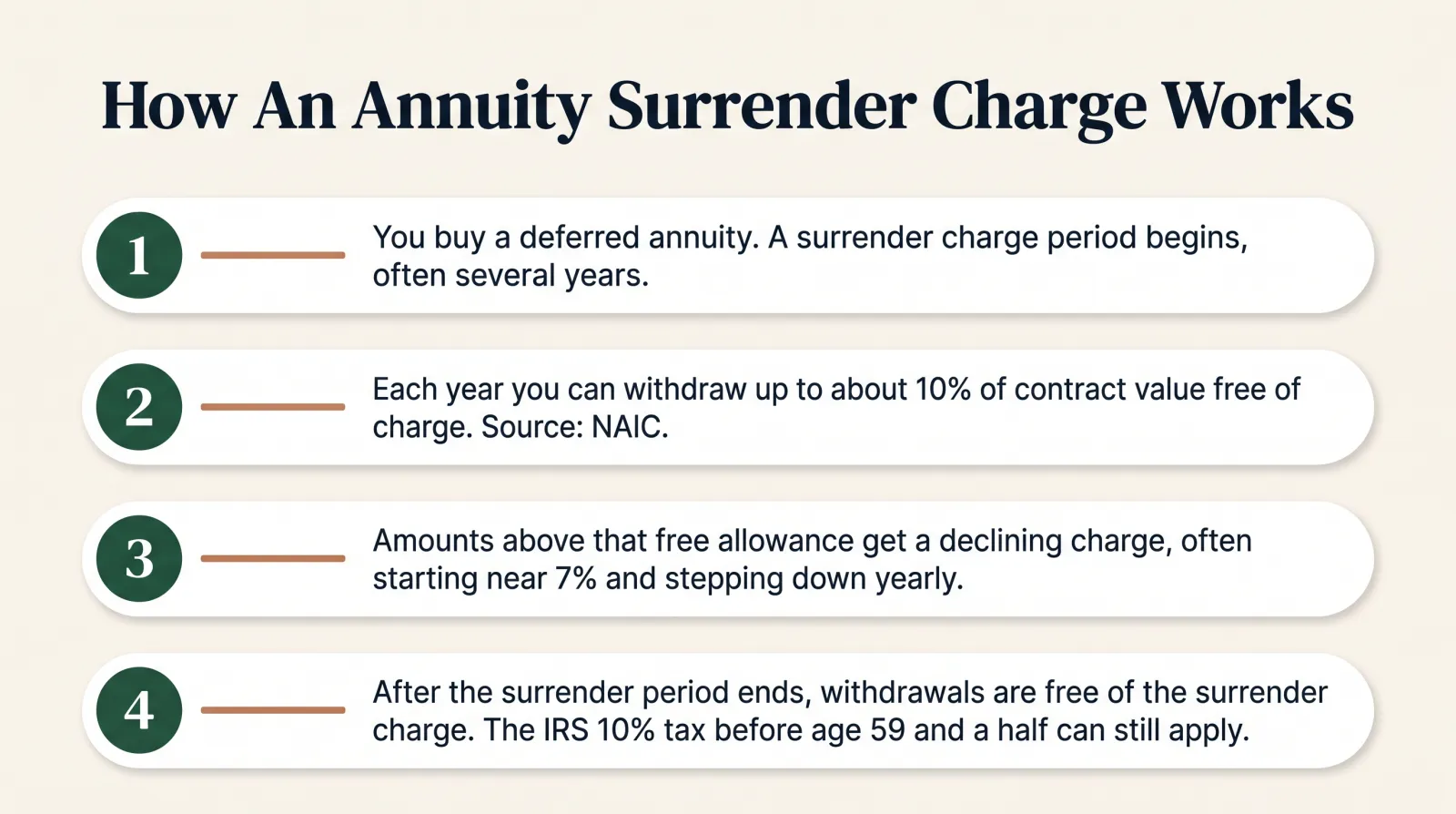
A surrender charge is a fee your insurance company subtracts from your annuity if you take out more money than your contract allows during a set number of years after you buy it, and the percentage is calculated against the amount you withdraw, not your entire account. It typically starts around 5 to 10 percent in the first year and steps down each year until the surrender period ends, per the NAIC’s 2022 Buyer’s Guide for Deferred Annuities. That single mechanic is the reason a decision that felt simple on the day you signed, “put this money somewhere safe that pays better than a savings account,” can feel like a trap the day you actually need some of it back.
The short version
- A surrender charge is a percentage-based fee on money you withdraw above your annuity's free allowance during the surrender charge period, and the percentage typically declines each year, per the NAIC's 2022 Buyer's Guide for Deferred Annuities.
- It is a different cost from the IRS's separate 10% additional tax on the taxable portion of any annuity distribution taken before age 59 and a half, under Internal Revenue Code Section 72(q), per IRS Topic 558. An early withdrawal can trigger both at the same time.
- Most annuities let you withdraw up to about 10% of your contract value each year, free of the surrender charge, according to the same NAIC guide.
- South Dakota's 2022 annuity best-interest law, Senate Bill 148, requires an agent to disclose the "potential surrender period and surrender charge" and "potential tax penalty" before recommending an annuity, and to act in your best interest rather than their own.
- U.S. annuity sales hit a record $123.9 billion in the second quarter of 2026 alone, according to LIMRA, meaning more South Dakota households than ever are signing contracts that include one of these schedules.
The pain: your own money doesn’t feel like yours anymore
Picture a 61-year-old in Brookings who moved $200,000 into a multi-year guaranteed annuity two years ago, chasing a rate that beat every bank CD she could find. The roof needs replacing this fall, the contractor’s estimate is $50,000, and when she calls the insurance company to ask about pulling the money, the answer isn’t the flat “sure, here’s your check” she was picturing. Part of it comes with a fee attached. Nobody explained that clearly enough at the kitchen table two years ago, or she didn’t hear it the way it mattered until now.
That gap between “I put money somewhere safe” and “some of my own money now costs money to touch” is not a rare experience. It is the single most common regret annuity owners report, and it is almost always traceable to one thing: not reading, or not being clearly shown, the surrender charge schedule before signing.
This is general education, not a review of your contract
Nothing here tells you what your specific annuity charges, what your free-look rights are today, or whether withdrawing right now is the right move. It walks through the mechanics and the South Dakota rules using named sources, so you can read your own contract with the right questions in hand.
An annuity, for anyone new to the word, is a contract with an insurance company: you give it a sum of money, or a series of payments, and in exchange it promises to grow that money on some schedule and eventually pay it back to you, often as guaranteed income you can’t outlive. That promise is genuinely valuable for the right household. It is also, structurally, a long-term contract, and long-term contracts almost always come with a cost for breaking them early. A surrender charge is that cost, spelled out.
Why it happens: the insurer priced this money to sit still
When you hand an insurance company $200,000, it doesn’t keep that money in a vault. It invests it, usually in bonds and other longer-term, relatively conservative assets, planning to earn a spread between what those investments return and what it credits back to your contract. Those investments have their own timelines. If a large share of contract holders decided to pull their money out early and all at once, the insurer would be forced to sell assets before they matured, potentially at a loss, to cover the withdrawals.
The surrender charge exists to discourage exactly that scenario, and to compensate the insurer for the cost of unwinding an investment early if you do withdraw. It is built into the pricing of the product from day one; annuities that carry meaningful surrender charges are typically able to offer a higher credited rate or better index-crediting terms than a fully liquid product could, because the insurer knows most of that money is committed for years, not days.
A few terms are worth defining precisely before going further, since they get used loosely and the differences matter for your actual math:
- Surrender charge period. The number of years, set in your contract, during which a surrender charge can apply to money you withdraw above your free allowance.
- Surrender charge. The percentage-based fee itself, applied to the portion of a withdrawal that exceeds your free withdrawal allowance during that period.
- Free withdrawal provision. The amount, commonly up to about 10% of your contract value per year, that you can withdraw without triggering any surrender charge, per the NAIC’s Buyer’s Guide for Deferred Annuities.
- Contract value (or account value). The total value credited to your annuity before any charges are applied.
- Cash surrender value. What you would actually receive if you withdrew the entire contract value at once: the contract value minus any applicable surrender charge and market value adjustment.
- Market value adjustment (MVA). A separate, contract-specific adjustment, present in some annuities but not all, that can increase or decrease what you receive on an early withdrawal based on how interest rates have moved since you bought the contract.
- Annuitize. The point at which you convert your annuity into a stream of guaranteed payments. Once you annuitize, you generally can’t take other withdrawals or reverse the decision, and surrender charges typically no longer apply because there is no remaining account value to withdraw from early.
How the charge actually shrinks over time
The mechanic that catches people off guard is not that a surrender charge exists. Most people who bought an annuity remember being told, in some form, “there’s a penalty for early withdrawal.” What catches people is how the schedule actually declines, and how long it stays meaningfully expensive.
A common structure, described generally in the NAIC’s 2022 Buyer’s Guide for Deferred Annuities, starts the surrender charge at its highest percentage in year one and steps it down by roughly a point or two each year until it reaches zero. Because no single number applies to every product, the table below is an illustrative example only, built to show the shape of a typical declining schedule; it is not a quote for any specific carrier’s contract.
| Contract year | Surrender charge on withdrawals above the free allowance |
|---|---|
| 1 | 7% |
| 2 | 6% |
| 3 | 5% |
| 4 | 4% |
| 5 | 3% |
| 6 | 2% |
| 7 | 1% |
| 8 and beyond | 0% |
Illustrative example of a declining surrender charge structure consistent with the general description in the NAIC's 2022 Buyer's Guide for Deferred Annuities. Actual percentages, duration, and structure vary by carrier and contract; this is not a quote for any specific product.
Illustrative surrender charge by contract year
Illustrative example only, structured consistent with the NAIC's 2022 Buyer's Guide for Deferred Annuities' general description of declining surrender schedules. Not a quote for any specific product; check your own contract's actual schedule.
Notice what this means in practice: a contract that is five years into a seven-year schedule still carries a real charge, just a smaller one. “I’ve had this a few years, I’m probably past the penalty” is a guess, not a fact, until you check your own contract’s page that states the schedule in writing.
The charge versus the free allowance: doing the actual math
Go back to the Brookings example: $200,000 in a multi-year guaranteed annuity, two years into the contract, needing $50,000 for a roof. Using the illustrative year-2 rate of 6% from the schedule above, here is what the arithmetic actually looks like, assuming a 10% free withdrawal allowance, which is a common structure per the NAIC’s guide.
| Item | Amount |
|---|---|
| Contract value | $200,000 |
| Free withdrawal allowance (10%) | $20,000 |
| Amount needed | $50,000 |
| Portion subject to surrender charge | $30,000 |
| Illustrative surrender charge (6% of $30,000) | $1,800 |
| Net received after surrender charge | $48,200 |
Author's calculation using a 10% free withdrawal allowance and the illustrative year-2 rate from the schedule above. Actual free withdrawal percentages and surrender rates are set by your specific contract; this is not a quote.
Eighteen hundred dollars is a real cost, and it is also a fixed, knowable number the moment you look at your actual contract’s schedule and free withdrawal terms, rather than a mystery fee that shows up on the statement. The point of doing this math before you call the insurance company is that it turns a stressful surprise into a decision: is $1,800 worth having the $50,000 today, compared with financing the roof another way and waiting for the surrender period to end? Different households will answer that differently, and both answers can be reasonable.
The other cost hiding behind it: the IRS’s separate 10% tax
Here is where the confusion gets expensive. A surrender charge and the federal early withdrawal tax are two completely different costs, from two completely different parties, and a withdrawal taken early enough can trigger both on the same dollar.
| Feature | Surrender charge | IRS 10% additional tax |
|---|---|---|
| Who charges it | Your insurance company | The federal government |
| What it applies to | The portion of a withdrawal above your contract's free allowance | The taxable portion of a distribution, under IRC Section 72(q) |
| What triggers it | Withdrawing during your contract's surrender period | Taking a distribution before you turn 59½, unless an exception applies |
| Where it's set | Your individual annuity contract | Federal tax law, the same for every non-qualified annuity nationwide |
| Does it end? | Yes, once the surrender period in your contract ends | Yes, once you turn 59½, or if an exception applies sooner |
The IRS’s rule, described in Topic 558, is straightforward once it’s separated from the insurer’s charge: distributions from an annuity taken before age 59½ can be subject to an additional 10% tax on the portion includible in your gross income, on top of ordinary income tax on that same amount. For a non-qualified annuity, meaning one you bought with money that was already taxed, only the growth is taxable, so the 10% tax applies to that growth portion, not your original premium. The IRS lists several exceptions, including death, total and permanent disability, terminal illness, certain domestic abuse situations, and a series of substantially equal periodic payments taken over your life expectancy, among others.
Two separate bills, and neither one is optional just because you didn't know about it
A 58-year-old who withdraws growth from a non-qualified annuity outside the free allowance, during the surrender period, can owe the insurer's surrender charge, ordinary income tax on the growth, and the IRS's additional 10% tax, all on the same withdrawal. This is general education about how the rules work, not tax advice for your specific situation. Talk with a qualified tax professional about your own numbers before you withdraw.
Market value adjustments: the wildcard some contracts add
Some annuities, though not all, layer a market value adjustment on top of any surrender charge. An MVA is a separate calculation that can move the amount you receive up or down, based on how interest rates have changed between the day you bought the contract and the day you withdraw, according to the NAIC’s 2022 Buyer’s Guide for Deferred Annuities. In general terms, if interest rates are lower on the day you withdraw than they were when you bought the annuity, the MVA can work in your favor and increase what you receive; if rates are higher, it can work against you and reduce it.
The guide is explicit that every insurer’s MVA formula is different, and it is not something you can estimate reliably without your contract’s actual language in front of you. If your annuity has one, it is worth asking your agent or the insurance company directly, before you withdraw, what the MVA calculation would do to your specific request on that day, rather than assuming it will be neutral.
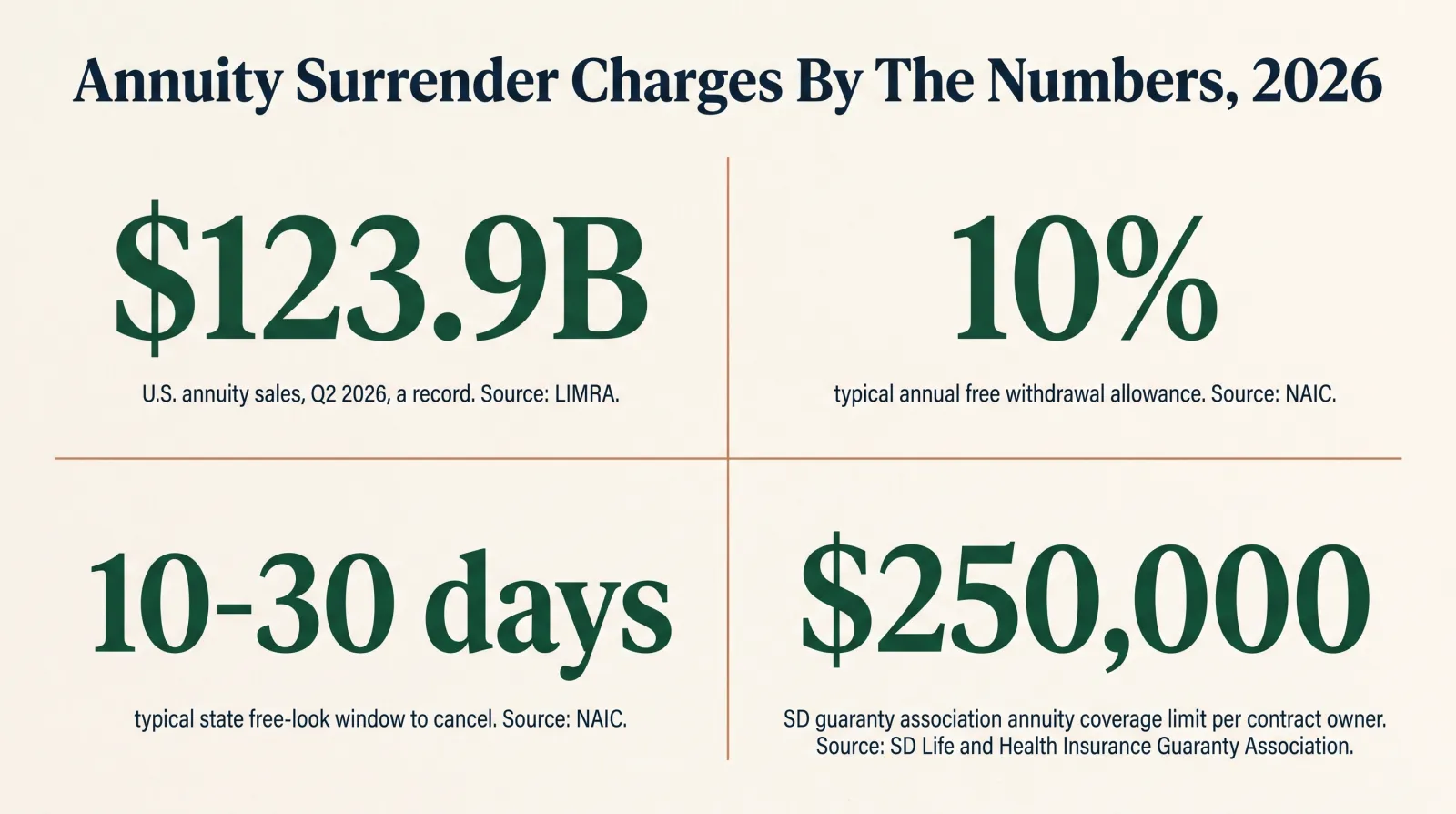
$123.9B
U.S. annuity sales, Q2 2026, a new quarterly record, per LIMRA
10%
typical annual free withdrawal allowance on annuities with surrender charges, per NAIC
10-30 days
typical state free-look window nationally to cancel an annuity penalty-free, per NAIC
$250,000
SD Life & Health Insurance Guaranty Association's annuity present-value coverage limit per contract owner
What South Dakota now requires your agent to tell you
South Dakota does not leave surrender charge disclosure to an individual agent’s discretion. Under South Dakota Senate Bill 148, enacted in 2022, the state replaced its older “suitability” standard for annuity sales with a “best interest” standard: a producer recommending an annuity must act in the consumer’s best interest and cannot place their own financial interest ahead of yours. As part of that standard, the producer must disclose the product’s potential surrender period and surrender charge, along with any potential tax penalty, before you buy, and must gather information about your financial situation, objectives, and risk tolerance before making a recommendation.
That is a meaningful shift from a generation ago, when “is this appropriate for you” was a much lower bar than “is this actually in your best interest.” It does not mean every annuity sold in South Dakota today is automatically the right fit for every buyer; it means the law now requires the surrender charge conversation to happen, in writing, before the contract is signed, not discovered afterward when you call to ask for your money back.
The surrender schedule is printed in your contract on day one. The best time to understand it is before you sign, not the week you need the roof fixed.
Mike Moore, Life Insurance AdvisorSouth Dakota also gives you a second, independent right that doesn’t depend on remembering a disclosure conversation: a free-look period. State law requires most individual life insurance and annuity contracts delivered in South Dakota to include a window, commonly at least 10 days, during which you can return the contract and get your money back, treated as if it had never been issued, according to consumer guidance summarized by HelpAdvisor citing South Dakota’s insurance code. The NAIC’s national guide confirms that most states set this window somewhere between 10 and 30 days, so it’s worth checking the exact number printed in your own contract rather than assuming.
The free withdrawal provision: your annual pressure-release valve
Before assuming a withdrawal will cost you anything, check your contract’s free withdrawal allowance. Most annuities with surrender charges let you take out up to roughly 10% of your contract value each year without triggering the charge at all, per the NAIC’s Buyer’s Guide. Some contracts calculate that percentage against your value at the start of the contract year; others recalculate it annually against the current value; some let unused allowance carry forward, most do not. All of those details live in your specific contract, not in a general rule that applies to every product.
This matters for planning, not just for emergencies. A household that knows it will want $15,000 a year for the next three years, on a $200,000 contract with a 10% free allowance, can likely take all three withdrawals without ever touching a surrender charge, simply by spacing the requests across contract years rather than pulling $45,000 in one request. That is not a loophole; it is the provision working exactly as designed. The mistake worth avoiding is the opposite one: pulling more than the allowance in a single year without checking first, then being surprised by the bill.
You can check this yourself before you call anyone
Your annuity's contract or annual statement states the free withdrawal percentage and the current surrender charge percentage for this contract year. Pull both numbers before you decide how much to request, and you'll know your exact cost, if any, before you make the call. Not ready to talk to anyone yet? Read How It Works first and come back when you are.
What happens if you die during the surrender period
This is one of the more reassuring parts of how most annuities are built. If the contract owner dies while a surrender charge period is still active, most contracts waive the surrender charge on the death benefit paid to the named beneficiary, so the full contract value, or the contract’s stated death benefit, typically passes without that fee reducing it. This is a common contract feature rather than a guaranteed one on every product, so it is worth confirming the exact wording in the death benefit section of your own contract, particularly if you are naming a beneficiary and want to know precisely what they would receive.
If your annuity’s issuing company were ever to become insolvent, South Dakota’s state-mandated backstop still applies on top of your contract’s own terms. The South Dakota Life and Health Insurance Guaranty Association covers up to $250,000 in annuity present value per contract owner, and up to $300,000 in life insurance death benefit per insured life, according to the association’s own published coverage limits. Confirm current limits directly with the association or your policy documents, since guaranty association coverage is a backstop of last resort, not a substitute for choosing a financially sound carrier in the first place.
Do all annuities have surrender charges?
No, and this is a useful sorting question when you’re comparing products. Immediate income annuities, sometimes called single premium immediate annuities, convert a lump sum into a stream of payments starting right away, and because you generally can’t reverse that decision or ask for the lump sum back once payments begin, there typically isn’t a separate account value left to apply a surrender charge against. For a deeper look at how that product works, including its own tradeoffs, see our guide to immediate income annuities.
Deferred annuities are the category where surrender charges live: fixed annuities, fixed indexed annuities, and multi-year guaranteed annuities (MYGAs) all typically include a surrender charge schedule, because all three hold your money in an accumulating contract for a period before you decide how or when to access it. If you’re weighing an MYGA against a bank CD specifically, our MYGA vs. CD comparison walks through the tradeoffs, including how each one’s early-withdrawal cost is structured differently. If you’re comparing a fixed indexed annuity’s crediting mechanics more broadly, see our fixed indexed annuity guide.
What tends to happen
- The surrender period and free withdrawal percentage are somewhere in the paperwork, unread
- An unexpected expense forces a withdrawal request with no idea what it will cost
- The surrender charge and the IRS's 10% tax get discovered on the same statement, at the same time
- The free-look window closes before anyone reviewed the actual terms
What tends to happen instead
- You know your surrender period, your current year's charge percentage, and your free withdrawal allowance before you sign
- A withdrawal request comes with a known, calculable cost, not a surprise
- Emergency funds are planned to come from a liquid account first, with the annuity as a longer-term piece
- The free-look window is used deliberately, to confirm the contract matches what was explained
How to work this out yourself
None of this requires a specialist to calculate. Here is the method, using only documents you already have or can request.
- Find your contract’s surrender charge schedule. It’s a table, usually near the front of the contract or in the disclosure document, listing a percentage for each contract year. If you can’t locate it, your insurance company is required to be able to tell you.
- Find your current contract year and your contract value. Your most recent annual statement has both. Contract year one starts the day the annuity was issued, not the calendar year.
- Find your free withdrawal allowance. Usually stated as a percentage, commonly around 10%, of either your contract value or your premium, depending on the contract’s specific language.
- Calculate what you’d actually owe on a hypothetical withdrawal. Subtract your free allowance from the amount you want, then apply this year’s surrender charge percentage to whatever remains, exactly as in the Brookings example above.
- Check for a market value adjustment clause, and if one exists, call the insurance company and ask what it would apply to your specific withdrawal request today, since it depends on current interest rates relative to your purchase date.
- Ask about the IRS side separately, with a tax professional, since that calculation depends on your age, your original premium versus your current value, and whether any exception applies to your situation.
Steps 1 through 4 take about twenty minutes with your statement in hand
Where a second opinion tends to help most is deciding whether an annuity fits your goals in the first place, comparing surrender structures across carriers before you buy, or working through whether an existing contract still matches what you need today.
You can also work through your broader retirement income picture, not just one contract’s withdrawal cost, with our guide on whether your retirement savings will last.
How we help
We’re independent, so we’re not built around selling one company’s annuity or defending a surrender schedule someone else wrote. We work through your actual goals for the money, whether that’s guaranteed income, principal protection, or tax-deferred growth, and compare how different carriers structure surrender periods, free withdrawal allowances, and MVA provisions before you commit to one. U.S. annuity sales reached a record $123.9 billion in the second quarter of 2026 alone, according to LIMRA, and a large share of that volume is going into contracts with schedules just like the ones described here. Reading the schedule before you sign costs nothing and takes far less time than discovering it the hard way later.
What you get
A surrender schedule you actually understand before you sign, not after you call to withdraw. A clear answer on your free withdrawal allowance, so you know what you can access without a fee in any given year. An honest comparison of annuity structures across more than one carrier, since surrender terms vary meaningfully between products marketed as nearly identical. And, if an annuity turns out to be the wrong tool for what you actually need, someone willing to say so.
Understand your surrender schedule before you sign or withdraw
Bring your existing contract, or your goals for new money, and we'll walk through the surrender period, free withdrawal allowance, and how different carriers structure each one.
Not ready to talk to anyone yet? Read How It Works first and come back when you are. If you’re still deciding whether an annuity fits your retirement income plan at all, our guide on will your retirement savings last is a good next stop.
Frequently asked questions
What is an annuity surrender charge?
A surrender charge is a fee an insurance company subtracts from your annuity if you withdraw more than an allowed amount during a set number of years after you buy the contract, called the surrender charge period. It is calculated as a percentage of the amount you withdraw, and that percentage typically gets smaller each year until the period ends, according to the NAIC’s 2022 Buyer’s Guide for Deferred Annuities.
How long do annuity surrender charges last?
The length is set in your specific contract and varies by product and carrier, commonly running several years. A multi-year guaranteed annuity’s surrender period often runs close to its guarantee term, while a fixed indexed annuity’s schedule is set independently by the carrier. Your contract’s disclosure document states the exact schedule; South Dakota law now requires your agent to review it with you before you buy, under the state’s 2022 annuity best-interest standard.
Is an annuity surrender charge the same thing as the IRS 10% early withdrawal penalty?
No, and confusing them is one of the most expensive mistakes an annuity owner can make. A surrender charge is a fee your insurance company keeps, set by your contract, and it can apply at any age. The IRS’s additional 10% tax under Internal Revenue Code Section 72(q) is a separate federal tax on the taxable portion of a distribution taken before you turn 59 and a half, according to IRS Topic 558. A withdrawal taken early enough can trigger both at once.
Can I withdraw money from an annuity during the surrender period without paying a charge?
Often yes, up to a limit. Most annuities with surrender charges include a free withdrawal provision that lets you take out a set amount, commonly up to 10% of your contract value each year, without a surrender charge, per the NAIC’s Buyer’s Guide for Deferred Annuities. Anything you withdraw above that allowance during the surrender period is typically charged at that year’s rate. The exact percentage and any annual reset rules are in your contract.
What is a market value adjustment on an annuity?
A market value adjustment, or MVA, is a separate calculation some annuity contracts apply on top of any surrender charge when you withdraw money early. It can increase or decrease what you receive, depending on how interest rates have moved since you bought the contract: rates lower than your purchase date can increase the adjustment in your favor, and rates higher than your purchase date can reduce it, according to the NAIC’s 2022 Buyer’s Guide for Deferred Annuities. Not every annuity has an MVA; check your contract.
Do surrender charges apply if I die during the surrender period?
Most annuity contracts waive the surrender charge on the death benefit paid to your beneficiary, though this is a contract-specific feature and not a guarantee that applies to every product automatically. Confirm the exact language in your own contract’s death benefit provision, since wording varies by carrier.
What must a South Dakota agent tell me about surrender charges before I sell my annuity?
Under South Dakota’s 2022 annuity best-interest law, an agent recommending an annuity must act in your best interest rather than their own financial interest, and must disclose the product’s potential surrender period and surrender charge along with any potential tax penalty before you buy, according to South Dakota Senate Bill 148 (2022). The agent must also gather information about your financial situation, objectives, and risk tolerance before making a recommendation.
Do all annuities have surrender charges?
No. Immediate income annuities, which convert a lump sum into a stream of payments right away, are generally irrevocable once purchased and typically do not carry a separate surrender charge, because there is no accumulated account value left to withdraw from early. Surrender charges apply to deferred annuities, including fixed, fixed indexed, and multi-year guaranteed annuities, where money sits in an accumulating contract before you decide how or when to take it out.
Before you sign or withdraw
This article is general education, not insurance, legal, financial, or tax advice. Product availability, features, surrender terms, and rates vary by carrier and are subject to the terms of your specific contract. Any guarantees are subject to the claims-paying ability of the issuing insurer. Please review your actual contract documents and speak with a licensed agent and a qualified tax professional about your situation.
Sources
- NAIC — Buyer’s Guide for Deferred Annuities (2022) — surrender charge mechanics, declining schedule structure, 10% typical free withdrawal allowance, market value adjustment definition, and 10-to-30-day national free-look range; 2022 edition
- IRS — Topic no. 558, Additional Tax on Early Distributions — the additional 10% tax on the taxable portion of early distributions before age 59½ and its exceptions
- South Dakota Legislature — Senate Bill 148 (2022) — South Dakota’s annuity best-interest standard, requiring disclosure of potential surrender period, surrender charge, and tax penalty before an annuity recommendation
- South Dakota Life & Health Insurance Guaranty Association — Frequently Asked Questions — $250,000 annuity present-value coverage limit per contract owner; $300,000 life insurance death benefit and $100,000 cash surrender value limits per insured life
- HelpAdvisor — South Dakota Life Insurance — South Dakota’s free-look period of at least 10 days, citing the South Dakota Insurance Code; independent corroboration alongside the NAIC’s national 10-to-30-day range
- LIMRA — U.S. Annuity Sales Set New Quarterly Record, Totaling $123.9 Billion in the Second Quarter of 2026 — Q2 2026 record sales figures, published July 27, 2026
The illustrative surrender charge schedule and worked withdrawal example above are the author’s own calculations, structured consistent with the general description in the NAIC’s 2022 Buyer’s Guide for Deferred Annuities. They are illustrative math only, not a quote for any specific insurer’s product or contract.
Related reading: MYGA vs. CD: Which Wins for South Dakota Savers in 2026?, Fixed Indexed Annuities Explained: A 2026 South Dakota Guide, Immediate Income Annuities: A 2026 Rapid City Guide, and Will Your Retirement Savings Last? A South Dakota Guide. See current options for annuities, or learn more about how it works.