
If a DUI is sitting on your driving record and you assume that closes the door on life insurance, the honest answer is: usually not, but which door you walk through, and for how long, depends on when it happened and whether it stands alone or comes with a broader pattern of alcohol use. Two carriers’ own 2026 underwriting field guides, reviewed directly for this article, keep a single DUI out of their best rate classes for five years, not forever, and move it into a more available class well before that. South Dakota gives this question extra weight for a specific reason: the state’s Attorney General reported a 3.46% drop in DUI arrests in 2025 compared to 2024, but 43 of South Dakota’s 146 traffic fatalities in 2024, 30%, still involved a driver at or above the legal blood alcohol threshold, according to NHTSA. This is a common file for an underwriter to see in this state, not an unusual one, and the actual rules are more specific, and more workable, than most people assume before they ever apply.
The short version
- A single DUI is priced, not automatically declined, at most carriers. Banner Life's March 2026 field guide and North American Company's April 2026 guidelines both keep a single DUI out of their top rate classes only if it occurred within the past five years.
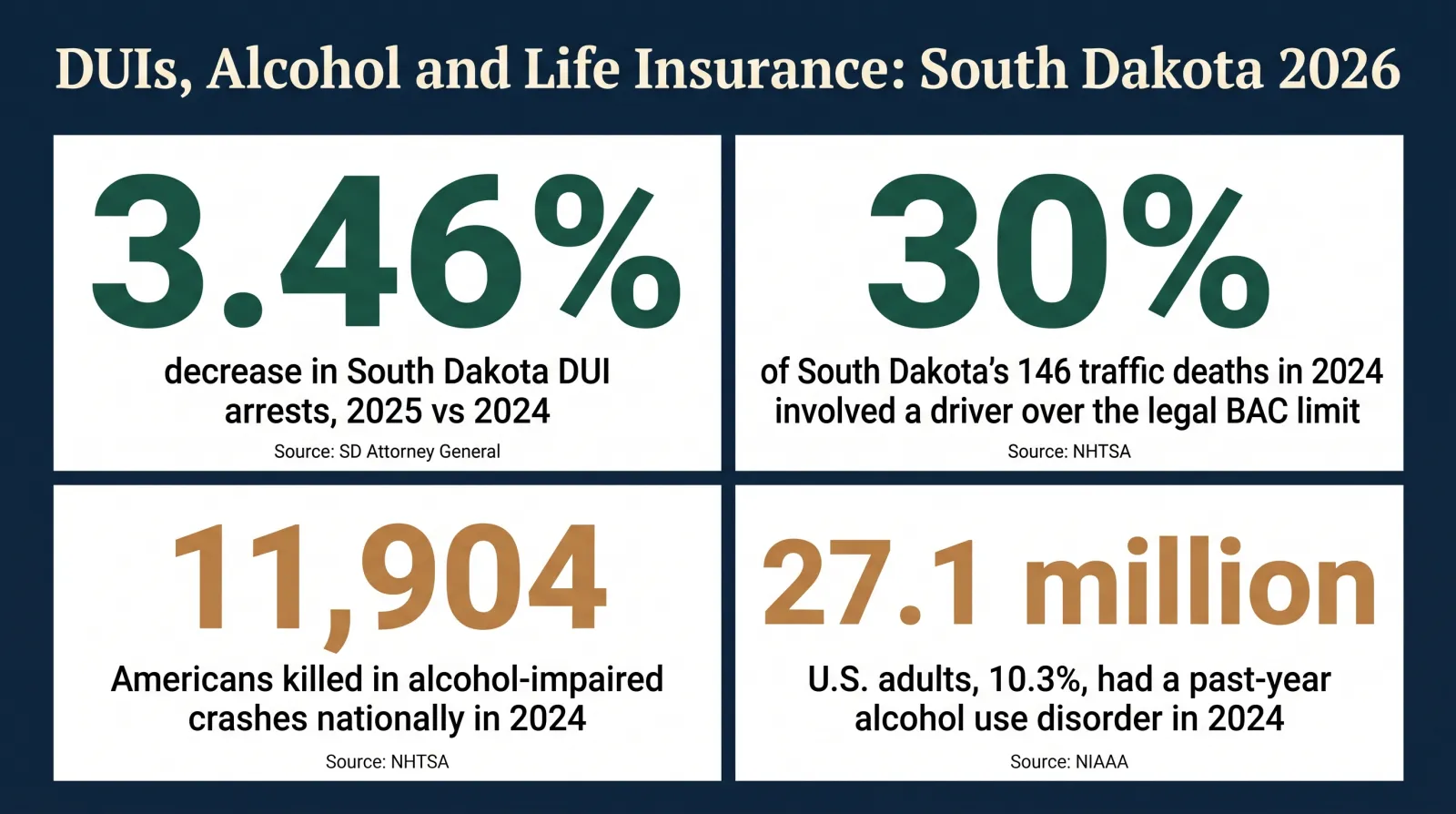
- DUI arrests in South Dakota fell 3.46% in 2025 compared to 2024, according to the South Dakota Attorney General's 2025 Crime in South Dakota Annual Report, yet 43 of the state's 146 traffic fatalities in 2024 (30%) involved a driver with a blood alcohol concentration of .08 g/dL or higher, per NHTSA's State Alcohol-Impaired-Driving Estimates: 2024 Data.
- Nationally, alcohol-impaired driving killed 11,904 people in 2024, 30% of all U.S. traffic deaths and one death roughly every 44 minutes, according to NHTSA. That rate decreased 3.9% from 12,382 deaths in 2023.
- 27.1 million U.S. adults age 18 and older (10.3%) had a past-year alcohol use disorder in 2024, according to the National Institute on Alcohol Abuse and Alcoholism's analysis of the National Survey on Drug Use and Health. Carriers evaluate that clinical pattern separately from a single driving-record DUI.
- South Dakota Codified Law 58-15-10 makes a life insurance policy incontestable, except for nonpayment of premium or fraud, two years after issue. Disclosing a DUI accurately up front, rather than assuming it no longer matters, is what protects a claim inside that window and after it.
The pain: you assume the question about your DUI already has an answer
Most people who have a DUI on their record never get as far as filling out a life insurance application. They picture the moment they would have to check the box, decide in advance that the honest answer ends the conversation, and never actually test that guess against a real underwriter. Nobody told them no. They told themselves no, based on an assumption nobody ever walked them through, often years after the conviction itself stopped affecting almost anything else in their life.
That guess is usually wrong, and it is an expensive one to keep believing. A mortgage does not check your driving record before it needs to be paid off. A spouse’s income gap if something happened to you does not care whether the DUI was three years ago or thirteen. The question “do I have a DUI” and the question “does my family need my income replaced if I die” are unrelated to each other, and treating an old conviction as a permanent answer to the second question is exactly how South Dakota households end up carrying real, unaddressed financial exposure over something that, for most applicants, is not the roadblock they assumed it was.
This is general education, not a recommendation
Nothing here tells you what rate class you will receive or promises approval, a specific premium, or a specific underwriting timeline. It explains how two carriers' own published guidelines currently treat a DUI and alcohol-use history, using named sources, so you can understand your situation instead of guessing at it. It is not legal advice about South Dakota's DUI laws or any criminal matter.
Why it happens: what underwriters are actually looking at, and the words they use
An underwriter’s job is to estimate mortality risk and price a policy accordingly. A DUI enters that math through two separate, related questions, and the terms carriers use are worth defining before anything else, because the words on the application are not always used the way people expect.
- DUI/DWI. Driving under the influence or driving while intoxicated, a criminal conviction for operating a vehicle above a state’s legal blood alcohol threshold, which is .08 grams per deciliter (g/dL) in South Dakota and every other state, per NHTSA. It is a driving-record fact with a specific conviction date, separate from any broader pattern of alcohol use.
- Moving violation. Any citation for how you operated a vehicle, from speeding to a DUI. Carriers count these over a rolling window, usually the past three years, and cap how many are allowed at each rate class.
- Underwriting class. The risk tier a carrier assigns after reviewing your application, driving record, and any medical information. Classes typically run from a top tier such as Preferred Plus, through Preferred, Standard Plus, and Standard, before dropping into a series of table ratings.
- Table rating. A pricing step above standard, assigned when an applicant is insurable but carries more risk than a standard applicant. Each step generally adds a percentage to the premium a standard applicant of the same age and sex would pay.
- Alcohol abuse/alcoholism. A clinical pattern of use, not a single legal conviction. Underwriters evaluate a documented history of abuse, dependence, or treatment on its own timeline, separate from a driving-record DUI, even though the two questions often appear on the same application.
- Contestability period. The two-year window after a policy is issued during which an insurer can investigate a claim and potentially deny it or rescind the policy over a material misrepresentation on the application. Fraud remains contestable even after that window closes, under South Dakota law.
- MIB and the motor vehicle report (MVR). MIB Group is a consortium life insurers use to check applications against a shared database and flag inconsistencies for follow-up, according to MIB’s own description of its role. Separately, MIB provides participating carriers with Motor Vehicle Record Alerts, which flag applicants whose driving records carry violations of significance to underwriting, per MIB’s own product description. An MVR itself, the actual state driving record, is a routine pull on nearly every life insurance application, exam-based or not.
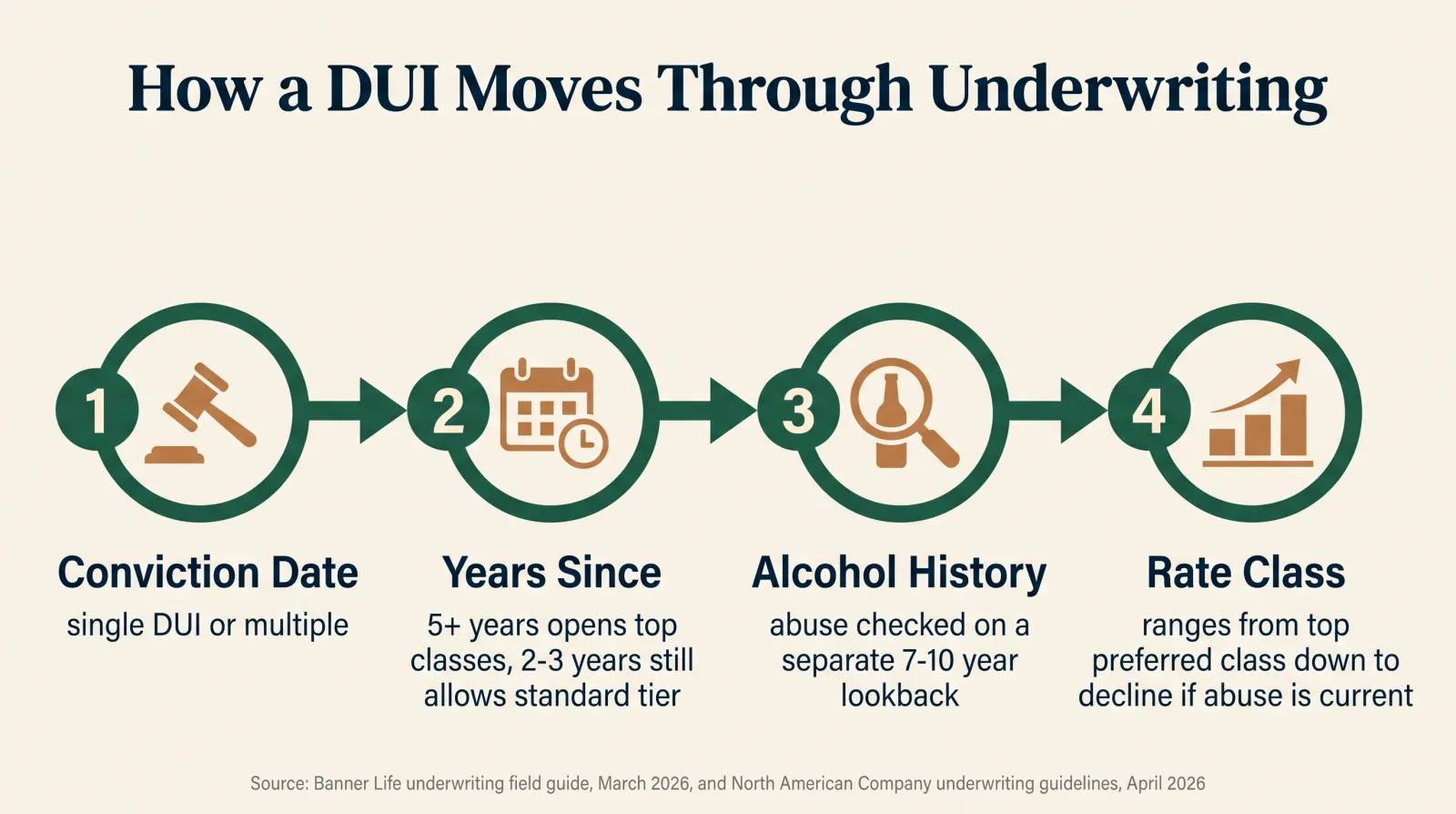
Two carriers’ currently published field underwriting guides, fetched directly for this article, show how these definitions turn into an actual rate table. The pattern is similar enough between them to be a genuine industry norm, not one company’s outlier rule, though the exact wording and thresholds always belong to the individual carrier and contract.
| Rate class | Banner Life (March 2026) | North American Company (April 2026) |
|---|---|---|
| Top class (Preferred Plus / Super Preferred) | No DUI in past 5 years (multiple DUIs excluded entirely); no alcohol abuse history disclosed | No DUI or reckless driving conviction in past 5 years; no alcohol/drug abuse or treatment history in past 10 years |
| Preferred | No DUI in past 5 years; no alcohol abuse in past 10 years | No DUI or reckless driving conviction in past 5 years; no alcohol/drug abuse or treatment history in past 7 years |
| Standard Plus | No DUI in past 3 years; no alcohol abuse in past 7 years | Not broken out separately in the sections reviewed |
| Standard | No DUI in past 2 years; no alcohol abuse in past 7 years | Not broken out separately in the sections reviewed |
| Decline or postpone | Current alcohol abuse/alcoholism, or abstinence of less than 2 years | Not broken out separately in the sections reviewed |
Sources: Banner Life family of companies, "Field guide for life insurance underwriting," March 2026; North American Company for Life and Health Insurance, "New Business Life underwriting requirements guidelines" (631NM), April 2026. Two carriers' published guidelines, shown as an illustrative example. This table does not represent premiums, quotes, or a promise of any outcome for any applicant, and other carriers' guidelines differ.
Here is the part that surprises people most: none of this is arbitrary or unusual under South Dakota law. Pricing a real, disclosed risk factor, whether a DUI, a health condition, or tobacco use, according to its actual effect on mortality is how the underwriting system is designed to work in every state, South Dakota included. What the law prohibits is charging two people with the same real risk profile different rates, not classifying people by an actual, disclosed risk they carry.
What it costs to get wrong: an illustration, not a quote
Consider a 41-year-old in Sioux Falls with a single DUI conviction from four years ago, no other alcohol-related history, and a clean driving record since. He has a $210,000 mortgage balance, two kids in elementary school, and a spouse who works part time. He looked into life insurance once, assumed the DUI would sink the application, and let the idea sit for two more years while the mortgage, and the risk behind it, stayed exactly where it was. This is an illustration of underwriting mechanics only, not a projection of any specific offer for any real applicant.
Under Banner Life’s published guide, a DUI four years old keeps this applicant out of the top two rate classes, which require five clean years, but it does not block Standard Plus, which only requires three DUI-free years, or, closer to that anniversary, a class one step above it. Under North American Company’s guide, the same four-year-old DUI similarly keeps him below its top two classes, which share that five-year threshold. In both cases, the fact pattern here, a single DUI, no alcohol abuse history, and four clean years since, is a solidly workable underwriting file at either company, not a decline.
5 years
DUI-free lookback both carriers reviewed require for their top rate classes
30%
of South Dakota's 146 traffic deaths in 2024 involved a driver at or above the legal BAC threshold, per NHTSA
2 years
South Dakota's incontestability period for life insurance policies, per SDCL 58-15-10
The real cost in this illustration is not a rate class. It is the two years this applicant spent assuming an answer instead of getting one: a $210,000 mortgage with no coverage behind it, sized against an income that stops the day something happens, sitting unaddressed over a guess that never got tested against an actual application. If you have not worked through what your own household would actually need to replace, our guide to figuring out how much coverage you actually need walks through that math separately from, and before, the underwriting question.
The 2026 picture: a common file, not a rare one, in South Dakota
South Dakota’s own numbers explain why this is such a routine underwriting scenario here. DUI arrests statewide fell 3.46% in 2025 compared to 2024, according to the South Dakota Attorney General’s 2025 Crime in South Dakota Annual Report, compiled by the Division of Criminal Investigation’s Statistical Analysis Center. A decline in arrests is real progress, but it does not mean the underlying exposure has disappeared. NHTSA’s 2024 state-by-state data shows alcohol-impaired driving remains a significant share of the state’s traffic deaths, and, measured the way NHTSA measures it, South Dakota’s share is statistically in line with the nation’s, not an outlier in either direction.
South Dakota traffic fatalities by driver BAC level, 2024
NHTSA, "State Alcohol-Impaired-Driving Estimates: 2024 Data" (DOT HS 813 813), Table 2, July 2026. BAC thresholds are cumulative (each includes the categories above it), not additive segments of the total.
Nationally, the same underlying problem is larger and moving in a similar direction. Alcohol-impaired driving killed 11,904 people in the United States in 2024, 30% of all traffic deaths that year and an average of one death every 44 minutes, according to NHTSA’s national fact sheet. That figure fell 3.9% from 12,382 deaths in 2023, continuing a longer decline, though NHTSA’s own historical data shows 2019’s toll of alcohol-related deaths was the lowest since the 1970s before ticking back up, which is a reminder that this trend is not a straight line in either direction.
A DUI on your record is a date on a driving report, not a permanent verdict on whether you can protect your family. The carriers that price this every day treat it that way. It is worth finding out how they'd actually price yours.
Mike Moore, Life Insurance AdvisorThe clinical side of this picture matters too, because carriers evaluate it separately from a single conviction. According to the National Institute on Alcohol Abuse and Alcoholism’s analysis of the 2024 National Survey on Drug Use and Health, 27.1 million U.S. adults age 18 and older, 10.3% of that population, had a past-year alcohol use disorder. That is a large, well-studied population, not a fringe one, and it is exactly why Banner Life’s guide draws a hard line between a single, disclosed DUI (a driving-record fact with its own lookback) and a documented pattern of alcohol abuse or alcoholism (a clinical fact with a longer lookback and, per that guide, a decline or postponement if use is current or sobriety has lasted less than two years). Those are two different underwriting conversations, even when they show up on the same application.
How it is typically evaluated
- Treated as a driving-record fact with a specific conviction date
- Priced on a lookback window, five years to a top class under both guides reviewed
- Standard or standard-plus classes often available well before that five-year mark
- Does not, by itself, trigger the alcohol-abuse review
How it is typically evaluated
- Treated as a clinical history, separate from any single conviction date
- Priced on a longer lookback, seven to ten years under Banner Life's and North American's guides
- Current use or under two years of sobriety can lead to a decline or postponement
- Evaluated alongside any related health findings, not the driving record alone
How to work it out yourself: what to gather before you apply
None of this requires anyone else to get started. A few pieces of information you already have, or can pull yourself, tell you more about your likely outcome than any guess will.
- Find your exact conviction date, or dates. The lookback windows above are counted from the conviction date, not the incident date or when a license was reinstated. A few months can matter if you are close to a five-year or three-year mark.
- Note whether it was a single DUI or more than one. Under Banner Life’s guide, multiple DUIs are excluded from its top two classes entirely, a materially different situation from a single, older conviction. If you have more than one, expect the conversation to center on standard or table-rated classes rather than a top tier, and treat that as useful, accurate information rather than a reason not to apply.
- Be honest with yourself about current alcohol use. If a carrier’s alcohol-abuse question would honestly be answered “yes, currently” or “sober less than two years,” expect that to matter more than the DUI date itself, and expect a real conversation about timing before applying makes more sense than applying immediately.
- Pull your own motor vehicle report if you are not sure what it shows. South Dakota’s Department of Public Safety and most other states let you request your own driving record. Knowing exactly what an underwriter’s MVR pull will show removes the single biggest source of surprise in this process.
- Plan to disclose accurately, every time, on every application. The two-year contestability period under South Dakota Codified Law 58-15-10 means an inaccurate answer discovered later, especially after a claim, is a far worse outcome for your beneficiaries than an accurate answer priced honestly today.
You can do steps 1 through 4 yourself, today
Most of this is information you already have or can request directly. Where a second opinion tends to help most is comparing how different carriers' actual published lookback windows apply to your specific dates, since that comparison is the part no single company's website will do for you.
When it is worth waiting before you apply
If your most recent DUI was very recent, or if you would honestly answer a carrier's alcohol-abuse question as "current use" or "less than two years sober," applying immediately at multiple carriers is more likely to produce declines on your file than a better outcome. In that specific situation, it is realistic, not defeatist, to treat sobriety and time since conviction as the actual variables to work on before applying, the same way you would manage a health condition before reapplying for a better class.
If you would rather have someone local run this comparison with you than call carriers one by one, that is what we do: Compare My Options.
How we help
We are independent, so we are not built around any single carrier’s DUI or alcohol-use guidelines. We start with your actual conviction date, or dates, whether alcohol abuse is part of the honest picture, and your coverage need, then compare how different carriers are likely to classify that specific file rather than assuming one company’s rule applies everywhere. If a standard-plus or standard classification genuinely fits your timeline, we look for it. If your file is closer to a top-tier class than you assumed, we say that too, and if timing is genuinely the issue, we say that honestly as well.
What you get
A clear, carrier-specific read on how your actual DUI history and current alcohol use are likely to be evaluated, not a generic answer pulled from an average applicant. A comparison across more than one carrier’s published guidelines, since that variation between companies is the single biggest lever in this decision and the hardest one to see on your own. And an honest answer about which rate class and which carrier are realistic for your specific dates, instead of a guess made from outside the application.
Find out how your driving record is actually likely to be underwritten
Bring your conviction date, an honest picture of your current alcohol use, and your coverage goals, and we will walk through how different carriers are likely to classify your file.
Not ready to talk to anyone yet? Read How It Works first and come back when you are. If you are still working out how much coverage you actually need before worrying about the underwriting question, our life insurance needs calculator is a reasonable place to start that math on your own. If a health condition is part of your picture alongside a driving record, our broader look at getting life insurance after a health condition covers how carriers weigh multiple factors together.
Frequently asked questions
Does a DUI automatically disqualify you from life insurance?
No. A single DUI is a factor underwriters price, not an automatic decline at most carriers. How much it affects you depends mainly on how long ago it happened and whether it comes with a broader pattern of alcohol abuse. Banner Life’s own March 2026 underwriting field guide, for example, keeps a single DUI out of its top two rate classes only if it happened within the last five years; North American Company’s April 2026 guidelines use the same five-year window for its comparable top classes. Multiple DUIs are a different, more serious story, covered separately below.
How long does a DUI actually affect my life insurance rate?
Under the two carrier guides reviewed for this article, a single DUI keeps you out of the top rate classes for five years from the conviction date, and out of the next-tier classes for two to three years, depending on the carrier and class. Banner Life’s Standard Plus class requires no DUI within three years, and its Standard class requires none within two years. That is two carriers’ published rules, not a universal timeline; guidelines vary by company, so the honest answer is that the timeline depends on which carrier you compare, not on a single fixed rule.
Does South Dakota’s high DUI arrest rate affect how carriers view South Dakota applicants specifically?
Not directly. Life insurance underwriting guidelines are set nationally by each carrier and applied the same way to an applicant in Sioux Falls as to one in Ohio; South Dakota’s own DUI numbers do not create a separate, harsher rate table for state residents. What South Dakota’s numbers do show is how common this underwriting scenario actually is here: DUI arrests statewide fell 3.46% in 2025 compared to 2024, according to the South Dakota Attorney General’s 2025 Crime in South Dakota Annual Report, and 43 of the state’s 146 traffic fatalities in 2024, 30%, involved a driver at or above the legal .08 g/dL blood alcohol threshold, per NHTSA. This is a routine file for a South Dakota underwriter to review, not a rare one.
Do I have to disclose a DUI on a life insurance application, even an old one?
Yes, if the application asks, which nearly every fully underwritten application does, typically asking about moving violations, license suspensions, and DUI or DWI convictions within a specific lookback window stated on the form. Carriers also pull a motor vehicle report (MVR) as a routine part of underwriting, and MIB Group provides carriers with MVR Alerts that flag applicants with driving violations, according to MIB’s own description of that service. An old DUI you leave off the form because you assume it no longer matters is a discrepancy a carrier’s own process is built to catch, and it surfaces at the worst possible time: during a claim.
What happens if an insurer finds an undisclosed DUI after my policy is already in force?
It depends on timing and materiality, but the risk is real. South Dakota Codified Law 58-15-10 requires every life insurance policy issued in the state to become incontestable, except for nonpayment of premium or fraud, after it has been in force during the insured’s lifetime for two years from the date of issue. Within that two-year contestability period, a carrier that discovers a material misrepresentation, an undisclosed DUI relevant to the underwriting decision, can investigate and potentially deny a claim or rescind the policy. After two years, fraud remains an exception even to incontestability. Disclosing accurately up front is the only version of this that reliably protects your beneficiaries.
Does one DUI matter less than a pattern of alcohol abuse?
Generally, yes, and the underwriting guides reviewed for this article draw that distinction explicitly. Banner Life’s guide separates driving-record questions (which key off the DUI conviction itself and its date) from substance and alcohol abuse questions (which key off a documented history of abuse, dependence, or treatment). A single, disclosed DUI with no other alcohol-related history is evaluated as a driving-record issue with its own lookback period. A pattern that meets the clinical bar for alcohol abuse or alcoholism is evaluated separately and, per Banner Life’s guide, can lead to a decline or postponement if use is current or abstinence has lasted less than two years. These are related questions on an application, but carriers do not treat them as the same question.
Can I get no-medical-exam life insurance with a DUI on my record?
No-exam life insurance is a real product category, including accelerated underwriting, which relies on data sources like a motor vehicle report and prescription history instead of a physical exam, and simplified-issue products, which ask a shorter set of health and driving questions. A DUI does not automatically rule either path out, but an MVR is typically still part of the process either way, since MIB’s MVR Alert service exists specifically to flag driving violations for exactly this kind of application. Whether a specific no-exam product fits your situation, and at what classification, depends on your age, the coverage amount, how long ago the DUI occurred, and the individual carrier’s own guidelines, which is worth comparing across more than one company rather than assuming from any single carrier’s marketing page.
Is it legal for a South Dakota insurer to charge more because of a DUI?
Yes. Charging a higher premium for a documented, disclosed risk factor that changes mortality risk, which a DUI can signal along with any related alcohol use, is how risk-based pricing works under South Dakota’s insurance code. It is a different question from unfair discrimination, which under South Dakota law means treating two applicants with the same actual risk profile differently, not pricing an actual, disclosed risk factor according to the real statistics behind it. A DUI conviction and any accompanying alcohol-use history are exactly the kind of disclosed, verifiable facts underwriting is built to price.
Before you apply
This article is general education, not insurance, legal, financial, or tax advice, and it is not legal advice about any DUI conviction, criminal matter, or South Dakota's DUI laws. Product availability, rate classes, underwriting outcomes, and premiums vary by carrier and are subject to underwriting and each applicant's specific history. No coverage exists until a policy is issued and in force. Any guarantees are subject to the claims-paying ability of the issuing insurer. Please review actual policy documents and speak with a licensed agent about your situation.
Sources
- South Dakota Attorney General — 2025 Crime in South Dakota Annual Report — DUI arrests decreased 3.46% in 2025 compared to 2024; compiled by the Division of Criminal Investigation’s Statistical Analysis Center under Attorney General Marty Jackley; published 2026.
- NHTSA — State Alcohol-Impaired-Driving Estimates: 2024 Data (DOT HS 813 813, July 2026) — Table 2: South Dakota recorded 146 total traffic fatalities in 2024, of which 43 (30%) involved a driver with a BAC of .08 g/dL or higher and 33 (23%) involved a driver at .15 g/dL or higher; U.S. total of 39,254 fatalities, 11,904 (30%) at .08+.
- NHTSA — Alcohol-Impaired Driving: 2024 Data — 11,904 people killed nationally in alcohol-impaired-driving crashes in 2024, 30% of all traffic fatalities, one death approximately every 44 minutes; a 3.9% decrease from 12,382 deaths in 2023.
- Banner Life family of companies — Field Guide for Life Insurance Underwriting (March 2026 edition) — driving-history and substance/alcohol-abuse criteria by rate class, including the decline/postpone criteria for current alcohol abuse or fewer than two years of sobriety. One carrier’s published guidelines, shown as an illustrative example; other carriers differ.
- North American Company for Life and Health Insurance — New Business Life Underwriting Requirements Guidelines (631NM) (April 2026 edition) — driving-record and alcohol/drug-abuse criteria by rate class, cited as a second, independent carrier’s published guidelines corroborating the general five-year DUI lookback pattern for top rate classes.
- National Institute on Alcohol Abuse and Alcoholism — Alcohol Use Disorder (AUD) in the United States: Age Groups and Demographic Characteristics — 27.1 million U.S. adults 18 and older (10.3%) had a past-year alcohol use disorder, based on the 2024 National Survey on Drug Use and Health; page updated August 2025.
- South Dakota Legislative Research Council — Codified Law 58-15-10 — life insurance policies issued in South Dakota must be incontestable, except for nonpayment of premium or fraud, after two years in force from the date of issue.
- MIB — Motor Vehicle Record Alerts through Verisk — description of MIB’s MVR Alert service, which flags participating carriers’ applicants who have driving violations of significance to underwriting.
Related reading: Getting Life Insurance After a Health Condition: 2026 Underwriting Trends, Does Vaping Count as Smoking for Life Insurance in 2026?, Life Insurance and Marijuana Use: A 2026 South Dakota Guide, and How Much Life Insurance Do You Actually Need?. See current options for no-medical-exam life insurance, or learn more about who we help.