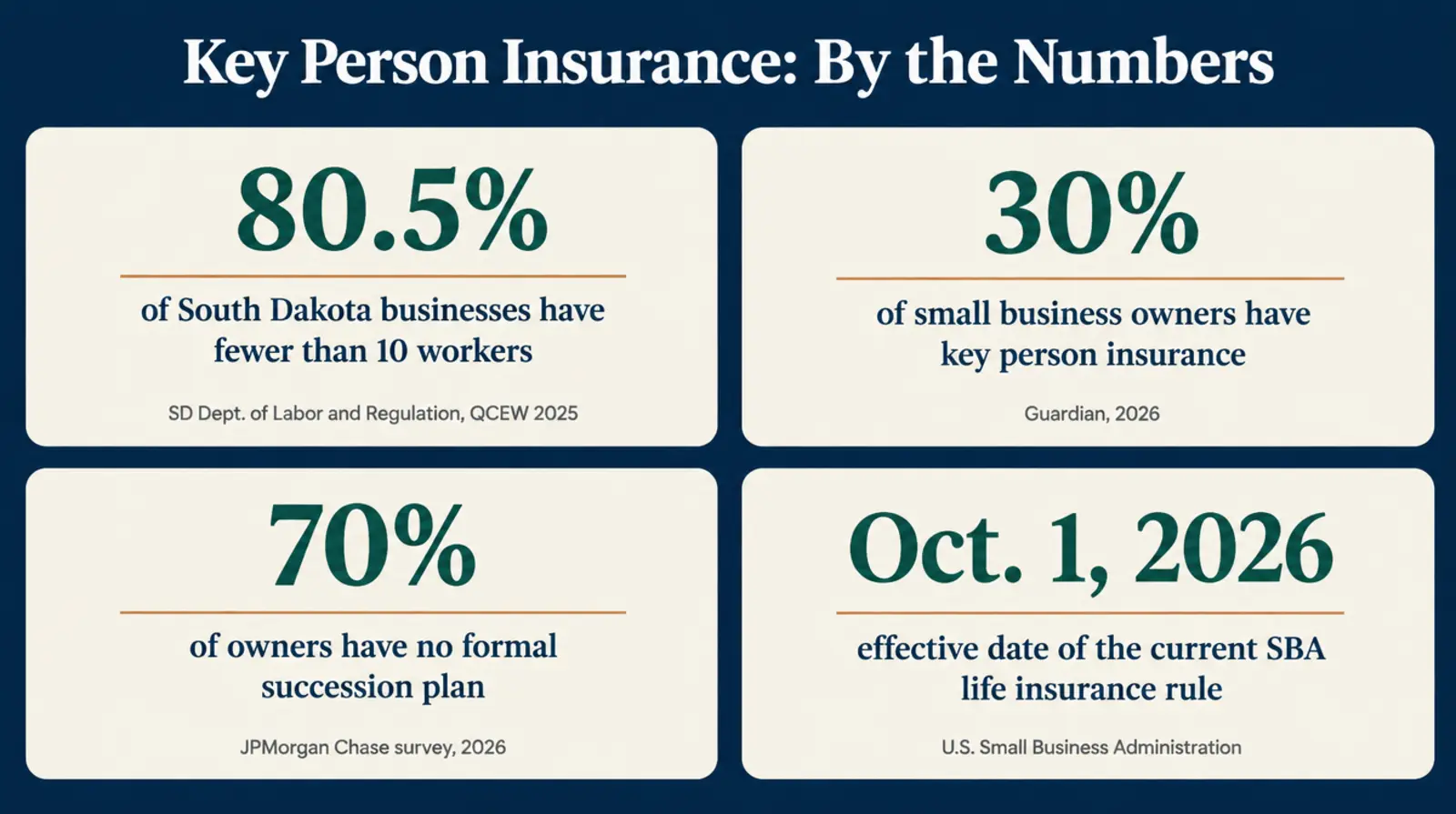
Yes, if your business just closed or is applying for a Standard SBA 7(a) or 504 loan that isn’t fully covered by other collateral, federal rules that took effect October 1, 2026 can require you to carry life insurance on the owner before the loan closes. That’s a new detail buried in SOP 50 10 8.1, the SBA’s current rulebook for lenders, and it lands squarely on the kind of business that makes up most of South Dakota’s economy: 33,109 of the state’s 41,142 private-sector establishments, about 80.5%, employ fewer than ten workers, according to the South Dakota Department of Labor and Regulation’s 2025 Quarterly Census of Employment and Wages (QCEW) report. A business that size is usually “otherwise dependent on one owner’s active participation,” in the SBA’s own language, which is exactly the phrase that triggers the requirement. This guide walks through what the rule actually says, how the required coverage amount gets calculated using the SBA’s own formula, and how to work out the separate, usually larger number your business would need to actually survive losing that person, with worked examples using real, current, sourced figures.
The short version
- SBA SOP 50 10 8.1 took effect October 1, 2026, and can require life insurance on a business owner before a Standard 7(a) or 504 loan closes, if the loan isn't fully secured by other collateral.
- The required amount usually isn't the full loan balance. It's the gap between the loan and the collateral backing it, sometimes called the collateral shortfall.
- 80.5% of South Dakota's 41,142 private-sector establishments have fewer than ten workers, per the state's own 2025 employment data, which is the population most exposed to this rule.
- Only 30% of small business owners nationally have key person insurance in place, and 70% are in early-stage planning or have no formal succession plan at all, according to two separate 2026 surveys cited in this guide.
- What a lender requires and what your business actually needs to survive your absence are two different numbers. This guide shows how to calculate both.
What actually happens to a South Dakota business when the one person who runs it is gone?
For most South Dakota businesses, there isn’t a bench. There’s an owner who does the estimating, signs the checks, knows which supplier will actually answer the phone on a Friday, and personally guaranteed the loan on the building or the equipment. When that person dies unexpectedly, the business doesn’t quietly keep running while someone sorts out a transition plan. Revenue often stops or drops hard immediately, at the same moment payroll, rent, and loan payments keep coming due on schedule.
That exposure isn’t rare here. South Dakota had 41,142 private-sector business establishments in 2025, and 33,109 of them, 80.5%, employed fewer than ten workers, according to the South Dakota Department of Labor and Regulation’s Labor Market Information Center, in its 2025 Quarterly Census of Employment and Wages (QCEW) Annual Report. Extend the cutoff to fewer than twenty workers and it’s 37,245 establishments, 90.5% of the state’s total. A shop that size doesn’t have a deep management bench to absorb the loss of its owner. It has the owner, and then whoever the owner was able to hire.

This is where key person life insurance comes in, as a distinct idea from the personal life insurance an owner carries for their own family. A key person policy is a policy the business owns, on a person whose death would create a measurable, specific financial problem for the business, with the business (or a lender, through an assignment) as beneficiary instead of that person’s spouse or kids. It’s not a new idea. What’s new, as of this month, is a federal rule that makes it mandatory in specific, common circumstances, and ties the required amount to a formula instead of leaving it to guesswork.
Why would a bank or the federal government care whether your business has this?
Because when an SBA loan isn’t fully backed by hard collateral, a big part of what’s actually securing that loan is the owner’s continued ability to run the business and generate the cash flow that makes the payments. If that person dies, the lender’s collateral position gets weaker at the exact moment the loan is most at risk of default. The SBA’s current guidance addresses that gap directly.
SOP 50 10 8.1 is the Standard Operating Procedure that governs SBA 7(a) and 504 lending, and the version now in force took effect October 1, 2026, replacing the prior version that had been in effect since June 2025. Its life insurance section is short but specific. For Standard 7(a) loans, the rule states plainly: “If the loan is not fully secured, life insurance is required in the amount of the collateral shortfall for the principals of sole proprietorships, single member LLCs, or for businesses otherwise dependent on one owner’s active participation,” per the SBA’s SOP 50 10 8.1 (Section A, Chapter 5). Two terms are doing real work in that sentence:
- Fully secured: the value of the collateral backing the loan, after applying the lender’s or SBA’s discount rates, equals or exceeds the loan amount.
- Collateral shortfall: the dollar gap between the loan balance and that discounted collateral value, which is the amount of life insurance the rule actually requires, not the full loan amount.
504 loans, which run through a nonprofit lender called a Certified Development Company working alongside SBA, use a similar rule anchored to the loan’s debenture, the bond-like note that funds a 504 loan: “CDCs must assess whether the viability of the business is tied to an individual or individuals. Life insurance is required for the principals of sole proprietorships, single member LLCs, or for businesses otherwise dependent on one owner’s active participation when the SBA Loan is not fully collateralized,” per the same SOP. For 504 loans specifically, the SOP also sets a minimum policy term: 10 years for a 10-year debenture, and 20 years for a 20- or 25-year debenture, so the coverage has to outlast enough of the loan to matter, not just exist on paper at closing.
Not every SBA loan triggers this. For 7(a) Small Loans, SBA Express, and Export Express loans, the SOP instead lets lenders “follow their internal written policy for their similarly-sized, non-SBA guaranteed commercial loans,” meaning there’s no single federal formula for those programs, just whatever that particular bank already requires for a comparably sized conventional loan.
| Loan program | When life insurance is required | Required amount | Who holds the assignment |
|---|---|---|---|
| Standard 7(a), EWCP, CAPLines, International Trade | Loan not fully secured, and borrower is a sole proprietorship, single-member LLC, or one-owner-dependent business | Collateral shortfall (loan balance minus discounted collateral value) | The 7(a) Lender, as assignee, acknowledged by the insurer's home office |
| 504 (Certified Development Company loans) | Loan not fully collateralized, and viability is tied to one individual | Net debenture amount minus discounted collateral value; minimum term 10–20 years, matched to the debenture term | The CDC/SBA, as assignee, acknowledged by the insurer's home office |
| 7(a) Small Loans, SBA Express, Export Express | Per the lender's own internal policy | Set by the lender, following its policy for similarly sized non-SBA commercial loans | Per the lender's own policy |
Source: U.S. Small Business Administration, SOP 50 10 8.1, Lender and Development Company Loan Programs, effective October 1, 2026, Section A, Chapter 5, Paragraph C.5 (Life Insurance). Accessed October 2026. General description of the rule's structure, not a substitute for the full SOP text or your lender's own closing requirements.
A lender can't require whole life insurance to satisfy this
The same SOP also protects borrowers on one specific point: "SBA Lenders may accept the pledge of an existing life insurance policy. Credit life insurance or whole life insurance should not be required." Term life insurance, which is typically much less expensive than whole life for the same death benefit, generally satisfies this requirement. If a lender pushes for a more expensive permanent policy when a term policy would cover the required amount, that's worth a second opinion.
The mechanism that actually protects the lender is called a collateral assignment: a document naming the lender (or the CDC/SBA, for a 504 loan) as assignee on the policy, acknowledged by the insurance company’s home office. That doesn’t make the lender the full beneficiary or the owner of the policy. Its claim is limited to the assigned amount, typically the outstanding loan balance; anything above that, if the death benefit is larger, still goes wherever the policy’s actual beneficiary designation points, whether that’s the business itself or the owner’s family.
What does it actually cost to guess instead of calculate?
The cost shows up in three different places, and none of them require anything to actually go wrong first.
The deal can stall at closing. A lender that identifies a collateral shortfall on a 7(a) or 504 loan isn’t optional about the life insurance requirement; it’s part of what closes the loan. An owner who hasn’t thought about this before their closing date is now trying to get underwritten for a new policy, assigned to the lender, on a timeline the loan is setting, not one they chose.
The tax treatment is less favorable than most owners assume. Under 26 U.S.C. Section 264(a)(1), the federal tax code is direct about this: a deduction is disallowed for “premiums on any life insurance policy, or endowment or annuity contract, if the taxpayer is directly or indirectly a beneficiary under the policy or contract.” A standard key person policy, where the business both owns the policy and is named beneficiary, falls squarely inside that rule. The premiums are generally not a deductible business expense. That’s a real, ongoing cost difference from ordinary business insurance premiums, and it’s worth knowing before the policy is set up, not after the first tax return that includes it. This is a general description of a federal tax rule, not tax advice for your specific situation; talk with a tax professional about your own return.
Most owners are running without any number at all, let alone the right one. Nationally, only 30% of small business owners have key person insurance in place, according to Guardian Life Insurance Company of America’s 2026 report, “Big Goals, Fragile Foundations.” The same report found just 34% have a formal succession plan, 24% have a buy-sell agreement, and 19% have disability buyout coverage. A separate survey, run by JPMorgan Chase in March 2026 among roughly 1,000 small business owners nationwide and published that May, found 40% of owners plan to retire within the next decade, yet 70% are either in early-stage planning or have no formal succession plan whatsoever, and only 8% describe themselves as fully prepared to transition ownership.
What share of small business owners actually have this covered?
Source: Guardian Life Insurance Company of America, "Big Goals, Fragile Foundations" report, published July 14, 2026 (distributed via PR Newswire). Accessed October 2026.
Those four numbers describe the same gap from four directions: most owners haven’t priced any of this out, which is a different problem from having priced it out and decided they don’t need it.
If you'd rather have someone local run this math against your specific loan and your specific business, that's what we do. Compare My Options.
How do you actually work out the number, instead of guessing?
There are two separate numbers worth calculating, and they answer two different questions. The first is what a lender requires. The second is what your business would actually need. They’re often not the same size, and the gap between them is usually the more important number.
Method 1: the lender-driven minimum, using the SBA’s own formula
This is the number a 7(a) or 504 loan can require at closing, and it’s calculated the same way the SOP describes it: the loan amount minus the discounted value of the collateral backing it.
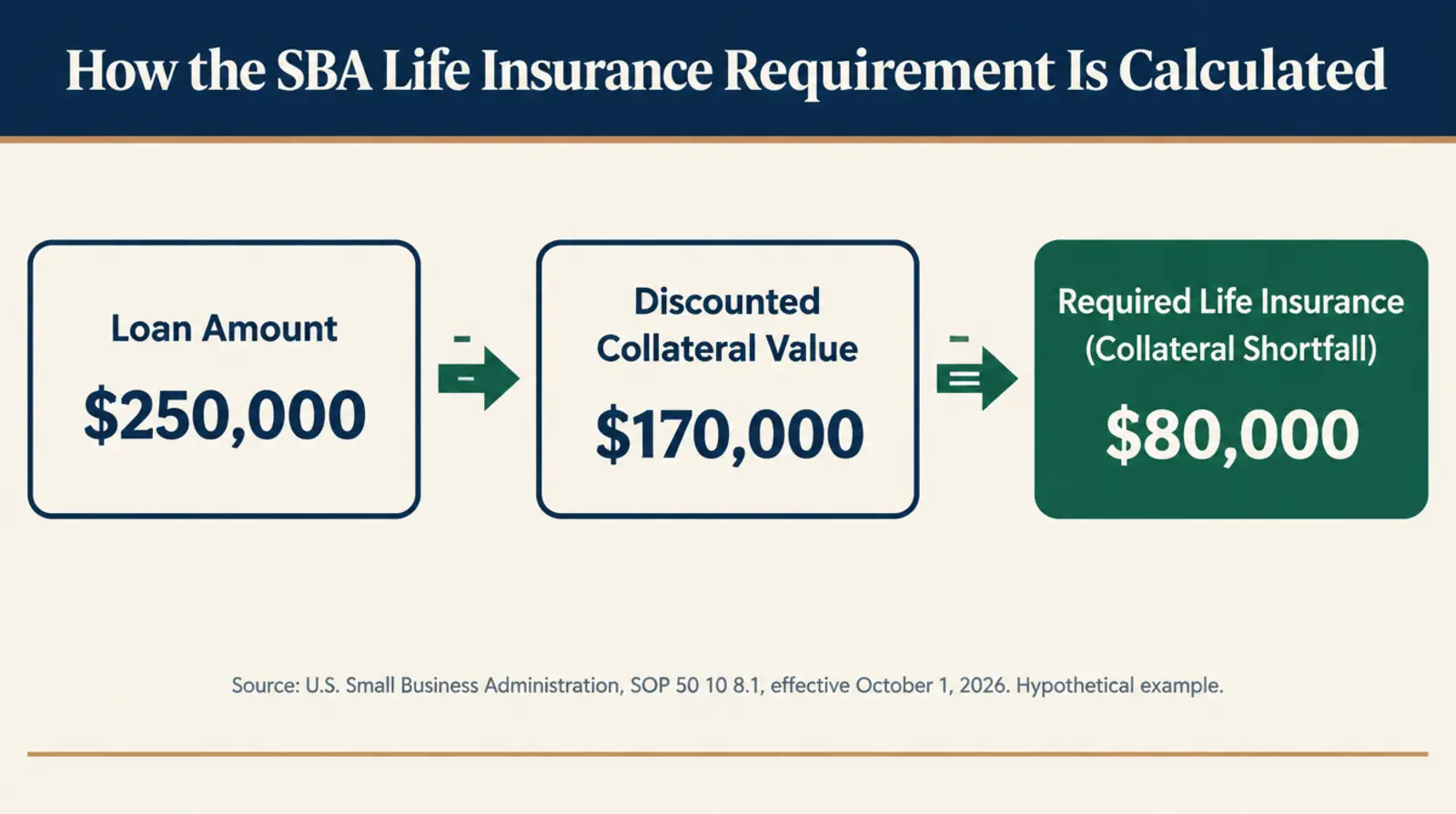
A hypothetical 7(a) example. Say a sole proprietor in Sioux Falls takes out a $250,000 Standard 7(a) loan to buy a used equipment fleet and build out a small warehouse space. The lender’s appraisal and equipment valuation, after applying its own discount rates, back out to $170,000 of eligible collateral. Because the loan isn’t fully secured ($170,000 of collateral against a $250,000 loan) and the business is a sole proprietorship, otherwise dependent on the owner’s active participation, SOP 50 10 8.1’s formula applies directly:
| Line item | Amount |
|---|---|
| Loan amount | $250,000 |
| Discounted collateral value | $170,000 |
| Collateral shortfall | $80,000 |
| Life insurance required on the owner, assigned to the lender | $80,000 |
A hypothetical example built only to illustrate the SBA's published formula; not a real loan, quote, or premium estimate. Formula source: U.S. Small Business Administration, SOP 50 10 8.1, Section A, Chapter 5, Paragraph C.5. Accessed October 2026.
A hypothetical 504 example. A Rapid City HVAC contractor finances a shop building with a $500,000, 20-year 504 debenture. The SOP’s own discount method for real estate is explicit: “Improved real estate at 85% of fair market value,” with other collateral categories, like new equipment, discounted separately (75% of price minus prior liens, per the same section). If the building appraises at $450,000, the discounted collateral value is $450,000 × 85% = $382,500. Since that’s less than the $500,000 net debenture, the loan isn’t fully collateralized, and the required life insurance equals the difference: $500,000 − $382,500 = $117,500, with a policy term of at least 20 years to match the debenture.
These are illustrative numbers only, built to show how the formula works, not real loan figures, premiums, or a quote for anyone’s actual business.
Method 2: what your business would actually need, independent of any lender
The SBA’s number is a floor set by a lender’s collateral position. It has nothing to do with what it would actually cost your business to function without that person for the months it takes to find, hire, and ramp up a replacement, or to wind the business down in an orderly way if no replacement is realistic.
One commonly used starting point, published by Nationwide, is to estimate a replacement multiple based on salary: “companies typically multiply [the key person’s salary] by a factor of five to seven” to get a rough coverage target, with the explicit caveat that “there’s no exact formula for determining how much coverage is necessary to insure a key person,” and that starting with the actual cost to replace that person is the more reliable approach than any fixed formula.
Applied to a real number: an HVAC contractor who pays himself $95,000 a year in owner’s compensation, using Nationwide’s 5-to-7 multiple, points toward roughly $475,000 to $665,000 of coverage, to fund a genuine search, a training and ramp-up period, and the lost productivity while a replacement gets up to speed. Compare that to the $117,500 the SBA’s formula required in the 504 example above. The lender’s number and the business’s number are not the same question, and treating the smaller, lender-driven figure as the whole answer is exactly the gap that leaves 70% of owners, per the Chase survey cited earlier, without a real plan.
Treating the SBA minimum as the whole answer
- Buys just enough coverage to close the loan, nothing more
- Never separately prices what losing the owner would actually cost the business
- Leaves the business's own survival need unfunded even though the loan requirement is satisfied
Common outcomeA loan that closes, and a business still exposed to its real risk
Pricing the lender's minimum and the business's real need separately
- Satisfies the collateral-shortfall requirement a lender can enforce at closing
- Adds a second, business-sized number based on replacement cost, not loan collateral
- Knows which number is which, instead of confusing a lender's floor for a business's ceiling
Common outcomeCoverage sized to the actual exposure, not just the closing requirement
The steps, start to finish
- Find out which SBA loan program applies, if any. Standard 7(a) and 504 loans carry the formula described in this guide; 7(a) Small Loans, SBA Express, and Export Express follow the lender’s own internal policy instead.
- Ask your lender directly whether your loan is “fully secured.” If the discounted collateral value is at or above the loan balance, the SBA-driven requirement doesn’t apply at all.
- If it isn’t fully secured, get the shortfall number from your lender in writing. That’s the minimum the loan will require, not a number worth estimating yourself.
- Separately, estimate your own compensation or draw from the business, and apply a replacement-cost multiple like Nationwide’s 5-to-7 range as a starting point, adjusted for how specialized or hard to replace your actual role is.
- Compare the two numbers. The larger one is usually the business-protection figure, not the lender’s minimum, and it’s the one worth taking seriously even if the loan itself only requires the smaller amount.
- Confirm the policy type. Per SOP 50 10 8.1, credit life insurance and whole life insurance should not be required by the lender; an existing or new term policy, with a collateral assignment for the required portion, typically satisfies the requirement at a lower cost than permanent insurance.
You can run these numbers yourself in twenty minutes with your loan paperwork in hand. Most people find the carrier comparison, getting the actual policy priced and underwritten, is the part worth a second opinion: Compare My Options.
How we help
We’re an independent agency, which matters here specifically because a key person policy, especially one with a lender’s collateral assignment attached, isn’t a product every carrier prices or structures the same way. When a South Dakota business owner comes to us with a loan that has a life insurance requirement attached, we walk through the actual numbers first, what the lender requires versus what the business would need to genuinely cover the loss, and then compare how the carriers we work with would price and structure a policy that satisfies both. We’re not a bank and we don’t set your loan’s collateral requirement; we help you get the coverage side of that requirement right, and sized to more than just the minimum. Compare My Options.
What you get
A clear, line-by-line read of what your SBA loan actually requires, using the SBA’s own published formula instead of a lender’s verbal summary of it. A separate, honest number for what your business would need to survive losing you, calculated from your actual compensation and role, not a generic rule nobody checked. And, if you want it, a comparison of how the carriers we represent would price a policy structured correctly from the start, term rather than more expensive permanent coverage where term satisfies the requirement, with the collateral assignment set up the way your lender needs it.
An SBA loan can tell you the minimum. It can't tell you what your business is actually worth without you in the room. Those are two different numbers, and most owners have only ever calculated one of them.
Mike MooreRelated reading
If you’re self-employed without a business partner, see our guide to life insurance for self-employed South Dakotans. If your business has more than one owner, a related but different document, a buy-sell agreement, usually needs its own funding; see buy-sell life insurance after Connelly. For farm and agricultural operations specifically, see how much life insurance your farm or business needs.
Running a South Dakota business?
See how we work with business owners to compare carriers and structure coverage correctly.
Want the product overview first?
See business life insurance: key-person and buy-sell needs, explained.
Not ready to talk to anyone?
Read how it works first and come back when you're ready.
Frequently asked questions
What is key person life insurance?
It’s a life insurance policy a business buys on an owner or employee whose death would create a direct, measurable financial problem for the business itself, not just for that person’s family. The business (not the family) applies for the policy, pays the premiums, and is typically the beneficiary, or at least the beneficiary of the portion assigned to a lender. It’s different from the personal life insurance that person might also carry to protect their own household.
Does my SBA loan require key person life insurance in 2026?
It depends on the loan type and whether it’s fully secured by other collateral. Under SBA SOP 50 10 8.1, effective October 1, 2026, a Standard 7(a) loan that isn’t fully secured requires life insurance, in the amount of the collateral shortfall, on the principals of a sole proprietorship, single-member LLC, or any business the SOP describes as otherwise dependent on one owner’s active participation. A 504 loan follows a similar rule tied to the debenture amount. 7(a) Small Loans, SBA Express, and Export Express loans instead follow the lender’s own internal policy for similarly sized non-SBA commercial loans, so there’s no single answer without knowing your specific loan program and collateral position.
How much key person life insurance do I need?
Two different numbers usually apply, and they’re not the same thing. If a lender requires it, the minimum is whatever formula that lender or the SBA’s own rule sets, commonly the gap between your loan balance and your collateral value. Separately, what your business would actually need to survive your absence, covering the cost of finding and training a replacement, a period of lost revenue, and any personal guarantees, is usually larger and is worth calculating on its own using a method like the ones walked through in this guide.
Can my business deduct key person life insurance premiums?
Generally, no. Under 26 U.S.C. Section 264(a)(1), premiums on a life insurance policy are not deductible if the taxpayer, including a business, is directly or indirectly a beneficiary under the policy. A standard key person policy, where the business owns the policy and is the beneficiary, falls squarely into that rule. This is a general description of the federal tax rule, not tax advice for your specific return; talk with a tax professional about your situation.
Who gets the money if a key person dies, the family or the business?
Whoever the policy names as beneficiary, and that’s a choice you make when the policy is set up, not something fixed by the fact that it’s a “key person” policy. A true key person policy names the business as beneficiary, so the death benefit goes to the business to cover its own losses and obligations. If a lender requires a collateral assignment, the lender is paid first from the proceeds, up to the assigned amount, with any remainder going wherever the policy’s beneficiary designation sends it.
What is a collateral assignment on a key person policy?
It’s a document that gives a lender the right to be paid from a life insurance policy’s death benefit, up to a specified amount, typically the outstanding loan balance, ahead of the policy’s named beneficiary. Under SBA SOP 50 10 8.1, the lender (for a 7(a) loan) or the CDC/SBA (for a 504 loan) must be identified as assignee on a collateral assignment that’s acknowledged by the insurance company’s home office. The lender doesn’t become the owner or the full beneficiary of the policy; its claim is limited to the assigned amount.
Does an SBA loan require whole life insurance?
No, and the SBA’s own current guidance says lenders shouldn’t require it. SOP 50 10 8.1 states that SBA Lenders may accept the pledge of an existing life insurance policy and that credit life insurance or whole life insurance should not be required. In practice, term life insurance, which is typically far less expensive than whole life for the same death benefit, generally satisfies the requirement, since what matters to the lender is the coverage amount and the collateral assignment, not the type of policy.
Sources
- U.S. Small Business Administration — SOP 50 10 8.1, Lender and Development Company Loan Programs — Section A, Chapter 5, Paragraph C.5 (Life Insurance); 7(a) and 504 life insurance, collateral assignment, and minimum-term requirements; effective October 1, 2026; accessed October 2026
- South Dakota Department of Labor and Regulation, Labor Market Information Center — Quarterly Census of Employment and Wages (QCEW), 2025 Annual Report — 41,142 total private establishments; 33,109 (80.5%) with 0–9 workers; 37,245 (90.5%) with fewer than 20 workers; 2025 data; accessed October 2026
- Legal Information Institute, Cornell Law School — 26 U.S.C. Section 264, Certain amounts paid in connection with insurance contracts — Section 264(a)(1), premium deduction disallowed where taxpayer is directly or indirectly a beneficiary; accessed October 2026
- Guardian Life Insurance Company of America — “Big Goals, Fragile Foundations” report, published July 14, 2026 (distributed via PR Newswire; accessed via webull.com mirror) — 30% of small business owners have key person insurance; 34% have a succession plan; 24% have a buy-sell agreement; 19% have disability buyout coverage; accessed October 2026
- JPMorgan Chase — Small business succession planning survey — approximately 1,000 small business owners surveyed nationwide, fielded March 2026, published May 4, 2026; 40% plan to retire within a decade; 70% in early-stage planning or no formal plan; 8% fully prepared; accessed October 2026
- Nationwide — What Is Key Person Insurance? — replacement-cost approach to sizing coverage; common multiplier of 5 to 7 times salary; accessed October 2026
- South Dakota Legislature — Administrative Rules of South Dakota 20:07:18:03, Limitations on purchase of life insurance on key person — South Dakota’s own banking regulations explicitly define and limit “key person” life insurance purchases by state-chartered banks (20 SDR 33, effective September 5, 1993); cited to show South Dakota law already recognizes the key-person concept, not as a rule that applies to non-bank small businesses; accessed October 2026
Related reading: Life insurance for self-employed South Dakotans, buy-sell life insurance after Connelly, and farm and business life insurance. See who we help: business owners and business life insurance.
Before you act on any of this
This article is general education, not insurance, legal, financial, or tax advice. It does not describe your specific loan's requirements; confirm those directly with your lender or Certified Development Company. Product availability, features, and rates vary by carrier and state and are subject to underwriting. No coverage exists until a policy is issued and in force. Any guarantees are subject to the claims-paying ability of the issuing insurer. The SBA rule and figures cited here reflect SOP 50 10 8.1 and the other sources as accessed in October 2026 and can change; speak with your lender, a tax professional, and a licensed insurance agent about your own situation before making a decision.
A lender’s minimum is not your business’s real number
South Dakota’s economy runs on businesses small enough that one person leaving changes everything, and as of this October, federal lending rules finally say so in writing, at least for the loans that trigger the requirement. The SBA’s formula gives you a floor: the collateral shortfall, nothing more, nothing less, and it isn’t optional if your loan qualifies. What it was never built to tell you is what your business would actually need to survive your absence, and that number, for most owners, has never been calculated at all. You can work out both numbers this week with the steps in this guide. Comparing how an actual policy gets structured and priced is the part worth a second opinion.
Want help sizing your actual coverage, not just the SBA minimum?
We'll compare how the carriers we represent would structure and price a key person policy for your business, term or permanent, sized to what you actually need.