
A Sioux Falls household buying near the metro’s September 2026 median listing price of $362,200 needs mortgage coverage sized to their actual loan balance, which is still $282,308, about 87% of the original loan, ten years into a typical 30-year fixed mortgage. That’s the number most people get wrong, whether they’re comparing a decreasing-benefit mortgage protection policy against a level term life policy or deciding whether to buy coverage at all. This guide walks through where Sioux Falls’ own numbers come from, works the math for a real local purchase, and shows you exactly how to size coverage against your own loan instead of a guess.
The short version
- Sioux Falls' median home listing price was $362,200 in September 2026, and the metro had 1,469 active listings, according to Realtor.com data hosted by the Federal Reserve Bank of St. Louis (FRED).
- The Realtor Association of the Sioux Empire reported a median sale price of $356,800 in May 2026, up 5.1% year-over-year, a separate but consistent read on the same rising market.
- On a $362,200 home with 10% down at today's 7.40% average 30-year rate, the loan still carries a balance of $282,308, about 87% of the original $325,980 borrowed, after ten years of payments.
- 27% of U.S. households say they would feel the financial impact of losing a primary wage earner within one month, and only 26% say they could manage for two years or more, according to LIMRA's 2025 Insurance Barometer Study.
- Nationally, 61.2% of owner-occupied homes carry a mortgage, according to the U.S. Census Bureau, meaning most Sioux Falls homeowners have exactly this exposure sitting on their household balance sheet right now.
The pain: the house is the problem nobody sized
Most people don’t think about what happens to the mortgage if they die. They think about homeowners insurance, which covers fire and storm damage, and they think about private mortgage insurance if their down payment was under 20%, which protects the lender, not the family. Almost nobody sits down and asks what happens to the monthly payment itself if the income that makes it stops.
The honest answer is that nothing about the loan changes. The balance doesn’t shrink, the lender doesn’t forgive anything, and the payment doesn’t pause for grief. Nationally, 61.2% of owner-occupied homes carry a mortgage, according to the U.S. Census Bureau’s American Community Survey 5-year estimates published in December 2024, which means the large majority of Sioux Falls homeowners are carrying exactly this exposure today, whether or not they’ve ever priced coverage for it.
The speed of the problem is what catches families off guard. According to LIMRA’s 2025 Insurance Barometer Study, 27% of U.S. households say they would feel the financial impact of losing their primary wage earner within one month, and only 26% say they could manage financially for two years or more. A mortgage payment that was comfortable on two incomes does not become comfortable on one just because everyone agrees it should.
This is general education, not financial, legal, or insurance advice
Nothing in this guide evaluates your specific finances or recommends a particular coverage amount, carrier, or product. It's a transparent method and a worked example, using Sioux Falls' own sourced numbers, so you can run your own math with a clear head before you talk to anyone.
Why it happens: a mortgage does not care who is left to pay it
When you and a co-borrower, typically a spouse, sign a mortgage together, both of you are fully responsible for the entire balance, not half each. If one of you dies, the survivor doesn’t inherit “their share” of the debt. They inherit all of it, on the same terms, due on the same schedule, whether or not their income alone was ever expected to carry the payment.
If you’re the sole borrower and you die, the loan doesn’t vanish either. It becomes a debt of your estate. Under federal law, 12 U.S.C. Section 1701j-3(d)(5), part of the Garn-St. Germain Depository Institutions Act of 1982, a lender generally cannot invoke a due-on-sale clause to demand immediate repayment or start foreclosure when a home passes to a relative through inheritance. The Consumer Financial Protection Bureau has directed mortgage servicers to maintain procedures for identifying and communicating with surviving family members, including, as the CFPB put it in its 2013 bulletin on the subject, “allowing heirs to continue to pay the mortgage.” That protects the right to keep the house. It does not supply the money to do it. Whoever inherits the mortgage still needs income, savings, or insurance proceeds to make the payment every month, and a house that can’t be carried on the terms it was inherited under usually ends up sold anyway, just later and under more stress than necessary.
A few terms are worth defining before you size anything, since the products that solve this problem get confused with each other constantly:
- Mortgage protection insurance (MPI). A life insurance policy, usually decreasing-benefit term, structured around your loan’s original amount and amortization schedule. Many MPI policies are marketed by lenders or direct-response insurers and structured so proceeds address the mortgage specifically.
- Level term life insurance. A policy with a fixed death benefit for a set number of years, paid to whatever beneficiary you name, who can use the money for the mortgage, for lost income, for anything.
- Decreasing term. A term structure where the death benefit shrinks over the life of the policy, typically to mirror a loan balance declining under amortization. The premium is usually level even as the benefit declines.
- Underwriting class. The risk tier a carrier assigns after reviewing your application, which drives your premium for a given amount of coverage.
- Free-look period. The window after you receive a policy during which you can cancel it and get your premium back. In South Dakota, that window is ten days under state law, covered below.
- Private mortgage insurance (PMI). An unrelated product with a confusingly similar name. PMI protects your lender against default risk on a low-down-payment loan and is often required by the lender. It has nothing to do with life insurance and does not pay your family anything if you die.
For the deeper mechanical comparison between MPI and standalone term life, including underwriting differences and a full side-by-side cost structure, see our guide to mortgage protection insurance versus term life insurance. This piece focuses on a narrower, more local question: given what homes and loans actually cost in Sioux Falls right now, what number are you actually sizing coverage against?
What it costs to get wrong: the Sioux Falls numbers
Here’s where the local data matters more than a national average. Sioux Falls’ median home listing price was $362,200 in September 2026, according to Realtor.com data hosted by FRED for the Sioux Falls, SD metropolitan statistical area. That’s a current-market figure, distinct from the Census Bureau’s $332,600 median value of owner-occupied housing units in Sioux Falls, from the 2024 American Community Survey 1-year estimates, which reflects homes already owned, often at older purchase prices. A third, independent read on the same trend: the Realtor Association of the Sioux Empire reported a median sale price of $356,800 for closed sales in May 2026, up 5.1% from a year earlier. All three numbers measure something slightly different, which is itself worth noticing. “What’s my house worth,” “what would I pay to buy right now,” and “what are homes actually closing at” are three different questions, and a coverage decision based on the wrong one can leave a real gap.
To see what today’s price means in real monthly and long-term terms, walk through an illustration. Assume a household buys near September’s median listing price with a 10% down payment, financing the rest at the current average 30-year rate.
| Item | Amount |
|---|---|
| Purchase price | $362,200 |
| Down payment (10%) | $36,220 |
| Loan amount financed | $325,980 |
| Monthly principal and interest | $2,257.02 |
Author's calculation using standard fixed-rate amortization on the loan amount and rate cited above. Excludes property tax, homeowners insurance, and any mortgage insurance premium, which would add to the actual monthly payment.
That’s the payment. Here’s the part that surprises most people, in Sioux Falls the same as anywhere else: on a fixed-rate loan, the balance you’d need covered doesn’t fall nearly as fast as the years go by.
| Years elapsed | Remaining balance | Percent paid off |
|---|---|---|
| 5 | $308,126 | 5.5% |
| 10 | $282,308 | 13.4% |
| 15 | $244,972 | 24.9% |
| 20 | $190,981 | 41.4% |
| 25 | $112,905 | 65.4% |
Author's amortization calculation on a $325,980 loan at 7.40%, the Freddie Mac average rate FRED reported for the week of October 15, 2026. Illustrative only, not a quote.
Ten years in, this illustrative household would still owe 87% of what they originally borrowed. A decreasing-term mortgage protection policy sized correctly at closing tracks that curve automatically. A level term policy doesn’t shrink at all, which is a feature if you want flexibility and a mismatch if you specifically wanted the benefit to track the loan exactly. Either way, “we’ve had the house ten years, it’s mostly paid off” is, for most fixed-rate buyers, simply not true yet, and sizing coverage on that assumption leaves a real gap.
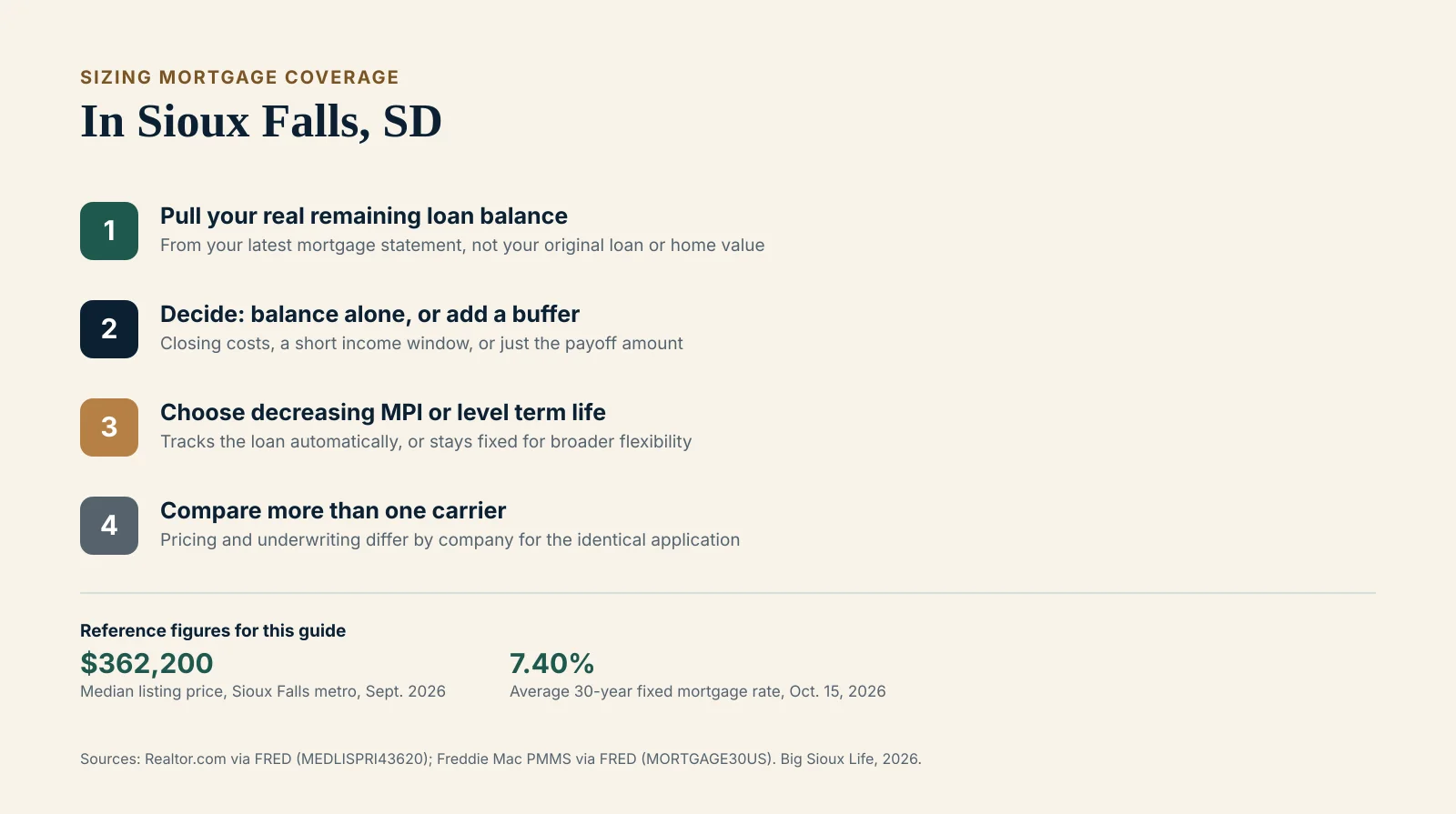
$362,200
Sioux Falls median home listing price, September 2026, per Realtor.com via FRED
7.40%
Average 30-year fixed mortgage rate, week of Oct. 15, 2026, Freddie Mac via FRED
1,469
Active home listings across the Sioux Falls metro, September 2026, FRED
87%
of an illustrative Sioux Falls-priced loan still owed after 10 years, author's amortization calculation

Three numbers, three different questions
It’s worth sitting with why Sioux Falls has three different “home price” figures in circulation at once, because picking the wrong one changes what you think you’re insuring.
| Measure | Value | What it actually reflects |
|---|---|---|
| Median owner-occupied home value | $332,600 | Self-reported value of homes already owned, often purchased years earlier (Census ACS 2024 1-year estimates) |
| Median closed sale price | $356,800 | What homes actually sold for in May 2026, per local MLS data (Realtor Association of the Sioux Empire) |
| Median active listing price | $362,200 | What's currently for sale and asking, September 2026 (Realtor.com via FRED) |
Sources: U.S. Census Bureau ACS 2024 1-year estimates via Census Reporter; Realtor Association of the Sioux Empire, reported May 2026; Realtor.com via FRED, September 2026.
If you already own your home, your mortgage balance is the only number of the three that actually matters for sizing coverage; your home’s current resale value is a separate question from what you still owe. If you’re shopping for a home right now, the active listing price is the more realistic starting point for what you’ll actually finance. Either way, your own loan statement beats all three for precision, because none of these citywide figures describes your specific mortgage.
How Sioux Falls compares, and what the statewide trend says
Sioux Falls’ housing market also behaves differently than a smaller South Dakota city, mostly because of scale. Realtor.com counted 1,469 active listings across the Sioux Falls metro in September 2026, compared with 73 across the entire Mitchell market the same month, both per FRED. A market with that much more volume is far less prone to the kind of sharp month-to-month swings a thin market produces, which makes a single month’s Sioux Falls figure a more dependable number to anchor coverage decisions on than the same kind of figure from a small city.
| Measure | Value | Source |
|---|---|---|
| Sioux Falls, SD median listing price | $362,200 | Realtor.com via FRED, Sept. 2026 |
| Rapid City, SD median listing price | $417,450 | Realtor.com via FRED, Sept. 2026 |
| South Dakota statewide house price index, year-over-year | +2.2% | FHFA via FRED, Q2 2026 vs. Q2 2025 |
Listing price and a repeat-sales price index measure different things. The statewide index, built from actual sales over a longer window, is a steadier read than any single metro's current listing price.
The Federal Housing Finance Agency’s All-Transactions House Price Index for South Dakota rose from 628.65 in the second quarter of 2025 to 642.50 in the second quarter of 2026, a 2.2% year-over-year increase, according to data hosted by FRED. That index is built from actual recorded sales and mortgage data over a longer window, which makes it a steadier measure of underlying trend than any single metro’s month-to-month listing price. The practical lesson for a Sioux Falls buyer: the statewide number tells you direction, Sioux Falls’ own current listing or sale price tells you what you’d actually pay today, and your mortgage statement tells you what you actually owe right now. Use the right one for the question you’re actually answering.
South Dakota’s statewide median household income was $82,460 as of the 2025 estimate, according to FRED, sourced from the U.S. Census Bureau, against Sioux Falls’ own city-level median household income of $77,208, with a margin of error of $6,619, from the Census Bureau’s 2024 American Community Survey 1-year estimates. Sioux Falls’ population was 209,297 as of that same 2024 estimate.
How to work it out yourself
You don’t need anyone else’s help to get most of the way through this math. Here’s the method, step by step.
- Pull your actual remaining balance, not your original loan amount and not your home’s current market value. Your latest mortgage statement has the exact figure. If you don’t have a recent statement handy, most loan servicers show it online, or you can estimate it with a standard amortization calculator using your original loan amount, interest rate, and start date.
- Decide whether you’re insuring the balance alone or adding a buffer. Some households insure exactly the payoff amount. Others add a cushion for closing costs on a future sale, a few months of income replacement while the family adjusts, or the fact that refinancing later could change what’s owed. There’s no single right answer; the point is to decide on purpose rather than by accident.
- Check whether your loan is fixed or adjustable, and where you are in the amortization schedule. As the table above shows, a fixed-rate loan pays down slowly early on. If you’re within the first ten to twelve years of a 30-year loan, assume your balance is still close to your original loan amount unless you’ve made extra principal payments.
- Decide between decreasing-benefit mortgage protection insurance and level term life insurance. MPI tracks a declining balance automatically, which can fit a straightforward “cover the house” goal. Level term life keeps a fixed benefit and lets your beneficiary decide how to use it, which fits a broader goal that includes income replacement, other debts, or future needs beyond the mortgage. Our mortgage protection vs. term life comparison walks through that tradeoff in more depth.
- Compare more than one carrier before you decide. Underwriting classes, pricing, and product availability differ by company. What one insurer offers a given applicant in Sioux Falls is not necessarily what another will offer for the identical application.
You can do steps 1 through 4 yourself, today
Pulling your balance, deciding on a buffer, checking your amortization stage, and picking between decreasing or level coverage are all things you can work out with your own mortgage statement and an amortization calculator. Where a second opinion tends to help most is step 5, comparing what different carriers actually offer for your specific application, since that's the part no single company's website shows you.
You can also run these numbers yourself in about twenty minutes using our life insurance needs calculator, which walks through your mortgage balance alongside income replacement and other obligations rather than the mortgage in isolation.
As one illustration of what term coverage can cost per dollar of protection, not a quote for your own situation, State Farm’s own published “starting at” online rate for a $250,000, 20-year level term policy was $15.22 a month as of October 2026, for a 25-year-old female in excellent health in Illinois; the same coverage over 10 years was $15.02 a month, and over 30 years, $19.14 a month. A Sioux Falls mortgage the size of the worked example above would typically require several times that coverage amount, and your own age, health, sex, and state will change your price, but the figures show how little the per-dollar cost of level term moves across term lengths for a healthy applicant, which is part of why it’s worth pricing against decreasing-benefit MPI rather than assuming the lender’s offer is the only option.
Mortgage protection insurance vs. term life, briefly
Both products can address a Sioux Falls mortgage, but they’re built differently, and the choice matters more than most people assume when they buy the first thing a lender’s closing-day mailer offers them.
Built to track your loan, and only your loan
- Death benefit typically decreases, following your original amortization schedule
- Often structured around the mortgage specifically
- Simple "cover the house" goal, nothing more
Best fitHouseholds who want coverage that tracks the loan and nothing else
A fixed benefit your beneficiary can use for anything
- Death benefit stays fixed for the full policy term
- Any named beneficiary, usable for the mortgage, income, or other debts
- Fits a broader goal beyond the house alone
Best fitHouseholds who want flexibility for income replacement or other debts too
A mortgage protection policy sized to your loan the day you closed doesn't know you refinanced, paid extra principal, or bought a bigger house since. Check the number against what you actually owe today, not the day you signed.
Mike Moore, Life Insurance AdvisorIf you’d rather have someone local run the comparison across carriers than call companies one by one, that’s what we do: Compare My Options.
Your rights during the first ten days
South Dakota law gives you a real, enforceable window to change your mind after a policy arrives. Under South Dakota Codified Law 58-15-8.1, every individual life insurance policy delivered in the state must include a notice that you can return it, in writing, within ten days of actually receiving it, and get your premium back, with the policy treated as if it had never been issued. That applies whether you bought decreasing-term mortgage protection insurance or a standalone level term policy. It’s worth reading the actual policy document during that window, not just the sales materials, since the fine print is what a claim will eventually be paid against.
How we help
We’re independent, so we’re not built around one company’s mortgage protection product. We start with your actual remaining balance, your amortization stage, and whether decreasing or level coverage fits your household better, then compare how different carriers price that specific need rather than defaulting to whichever product a lender’s closing-day mailer pushed first. Serving all of South Dakota, including Sioux Falls and the surrounding metro, means the local housing numbers above aren’t an abstraction to us; they’re the starting point for the conversation.
What you get
A coverage amount sized to your real loan balance, not a guess based on your original mortgage or a headline home-price figure that may not describe your own purchase. A clear answer on whether decreasing-benefit mortgage protection or level term life fits your goals better. And a comparison across more than one carrier, since that variation is the part hardest to see without asking.
Size your Sioux Falls mortgage coverage with real numbers
Bring your mortgage statement, or your best estimate of your remaining balance, and we'll walk through decreasing-term and level term options side by side.
Not ready to talk to anyone yet? Read How It Works first and come back when you are. If you want to work through the underwriting side before the sizing question, our guide to mortgage protection insurance vs. term life insurance is a good next stop.
Frequently asked questions
How much mortgage protection insurance do I need in Sioux Falls, SD?
Start with your actual remaining loan balance, not your original loan amount and not your home’s current market value. Pull your latest mortgage statement for the exact figure, or estimate it with an amortization calculator using your original loan amount, rate, and start date. If you bought near Sioux Falls’ September 2026 median listing price of $362,200, according to Realtor.com data hosted by FRED, and financed most of it, your balance is still close to the original loan for the first decade, because fixed-rate loans pay down slowly at first. Some households add a buffer for closing costs or a short income-replacement window on top of the bare balance; others insure the balance alone. Either is defensible. What matters is starting from your real number.
What is the difference between mortgage protection insurance and term life insurance?
Mortgage protection insurance (MPI) is typically a decreasing-benefit policy sized to your original loan and its amortization schedule, and many MPI policies are structured so proceeds address the mortgage specifically. A standalone level term life policy pays a fixed death benefit to whatever beneficiary you name, usually a spouse or family member, who can use the money for the mortgage, for lost income, or for anything else. For the deeper side-by-side on underwriting, cost structure, and who each product fits, see our full guide to mortgage protection insurance versus term life.
Why did Sioux Falls home prices rise in 2026?
Local market reporting points to continued demand against still-limited inventory. The Realtor Association of the Sioux Empire reported a median sale price of $356,800 in May 2026, up 5.1% from a year earlier. Realtor.com data hosted by FRED shows 1,469 active listings across the Sioux Falls metro in September 2026, a market considerably larger and less volatile month to month than a small city like Mitchell, but still priced well above the metro’s median owner-occupied home value of $332,600 reported by the Census Bureau’s 2024 American Community Survey, since that figure reflects homes already owned, often purchased years earlier at lower prices.
Do I need mortgage protection insurance if I already have life insurance through my job?
Group life insurance through an employer is commonly one to two times salary and ends the day you leave that job, whether you choose to leave or are let go. State and local government workers have notably better access to this benefit than private-industry workers, 84% versus 59%, according to the U.S. Bureau of Labor Statistics’ March 2026 Employee Benefits in the United States release. Either way, if your mortgage balance is close to or larger than that group benefit, that gap is worth sizing separately, since the coverage disappears exactly when a new employer’s group plan hasn’t started yet.
Can I get mortgage protection insurance without a medical exam in South Dakota?
No-exam and simplified-issue products exist as a category in today’s market and are worth asking about directly with a licensed agent, since eligibility, underwriting requirements, and cost depend on your age, health, and the specific carrier and product. We are not able to state that any particular no-exam outcome or timeline is available to a given applicant in advance of underwriting.
What happens to my mortgage in South Dakota if I die and there is no coverage?
If you have a co-borrower, such as a spouse, they typically remain responsible for the full loan under the terms you both signed. If you are the sole borrower, the loan becomes a debt of your estate rather than disappearing. Under federal law, 12 U.S.C. Section 1701j-3(d)(5), a lender cannot invoke a due-on-sale clause to force immediate repayment or foreclosure when a home passes to a relative through inheritance, and the Consumer Financial Protection Bureau has directed mortgage servicers to have procedures in place for allowing heirs to continue paying the mortgage. That protects the right to keep the house. It does not supply the money to do it.
Can I cancel a mortgage protection or life insurance policy after I buy it?
Yes. South Dakota law (SDCL 58-15-8.1) requires every individual life insurance policy delivered in the state to include a free-look provision: you can return the policy in writing within ten days of actually receiving it and get your premium back, with the policy treated as if it had never been issued. After that window, you can generally still cancel by stopping payment, though past premiums are not refunded, so it’s worth reading the policy carefully during those first ten days.
Is Sioux Falls’ housing market more stable than smaller South Dakota cities?
On the data available, yes, by volume alone. Realtor.com counted 1,469 active listings across the Sioux Falls metro in September 2026, compared with 73 in Mitchell the same month, both per FRED. A market with that much more inventory and transaction volume is far less likely to show the kind of month-to-month price swings a thin market like Mitchell’s produces, which makes a single month’s Sioux Falls figure a more dependable starting point than the same kind of figure from a smaller city.
Before you decide
This article is general education, not insurance, legal, financial, or tax advice. Product availability, underwriting outcomes, rate classes, and premiums vary by carrier and are subject to underwriting. No coverage exists until a policy is issued and in force. Any guarantees are subject to the claims-paying ability of the issuing insurer. The worked examples in this guide are hypothetical and illustrative only, not a quote or a promise of any specific coverage amount, premium, or underwriting outcome. Please review actual policy documents and speak with a licensed agent about your situation.
Sources
- Federal Reserve Bank of St. Louis (FRED) — Housing Inventory: Median Listing Price in Sioux Falls, SD (CBSA) (MEDLISPRI43620) — $362,200 in September 2026; underlying data from Realtor.com
- Federal Reserve Bank of St. Louis (FRED) — Housing Inventory: Active Listing Count in Sioux Falls, SD (CBSA) (ACTLISCOU43620) — 1,469 active listings in September 2026; underlying data from Realtor.com
- Federal Reserve Bank of St. Louis (FRED) — Housing Inventory: Median Listing Price in Rapid City, SD (CBSA) (MEDLISPRI39660) — $417,450 in September 2026; underlying data from Realtor.com
- Federal Reserve Bank of St. Louis (FRED) — 30-Year Fixed Rate Mortgage Average in the United States (MORTGAGE30US) — 7.40% for the week of October 15, 2026; underlying data from Freddie Mac’s Primary Mortgage Market Survey
- Federal Reserve Bank of St. Louis (FRED) — All-Transactions House Price Index for South Dakota (SDSTHPI) — index value 642.50 for Q2 2026, up from 628.65 in Q2 2025, a 2.2% year-over-year increase (calculated from the two index levels); data produced by the Federal Housing Finance Agency
- Federal Reserve Bank of St. Louis (FRED) — Real Median Household Income in South Dakota (MEHOINUSSDA672N) — 2025 estimate; $82,460, sourced from the U.S. Census Bureau
- Census Reporter — Sioux Falls city, SD (American Community Survey 2024 1-Year Estimates) — accessed October 2026; population 209,297, median household income $77,208 (±$6,619), and median value of owner-occupied housing units $332,600
- Realtor Association of the Sioux Empire, via Sioux Falls Business — May 2026 median sale price of $356,800, up 5.1% year-over-year
- LIMRA — “Trends in Focus: The 2025 Life Insurance Barometer,” 2025 Life Insurance and Annuities Conference — 2025 study; 51% life insurance ownership, an estimated 99 million adults (74 million with no coverage, 25 million underinsured) who say they need life insurance or more of it, and 27% of households who say they would feel the financial impact of losing a primary wage earner within one month, versus 26% who say they could manage two years or more
- U.S. Bureau of Labor Statistics — Employee Benefits in the United States, March 2026 (USDL-26-1534) — published September 25, 2026; 59% of private industry workers and 84% of state and local government workers have access to employer-provided life insurance
- U.S. Census Bureau — New 5-Year American Community Survey Statistics on Homeowners, Renters — published December 12, 2024; 2019-2023 ACS 5-year estimates; 61.2% of owner-occupied homes nationally carry a mortgage
- South Dakota Department of Revenue — Individuals: Taxes — accessed October 2026; confirmation that South Dakota levies no state personal income tax
- State Farm — Term Life Insurance — accessed October 2026; illustrative “starting at” term life pricing referenced for context on term coverage affordability
- Consumer Financial Protection Bureau — CFPB Clarifies Mortgage Lending Rules to Assist Surviving Family Members — servicer procedures for allowing heirs/successors in interest to continue paying a mortgage after a borrower’s death
- Cornell Law School, Legal Information Institute — 12 U.S. Code Section 1701j-3 — due-on-sale clause exception at subsection (d)(5) for a transfer to a relative resulting from the death of a borrower
- South Dakota Legislature — SDCL 58-15-8.1 — accessed October 2026; ten-day free-look cancellation provision for individual life insurance policies delivered in South Dakota
Related reading: Mortgage Protection Insurance vs. Term Life: Which Is Better?, Mortgage Protection Insurance in Mitchell, SD: 2026 Guide, Mortgage Protection Insurance in Rapid City, 2026, and How Much Life Insurance Do Sioux Falls Families Need?. See current options for mortgage protection insurance, or learn more about who we help.