
Bariatric surgery does not disqualify you from life insurance. It is one documented event in your medical history that a carrier reviews alongside your current weight, your stabilized health numbers, and how much time has passed since the operation, not a flat decline. South Dakota’s own numbers make this worth answering directly: 34.3% of South Dakota adults had obesity in 2025, and 37.0% did in 2024, according to the CDC’s Behavioral Risk Factor Surveillance System (BRFSS), among the higher rates nationally. A meaningful share of the state has either had bariatric surgery, is considering it, or is living with the obesity-related conditions that make a carrier ask about it. This guide walks through how underwriters actually treat a post-surgical file, what the timing question really depends on, and the arithmetic you can work through yourself before you apply.
The short version
- 34.3% of South Dakota adults had obesity in 2025, down from 37.0% in 2024 and 36.0% in 2023, according to the CDC's Behavioral Risk Factor Surveillance System (BRFSS).
- The National Institutes of Health's NIDDK program lists general candidacy guidance for weight-loss surgery as a BMI of 40 or more, or 35 or more with a serious obesity-related condition such as type 2 diabetes, heart disease, or sleep apnea.
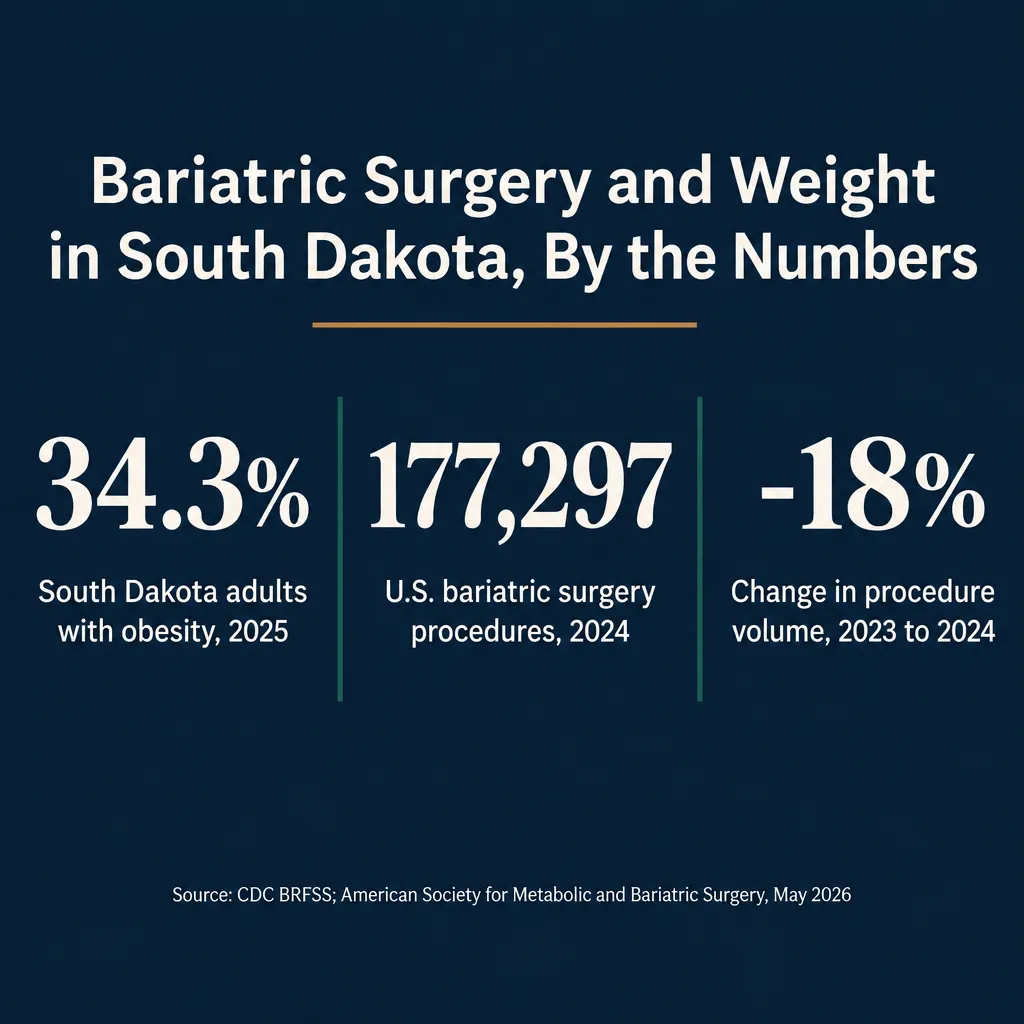
- An estimated 177,297 metabolic and bariatric procedures were performed in the U.S. in 2024, down about 18% from 217,387 in 2023, according to the American Society for Metabolic and Bariatric Surgery (ASMBS), which points to rising GLP-1 medication use as a factor in the decline.
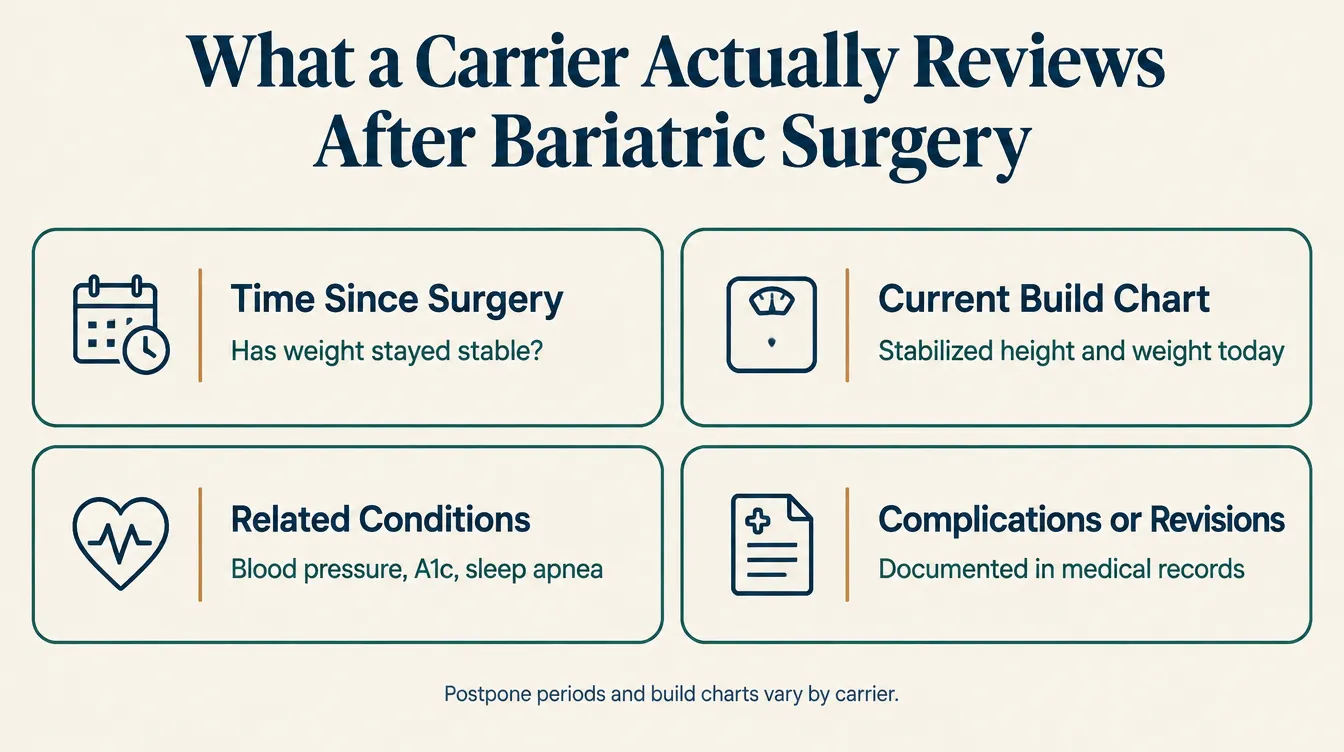
- Carriers do not decline based on the fact of surgery; they weigh how long ago it happened, whether your weight and related numbers have stabilized, whether complications occurred, and whether obesity-related conditions have improved.
- Every carrier sets its own rules for recent surgery and its own build chart for your current numbers, which is why comparing more than one carrier matters here as much as for any other underwriting question this blog covers.
The pain: assuming the surgery already decided the answer
People who have been through bariatric surgery tend to fall into one of two camps when the subject of life insurance comes up, and both camps usually skip the same step: actually asking.
The first camp assumes the worst. They had a gastric sleeve or a gastric bypass, they remember how invasive it was, and they figure a major abdominal surgery has to be a red flag serious enough to end the conversation before it starts. The second camp assumes the opposite, and just as wrongly: they have lost sixty, eighty, a hundred pounds, they feel the healthiest they have in years, and they expect that improvement to walk straight through underwriting without anyone asking a follow-up question. Neither assumption holds up, because neither one accounts for what a carrier is actually trying to measure.
These are not rare situations in this state. They are a warehouse worker in Rapid City who had a sleeve gastrectomy fourteen months ago and has kept the weight off, still carrying the old assumption that “obesity surgery” reads as a permanent red flag on any application. They are a mother in Watertown two years past a gastric bypass, off her blood pressure medication for the first time in a decade, who has never asked whether that change would actually move her into a better rate class. They are a small business owner in Sioux Falls, four months post-surgery and still losing weight fast, who wants to lock in a term policy right now without realizing that applying today, mid-transition, is the single least favorable moment to do it.
What underwriters actually look at is more specific than either assumption, and for a meaningful share of applicants, more forgiving than people expect once the numbers have settled. A carrier is not asking “did this person have surgery.” It is asking where you are today: your current weight, how long you have held it, your blood pressure and blood sugar, whether the conditions that may have led to the surgery in the first place have improved, and whether anything went wrong along the way. Two people who had the identical procedure on the identical day can land in very different places eighteen months later, and underwriting is built to price the difference, not the surgery itself.
This is general education, not medical or insurance advice
Nothing here diagnoses, treats, or recommends for or against any medical procedure, and nothing here promises that any specific carrier will approve any specific applicant at any specific rate. It is a plain explanation of how bariatric surgery history factors into life insurance underwriting, sourced from federal health data and public consumer guidance, so you can see the mechanics before you decide when and how to apply.
Why it happens: how underwriters actually read a post-surgical file
Life insurance underwriting is a mortality estimate. A carrier prices your policy by comparing your risk profile against a large pool of similar applicants and estimating the statistical likelihood it will pay a death benefit during the life of the policy. Obesity is statistically associated with higher rates of conditions like type 2 diabetes, high blood pressure, and heart disease, which is why weight shows up in underwriting at all. Bariatric surgery enters the picture because it is a documented attempt to change that risk profile, through a major surgical procedure with its own short-term risks, on the way to what is hopefully a lower long-term risk. Underwriters have to evaluate both halves of that at once: the surgery itself, and where it leaves you once you have healed and stabilized.
A handful of terms carry this entire topic, and they are worth defining once, since applications and underwriters use them without translating them:
- Bariatric surgery is a category, not one procedure. The most common current versions are sleeve gastrectomy (removing most of the stomach to restrict food intake), Roux-en-Y gastric bypass (rerouting part of the digestive tract), gastric banding (an adjustable band placed around the upper stomach, less common today than a decade ago), and revision surgery (a second procedure to adjust or redo an earlier one). Which type you had, and whether it was a first surgery or a revision, is part of what an underwriter records.
- Build chart is a carrier’s own table listing the maximum, and sometimes minimum, weight allowed at each height for each rate class it offers. Every carrier writes and periodically revises its own chart.
- Underwriting class (or rate class) is the risk tier a carrier assigns an approved applicant, which sets the premium: typically Preferred Plus or Preferred at the top, then Standard, then table-rated classes for higher but still insurable risk.
- Table rating is a step above Standard pricing, used when a build, a health condition, or a combination of factors raises mortality risk above what Standard pricing covers. The exact increment at each table step is set by the individual carrier.
- Postpone is a temporary hold, not a decline. A carrier tells you it will reconsider the application after a stated event or time period, commonly used for very recent surgery, because the underwriter does not yet have enough stable information to price the risk with confidence.
- Attending Physician Statement (APS) is medical records a carrier requests directly from your surgeon or primary care provider, used to verify the surgery date, any complications, and your current status, rather than relying only on what you wrote on the application.
- Reconsideration is a request, made after a policy is issued or after a postpone period, to have a carrier review updated records and potentially move you into a better rate class once your weight and health numbers have stabilized at a healthier level.
- Contestability period is the window, typically two years from a policy’s issue date, during which an insurer can investigate a claim and deny it over a material misstatement on the original application, which is why accurate disclosure of a surgery matters regardless of the underwriting outcome you expect.
The mechanical detail that surprises most people: carriers are generally less interested in the surgery as a historical fact and more interested in trajectory and stability. A person eighteen months out, at a stable weight for the last year, with resolved or well-controlled comorbidities, presents underwriting with a settled picture. A person four months out, still actively losing weight, with numbers that are moving every month, presents an unsettled one. The same eventual outcome, the same total weight lost, the same person, can underwrite very differently at four months versus eighteen months simply because one file is stable and the other is not yet.
What it costs to get wrong: the numbers behind the decision
This is not a niche question in South Dakota, and it is becoming a moving target nationally as more people manage weight with medication instead of surgery.
South Dakota’s obesity rate climbed for more than a decade before easing slightly in the most recent year on record. The CDC’s Behavioral Risk Factor Surveillance System puts the state’s adult obesity rate at 30.1% in 2018, 33.0% in 2019, 38.4% in 2021, 36.0% in 2023, 37.0% in 2024, and 34.3% in 2025. South Dakota was one of 23 states the CDC classified as having a 2023 adult obesity prevalence of 35% or higher, in a September 12, 2024 news release, alongside neighbors like Nebraska and North Dakota.
South Dakota adult obesity rate, 2018-2025
CDC, Behavioral Risk Factor Surveillance System (BRFSS), Nutrition, Physical Activity, and Obesity dataset, accessed September 2026. Figures are self-reported adult obesity prevalence for South Dakota, "Total" stratification, by survey year.
At the same time, the national picture around bariatric surgery itself is shifting. The American Society for Metabolic and Bariatric Surgery (ASMBS), the specialty’s own professional organization, estimated 177,297 metabolic and bariatric procedures performed in the U.S. in 2024, down roughly 18% from 217,387 in 2023. In its May 2026 release of that estimate, ASMBS pointed to the rising use of GLP-1 medications, drugs like Ozempic, Wegovy, and Zepbound, as a factor behind the decline, meaning more people are managing weight and obesity-related risk through medication rather than surgery. That does not make either path more or less “correct” for underwriting purposes; it means a life insurance applicant’s history increasingly includes one, the other, or sometimes both, and a carrier evaluates the current documented picture either way.
The NIDDK, the National Institute of Diabetes and Digestive and Kidney Diseases, part of the National Institutes of Health, lists general guidance on who may be a candidate for weight-loss surgery: a body mass index (BMI) of 40 or more on its own, a BMI of 35 or more with a serious obesity-related health problem such as type 2 diabetes, heart disease, or sleep apnea, or in some cases a BMI of 30 or more with type 2 diabetes that is difficult to control with medical treatment and lifestyle changes alone. That is medical candidacy guidance, not an insurance rule, but it is a useful anchor: the population it describes overlaps heavily with the higher end of South Dakota’s own obesity numbers above, which is the actual, practical reason this topic belongs in the same conversation as the state’s health data rather than as an abstract national question.
Two accredited bariatric surgery programs, at Sanford USD Medical Center and at Avera McKennan University & Health Center, both operate in Sioux Falls, which means a meaningful number of South Dakotans go through this exact surgery, recovery, and eventually an insurance application without ever leaving the state for care.
How to work it out yourself: read your own timeline before you apply
You do not need anyone’s help to get an honest, specific read on where you stand before you talk to a carrier or an agent.
Step 1: Mark your surgery date and calculate how much time has passed. Months since surgery is the single input that changes the most about how a file reads, because it is the clearest proxy for whether your weight and related numbers have had time to settle.
Step 2: Calculate your current BMI using the standard formula, and compare it against your pre-surgery number. BMI = (weight in pounds × 703) ÷ (height in inches)². Knowing both numbers, before and now, shows the underwriter the size of the change, not just the endpoint.
Step 3: Check whether your weight has been stable, not just lower, for the last several months. A carrier reading a chart that shows your weight still dropping month over month reads that differently than a chart that shows the same weight held for six months or a year. If you can, pull your last two or three documented weights from your provider’s records.
Step 4: Take inventory of any obesity-related condition you had before surgery. Type 2 diabetes, high blood pressure, high cholesterol, and sleep apnea are the ones that come up most often. For each one, note whether it has resolved, improved and is now well-controlled, or is unchanged, along with your most recent lab values if you have them (A1c, blood pressure readings, a recent sleep study if relevant).
Step 5: Write down exactly what happened during and after surgery, including the type of procedure, the surgeon or facility, and whether there were any complications, a leak, a stricture, a nutritional deficiency, an infection, or a revision procedure. Vague or incomplete answers slow underwriting down; specific, accurate ones speed it up.
Step 6: Work through two realistic scenarios to see how timing changes the picture.
| Detail | Applicant A | Applicant B |
|---|---|---|
| Procedure | Sleeve gastrectomy | Sleeve gastrectomy |
| Time since surgery | 4 months | 18 months |
| Weight trend | Still actively losing, down 15 lb last month | Stable for 10 months |
| Pre-surgery blood pressure | Elevated, on medication | Elevated, on medication |
| Current blood pressure | Improving, still on medication | Normal, off medication for 8 months |
| Complications | None | None |
| Likely underwriting posture | More likely postponed or asked to reapply once stable | More likely evaluated on today's stable numbers |
Illustrative scenario, not an underwriting outcome or a quote. Actual results depend on the specific carrier, the complete application, and underwriting at the time of application.
Applicant A and Applicant B had the identical procedure. The only real difference is where each one sits on their own recovery timeline, and that difference is exactly what a carrier is trying to read. Applicant A is not a worse risk than Applicant B forever; Applicant A is an unfinished picture. Waiting until the picture is finished, a stable weight held for a meaningful stretch and comorbidities resolved or controlled, is very often the single highest-leverage thing a post-surgical applicant can do before submitting an application, more than anything about the surgery itself.
You can gather all of this yourself first
Steps 1 through 5 just require your own memory, a scale, and whatever your surgeon's office or primary care provider already has on file. Where a second opinion tends to help most is deciding whether your specific timeline and numbers are ready for today's best available outcome, or whether waiting a few more months first would change the answer, since that judgment call is hard to make alone from outside the industry.
If you would rather have someone local walk through that timing question with you, that is what we do: Compare My Options.
The surgery isn't the question underwriting is asking. Where you are today, and how long you've been there, is.
Mike Moore, Life Insurance AdvisorWhy South Dakota shopping matters here specifically
The National Association of Insurance Commissioners (NAIC), the organization that coordinates state insurance regulators nationally, tells consumers plainly to compare similar policies from different companies to find the best value, because life insurance is a competitive marketplace rather than a single fixed price. That advice applies with extra weight to a post-surgical file, since postpone periods, build charts, and reconsideration policies genuinely differ by carrier, and the same file can draw a different answer at a different company.
If you ever have a concern about how an application was handled, South Dakota’s Division of Insurance, the state agency that licenses and regulates every carrier authorized to sell here, maintains a consumer complaint process and information line at (605) 773-3563, with its office in Pierre. You can also confirm that any company you are considering is actually licensed to sell in South Dakota through the division’s own listings before you apply.
How we help
We are independent, so we are not tied to one carrier’s postpone period or one company’s build chart. We start with your actual timeline, your current numbers, and your medical records, not a guess about what a single company will say, and compare how the carriers we work with treat a file like yours today. Because these rules genuinely differ by company and change as carriers update their own underwriting guidelines, that comparison is one of the more valuable things an independent agency can do for someone in exactly this situation. We are local to Sioux Falls and licensed to serve all of South Dakota, so the person doing that comparison is someone you can actually talk to, not a call center reading from a script.
What you get
A clear, honest read on how your surgery date, your current stabilized numbers, and your health history line up against what several carriers are actually looking for right now, not an outdated assumption about what “bariatric surgery” means on an application. A comparison across more than one carrier’s postpone rules and build chart, instead of a single company’s answer treated as universal. And a plain explanation, in advance, of South Dakota’s own consumer protections and complaint process if you ever need them.
Find out what your timeline actually supports
We will go through your surgery date, your current numbers, and what you need to protect, and show you how the carriers we work with actually evaluate a file like yours today.
Not ready to talk to anyone yet? Read How It Works first and come back when you are.
If you have a health condition, a surgery, or a diagnosis you assume rules you out entirely, it is worth asking rather than deciding for yourself in advance. Reach out when you are ready, or run the timeline arithmetic above on your own first.
Frequently asked questions
Can you get life insurance after bariatric surgery?
Yes, in the large majority of cases. Bariatric surgery is a disclosed medical history item, not an automatic decline. Carriers want to see how much time has passed since surgery, whether your weight has stabilized, whether any obesity-related conditions you had (like type 2 diabetes, high blood pressure, or sleep apnea) have improved or resolved, and whether there were any complications. A recent, uncomplicated surgery with early, unstable weight loss underwrites differently than the same surgery two or three years out with a stable weight and resolved comorbidities.
How long after bariatric surgery should I wait to apply for life insurance?
There is no single industry-wide number, because every carrier sets its own postpone period and its own underwriting rules for recent surgery, and companies change these guidelines over time. As a general pattern, carriers tend to want to see your weight and any related lab values (blood pressure, A1c, cholesterol) stabilize before they will offer their best available outcome, which usually means waiting until you are at least a year or more removed from surgery with a documented stable weight, rather than applying in the first few months while you are still losing. Applying earlier is not impossible, but it is more likely to draw a postponement or a less favorable class at some carriers. Because this varies by company, comparing more than one carrier matters here more than for most other underwriting questions.
What underwriting class can I expect after bariatric surgery?
It depends on where you land today, not on the fact that you had surgery. A carrier will look up your current, stabilized height and weight on its own build chart, plus your blood pressure, cholesterol, blood sugar, and whether any obesity-related condition is controlled or resolved. Many carriers also add back a portion of very recent, very fast intentional weight loss until it has held for about a year, specifically so a temporary post-surgical dip does not create an artificially favorable class that will not hold up at your next physical. The honest range runs from a Standard or better class for a stable, well-documented file to a table-rated class for a more complicated one; only an actual application to a specific carrier tells you which.
Do I have to disclose bariatric surgery on a life insurance application?
Yes. Life insurance applications ask about surgeries and major medical history, and bariatric surgery is a major abdominal surgery, so it belongs on the application whether or not you think it will change the outcome. Carriers routinely request an Attending Physician Statement, records pulled directly from your surgeon or primary care provider, so an undisclosed surgery is very likely to surface anyway. Most policies also carry a contestability period, typically two years from the issue date, during which an insurer can investigate and deny a claim over a material misstatement, which is the practical reason accurate disclosure matters regardless of what you expect the underwriting answer to be.
Does losing weight after surgery ever lower my premium later?
It can, through a process usually called reconsideration or a rate reassessment, but it is not automatic and not every carrier offers it the same way. If you were rated or postponed shortly after surgery and your weight, blood pressure, and other markers have since stabilized at a healthier level for a meaningful period, typically a year or more, you (or your agent) can ask the carrier to review updated records and potentially reclassify you into a better rate. Whether that produces a lower premium depends on the specific carrier’s rules and your updated file, so it is worth asking rather than assuming either way.
What if I had complications from bariatric surgery?
Complications, such as a leak, a stricture, a nutritional deficiency, or a revision procedure, are part of what an underwriter reviews and generally call for more time and more documentation before a carrier will offer its best outcome, sometimes including a longer postpone period. This does not mean coverage is unavailable; it means the file needs a clearer, more complete medical record, usually through an Attending Physician Statement, before a carrier can price the risk with confidence. Being specific and complete about what happened, rather than vague, tends to produce a faster and more accurate underwriting decision.
Is a GLP-1 medication like Ozempic a better path than surgery for life insurance purposes?
Neither path is inherently better or worse for underwriting purposes; carriers evaluate your current, documented health picture rather than ranking the method you used to get there. GLP-1 medications have become common enough that bariatric surgery volume itself has declined nationally as more people manage weight with medication instead, according to the American Society for Metabolic and Bariatric Surgery. If you are choosing between the two for health reasons, that is a conversation for your physician, not an insurance question; either way, a stable, well-documented health picture is what underwriting is actually pricing.
How common is severe obesity in South Dakota, and why does that matter here?
34.3% of South Dakota adults had obesity in 2025, according to the CDC’s Behavioral Risk Factor Surveillance System, down from 37.0% in 2024 but still among the higher rates nationally; South Dakota was one of 23 states the CDC classified as having a 2023 adult obesity prevalence of 35% or higher. Obesity at the higher end of that range, generally a BMI of 35 or above with a related condition, or 40 and above on its own, is also the range the National Institutes of Health uses as its general guidance for who may be a candidate for weight-loss surgery. That overlap means a meaningful number of South Dakotans are living through exactly this sequence: obesity, a decision about bariatric surgery, and eventually a life insurance application that has to account for both.
Before you apply
This article is general education, not insurance, legal, financial, medical, or tax advice. Product availability, features, underwriting criteria, and rates vary by carrier and are subject to underwriting; a specific outcome for any individual applicant cannot be predicted or guaranteed. No coverage exists until a policy is issued and in force. Any guarantees are subject to the claims-paying ability of the issuing insurer. Please speak with a licensed agent and your health care provider about your specific situation.
Sources
- CDC, Behavioral Risk Factor Surveillance System (BRFSS) — Nutrition, Physical Activity, and Obesity dataset — accessed September 2026; South Dakota adult obesity prevalence by year, 2018 through 2025
- CDC Newsroom — “New CDC Data Show Adult Obesity Prevalence Remains High” — published September 12, 2024; South Dakota among 23 states with 2023 adult obesity prevalence of 35% or higher
- NIDDK (National Institute of Diabetes and Digestive and Kidney Diseases) — Potential Candidates for Weight-Loss Surgery — last reviewed September 2020; general BMI-based candidacy guidance for adults
- American Society for Metabolic and Bariatric Surgery — “Bariatric Surgery Procedures Fall Below 200,000, First Time Since 2020, New Research Finds” — published May 5, 2026; estimated 177,297 U.S. procedures in 2024, down from 217,387 in 2023
- National Association of Insurance Commissioners — Tips for Buying Life Insurance — accessed September 2026; consumer guidance on comparison shopping across carriers
- South Dakota Division of Insurance — Consumer Information — accessed September 2026; complaint process and consumer contact information
Related reading: Life Insurance With a High BMI: A 2026 South Dakota Guide, Does Ozempic Affect Your Life Insurance? 2026 SD Guide, and Getting Life Insurance After a Health Condition: 2026 Underwriting Trends. See our page for people with health conditions, current options for term life, or learn more about how it works.