
A bankruptcy does not close the door on life insurance. It is a disclosed piece of financial history that some carriers ask about, reviewed alongside your current income, your discharge status, and how long ago it happened, not a flat decline. It is also a more common situation in South Dakota right now than it was a year ago: the U.S. Bankruptcy Court for the District of South Dakota reported that filings in the first nine months of 2026 ran 18% ahead of the same period in 2025. This guide walks through how an application actually gets read after a bankruptcy, what the timing question really depends on, and what you can work out yourself before you talk to anyone.
The short version
- South Dakota bankruptcy filings in the first nine months of 2026 were up 18% from the same nine months of 2025, according to the U.S. Bankruptcy Court for the District of South Dakota.
- Nationally, bankruptcy filings totaled 574,314 for the year ending December 31, 2025, up 11% from 517,308 the year before, according to the Administrative Office of the U.S. Courts.
- A Chapter 7 case typically reaches a creditors' meeting 21 to 40 days after filing and a discharge order 60 to 90 days after that, with more than 99% of Chapter 7 cases ending in discharge, under the U.S. Courts' own published process.
- A Chapter 13 repayment plan runs three to five years by law and can never run longer than five, so a Chapter 13 filer may still be mid-plan, not yet discharged, when the question of life insurance comes up.
- Bankruptcy does not move you into a different mortality-based rate class the way a health condition can; the practical issue is usually documentation and timing, not price, and it varies by carrier.
The pain: assuming the bankruptcy already decided the answer
People who have been through bankruptcy tend to go quiet on the subject of life insurance, and for an understandable reason: a bankruptcy filing feels like the kind of thing that disqualifies you from financial products generally, so a lot of people never ask the actual question. They assume the filing is still visible to everyone forever, that an insurance application will surface it and end the conversation, or that even if they could get approved, it would cost so much more that it isn’t worth asking.
This shows up constantly in ordinary South Dakota situations. A mechanic in Rapid City who filed Chapter 7 three years ago after a medical bill spiral, now with a stable job and a new baby, who has never applied for a policy because he assumes the filing is a permanent mark against him. A woman in Aberdeen two years into a five-year Chapter 13 repayment plan, current on every payment, who wants to protect her kids but believes she has to wait until the plan ends. A small business owner in Sioux Falls whose business bankruptcy years ago had nothing to do with his personal finances today, still carrying the assumption that it follows him everywhere.
What actually happens in underwriting is narrower and more specific than the fear. A life insurance application is not a credit check. Most carriers price a policy almost entirely on mortality risk: your age, your health, your tobacco use, your family health history, sometimes your occupation and hobbies. Some carriers also ask about financial background or require a stated income to confirm the coverage amount makes sense for your situation, a concept called insurable interest, meaning you have a real financial reason to want that much coverage. A past bankruptcy can come up inside that financial-background question on some applications, but it is one data point among many, reviewed for where things stand today, not treated as a permanent character judgment.
This is general education, not legal, financial, or insurance advice
Nothing here tells you whether to file bankruptcy, recommends a chapter, or promises that any specific carrier will approve any specific applicant at any specific rate. It is a plain explanation of how a past bankruptcy factors into a life insurance application, sourced from federal court data and public consumer guidance, so you can see the mechanics before you decide when and how to apply.
Why it happens: how an application actually reads a financial history
Life insurance underwriting answers one question: how likely is this specific person to die during the length of this specific policy. Everything a carrier asks is in service of that estimate. Health history, build, tobacco use, driving record, and family history all move the mortality needle directly. A bankruptcy filing does not change your mortality risk at all, which is exactly why it is not priced the way a health condition is. Where it enters the picture is narrower: verifying that the coverage amount you are requesting is justified by your actual financial situation, and, for carriers whose application asks the question directly, understanding your current financial stability as part of a complete picture of you.
A handful of terms carry this entire topic, worth defining once since applications and the people who read them do not always translate them:
- Chapter 7 bankruptcy is a liquidation case. A court-appointed trustee identifies any non-exempt property, sells it, and distributes the proceeds to creditors, and most individual debtors still walk away with little or no property actually sold because most of what they own is exempt. It is the shorter of the two common consumer paths.
- Chapter 13 bankruptcy lets someone with regular income keep their property and repay debts over time through a court-approved plan, rather than liquidating assets. Under the U.S. Courts’ own published guidance, the plan “usually” runs three to five years, and by law can never run longer than five years.
- Discharge is the court order that releases you from personal liability for most of the debts included in the case. It is the formal end point of a bankruptcy case, not the filing date, and it is the point at which the matter is legally closed.
- Means test is the income calculation used in a Chapter 7 case to determine whether a filer qualifies for that chapter, generally comparing household income against the median income for a household of that size in that state.
- Insurable interest is the legal and practical requirement that you have a genuine financial reason to want the amount of coverage you are requesting, which is part of why some carriers ask about income and financial background on larger policies regardless of bankruptcy history.
- Underwriting class (or rate class) is the risk tier a carrier assigns an approved applicant, which sets the premium, built on mortality factors, not credit or bankruptcy history.
- Contestability period is the window, typically two years from a policy’s issue date, during which an insurer can investigate a claim and deny it over a material misstatement on the original application, which is the practical reason accurate disclosure matters whenever an application asks a financial-history question.
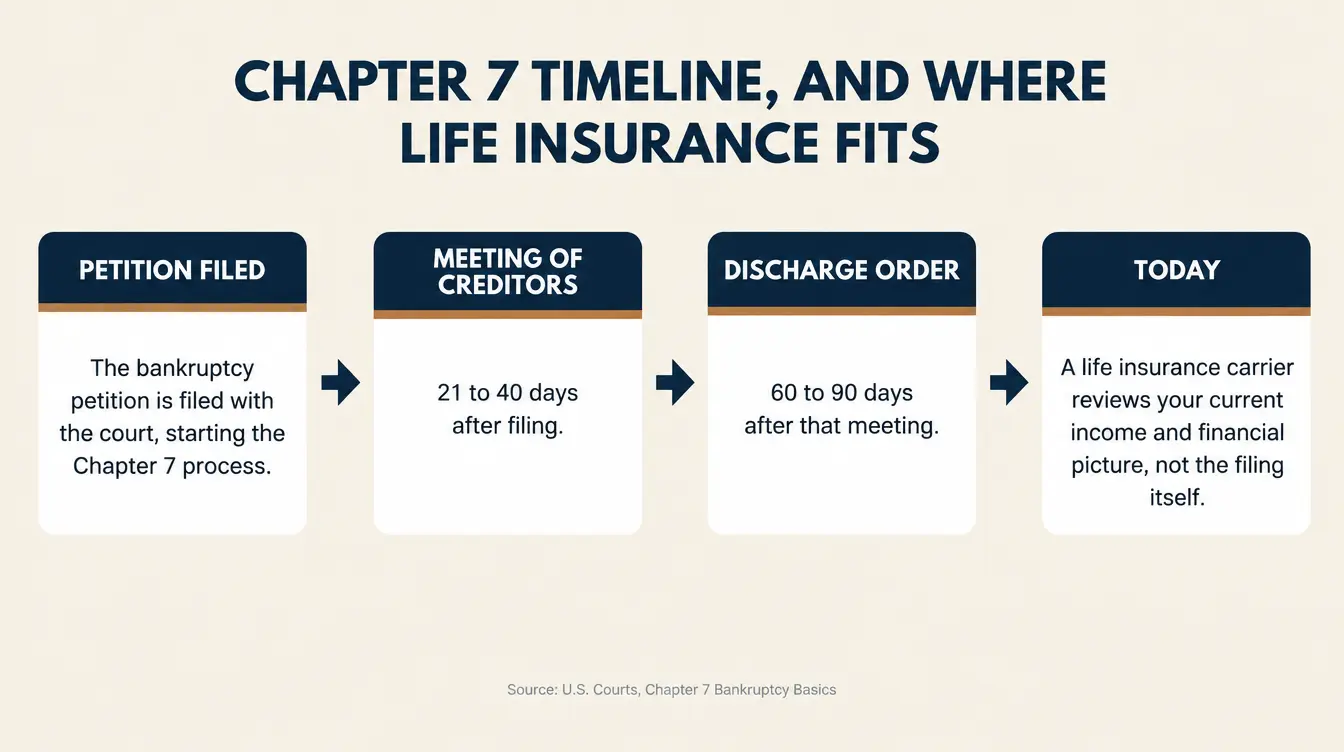
The mechanical detail that surprises most people: for a carrier that does ask about financial background, what matters most is not that a bankruptcy happened, but where things stand now. A discharged case with two years of stable, verifiable income behind it reads as a settled picture. An open case, or a very recent discharge with no track record of stability yet, reads as unsettled, the same way a post-surgical file with numbers still moving reads differently than one that has held steady for a year. The bankruptcy itself is historical; your current income and your current situation are what the application is actually trying to confirm.
What it costs to get wrong: the numbers behind the decision
This is a larger and more current question in South Dakota than most people assume, and the trend has been building for several years, not just this one.
The South Dakota number comes directly from the court that handles every bankruptcy case filed in this state. In its October 1, 2026 update, the U.S. Bankruptcy Court for the District of South Dakota reported: “In the first nine months of 2026 South Dakota bankruptcy filings increased by 18 percent from the number of bankruptcies filed in the first three-quarters of last year.” That is not an estimate or a projection; it is the court’s own count of cases actually filed in South Dakota.
U.S. bankruptcy filings by chapter, year ending December 31, 2025
Administrative Office of the U.S. Courts, 12-month period ending December 31, 2025, reported February 4, 2026. Chapter 7 and Chapter 13 together account for the large majority of individual filings.
Nationally, the Administrative Office of the U.S. Courts reported that total bankruptcy filings reached 574,314 for the year ending December 31, 2025, up 11% from 517,308 the year before, with Chapter 7 cases at 356,724 and Chapter 13 cases at 207,889 for that same 12-month period. Business filings rose a smaller 7.1%, to 24,737, while non-business, meaning individual and household, filings rose 11.2%, to 549,577. In other words, almost all of the increase is households, not companies, which lines up with what the South Dakota court is also reporting at the state level.
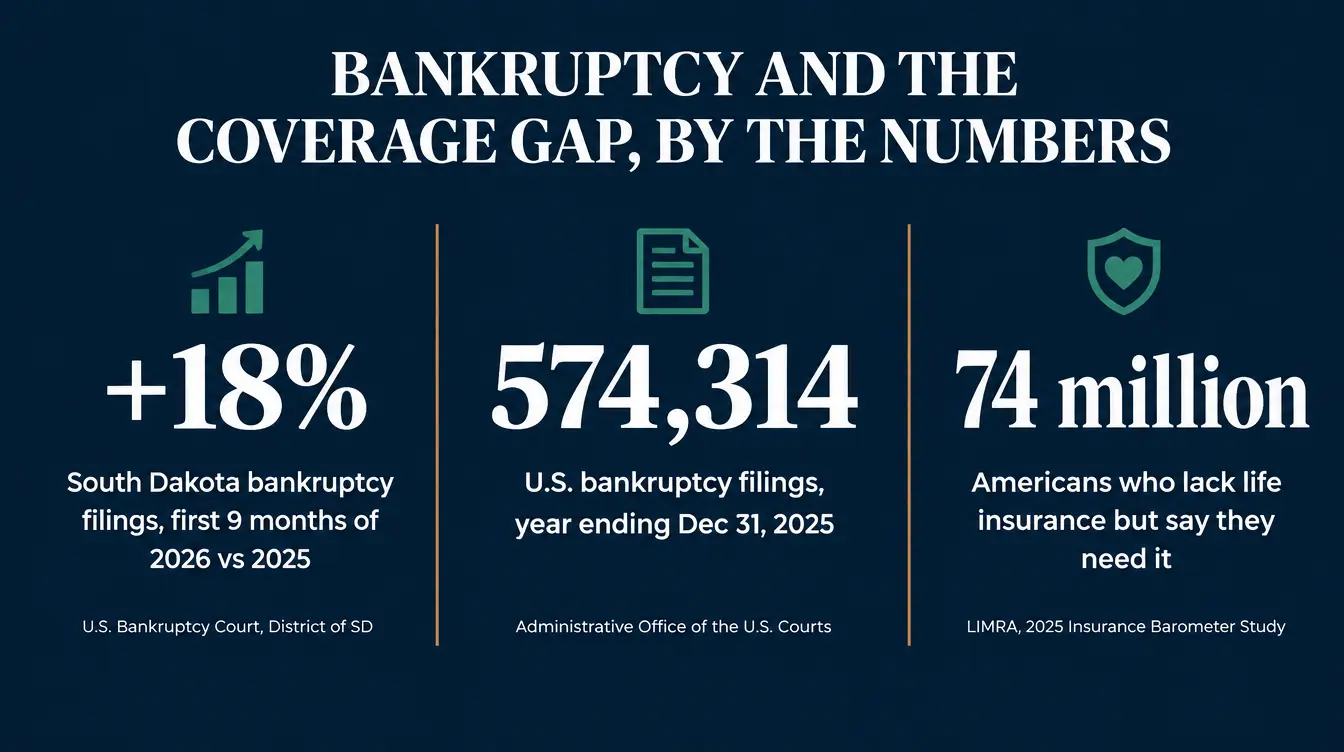
At the same time, the coverage gap this blog returns to again and again has not closed. LIMRA’s 2025 Insurance Barometer Study found that 74 million Americans lack life insurance but say they need it, with an additional 25 million who already own some coverage but recognize they are underinsured. Put those two data points next to each other and the practical risk comes into focus: a rising number of South Dakotans are going through bankruptcy at the same time a very large share of the country is already going without life insurance they say they need. The worst version of that combination is someone who files, assumes the filing closed the door on coverage too, and simply never asks, adding one gap on top of another.
To make the dollars concrete with an illustration, not a quote: a 38-year-old with a $220,000 mortgage balance, two kids under 12, and a spouse earning less than half the household income has a straightforward arithmetic need regardless of bankruptcy history, roughly the mortgage balance plus five to ten years of income replacement. That math does not change because of a Chapter 7 filed three years ago. What can change is how quickly and how easily that person finds a carrier willing to write the policy today, which is a shopping problem, not a math problem.
How to work it out yourself: read your own file before you apply
You do not need anyone’s help to get an honest, specific read on where you stand before you talk to a carrier or an agent.
Step 1: Identify your chapter and your case status. Chapter 7 or Chapter 13 matters because of timing, not severity. If you filed Chapter 7, find your discharge date; the case is very likely closed by now given the U.S. Courts’ typical timeline of a creditors’ meeting 21 to 40 days after filing and a discharge order 60 to 90 days after that. If you filed Chapter 13, note what year of your three-to-five-year plan you are in and whether your payments are current.
Step 2: Separate the bankruptcy from your current financial picture. Write down your current income, how long you have held your current job or business, and whether that income is stable and documentable through pay stubs, tax returns, or bank statements. This is the part of the file that actually does the work in underwriting.
Step 3: Calculate the coverage amount you actually need, using the same arithmetic this blog uses for every reader: add your outstanding debts (mortgage, car loans, remaining credit balances not discharged), then add five to ten years of your income for anyone who depends on it. A bankruptcy discharge may have already reduced or eliminated some of those debts, which can lower the number on the debt side even as it has no effect on the income-replacement side.
Step 4: Gather your paperwork before you apply, not after a carrier asks for it. Discharge paperwork (or your current Chapter 13 plan and payment history), two years of tax returns or recent pay stubs, and a short written explanation of what led to the filing, if asked, all speed up a conversation that otherwise stalls on missing documents.
Step 5: Compare two realistic scenarios to see how timing and documentation change the picture.
| Detail | Applicant A | Applicant B |
|---|---|---|
| Chapter filed | Chapter 7 | Chapter 13 |
| Case status | Discharged 2 years ago | Year 2 of a 5-year plan, current on payments |
| Current income | Stable, same employer 3 years | Stable, same employer 2 years |
| Documentation ready | Discharge order, 2 years of pay stubs | Plan confirmation, payment history, pay stubs |
| Likely underwriting posture | Reviewed primarily on today's income and health | Depends on the carrier; some will consider a current, in-plan filer, others prefer to wait for discharge |
Illustrative scenario, not an underwriting outcome or a quote. Actual results depend on the specific carrier, the complete application, and underwriting at the time of application.
Applicant A and Applicant B are not being judged on whether bankruptcy was the right call for their situation; they are being read on where their case and their income stand today. Applicant B’s path has more variability built in, simply because a Chapter 13 plan is still open, which is exactly why comparing more than one carrier matters more here than it does for most other topics on this blog.
You can gather all of this yourself first
Steps 1 through 4 just require your own bankruptcy paperwork, a couple of pay stubs, and twenty minutes. Where a second opinion tends to help most is knowing which carriers are comfortable with a file like yours today, since that answer changes by company and is hard to guess from outside the industry.
If you would rather have someone local walk through your paperwork and your numbers with you, that is what we do: Compare My Options.
The bankruptcy isn't the question an application is asking. Where your income and your case stand today is.
Mike Moore, Life Insurance AdvisorWhy South Dakota shopping matters here specifically
The National Association of Insurance Commissioners, the organization that coordinates state insurance regulators nationally, tells consumers plainly to compare similar policies from different companies to find the best value, because life insurance is a competitive marketplace rather than a single fixed price. That advice applies with extra weight to a financial-history question like this one, since whether an application even asks about bankruptcy, and how a carrier weighs an open Chapter 13 plan versus a years-old discharged Chapter 7, genuinely differs by company.
If you already own a life insurance policy with cash value and bankruptcy is something you are weighing, raise it with the bankruptcy attorney handling your case before you file. Which assets, including a policy’s cash value, are protected from creditors depends on exemption rules that vary by state and by the specifics of your case, which makes it a legal question for your attorney rather than something a general insurance guide can answer for your specific situation.
If you ever have a concern about how an insurance application was handled, South Dakota’s Division of Insurance, the state agency that licenses and regulates every carrier authorized to sell here, maintains a consumer complaint process and information line at (605) 773-3563, with its office in Pierre. You can also confirm that any company you are considering is actually licensed to sell in South Dakota through the division’s own listings before you apply.
How we help
We are independent, so we are not tied to one carrier’s view of a bankruptcy on your record. We start with your actual case, your discharge status or your current plan standing, and your income documentation, not a guess about what a single company will say, and compare how the carriers we work with treat a file like yours today. Because this varies by company and changes as carriers update their own guidelines, that comparison is one of the more valuable things an independent agency can do for someone in exactly this situation. We are local to Sioux Falls and licensed to serve all of South Dakota, so the person doing that comparison is someone you can actually talk to, not a call center reading from a script.
What you get
A clear, honest read on how your chapter, your case status, and your current income line up against what several carriers are actually looking for right now, not an outdated assumption about what a bankruptcy means on an application. A comparison across more than one carrier’s view of financial history, instead of a single company’s answer treated as universal. And a plain explanation, in advance, of South Dakota’s own consumer protections if you ever need them.
Find out what your file actually supports
We will go through your case status, your current income, and what you need to protect, and show you how the carriers we work with actually evaluate a file like yours today.
Not ready to talk to anyone yet? Read How It Works first and come back when you are.
If you assume a past bankruptcy rules you out entirely, it is worth asking rather than deciding for yourself in advance. Reach out when you are ready, or run the arithmetic above on your own first.
Frequently asked questions
Can you get life insurance after filing bankruptcy?
Yes, in most cases. A bankruptcy filing is a disclosed financial history item, not an automatic decline. Carriers that ask about it want to know which chapter you filed, whether it has been discharged, and whether your current income is stable and verifiable. A discharged Chapter 7 with a year or more of stable income behind it underwrites very differently than a bankruptcy filed last month with the case still open.
Does Chapter 7 or Chapter 13 affect life insurance underwriting differently?
They can, mostly because of timing rather than severity. A Chapter 7 case is typically filed and discharged within several months, so by the time you apply for life insurance the case is usually closed. A Chapter 13 case runs on a repayment plan that, under the U.S. Courts’ own bankruptcy basics, lasts three to five years and can never run longer than five years, so a Chapter 13 filer may still be mid-plan when they want coverage. Some carriers will consider an applicant during an active Chapter 13 plan if payments are current; others prefer to wait for discharge. This varies by company, which is exactly why comparing more than one matters here.
Can you apply for life insurance while still in a Chapter 13 repayment plan?
Sometimes, yes. Because Chapter 13 involves a court-approved repayment plan rather than liquidation, some carriers will underwrite an applicant who is current on their plan payments without waiting for the final discharge. Others set their own waiting period. There is no single industry-wide rule, so the honest answer is that it depends on the carrier, which is why shopping more than one company is the actual answer to this question rather than a guess.
Do you have to disclose a bankruptcy on a life insurance application?
If the application asks about it, yes. Not every carrier’s application asks a financial-history question, but when one does, it belongs on the form whether or not you think it will change the outcome. Life insurance applications also carry a contestability period, typically two years from the issue date, during which an insurer can investigate a claim and deny it over a material misstatement, which is the practical reason accurate disclosure matters regardless of what you expect the underwriting answer to be.
Will bankruptcy make my life insurance premium higher?
Not directly the way a health condition does. Life insurance pricing is built around mortality risk, meaning your age, health, and tobacco use, not your credit history. A bankruptcy itself does not move you into a different mortality-based rate class. Where it can matter is indirectly: if a carrier declines to offer its best outcome because your income documentation is thin or your case is still open, you may end up comparing fewer options, which is a different problem than a higher price for the same policy.
What happens to an existing life insurance policy if I file bankruptcy?
This depends on the type of policy and on exemption rules that vary by state, which makes it a question for the bankruptcy attorney handling your specific case rather than a general insurance question. Term life insurance with no cash value is generally treated differently from a whole life or indexed universal life policy that has built up cash value, because that cash value can have value to the bankruptcy estate depending on the exemptions that apply. If you already own a policy and are considering bankruptcy, raise it with your attorney before you file, not after.
How soon after a Chapter 7 discharge can I apply for life insurance?
There is no fixed waiting period set by law or by the industry as a whole; each carrier that asks about financial history sets its own view of how recent is too recent. Under the U.S. Courts’ own published process, a Chapter 7 case typically reaches discharge within a few months of filing, at which point the case is closed and your current income and financial picture become the center of the conversation rather than the filing itself. Comparing how different carriers treat a recently discharged file is the practical next step, not waiting a fixed, arbitrary number of years.
Why are South Dakota bankruptcy filings rising in 2026?
The U.S. Bankruptcy Court for the District of South Dakota reported that filings in the first nine months of 2026 were up 18% from the same nine-month period of 2025, part of a broader national trend: the Administrative Office of the U.S. Courts reported 574,314 total bankruptcy filings nationwide for the year ending December 31, 2025, up 11% from 517,308 the year before. Neither source breaks down the exact cause county by county, so treat the trend as context for how common this situation has become, not as a statement about any individual’s reasons for filing.
Before you apply
This article is general education, not insurance, legal, financial, or tax advice. It does not recommend bankruptcy, a specific chapter, or any course of action for your situation; speak with a bankruptcy attorney about your legal options. Product availability, features, underwriting criteria, and rates vary by carrier and are subject to underwriting; a specific outcome for any individual applicant cannot be predicted or guaranteed. No coverage exists until a policy is issued and in force. Any guarantees are subject to the claims-paying ability of the issuing insurer.
Sources
- U.S. Bankruptcy Court, District of South Dakota — “Bankruptcy UPdate,” October 1, 2026 — South Dakota bankruptcy filings up 18% in the first nine months of 2026 versus the first three quarters of 2025
- Administrative Office of the U.S. Courts — “Bankruptcy Filings Rise 11 Percent,” February 4, 2026 — 574,314 total U.S. bankruptcy filings for the year ending December 31, 2025, versus 517,308 in 2024; Chapter 7: 356,724; Chapter 13: 207,889
- U.S. Courts — Chapter 7 Bankruptcy Basics — accessed October 2026; creditors’ meeting and discharge timeline, filing fees, discharge rate
- U.S. Courts — Chapter 13 Bankruptcy Basics — accessed October 2026; repayment plan length of three to five years
- LIMRA — 2025 Insurance Barometer Study — 74 million Americans lack life insurance but say they need it; 25 million additional Americans say they are underinsured
- American Bankruptcy Institute — “Bankruptcy Filing Trends in South Dakota: 2000-2025” — South Dakota population and income context, data from the U.S. Census Bureau, January 2026
- National Association of Insurance Commissioners — Tips for Buying Life Insurance — accessed October 2026; consumer guidance on comparison shopping across carriers
- South Dakota Division of Insurance — Consumer Information — accessed October 2026; complaint process and consumer contact information
Related reading: Self-Employed Life Insurance in South Dakota: 2026 Guide, No Medical Exam Life Insurance in South Dakota: 2026 Guide, and Life Insurance Cost by Age: 2026 Data. See current options for term life, or learn more about how it works.