
An ADHD diagnosis does not close the door on life insurance, and neither does a stimulant prescription. Underwriters are estimating mortality risk, not grading your attention span, and a well-managed diagnosis with a steady medication routine is a routine file for most carriers. What actually moves the needle is how stable your treatment has been, whether anything else is layered on top of it, and how complete your medical record is when you apply. This guide walks through how an application actually gets read, what the current federal data says about how common this situation has become, and what you can work out yourself before you talk to anyone.
The short version
- 6.0% of U.S. adults, about 15.5 million people, had a current ADHD diagnosis as of a 2023 federal survey, and 55.9% of them were diagnosed at age 18 or older, according to the CDC.
- 33.4% of adults with ADHD took stimulant medication in the past 12 months, and 71.5% of those had trouble filling their prescription because the medication was unavailable, per the same CDC survey.
- National stimulant dispensing rose from 5.6 to 6.1 prescriptions per 100 people between 2014 and 2019, with the fastest growth among adults, not children, according to CDC-authored research.
- South Dakota law gives every life insurance policy sold here a two-year incontestability period from its issue date, under SDCL 58-15-10, which is the practical reason accurate disclosure matters regardless of what you expect underwriting to decide.
- ADHD itself does not change your mortality risk the way a cardiac or respiratory diagnosis can; what underwriters actually weigh is treatment stability and whether anything else, like anxiety, depression, or a substance history, is layered on top of it.
The pain: assuming a diagnosis or a prescription already decided the answer
A lot of adults who get diagnosed with ADHD, especially later in life, go quiet on the subject of life insurance the same way people do after a cancer diagnosis or a DUI. The diagnosis itself feels disqualifying, even before anyone has looked at an actual application. Add a controlled-substance prescription, since stimulant medications like Adderall and Vyvanse are legally classified as Schedule II controlled substances, and the assumption gets stronger: if it is controlled by the DEA, surely an insurance company treats it as a red flag.
This shows up constantly in ordinary South Dakota situations. A 32-year-old nurse in Sioux Falls diagnosed with ADHD last year after her own daughter’s diagnosis prompted her to get evaluated, now on a stable dose of Vyvanse, who has never looked into life insurance because she assumes the prescription alone disqualifies her. A contractor in Rapid City who has taken the same dose of Adderall for eight years and manages a growing business, who avoided applying because he didn’t want to explain a “controlled substance” on a form. A college-educated professional in Aberdeen diagnosed with ADHD and mild anxiety in the same year, assuming two mental-health-adjacent diagnoses on one file automatically means a decline.
What actually happens in underwriting is narrower than the fear. Life insurance pricing is built around mortality risk: how likely you are to die during the length of the specific policy you’re buying. Health conditions that measurably shorten life expectancy, like advanced heart disease or certain cancers, move that estimate directly. ADHD, treated and stable, does not carry the same mortality signal. What an underwriter is actually trying to confirm is simpler: is this a settled, well-managed condition, or an unsettled one with open questions. A stimulant prescription taken as directed, under a doctor’s ongoing care, for a diagnosed condition is itself evidence of the former, not the latter.
This is general education, not medical, legal, or insurance advice
Nothing here tells you whether to pursue or continue ADHD treatment, recommends a medication, or promises that any specific carrier will approve any specific applicant at any specific rate. It is a plain explanation of how a diagnosis and a stimulant prescription factor into a life insurance application, sourced from federal health data and South Dakota law, so you can see the mechanics before you decide when and how to apply.
Why it happens: how an application actually reads an ADHD file
An underwriter reading your file is not asking “does this person have ADHD.” They’re asking a narrower set of questions: how long have you been diagnosed, how long have you been on your current treatment, has the treatment been stable, and is anything else going on alongside it. A handful of terms carry this entire topic, worth defining once since applications and the people reading them don’t always spell them out:
- Underwriting class, also called a rate class, is the risk tier a carrier assigns an approved applicant, which sets the premium. It is built from mortality factors, such as age, health history, and tobacco use, not from any single diagnosis label.
- Comorbid condition means a second condition present alongside the first. ADHD with no other diagnosis reads differently than ADHD alongside an active anxiety disorder, depression, or a documented substance use history, because the combination changes the overall picture more than either condition alone.
- Medication stability is how long you’ve been on the same medication at the same dose without a change. Underwriters generally treat a longer stable stretch, often framed as six to twelve months, as a stronger signal than a recent diagnosis or a recent medication switch.
- Schedule II controlled substance is a DEA classification for drugs with recognized medical use but high potential for misuse, which includes amphetamine-based stimulants like Adderall and Vyvanse and methylphenidate-based stimulants like Ritalin and Concerta. The classification describes the drug’s regulatory category, not whether any individual patient is using it appropriately.
- Contestability period is the window, two years from a policy’s issue date under South Dakota law (SDCL 58-15-10), during which an insurer can investigate a claim and deny it over fraud or a material misstatement on the original application. It is the practical reason accurate disclosure matters on any application, this one included.
- Attending physician statement, often shortened to APS, is the medical records request a carrier sends to your prescribing doctor to confirm diagnosis dates, treatment history, and current status. For an ADHD file, this is usually the document that actually answers the stability question, more than anything you write on the application yourself.
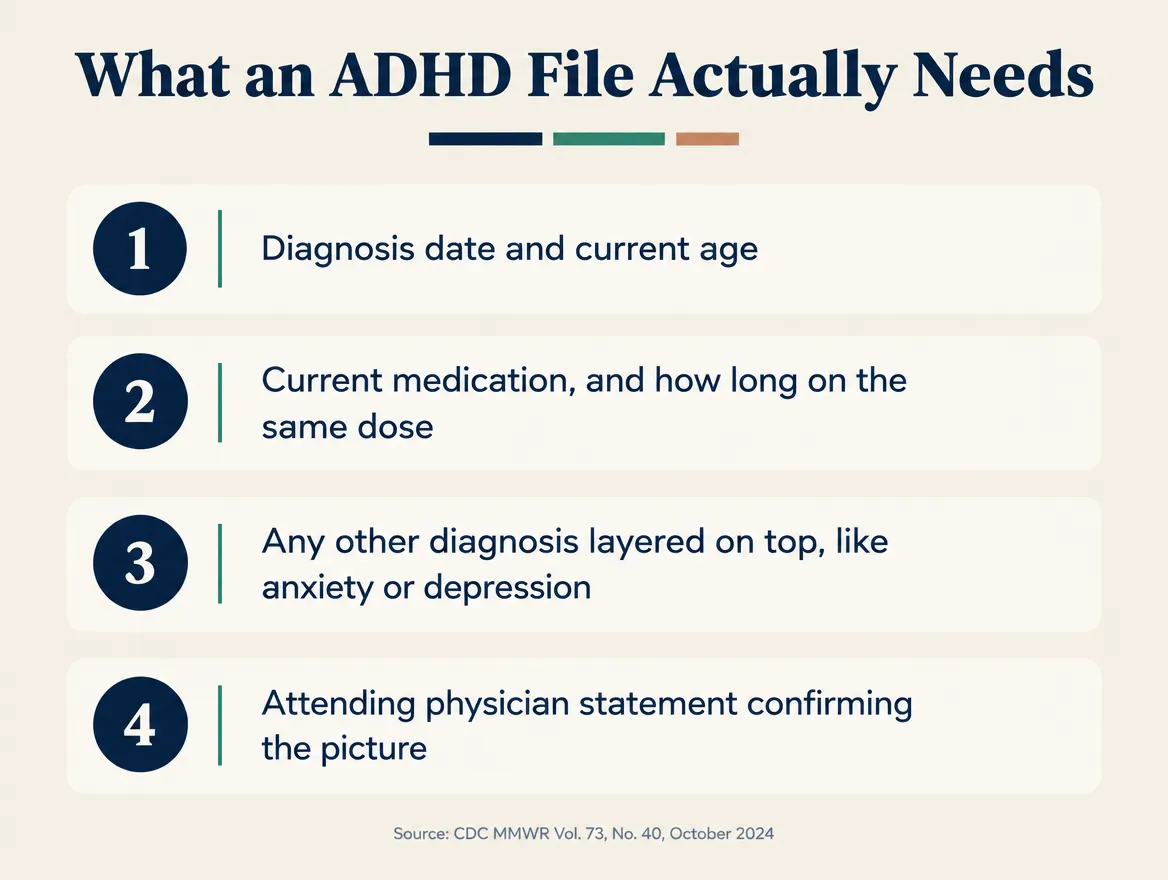
The mechanical detail that surprises most people: the controlled-substance classification of a stimulant is not itself the thing underwriters are flagging. Opioid painkillers, benzodiazepines, and stimulants are all regulated under the same federal scheduling system but read completely differently in a life insurance file, because the question is never “is this a controlled substance,” it’s “what does the use pattern look like.” A consistent prescription, filled on schedule, from one prescriber, for a diagnosed condition, is the opposite of a red flag. Multiple prescribers, doses outside what was prescribed, or a documented history of misuse is a different file entirely, and that distinction, not the drug schedule, is what underwriting actually weighs.
What it costs to get wrong: the numbers behind how common this has become
This is a considerably larger and more current situation than most applicants assume, and the federal data on it is recent enough that a lot of agents haven’t caught up to it either.
Those four figures come from the same source: the CDC’s National Center for Health Statistics Rapid Surveys System, published in the Morbidity and Mortality Weekly Report on October 10, 2024. The survey collected data from 7,046 adults in October and November 2023, and it is the most current nationally representative estimate of adult ADHD diagnosis published by a federal agency as of this writing. Because it is the only survey of its kind at this scale, there isn’t yet a second, fully independent national dataset to cross-check the exact 6.0% figure against; it stands as the CDC’s own most recent published number, worth stating plainly rather than implying a second confirmation that doesn’t exist yet.
What does have independent corroboration is the trend underneath it: adult stimulant use has been rising for years, not just since the 2023 survey. CDC-authored research published in the journal Drug and Alcohol Dependence, using a separate dataset (IQVIA National Prescription Audit data covering roughly 92% of U.S. pharmacy dispensing), found that the national annual rate of stimulant dispensing rose from 5.6 to 6.1 prescriptions per 100 people between 2014 and 2019. The growth was concentrated in adults, not children: dispensing rates rose by an average of 9.7% per year among adults aged 40 to 59, 6.9% per year among adults 60 and older, and 6.7% per year among adults 20 to 39 over that period.
Average annual increase in stimulant dispensing by age group, 2014-2019
Board et al., "Trends in stimulant dispensing by age, sex, state of residence, and prescriber specialty, United States, 2014-2019," CDC-authored, Drug and Alcohol Dependence, 2020 (hosted by CDC Stacks). AAPC = average annual percent change in prescriptions dispensed per 100 persons.
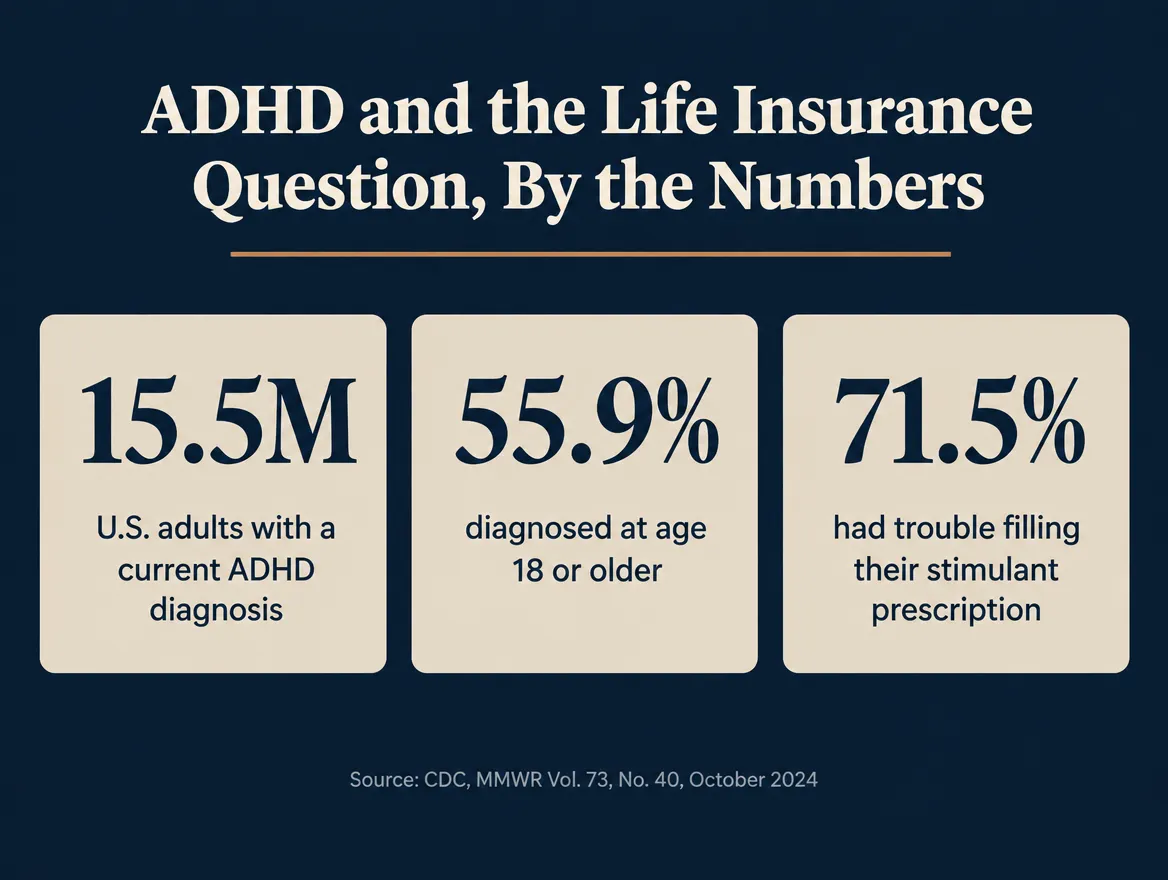
Put plainly: a diagnosis that used to be thought of as mostly a childhood condition is now, by the CDC’s own count, more often diagnosed in adulthood than not. More than half the adults with a current diagnosis got it after turning 18, which means a growing share of life insurance applicants are walking in with a relatively new file, not a decades-old one. At the same time, this is happening against the backdrop of the coverage gap this blog returns to often: LIMRA’s 2025 Insurance Barometer Study found that 74 million Americans lack life insurance but say they need it, with another 25 million who already own a policy but recognize they are underinsured. A newly diagnosed adult who assumes ADHD rules out coverage and never applies is adding one gap on top of the other.
To make this concrete with an illustration, not a quote: a 34-year-old diagnosed with ADHD two years ago, stable on the same dose of Vyvanse for the past 14 months, with no other diagnosis on record, has a straightforward file by underwriting standards regardless of the stimulant prescription on it. The arithmetic for how much coverage that person needs, built from debts plus years of income replacement, doesn’t change because of the diagnosis. What can change is how quickly that person finds a carrier that reads a recent-but-stable ADHD file comfortably, which is a shopping question, not a health question.
How to work it out yourself: read your own file before you apply
You don’t need anyone’s help to get an honest, specific read on your own situation before you talk to a carrier or an agent.
Step 1: Write down your diagnosis date and your current medication timeline. Note when you were diagnosed, what you were prescribed first, and any changes since, including dose adjustments. If you’ve been on the same medication and dose for six months or more, that’s useful to know going in; if you were just diagnosed or just changed medications, that’s useful to know too, since it shapes which carriers are likely to be comfortable with your file today.
Step 2: List anything else in your medical history that overlaps. Anxiety, depression, sleep issues, or a past substance history, even resolved, all change how a combined file reads. None of these are automatic declines, but carriers vary in how they weigh the combination, which is exactly why comparing more than one matters here.
Step 3: Gather your treatment records before you apply, not after a carrier asks for them. Your prescriber’s name and the dates you started and, if applicable, changed medications, speed up the attending physician statement request that carriers typically order on a mental-health-adjacent or controlled-substance file. A thin or inconsistent record slows this step down regardless of how well-managed your ADHD actually is.
Step 4: Calculate the coverage amount you actually need, using the same arithmetic this blog uses for every reader: add your outstanding debts (mortgage, car loans, remaining balances), then add five to ten years of your income for anyone who depends on it. A diagnosis doesn’t change this math at all; it only affects which carriers you’re likely to have the easiest time with.
Step 5: Compare two realistic scenarios to see how timing and documentation change the picture.
| Detail | Applicant A | Applicant B |
|---|---|---|
| Diagnosis timing | Diagnosed at age 9, well-documented history | Diagnosed 4 months ago at age 31 |
| Current medication | Same dose of Ritalin for 6 years | Started Adderall 4 months ago, one dose adjustment so far |
| Other diagnoses | None | Mild, treated anxiety noted at diagnosis visit |
| Records available | Years of consistent prescriber notes | One diagnosing visit, limited follow-up history yet |
| Likely underwriting posture | Reviewed as a routine, stable file | May be asked to wait for more stable history, or reviewed with a higher rate class; varies by carrier |
Illustrative scenario, not an underwriting outcome or a quote. Actual results depend on the specific carrier, the complete application, and underwriting at the time of application.
Applicant A and Applicant B both have the same diagnosis; what differs is how much settled history exists behind it. Applicant B isn’t uninsurable, but the file is newer, which is exactly the situation where shopping more than one carrier, rather than taking one company’s answer as the final word, tends to produce a meaningfully different outcome.
You can gather all of this yourself first
Steps 1 through 4 just require your own diagnosis date, your prescriber's name, and about twenty minutes. Where a second opinion tends to help most is knowing which carriers are currently comfortable with a recent diagnosis or a layered mental-health file, since that answer changes by company and is hard to guess from outside the industry.
If you’d rather have someone local walk through your treatment timeline and your numbers with you, that’s what we do: Compare My Options.
The prescription on your file isn't the question an underwriter is asking. How settled and well-documented your treatment is, is.
Mike Moore, Life Insurance AdvisorWhy South Dakota shopping matters here specifically
The National Association of Insurance Commissioners, the organization that coordinates state insurance regulators nationally, tells consumers plainly to compare similar policies from different companies to find the best value, because life insurance is a competitive marketplace rather than a single fixed price. That advice carries extra weight for a diagnosis like ADHD, where how a carrier weighs a recent adult diagnosis, a layered anxiety or depression history, or a documented medication gap from a stimulant shortage genuinely differs by company, sometimes significantly.
Disclosure matters regardless of which carrier you choose. Under South Dakota law, SDCL 58-15-10, a life insurance policy becomes incontestable, meaning the insurer generally can’t deny a claim over a misstatement on the original application, two years after the policy’s issue date, except in cases of fraud. That two-year window is the practical reason an ADHD diagnosis and a current stimulant prescription belong on an application whenever the health questions ask about them, whether or not you expect the answer to change your rate.
If you ever have a concern about how an insurance application was handled, South Dakota’s Division of Insurance, the state agency that licenses and regulates every carrier authorized to sell here, maintains a consumer complaint process and information line at (605) 773-3563. You can also confirm that any company you’re considering is actually licensed to sell in South Dakota through the division’s own listings before you apply.
How we help
We’re independent, so we’re not tied to one carrier’s view of an ADHD diagnosis or a stimulant prescription. We start with your actual treatment timeline, your medication history, and anything else layered on top of it, not a guess about what a single company will say, and compare how the carriers we work with treat a file like yours today. Because this varies by company and changes as carriers update their own underwriting guidelines, that comparison is one of the more useful things an independent agency can do for someone in exactly this situation. We’re local to Sioux Falls and licensed to serve all of South Dakota, so the person doing that comparison is someone you can actually talk to, not a call center reading from a script.
What you get
A clear, honest read on how your diagnosis timeline, your current medication, and anything else in your file line up against what several carriers are actually looking for right now, not an outdated assumption about what a controlled-substance prescription means on an application. A comparison across more than one carrier’s view of ADHD and stimulant medication, instead of a single company’s answer treated as universal. And a plain explanation, in advance, of South Dakota’s own disclosure rules and consumer protections, so there are no surprises two years into a policy.
Find out what your file actually supports
We'll go through your diagnosis timeline, your current treatment, and what you need to protect, and show you how the carriers we work with actually evaluate a file like yours today.
Not ready to talk to anyone yet? Read How It Works first and come back when you are.
If you assume an ADHD diagnosis or a stimulant prescription rules you out entirely, it’s worth asking rather than deciding for yourself in advance. Reach out when you’re ready, or run the arithmetic above on your own first.
Frequently asked questions
Does ADHD disqualify you from getting life insurance?
No. ADHD on its own is not a reason carriers decline an application. Underwriters are estimating mortality risk, meaning how likely you are to die during the length of the policy, and a well-managed ADHD diagnosis with no serious comorbid conditions does not move that estimate much. What underwriters actually review is how stable your treatment has been, whether ADHD shows up alongside depression, anxiety, or a substance history, and how complete and consistent your medical record is.
Does taking Adderall, Vyvanse, or Ritalin affect your life insurance rate?
The specific stimulant rarely matters on its own; stability does. A carrier reading your prescription history is looking for the same medication and dose held steady for roughly six to twelve months, not which brand you take. A recent medication change, a recent dose increase, or several different stimulants tried in a short window can slow an application down while the underwriter waits to see how you respond, even though the ADHD diagnosis itself has not changed.
Do you have to disclose an ADHD diagnosis on a life insurance application?
If the application’s health questions cover it, yes, the same as any other diagnosed condition or prescription medication. South Dakota law, SDCL 58-15-10, gives a life insurance policy an incontestability period of two years from its issue date, after which the insurer generally cannot deny a claim over a misstatement on the original application, except in cases of fraud. Before that two-year window closes, an inaccurate or incomplete answer about a diagnosis or a prescription is exactly the kind of thing that period exists to review.
Does a recent adult ADHD diagnosis underwrite differently than a childhood diagnosis?
It can, mostly because of how much history exists to review. A childhood diagnosis usually comes with years of treatment records and a settled medication routine by the time someone applies as an adult. A diagnosis received at 28 or 35 is newer, which means less history for an underwriter to see. CDC data shows this is now the more common pattern: 55.9% of adults with a current ADHD diagnosis in a 2023 federal survey received that diagnosis at age 18 or older, so a recent adult diagnosis is not an unusual file, just a thinner one, and waiting for six to twelve months of stable treatment history before applying is one practical way to thicken it.
What if ADHD comes with anxiety, depression, or a past substance history?
This is where underwriting gets more involved, not because any one condition is disqualifying, but because carriers are reading the combination. A single, well-managed diagnosis treated with the same medication for a year reads as settled. ADHD plus an active anxiety or depression diagnosis, a recent hospitalization, or a substance use history in the past few years reads as a more complex file, and different carriers weigh that combination differently. This is exactly the kind of file where comparing more than one carrier’s view, rather than accepting one company’s answer as final, tends to matter most.
Will a stimulant shortage or a recent prescription change hurt my application?
Not by itself, but it can introduce gaps an underwriter will ask about. CDC survey data found that 71.5% of adults with ADHD who took a stimulant medication in the prior 12 months had trouble filling that prescription because the medication was unavailable, a well-documented national shortage rather than anything about an individual applicant. If a pharmacy shortage forced you to switch stimulants or go without for a stretch, be ready to explain that gap in your own words; carriers see this pattern often enough now that a documented shortage, not a gap you can’t explain, is a very different file to review.
How long should you be on stable ADHD medication before applying for life insurance?
There is no single industry-wide rule, but six to twelve months of the same medication at the same dose, with no new comorbid diagnosis in that window, is the range that comes up most often in how carriers describe a stable file. If you were just diagnosed or just changed medications, applying is still possible; it just means the file looks newer, which is one more reason comparing carriers matters, since some are more comfortable with a recent diagnosis than others.
Can a carrier decline you for life insurance just for taking a controlled substance like Adderall?
A stimulant prescription alone is not a decline reason; these are commonly prescribed, FDA-approved medications taken under a doctor’s ongoing care, not evidence of misuse. Underwriters are trained to distinguish a controlled substance taken as prescribed for a diagnosed condition from signs of misuse, such as multiple prescribers, doses outside the prescribed range, or a documented substance use disorder. The prescription itself, taken as directed, is a managed-condition data point, not a red flag.
Before you apply
This article is general education, not medical, legal, insurance, or financial advice. It does not recommend any treatment, medication, or course of action for your situation; speak with your prescribing physician about your care. Product availability, features, underwriting criteria, and rates vary by carrier and are subject to underwriting; a specific outcome for any individual applicant cannot be predicted or guaranteed. No coverage exists until a policy is issued and in force. Any guarantees are subject to the claims-paying ability of the issuing insurer.
Sources
- CDC, Morbidity and Mortality Weekly Report, Vol. 73, No. 40 — “Attention-Deficit/Hyperactivity Disorder Diagnosis, Treatment, and Telehealth Use in Adults,” October 10, 2024 — 6.0% of U.S. adults (15.5 million) with a current ADHD diagnosis; 55.9% diagnosed at age 18 or older; 33.4% on stimulant medication in the past 12 months; 71.5% of those had difficulty filling the prescription; data collected October-November 2023
- CDC, National Center for Health Statistics — FastStats: Attention Deficit Hyperactivity Disorder — 12.0% of U.S. children ages 3-17 ever diagnosed with ADHD, 2024 estimate from the National Health Interview Survey, 2019-2024
- Board AR, Guy G, Jones CM, Hoots B — “Trends in stimulant dispensing by age, sex, state of residence, and prescriber specialty, United States, 2014-2019,” Drug and Alcohol Dependence, 2020 (CDC-authored, hosted via CDC Stacks) — national stimulant dispensing rate rose from 5.6 to 6.1 prescriptions per 100 persons, 2014-2019; average annual increase of 9.7% for ages 40-59, 6.9% for ages 60+, and 6.7% for ages 20-39
- South Dakota Legislature — SDCL 58-15-10 — accessed October 2026; two-year incontestability period for life insurance policies issued in South Dakota
- LIMRA — 2025 Insurance Barometer Study — 74 million Americans lack life insurance but say they need it; 25 million additional Americans say they are underinsured
- National Association of Insurance Commissioners — Tips for Buying Life Insurance — accessed October 2026; consumer guidance on comparison shopping across carriers
- South Dakota Division of Insurance — Consumer Information — accessed October 2026; complaint process and consumer contact information
Related reading: Life Insurance With a Mental Health History: 2026 SD Guide, What to Expect at a Life Insurance Medical Exam in 2026, and No-Medical-Exam Life Insurance in South Dakota: 2026 Guide. See current options for term life, learn more about coverage for people with health conditions, or read how it works.