
If you inherited a traditional IRA from someone who was not your spouse and they had already started their own required withdrawals, the IRS now requires you to take money out of that account every year, not just by the end of a ten-year window. That rule became enforceable in 2025, it carries a real penalty if you miss a year, and a lot of South Dakota families who inherited an account in the last few years are only now finding out about it. This explains what changed, what it costs to get wrong, and how to work out your own numbers before a missed withdrawal turns into an IRS letter.
The short version
- Final IRS regulations require most non-spouse IRA beneficiaries to take annual withdrawals throughout a 10-year window, not just a lump sum by year 10, applicable for RMD calendar years beginning on or after January 1, 2025, per IRS Internal Revenue Bulletin 2024-33 (T.D. 10001).
- The IRS waived the missed-RMD penalty for 2021 through 2024 while the rule was finalized, under Notice 2024-35, but that relief has ended. 2025 and 2026 are not covered by it.
- Missing a required annual withdrawal can trigger a 25% excise tax on the shortfall, reduced to 10% if corrected within the correction window, per the IRS's Retirement Plan and IRA RMD FAQs and IRS Publication 590-B.
- Five categories of "eligible designated beneficiaries" are exempt from the 10-year rule and can stretch withdrawals over their own life expectancy instead: a surviving spouse, a minor child of the owner, a disabled individual, a chronically ill individual, or someone not more than 10 years younger than the owner, per IRS Publication 590-B.
- South Dakota is one of seven states with no individual income tax, per the South Dakota Department of Revenue, so an inherited IRA withdrawal here is federal tax exposure only.
The pain: the IRS is making you take money out on a schedule you didn’t choose
Somebody you loved died, and somewhere in the paperwork that followed, you became the owner of what the IRS calls an inherited IRA. Nobody handed you a manual. Maybe your mom’s financial advisor retired and nobody picked up the file, or maybe you did everything right and opened the inherited IRA the way the custodian told you to, and you’ve mostly left it alone since, grieving and not thinking about withdrawal schedules.
Here’s the problem: the IRS has been quietly finalizing exactly how that account has to be drained, and the rule that applies to most people in that situation isn’t “take it all out whenever you want within ten years.” For a specific, common group of beneficiaries, it’s “take some out every single year, starting now, or face a penalty.” That rule has been enforceable since 2025. If you inherited an IRA from a parent who was already retired and taking their own withdrawals, and you haven’t been taking anything out yourself, you may already be behind.
This isn’t a hypothetical scare. It’s a real rule, finalized by the IRS in 2024, and it’s exactly the kind of thing that falls through the cracks during a year that’s already hard. The good news is the math is knowable and the deadlines are fixed, which means you can get ahead of it with about twenty minutes and the right documents.
This is general education, not advice
Nothing here tells you to take a specific withdrawal, buy a specific product, or make a specific tax decision. It explains how the current IRS rules work, using the IRS's own published guidance, so you can work through the first pass yourself or bring real numbers to a tax professional or advisor.
Why it happens: SECURE Act timing rules nobody explained to you
Before 2020, inheriting an IRA was relatively simple for most people: you could “stretch” withdrawals over your own life expectancy, often for decades, which kept the tax bill small and spread out. The Setting Every Community Up for Retirement Enhancement (SECURE) Act, which took effect in 2020, ended that for most non-spouse beneficiaries and replaced it with a flat 10-year deadline to empty the account. What the SECURE Act’s original text didn’t spell out clearly was whether beneficiaries subject to that 10-year rule also had to take withdrawals every single year along the way, or could simply wait until year 10 and take it all at once. That ambiguity sat unresolved for years while the IRS drafted guidance, withdrew it, redrafted it, and granted temporary penalty relief while it figured out the final answer.
A few terms worth defining once, since the rest of this only makes sense with them straight:
- Inherited IRA. An individual retirement account a beneficiary owns after the original account holder’s death, retitled in the deceased owner’s name for the beneficiary’s benefit. It is a different legal structure from your own personal IRA and has its own withdrawal rules.
- Required minimum distribution (RMD). The minimum amount the IRS requires to be withdrawn from a tax-deferred retirement account each year, for the original owner starting at the applicable RMD age under current law, and for most inherited accounts, on the schedule described below.
- The 10-year rule. The requirement, under the SECURE Act, that most non-spouse beneficiaries fully withdraw an inherited IRA by December 31 of the tenth year after the original owner’s death.
- Required beginning date. The date the original account owner was legally required to start their own RMDs. Whether the owner died before or after this date determines whether their beneficiary owes annual withdrawals during the 10-year window.
- Eligible designated beneficiary. A beneficiary in one of five categories the IRS exempts from the 10-year rule, allowed instead to stretch withdrawals over their own life expectancy: a surviving spouse, a minor child of the owner, a disabled individual, a chronically ill individual, or an individual not more than 10 years younger than the owner, per IRS Publication 590-B.
- Excise tax. A penalty tax, separate from ordinary income tax, the IRS can assess when a required withdrawal isn’t taken on time.
The IRS answered the ambiguity in final regulations, published as Treasury Decision 10001 in Internal Revenue Bulletin 2024-33, effective September 17, 2024, and applicable for RMD calendar years beginning on or after January 1, 2025, according to the IRS. The final rule: if the original owner died on or after their required beginning date, their non-spouse beneficiary who is not an eligible designated beneficiary must take annual RMDs throughout the 10-year window, calculated the same way the owner’s own RMDs would have been calculated, and still has to zero out the account by the end of year 10. If the owner died before reaching their required beginning date, the beneficiary has more flexibility on timing within those same 10 years, no annual minimum is enforced, but the account still must reach zero by the deadline.
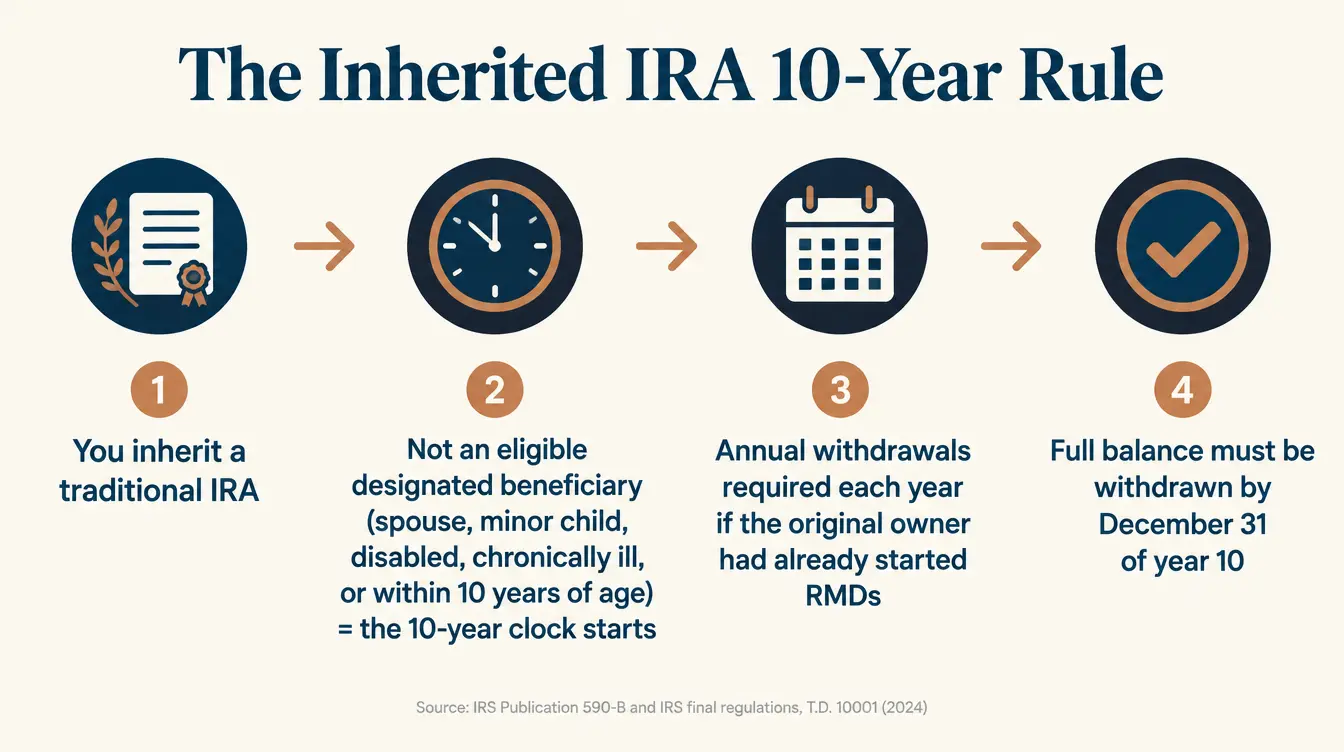
Why did the IRS land here instead of the simpler “just empty it by year 10, whenever you like” reading some commenters pushed for? The agency’s July 2024 announcement on the final rule said directly that it considered and rejected that approach, choosing instead to keep the annual-payment requirement from the proposed regulations, according to the IRS. The practical effect is that a lot of beneficiaries who assumed they had ten years of total flexibility actually have ten years of mandatory annual withdrawals, and many didn’t find out until the penalty relief period ended.
The penalty relief already ended
Under IRS Notice 2024-35, the IRS said it would not assess the missed-RMD excise tax for 2021 through 2024 while the final rule was being worked out, and that the new requirement would not apply any earlier than 2025. That means 2025 withdrawals were the first ones the penalty applied to, and 2026 withdrawals are squarely covered. If you have been treating this as "flexible," check your actual required-beginning-date status before you assume another year of flexibility you may not have.
What it costs to get wrong: a worked example with real 2026 tax brackets
Let’s put real numbers on this, built from the current 2026 federal tax brackets rather than a guess.
Say a South Dakota resident inherits a $300,000 traditional IRA from a parent who had already been taking their own RMDs for several years before they died. The beneficiary doesn’t need the money for current expenses, has a modest full-time income, and assumes, like a lot of people, that the smart move is to leave it alone and take it all in year 10 to let it keep growing tax-deferred as long as possible. Under the final 2025 rule, that assumption is wrong for this specific situation: because the parent had already reached their required beginning date, the IRS requires annual withdrawals throughout the 10-year window.
This is a simplified illustration to show the scale of the issue, not an official RMD calculation; the actual required amount each year depends on IRS life-expectancy tables applied to the beneficiary’s age and the account’s year-end balance, recalculated annually. For illustration, assume a roughly even spread across the 10 years, about $30,000 withdrawn per year before any investment growth or decline is factored in.
| Scenario | Added taxable income | Marginal federal bracket touched | What it means |
|---|---|---|---|
| Annual withdrawal taken as required | ~$30,000/year | Likely stays within the 22% bracket for most filers (income over $50,400 in 2026) | Predictable, plannable annual tax bill |
| Withdrawal skipped, then caught in an IRS review | $30,000 shortfall identified | Same ordinary income tax, plus a penalty on top | 25% excise tax = $7,500, or 10% = $3,000 if corrected within the correction window |
| Full $300,000 taken as a single lump sum in year 10 | $300,000 in one year | Pushes well into the 32% and 35% federal brackets ($105,700+ and $201,775+ for 2026 single filers) | A materially larger tax bill than spreading the same income over 10 years, even before considering the annual-withdrawal requirement that applies here anyway |
Illustrative example only, not a projection for any specific account or taxpayer. 2026 federal single-filer bracket thresholds (22% bracket begins at $50,400; 24% bracket begins at $105,700) per IRS tax year 2026 inflation adjustments. Excise tax rates of 25% and 10% per the IRS's Retirement Plan and IRA RMD FAQs and IRS Publication 590-B. Actual tax owed depends on filing status, total income, deductions, and the account's actual required distribution each year.
The point isn’t that a lump sum is always wrong or that spreading withdrawals is always right; it depends on your total income picture in each year. The point is that “wait and see” isn’t actually an option for a beneficiary whose benefactor had already started RMDs: the account’s own annual requirement and the tax-bracket math are both working against indefinite deferral at the same time, and ignoring either one gets expensive.
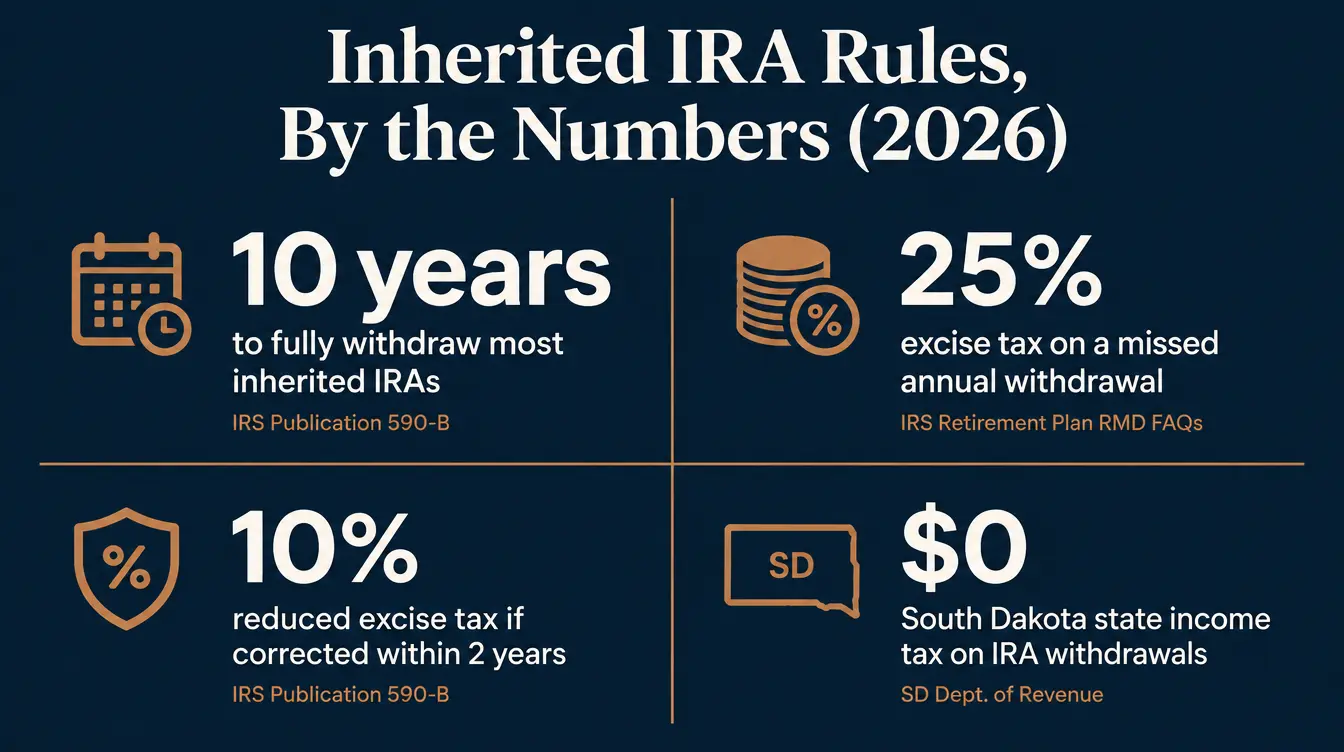
10 years
Deadline to fully withdraw most inherited IRAs, per IRS Publication 590-B
25% → 10%
Excise tax on a missed RMD, reduced to 10% if corrected within the correction window, per the IRS
2025
First year the final rule's penalty relief did not apply, per IRS Notice 2024-35
A corrected mistake costs half as much as an uncorrected one
Illustrative example on a $30,000 missed annual withdrawal. Excise tax rates of 25% and 10% per the IRS's Retirement Plan and IRA RMD FAQs and IRS Publication 590-B.
The 2026 rules in full
Who the 10-year rule applies to. Most individuals who inherit a traditional or Roth IRA from someone other than a spouse, and who don’t fall into one of the five eligible-designated-beneficiary categories below, must empty the account by December 31 of the tenth year after the owner’s death, according to IRS Publication 590-B.
Who’s exempt, and what they get instead. Five categories of “eligible designated beneficiaries” can use life-expectancy withdrawals instead of the 10-year deadline:
| Beneficiary type | Withdrawal method | Deadline to empty the account |
|---|---|---|
| Surviving spouse | Can treat the IRA as their own, or use life-expectancy withdrawals | No 10-year deadline; spousal rules apply |
| Minor child of the owner | Life-expectancy withdrawals until reaching the age of majority | 10-year clock starts once the child reaches majority |
| Disabled individual | Life-expectancy withdrawals | No 10-year deadline, for as long as the disability status holds |
| Chronically ill individual | Life-expectancy withdrawals | No 10-year deadline, for as long as the status holds |
| Not more than 10 years younger than the owner | Life-expectancy withdrawals | No 10-year deadline |
| Everyone else (most adult children, other relatives, friends) | Annual RMDs if owner died on/after required beginning date; flexible timing if before | December 31 of the tenth year after death |
The penalty for missing a required withdrawal. A 25% excise tax on the amount that should have been withdrawn, reduced to 10% if the shortfall is corrected within the correction window, generally by the end of the second tax year following the year the RMD was due, according to the IRS’s Retirement Plan and IRA RMD FAQs and IRS Publication 590-B.
Roth IRAs follow the same 10-year deadline, different tax bill. Inherited Roth IRAs are also subject to the 10-year rule for non-eligible beneficiaries, but the IRS does not require annual withdrawals within that window, because the original owner was never subject to RMDs during their lifetime, per IRS Publication 590-B. Qualified withdrawals from an inherited Roth are generally tax-free, so the stakes of the timing question are lower, though the 10-year deadline to empty the account still applies.
The 10-year rule was never the confusing part. Whether you owe annual withdrawals inside those 10 years is the part that caught people off guard, and the IRS didn't finish answering it until 2024.
Mike Moore, Life Insurance AdvisorHow South Dakota’s tax setup changes the math
South Dakota is one of seven states that does not impose a state individual income tax, according to the South Dakota Department of Revenue. That matters here in a specific, limited way: every dollar you withdraw from an inherited traditional IRA is still ordinary income on your federal return, taxed at your federal marginal rate exactly as it would be anywhere else in the country. What doesn’t happen in South Dakota is a second layer of state tax on top of that federal bill, the way a beneficiary in a state with its own income tax would face.
That doesn’t make the 10-year rule or the annual-withdrawal requirement go away, and it doesn’t change the excise tax exposure on a missed withdrawal, which is a federal penalty regardless of state. What it does mean is that a South Dakota beneficiary’s total tax exposure on an inherited IRA is lower, dollar for dollar, than an identical inheritance would produce in a state that taxes retirement income, which is worth factoring in if you’re comparing your own numbers to a spreadsheet or article written with a different state in mind.
How to work it out yourself
You can do the first pass of this entirely on your own, with documents you likely already have.
- Find out when the original owner died, and whether it was before or after their required beginning date. This single fact determines whether you owe annual withdrawals during the 10-year window or have more flexible timing. Your IRA custodian’s beneficiary services team can usually confirm the owner’s required-beginning-date status if you don’t already know it.
- Confirm your beneficiary category. If you’re a surviving spouse, a minor child of the owner, disabled, chronically ill, or not more than 10 years younger than the owner, you’re likely an eligible designated beneficiary with different, often more flexible rules. Everyone else falls under the 10-year rule described above.
- Check whether you’ve already missed a required annual withdrawal. If the owner died before their required beginning date, and you’ve taken nothing out yet, you still have time within the 10-year window since annual withdrawals aren’t mandated in that case. If the owner had already started RMDs, and you haven’t taken an annual withdrawal for 2025, confirm with your custodian or a tax professional how to correct it inside the window that reduces the penalty to 10%.
- Mark the 10-year deadline on your own calendar. It’s December 31 of the tenth year after the year of death, not the tenth anniversary date. Missing that final deadline carries the same excise-tax exposure as missing any other year’s withdrawal.
- Model your withdrawal pattern against your own income, not a generic example. The worked example above shows the shape of the problem, not your actual numbers. Your own tax bracket, other income, and the account’s actual required distribution each year determine whether spreading withdrawals evenly, front-loading them, or taking the required minimum and no more makes the most sense for you.
Steps 1 through 4 are yours to do today
All you need is the original owner's date of death, their age at death, and your account statement. Where a second opinion tends to help is deciding how to structure withdrawals across the full 10 years against your own changing income and whether converting part of the account into a more predictable income stream fits your situation.
Life insurance vs. an inherited IRA as what you leave behind
Here’s a contrast worth knowing whether you’re the one inheriting or the one planning what you’ll leave behind. An inherited traditional IRA is taxable income to whoever receives it, has to be drained within 10 years for most beneficiaries, and the government decides the minimum pace. Life insurance works differently: proceeds paid to a beneficiary because of the insured person’s death generally are not included in the beneficiary’s gross income at all, according to the IRS. No 10-year clock, no annual withdrawal requirement, no excise tax for taking too little, because there’s no federal income tax on the death benefit itself to begin with.
That doesn’t make life insurance a replacement for retirement savings, and it isn’t a reason to withdraw an IRA early just to buy a policy; doing that would trigger its own tax consequences on the withdrawal. It’s a reason some people, when they’re the ones doing the planning, choose to use retirement accounts for their own spending in retirement and use permanent life insurance for part of what they intend to leave behind, precisely because the two assets get treated so differently at death. If you’re the beneficiary of an inherited IRA right now, this same contrast is worth knowing as you decide what to do with withdrawals you don’t immediately need to spend, since how you hold that money going forward carries its own tax character, separate from the inherited IRA itself. Our guide on how annuities are taxed in South Dakota covers how that works if you’re considering converting part of an inheritance into guaranteed income.
How it's taxed at death and after
- Every withdrawal is ordinary taxable income to the beneficiary
- Must be fully withdrawn within 10 years for most beneficiaries
- Annual withdrawals required if the owner had started their own RMDs
- Missing a required withdrawal risks a 25% excise tax (10% if corrected)
How it's taxed at death and after
- Generally not included in the beneficiary's gross income, per the IRS
- No 10-year withdrawal deadline on the death benefit itself
- No annual withdrawal requirement imposed by the IRS
- Interest earned if proceeds are held in installments is separately taxable
This is not a sales pitch disguised as a comparison
Life insurance and an IRA solve different problems and most people need some version of both. This section exists to explain a real, frequently misunderstood tax difference between the two, not to suggest replacing one with the other.
If you’d rather have someone local run your specific inherited IRA numbers with you than work through IRS tables alone, that’s what we do: Compare My Options.
When this genuinely isn’t a problem you need to solve right now
If you’re a surviving spouse, you have options the 10-year rule doesn’t touch, including treating the IRA as your own. If you inherited a Roth IRA, the tax bill on qualified withdrawals is generally zero regardless of when you take them, so the timing question matters far less than it does for a traditional IRA. And if the original owner died before reaching their required beginning date, you have real flexibility on timing within the 10-year window, no annual minimum is forcing your hand, which means you can plan withdrawals around your own income years rather than a fixed schedule.
Where this becomes urgent is the specific combination this guide focuses on: a non-spouse beneficiary, not in one of the exempt categories, who inherited from someone already taking their own RMDs. That’s the beneficiary the final 2024 regulations squarely target, and it’s worth confirming which category you actually fall into before assuming either extreme, that you’re fine to ignore it or that you’re already behind.
How we help
We’re independent, so we’re not built around selling a specific inherited-IRA product. We start with the facts of your inheritance, when the original owner died, whether they’d started their own RMDs, which beneficiary category you fall into, and work through what that actually requires from you under current IRS rules. If converting part of the account into an annuity for more predictable annual income fits what you’re trying to do, we compare that across carriers rather than one. If it doesn’t fit, we say so.
What you get
A clear read on which IRS rules actually apply to your specific inheritance, not a generic explanation. A look at how annual withdrawals over the remaining years of your 10-year window would affect your own tax picture, using your real numbers instead of an illustration. And, if it’s relevant to what you’re trying to accomplish, a comparison of annuity options that can turn part of an inherited account into predictable income within the rules the IRS requires anyway.
Work through your actual inherited IRA numbers
Bring your account statement and the original owner's date of death, and we'll go through what the current rules actually require for your situation.
Not ready to talk to anyone yet? Read How It Works first and come back when you are.
Frequently asked questions
Do I have to take money out of an inherited IRA every year now?
If you inherited a traditional IRA from someone who was not your spouse, and that person had already reached their required beginning date for RMDs before they died, then yes: final IRS regulations require you to take an annual withdrawal every year within the 10-year window, not just empty the account by the end of year 10, according to IRS Publication 590-B and the IRS’s July 2024 announcement on the final rules (IR-2024-190). If the original owner died before their required beginning date, you have more flexibility on timing within the same 10 years, but the account still has to reach zero by December 31 of the tenth year.
What is the required beginning date, and why does it matter so much here?
The required beginning date is the date the original IRA owner was required to start their own RMDs, generally April 1 of the year after they turned the applicable RMD age under current law. Whether the owner died before or after that date is the single factor that decides whether their non-spouse beneficiary owes annual withdrawals during the 10-year window or can wait and take a lump sum in year 10, according to IRS Publication 590-B. It is worth checking this one fact before assuming either way.
Who is exempt from the 10-year rule?
The IRS calls these beneficiaries “eligible designated beneficiaries,” and they can generally stretch withdrawals over their own life expectancy instead of the 10-year window: a surviving spouse, a minor child of the account owner (until they reach the age of majority, at which point the 10-year clock starts), a disabled individual, a chronically ill individual, or any other individual not more than 10 years younger than the account owner, according to IRS Publication 590-B. Everyone else who inherits a traditional IRA as a non-spouse beneficiary falls under the 10-year rule.
What happens if I miss an annual withdrawal?
The IRS can assess a 25% excise tax on the amount you should have withdrawn and did not, reduced to 10% if you correct the shortfall within the correction window, generally the end of the second tax year after the year the RMD was due, according to the IRS’s Retirement Plan and IRA RMD FAQs and IRS Publication 590-B. The IRS waived this penalty for 2021 through 2024 while the rule was being finalized, under Notice 2024-35, but confirmed the new regulations would not apply earlier than 2025. That transition relief has ended; 2025 and 2026 withdrawals are subject to the penalty if missed.
Does South Dakota tax the money I withdraw from an inherited IRA?
No. South Dakota is one of seven states that does not impose a state individual income tax, according to the South Dakota Department of Revenue. A withdrawal from an inherited IRA is still ordinary income on your federal return, taxed at your federal marginal rate, but South Dakota does not add a second layer of state tax on top of it the way many other states do.
Can I roll an inherited IRA into an annuity to spread out the tax hit?
You can direct an inherited IRA, while it remains titled as an inherited IRA, into an annuity contract, and some carriers offer inherited IRA annuity options designed to pay out systematically within the 10-year window instead of as unpredictable lump withdrawals. That does not remove the requirement to empty the account within 10 years or eliminate the federal tax on each withdrawal; it changes how the money is delivered to you, which can make annual tax planning more predictable. Whether that fits your situation depends on your income needs and the rest of your tax picture, which is worth working through with real numbers rather than assuming it is automatically the right move.
Is money from a life insurance policy taxed the same way as an inherited IRA?
No, and this is one of the bigger practical differences between the two. Life insurance proceeds paid to a beneficiary because of the insured person’s death generally are not included in the beneficiary’s gross income, according to the IRS. An inherited traditional IRA is the opposite: every withdrawal is ordinary taxable income to the beneficiary, and under current rules it must all come out within 10 years for most beneficiaries. That contrast is worth knowing both when you are planning what you leave behind and when you are deciding how to handle money you inherit.
Does this apply to Roth IRAs too?
The 10-year withdrawal deadline applies to inherited Roth IRAs in the same way it applies to inherited traditional IRAs for non-spouse beneficiaries who are not eligible designated beneficiaries, according to IRS Publication 590-B. The difference is the tax bill: because Roth IRA owners already paid tax on their contributions and qualified withdrawals are tax-free, a beneficiary generally does not owe federal income tax on a qualified Roth withdrawal. The IRS has also said annual withdrawals are not required within the 10-year window for an inherited Roth IRA, because the original owner was never subject to RMDs during their own lifetime, so a beneficiary can let it grow and take it all in year 10 if they choose.
Before you make a withdrawal decision
This article is general education, not insurance, legal, financial, or tax advice. Product availability, contract terms, and tax treatment vary by carrier and are subject to underwriting, current IRS rules, and your specific accounts. No coverage exists until a policy or contract is issued and in force. Any guarantees are subject to the claims-paying ability of the issuing insurer. Please review actual account and policy documents and speak with a licensed agent and a tax professional about your situation.
Sources
- Internal Revenue Service — Notice 2024-35 — issued April 16, 2024; transition relief from the missed-RMD excise tax for 2021 through 2024, and confirmation the new rule would not apply earlier than 2025
- Internal Revenue Service — Internal Revenue Bulletin 2024-33 (T.D. 10001) — published August 12, 2024; final regulations on required minimum distributions, effective September 17, 2024, applicable for RMD calendar years beginning on or after January 1, 2025
- Internal Revenue Service — Treasury, IRS issue updated guidance on required minimum distributions (IR-2024-190) — July 18, 2024; confirms the final regulations retain the annual-withdrawal requirement within the 10-year window
- Internal Revenue Service — Retirement Plan and IRA Required Minimum Distributions FAQs — 25% excise tax on a missed RMD, reduced to 10% if corrected within the correction window
- Internal Revenue Service — Publication 590-B — 10-year rule, eligible designated beneficiary categories, excise tax rates, Roth IRA inherited-account rules
- Internal Revenue Service — Life Insurance & Disability Insurance Proceeds FAQ — life insurance death benefits generally not includible in a beneficiary’s gross income
- Internal Revenue Service — tax year 2026 annual inflation adjustments — 2026 federal income tax bracket thresholds and standard deduction
- South Dakota Department of Revenue — Individual Taxes — confirmation South Dakota does not impose a state individual income tax
Related reading: What Is a QLAC? Delaying RMDs in South Dakota, 2026, How Annuities Are Taxed in South Dakota: 2026 Guide, and What Happens to Your Annuity When You Die? 2026 SD Guide. See current options for annuities and immediate income annuities, or learn more about who we help: seniors.